
Italian Marble vs Quartz
The definitive luxury-surface decision — provenance, performance, maintenance and cost in India
Walk into any newly finished luxury home in Mumbai or Hyderabad and the conversation almost always lands on the same surface — the stone. A river of grey veining running across a foyer floor, a kitchen island that has survived three years of turmeric and lime without a mark. To the untrained eye both can look like "marble". They are not. One is a single block of metamorphic rock carved out of a Tuscan mountain; the other is engineered in a press from ground quartz and resin. They behave completely differently, they cost completely differently, and choosing wrong is one of the most expensive mistakes a luxury interior can make.
This guide settles the Italian-marble-versus-quartz question properly — not with marketing adjectives but with mineralogy, maintenance reality and honest 2026 Indian pricing. We cover what genuine Italian marble actually is (Statuario, Calacatta, Carrara, Botticino, Dyna), what engineered quartz actually is, and how they compare on every axis that matters: appearance and authenticity, hardness, staining and acid-etching, heat, maintenance, weight and structural load, sustainability, and installed cost. We also expose how buyers get cheated in the imported-stone supply chain, and where honest Indian stones like Makrana fit in.
The single idea to hold onto: this is not a "which is better" question — it is a "which belongs where" question. Italian marble is a low-traffic statement material; engineered quartz is a high-use working material. The luxury homes that get it right use both, deliberately. If you are still defining what luxury means in your own home, start with our pillar, what defines luxury interiors in India, and treat this as the surface-selection deep dive beneath it.
What Italian marble actually is
Marble is a metamorphic rock — limestone that has been recrystallised under heat and pressure over millions of years until its calcite or dolomite grains interlock into a dense, translucent mass. The veining everyone covets is mineral impurity: iron, clay, graphite and silt that were trapped in the original sediment and then smeared into rivers of colour during metamorphism. That is why no two slabs are identical and why a single block is so prized — the veins flow continuously through it, allowing fabricators to "book-match" adjacent slabs into a mirrored, symmetrical pattern.
"Italian marble" specifically means stone quarried in Italy, overwhelmingly from the Apuan Alps around Carrara in Tuscany — the same quarries Michelangelo sourced from. The names you will hear quoted in Indian showrooms each describe a distinct visual:
| Variety | Origin | Look | Typical use |
|---|---|---|---|
| Statuario | Carrara, Italy | Bright white, bold dramatic grey veining | The prestige choice — foyers, feature walls |
| Calacatta | Carrara, Italy | Warm white, thick gold-grey veins | Statement vanities, islands, cladding |
| Carrara | Carrara, Italy | Soft grey-white, fine feathery veins | The "classic", more affordable white |
| Botticino | Brescia, Italy | Warm beige, subtle cloud veining | Floors, classical interiors |
| Dyna / Dyna White | Often Turkey/India, marketed as Italian | Beige-grey, linear veins | Budget "Italian-look" floors |
That last row matters. Dyna is frequently sold as "Italian marble" in Indian markets, but a great deal of Dyna is Turkish or even Indian stone — visually similar, materially fine, but not Carrara, and it should never command Carrara prices. This is where the deception begins.
What engineered quartz actually is
Engineered quartz is not stone in the geological sense. It is a manufactured composite: roughly 90 to 93 percent ground natural quartz mineral, bound with about 7 to 10 percent polymer resin (usually polyester), plus pigments and sometimes recycled glass or mirror flecks. The mixture is colour-blended, vacuum-compressed and vibro-cured into dense, non-porous slabs through a process patented by the Italian firm Breton — which is why the trade still calls it "Bretonstone".
The brands you will encounter in India:
| Brand | Origin | Position |
|---|---|---|
| Caesarstone | Israel | Premium imported, wide palette |
| Silestone (Cosentino) | Spain | Premium imported, antibacterial range |
| Cosentino (Dekton/Silestone) | Spain | Premium, ultra-compact surfaces |
| Kalingastone | India (Odisha) | Strong domestic value brand |
| Pokarna Quartz (Quantra) | India (Hyderabad) | Indian manufacturer, exports globally |
Because quartz mineral sits at 7 on the Mohs hardness scale — harder than a steel knife — and because the resin seals every pore, engineered quartz is the most stain- and scratch-resistant surface most homeowners will ever own. The trade-off is heat sensitivity and a look that, however convincing, is a designed pattern repeated across slabs rather than a one-off act of geology.
Head to head, on the properties that decide
Appearance and authenticity
Marble wins this outright, and it is not close. The translucency of calcite means light penetrates a millimetre or two before scattering, giving real marble a soft inner glow that printed quartz cannot fully fake. The veining is genuinely unique. Quartz manufacturers have closed the gap dramatically — top Calacatta-look quartz slabs are convincing at arm's length — but a designer or a discerning guest will read the repeat. If the entire point of the surface is to be admired, marble is the authentic article.
Hardness and scratch
Quartz wins decisively. At Mohs 7 it resists knife scratches, grit and abrasion that would dull a Mohs-3 marble surface within months in a working kitchen. Marble scratches and, worse, its high polish abrades to a duller sheen along traffic lines — visible on glossy foyer floors as "walking paths" within a few years.
Staining and acid-etching — marble's Achilles heel
This is the most misunderstood, most important difference. Marble is calcareous — its calcium carbonate reacts chemically with acid. Lime juice, vinegar, wine, tomato, sambar, even some cola and bathroom cleaners will etch marble: a dull, slightly rough, lightened mark where the acid has literally dissolved the polished surface. Etching is not a stain you can wipe away; it is microscopic erosion, and on dark or highly polished marble it is glaringly visible. Marble is also porous, so oil and coloured liquids can soak in and stain if not sealed.
Quartz, being non-porous and resin-bound, does neither. It does not etch and effectively does not stain. For an Indian kitchen — turmeric, oil, citrus, masala, daily scrubbing — this single property is why quartz is the default worktop.
Etching is the word every marble buyer should learn before they sign. It is not dirt and it is not a stain — it is acid eating the polish, and on a kitchen counter it is a matter of when, not if.
Heat
Marble wins here. As natural stone it tolerates a hot vessel far better than resin-bound quartz, whose polymer can scorch, yellow or develop a dull thermal mark above roughly 150 degrees Celsius. That said, the honest advice for both is identical: never place a hot pan, pressure cooker or kadhai directly on either surface — always use a trivet. The difference matters most where heat is unavoidable, such as immediately beside the hob.
Maintenance and sealing
Quartz wins comfortably. It needs nothing beyond soap and water; it is never sealed. Marble must be sealed with a penetrating sealer on installation and re-sealed periodically (typically every one to three years depending on use and traffic), wiped of acidic spills immediately, and occasionally re-polished by a professional to restore etched or dulled areas. Marble is a relationship; quartz is a one-time decision.
Where each one belongs

The decision becomes obvious once you stop asking "which is better" and start mapping each application by two things: how much daily traffic it sees, and how much acid and water it is exposed to.
| Application | Recommended | Why |
|---|---|---|
| Entrance foyer floor | Italian marble | Low footfall, no acid, the arrival statement |
| Living-room feature wall | Italian marble | Vertical, never touched by food acid |
| Master bath vanity / cladding | Italian marble (sealed) | Spa luxury; manage acidic cleaners |
| Centre table / console tops | Italian marble (with coasters) | Statement, but wine and lime will etch |
| Kitchen worktop | Engineered quartz | Turmeric, lime, oil daily; no sealing |
| Kitchen island / breakfast counter | Engineered quartz | Heavy daily use, durability first |
| Utility / wet-kitchen ledge | Engineered quartz | Constant water and scrubbing |
| Kids' / guest bath vanity | Engineered quartz | Neglect-proof, toothpaste-proof |
The mature luxury approach is not loyalty to one material — it is a marble foyer and feature wall that announce the home, with quartz running the entire working kitchen invisibly behind the scenes. Pair this with your overall surface schedule in our flooring and finishes specification guide, and if marble is going into wet zones, plan it alongside our luxury bathroom moodboards for India.
Cost in India, 2026 — material is only part of it
The slab quote is never the real number. Every installed surface is material plus fabrication and edging plus polishing or finishing plus, for marble, lifelong sealing. Here are realistic 2026 metro bands.
| Surface | Material (₹/sqft) | Installed, all-in (₹/sqft) |
|---|---|---|
| Dyna / budget "Italian-look" | ₹350 – 650 | ₹650 – 950 |
| Botticino / mid Italian | ₹600 – 1,200 | ₹950 – 1,600 |
| Carrara | ₹900 – 1,800 | ₹1,300 – 2,300 |
| Calacatta | ₹1,800 – 3,500 | ₹2,400 – 4,500 |
| Statuario (premium blocks) | ₹2,400 – 3,500+ | ₹2,900 – 5,000+ |
| Indian quartz (Kalingastone, Pokarna) | ₹250 – 550 | ₹550 – 900 |
| Imported quartz (Caesarstone, Silestone) | ₹500 – 900 | ₹900 – 1,500 |
Two honest observations. First, rare and reserved blocks of Statuario and Calacatta routinely break ₹3,500 per square foot for material alone — exotic stones can go far higher. Second, a "cheap" Italian marble at ₹600 stops looking cheap once you add ₹350 of fabrication, polishing and the sealer you will keep buying for the life of the floor. Quartz front-loads almost nothing into upkeep, which is the hidden saving across a decade. Run your own numbers against alternatives in our material comparison tool.
The imported-marble supply chain — and how buyers get cheated
Genuine imported Italian marble arrives in India as numbered blocks and slabs with quarry documentation. The luxury process is "slab booking" or "block selection": you reserve specific slabs cut sequentially from one block (a "block number"), so the veining flows continuously and can be book-matched. Reputable importers in Kishangarh (Rajasthan), Silvassa, Mumbai and Bengaluru can show you the actual slabs, the block number, and often the bill of entry.
Here is where buyers lose money:
- Indian or Turkish stone sold as Italian. Dyna, Indian "white marble" and Turkish beige are routinely badged "imported Italian". Ask for the country of origin on the import documentation, not the salesperson's word.
- No slab booking. If you cannot see and reserve your specific slabs by block number, you cannot control the veining — and the slabs delivered may not match the showroom sample.
- Sample-and-switch. A flawless display slab, ordinary stock delivered. Insist on signing the actual slabs.
- Hidden fabrication and wastage. Quotes that exclude edge-polishing, cut-outs and the 15 to 25 percent wastage inherent in book-matching. Get an all-in number.
- "Italian quartz" confusion. Some dealers blur quartz and marble terminology to upsell. Confirm in writing exactly what the material is.
For a structured way to weigh material claims against your actual priorities, use our material decision framework before you commit a deposit.
Indian natural stones, honestly
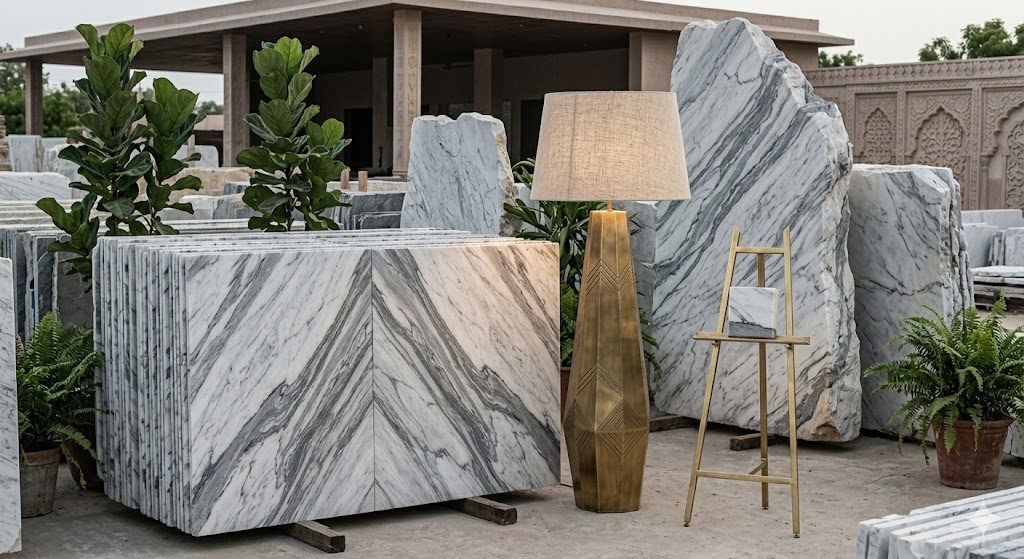
It would be dishonest to discuss luxury stone in India and ignore our own. Makrana marble — quarried in Rajasthan and famously the marble of the Taj Mahal — is a genuinely fine, dense, white-to-creamy stone that ages beautifully and is markedly cheaper than Carrara, typically ₹150 to 600 per square foot for material depending on grade. It is calcareous like all marble, so it etches and needs sealing, but for a buyer who wants real stone with heritage and is comfortable with patina, Makrana is an honourable, often underrated choice.
Other Indian marbles (Ambaji, Indian Statuario-look, green marble) and Indian granites give you durability at a fraction of imported cost. The reason to pay the Italian premium is specific: the particular whiteness and dramatic veining of Carrara stone, and the prestige attached to provenance. If those are not the point for your project, an honest Indian marble or a good quartz will serve you better for the money.
Weight, structural load and sustainability
Both materials are heavy — roughly 2,600 to 2,700 kilograms per cubic metre — so 20 mm slabs add real dead load. For vertical feature walls and apartment installations, the substrate, adhesive system and (for tall cladding) mechanical anchoring must be specified by your designer or structural engineer per IS 14223 stone-cladding practice; do not let a stone vendor cantilever heavy marble off plaster alone. Always confirm your slab labs against load and a clear backing detail.
On sustainability, the picture is nuanced. Marble is a natural, fully mineral material with no resin, and a quarried slab can outlast the building — but quarrying, block-cutting and long-haul shipping from Italy carry a heavy carbon and water footprint. Quartz contains plastic resin and is energy-intensive to manufacture, but Indian-made quartz (Kalingastone, Pokarna) eliminates the import shipping and several brands now incorporate recycled content. Neither is "green"; the lowest-impact luxury choice is usually a quality Indian stone fabricated close to where it is installed.
The honest verdict
| If your priority is... | Choose |
|---|---|
| Authenticity, unique veining, prestige | Italian marble |
| A worry-free working kitchen surface | Engineered quartz |
| A statement foyer or feature wall | Italian marble |
| Lowest lifetime maintenance | Engineered quartz |
| Best real-stone value with heritage | Makrana / Indian marble |
| Resistance to acid, stains and scratches | Engineered quartz |
| Heat tolerance beside the hob | Marble (still use a trivet) |
| One material for the whole home | Engineered quartz |
There is no universal winner — only a correct material for each surface.
Get it right, in order
1. Map every surface by traffic and acid exposure. Statement and dry zones lean marble; working and wet zones lean quartz.
2. Set the material against the application, not your ego. A quartz kitchen with a marble foyer outranks an all-marble home that etches within a year.
3. For marble, demand provenance. Country-of-origin documentation, block number, and physical slab booking — sign your actual slabs.
4. Get all-in installed quotes, including fabrication, edge-polishing, cut-outs and 15 to 25 percent wastage for book-matching.
5. For marble, budget for sealing and re-polishing as an ongoing cost, not a one-time line.
6. Confirm structural backing and load for any heavy vertical cladding before fabrication.
7. Consider Indian marble and Indian quartz honestly — often the smarter spend unless Carrara provenance is the actual point.
Picking surfaces is where luxury budgets are won or lost. DesignAI lets you visualise a marble foyer beside a quartz kitchen in your own plan, compare installed costs across varieties, and stress-test the choices before a single slab is booked — so you commit to stone with confidence, not after a costly mistake.
References
- Bureau of Indian Standards (2010) IS 14223 (Part 1): Polished Building Stones — Specification. BIS, New Delhi.
- Bureau of Indian Standards (1999) IS 1130: Marble (Blocks, Slabs and Tiles) — Specification. BIS, New Delhi.
- National Building Code of India (2016) Part 6: Structural Design — cladding and fixing of stone. BIS, New Delhi.
- The Marble Institute of America / Natural Stone Institute (2023) Dimension Stone Design Manual. Natural Stone Institute, Ohio.
- Cosentino / Silestone (2024) Engineered Quartz Surfaces — Technical Specification and Care Guide. Cosentino, Almería.
- Winkler, E. M. (1997) Stone in Architecture: Properties, Durability. Springer-Verlag, Berlin.
Continue the cluster: weigh whole-home surfaces in flooring and finishes specification, plan wet-zone stone with luxury bathroom moodboards for India, and compare cabinetry surfaces in the best laminate finishes for Indian homes — all anchored to the pillar, what defines luxury interiors in India.
Export this guide
Related Guides — Deep-dive reading
Italian Marble Flooring in India: Carrara, Statuario, Botticino, Cost & the High-Maintenance Reality (2026)
Imported Italian marble gives the most luxurious floor money can buy in India — here is the honest homeowner's guide to Carrara, Statuario, Botticino, Dyna Beige, Michelangelo and Onyx, book-matching, why it costs 250-1,500+ /sq ft, the real sealing and anti-etch upkeep, and whether it beats PGVT marble-look tiles.
Flooring & SurfacesQuartz Bathroom Countertop India: Engineered Quartz Vanity Tops, Cost & vs Granite/Marble
A practical, India-first guide to engineered quartz vanity tops for bathrooms — why the non-porous, no-seal surface beats granite and marble on a wet counter, plus thickness, seams, heat caution, brand quality and honest ₹ per sq ft costs.
BathroomsBathroom Stone Cladding India: Marble, Granite & Stone Feature Walls
A practical, India-first guide to natural stone wall cladding in bathrooms — book-matched marble slabs, granite, ledgestone and stone veneer feature walls — with honest ₹ per sq ft costs, adhesive vs mechanical fixing, sealing against water and staining, and hard-water maintenance that keeps the stone looking new.
BathroomsRelated Tools — Try Free
Marble Flooring Cost Calculator
Estimate installed marble-floor cost — material, laying, grinding and polishing, sealing, wastage and GST.
Flooring CalculatorMaterial Compare — Side by Side
Compare materials side-by-side: granite vs quartz vs marble, laminate vs acrylic vs PU, and more.
ComparisonBefore vs After — Cost Reality Check
Compare what you expected to pay vs what you actually paid, category by category.
Reality Check