
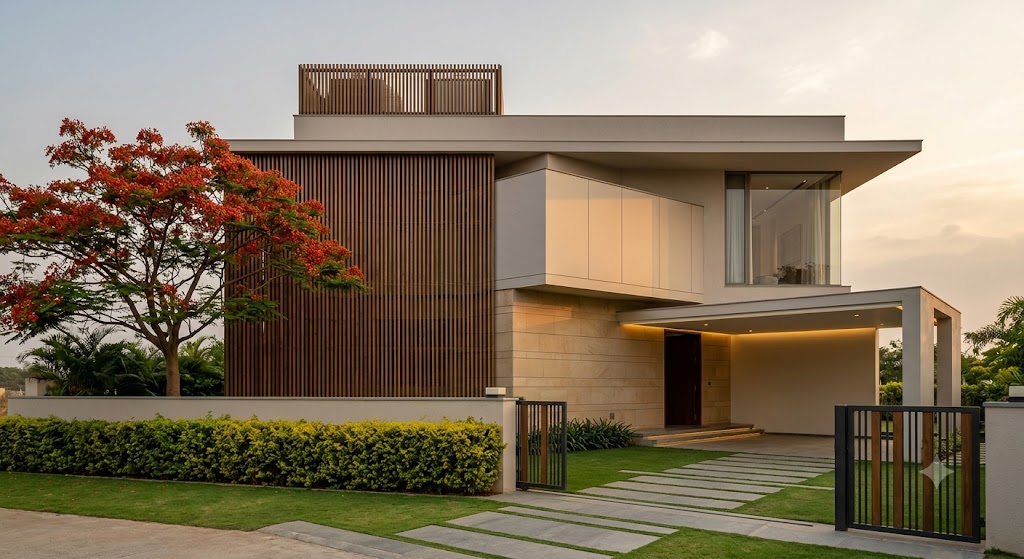
Villa Elevation Design in India — Styles, Anatomy, Materials & Bylaws
The Nine Components, Five Style Vocabularies, Fifteen Materials, Setback Rules & The Six Mistakes to Avoid
Of the four big residential product categories in India — apartment, row-house, independent house, and villa — the villa is the only one where the elevation is bought before the plan. Buyers walk a sample villa, photograph the facade, send it to family, and decide. The plan is verified afterwards. This makes villa elevation design a different discipline from front-elevation design for a 1,200 sq ft 30 × 40 plot: it carries the burden of resale price, neighbourhood-anchor status, and family pride — usually all three.
This guide is the working architect-led reference. It covers what "villa" actually means in 2026 Indian residential vocabulary (and what it doesn't), the nine components that make a complete villa elevation, the five style vocabularies in active use across Tier-1 and Tier-2 cities, a fifteen-material cost matrix with per-square-foot rates and maintenance characteristics, plot bylaw rules across the four major Indian metro byelaws, four cost bands from budget to luxury, climate adaptation for each major Indian zone, Vastu interactions specific to multi-floor villas, the six most-common villa elevation mistakes, and a pre-construction checklist you can take to your architect.
A villa is not a "bigger 3BHK." It is a different product, a different conversation, a different elevation logic. Getting that distinction right at concept stage is what separates a memorable villa from an expensive one.
What "Villa" Actually Means in Indian Residential Vocabulary
The word villa carries different weight in Indian real estate than it does in European architectural vocabulary. In Italian or Mediterranean usage, villa originally meant a country house, often with productive land and modest scale. In 2026 Indian usage, villa has come to mean a specific residential product — a stand-alone or row-stand-alone house, typically two or three storeys, on a private plot, usually inside a gated community or on a generous independent plot. It carries premium pricing relative to apartments of equivalent built-up area.
The key distinguishing characteristics of a villa in Indian residential vocabulary:
- Private plot: 1,200 sq ft minimum, more typically 2,400–10,000 sq ft. The plot is exclusive to one household.
- Two-storey or three-storey form: rarely single-storey except in farmhouses or hillside villas. The form is vertical; the volume is sufficient to read as "house" from the road.
- Detached or semi-detached: a standalone object on its plot, with setbacks on all four sides. Row-villas (party-wall sharing) are villa-adjacent product but typically priced lower.
- Architect-signed facade: even budget villas typically pass through facade designers, distinguishing them from the more generic apartment elevation.
- Premium pricing: typically 1.4× to 2.0× the per-sft price of an apartment in the same micro-market, even after adjusting for the carpet-to-built-up area difference.
A villa is therefore not just a "bigger 3BHK." It is a product category with its own design rules, its own bylaws, its own materials palette, its own Vastu expectations, and its own resale dynamics. The elevation is the first and often the only thing the prospective buyer or visitor evaluates.
For the front-elevation discussion of more compact 1,200–2,400 sq ft plots (the entire smaller-house universe), see Indian House Front Elevation Design — the foundational reference. This villa guide layers on top of that: the same anatomy applies, but the proportions, materials, and bylaws shift up a tier.
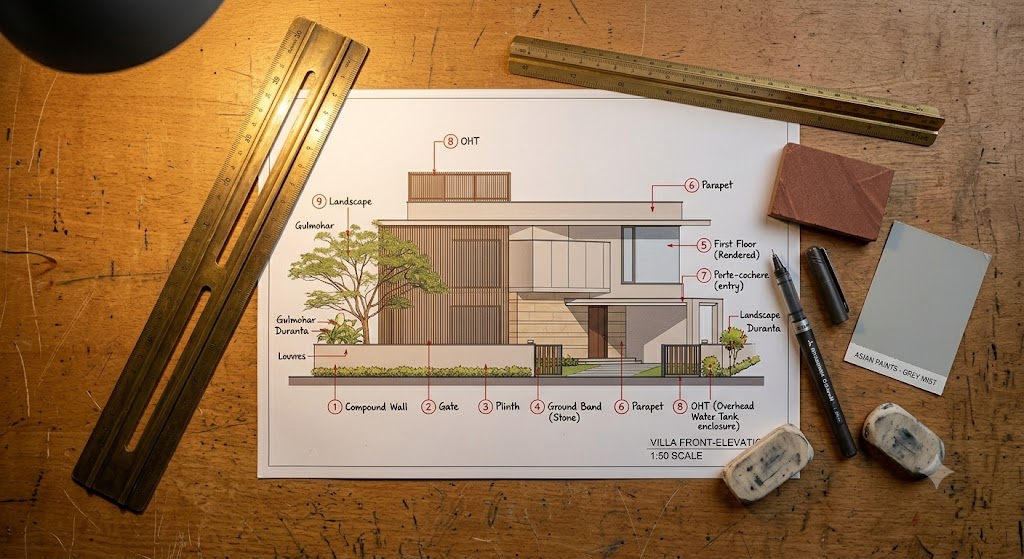
The Nine Components of a Complete Villa Elevation
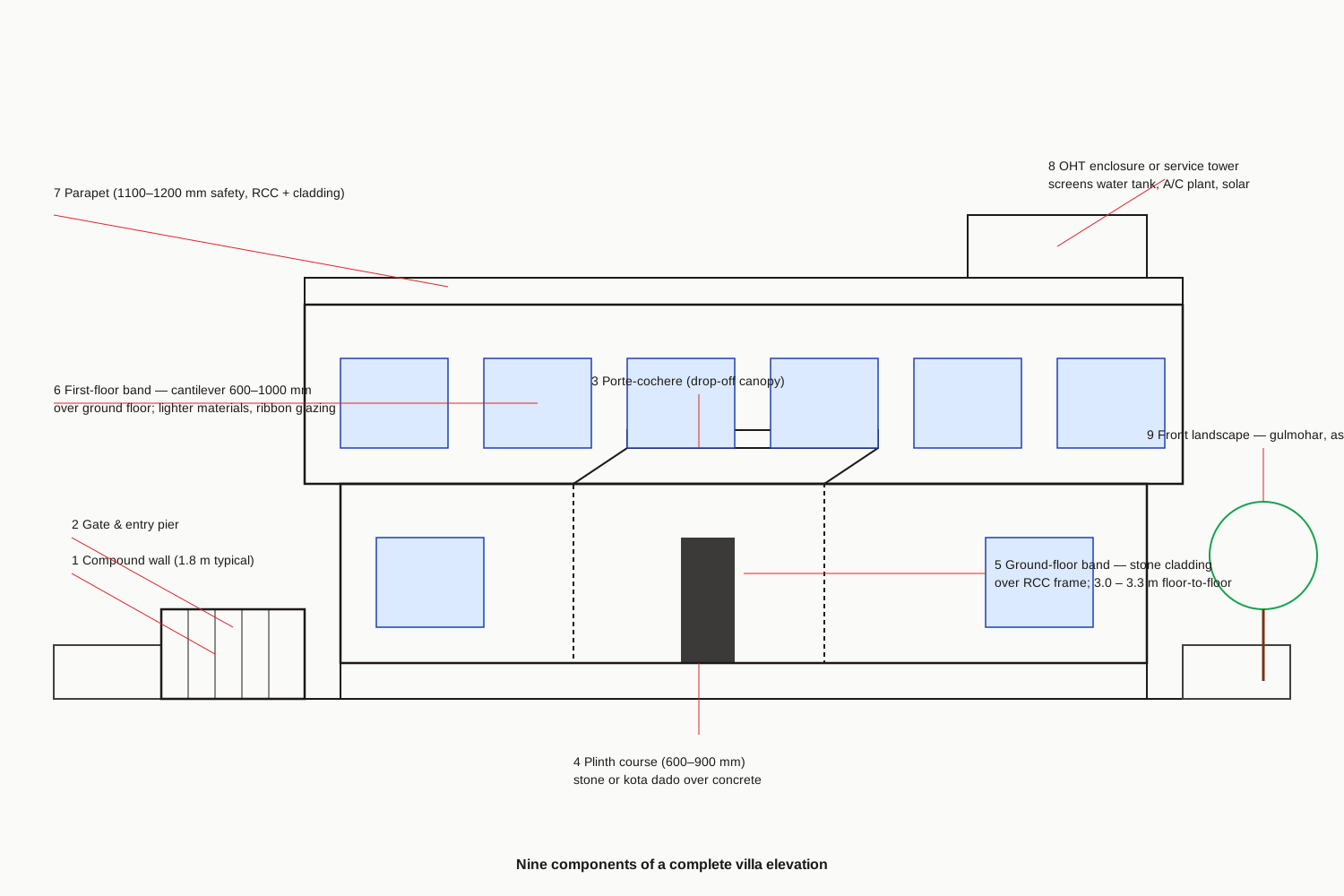
The figure above is the canonical front-elevation anatomy for an Indian villa. Every facade decision sits on this skeleton.
1. Compound Wall
The first thing a visitor reads. Indian villa compound walls are typically 1.5 to 1.8 m high (5 to 6 feet), sometimes 2.1 m (7 ft) where road exposure is high. Construction is 230 mm brick or 200 mm concrete block masonry, plastered both sides, or finished with stone cladding on the road face. The wall is structural — it supports the gate posts and resists vehicle nudges from the road.
Design discipline: the compound wall should read as a subordinate element to the villa, not a competitor. Heavy stone cladding, ornate caps, and articulated piers turn the wall into a feature wall — usually wrong. Strip-form, single-material, plain coping is the discipline.
2. Gate and Entry Pier
The villa gate is the most-photographed component of the elevation, and the one most-frequently over-spent. Standard swing gate widths are 3.0 to 3.6 m (10 to 12 ft) — enough for an SUV with mirrors out. Sliding gates trade swing space for plot depth, useful on tight plots.
Materials: mild steel with powder-coat finish (₹ 1,200 – 1,800 per sq ft of gate area), stainless steel (₹ 2,500 – 4,000), wood-and-steel composites (₹ 3,500 – 6,000), and custom CNC-cut steel patterns (₹ 4,000 – 8,000).
The 10% rule: spend roughly 10% of the villa-shell budget on the gate-plus-compound-wall package. Spending 30% — common in nouveau-riche villas — turns the gate into a stand-alone object and the villa into its accessory.
3. Plinth Course
The plinth is the 600 to 900 mm raised band above grade, providing a moisture barrier (DPC), termite barrier, and visual base course. Construction is RCC with masonry infill; finish is stone (Kota, granite, sandstone) or rough-textured plaster. The plinth height is set by structural and flood considerations — areas with a 1-in-50-year flood risk should plinth at +600 mm or higher.
4. Ground-Floor Band
The main public-facing band of the elevation, typically 3.0 to 3.3 m floor-to-floor. This is where the entry door, foyer wall, living-room picture window, and (often) the kitchen-window-screened-from-road sit. Materials are typically heavier and more textured than the first floor — stone bands, brick screens, vertical louvres, fluted brick.
The ground band carries the front door (the elevation's narrative centre) and the car porch/porte-cochere (the functional centre). These two elements anchor the entire facade composition.
5. First-Floor Band
The first floor reads as a different mass — usually lighter, often cantilevered 600 to 1,000 mm beyond the ground floor. The cantilever creates visual lift and provides the porte-cochere roof. Materials are typically lighter than the ground floor: cement-board, smooth plaster, ribbon glazing, or fluted teak louvre.
The contrast between ground (heavy, textured, dark, stone) and first floor (lighter, smooth, paler, glazed) is a foundational compositional move in modern Indian villa design. Reversing it (heavy first floor over light ground) is structurally awkward and reads as upside-down.
6. Parapet Line
The parapet is the 1.1 to 1.2 m safety rail around the terrace edge, mandatory under National Building Code 2005 (§ 9). It also visually closes the facade — without it, the building reads as unfinished. Parapet construction is RCC with cladding to match the first-floor band.
OHT (overhead tank), AC outdoor units, solar panels, DG enclosure, and other service equipment sit behind the parapet, hidden from the road view. The parapet height is therefore not merely a safety device — it is the service-screen line. Set it too low and the facade looks like a workshop roof.
7. Porte-cochère (Drop-Off Canopy)
The covered drop-off zone in front of the entry door. Indian residential porte-cochères are typically 4.5 × 5.5 m to 5.5 × 7.0 m — large enough for the family car to roll under and let passengers off in the rain. The roof is the underside of the cantilevered first floor, usually finished in wood or smooth plaster.
The porte-cochère is the transitional element between the gate (public) and the front door (private). It also handles monsoon arrivals — a critical function in Mumbai, Bengaluru, Chennai, Kolkata. Skipping it on a villa in heavy-rain climates is an error of omission.
8. OHT Enclosure or Service Tower
The overhead water tank, sized at 1,000 to 5,000 litres per family. The OHT must sit 3 m above the highest tap to provide gravity-fed pressure, so it lives on the roof. The enclosure for the OHT — louvred box, slatted wood screen, or perforated metal cage — is the small vertical element on the parapet line that contains the tank visually.
A villa with a bare blue Sintex tank on the roof reads as half-finished. A villa with an architecturally articulated OHT enclosure reads as designed. The difference in cost is ₹ 40,000 to ₹ 1.5 lakh — trivial in a villa budget.
9. Front Landscape
The front setback is the elevation's stage. Indian villa landscapes typically run to:
- 1 mature flowering tree (gulmohar, ashoka, rain-tree, jacaranda) — anchor canopy at the corner
- 2–3 mid-storey trees (frangipani, magnolia, kadamba) for height layering
- Continuous hedge along the compound wall — duranta, croton, or ixora
- Lawn or hardscape forecourt in front of the porte-cochère
- Path of stone or concrete from gate to door
The total landscape cost typically runs 8 to 15% of the villa-shell budget. Skipping landscape is the most-common villa elevation mistake — without it, the elevation reads as a sample-flat catalogue image, not as a home.
The Five Style Vocabularies — Active in Indian Villa Design
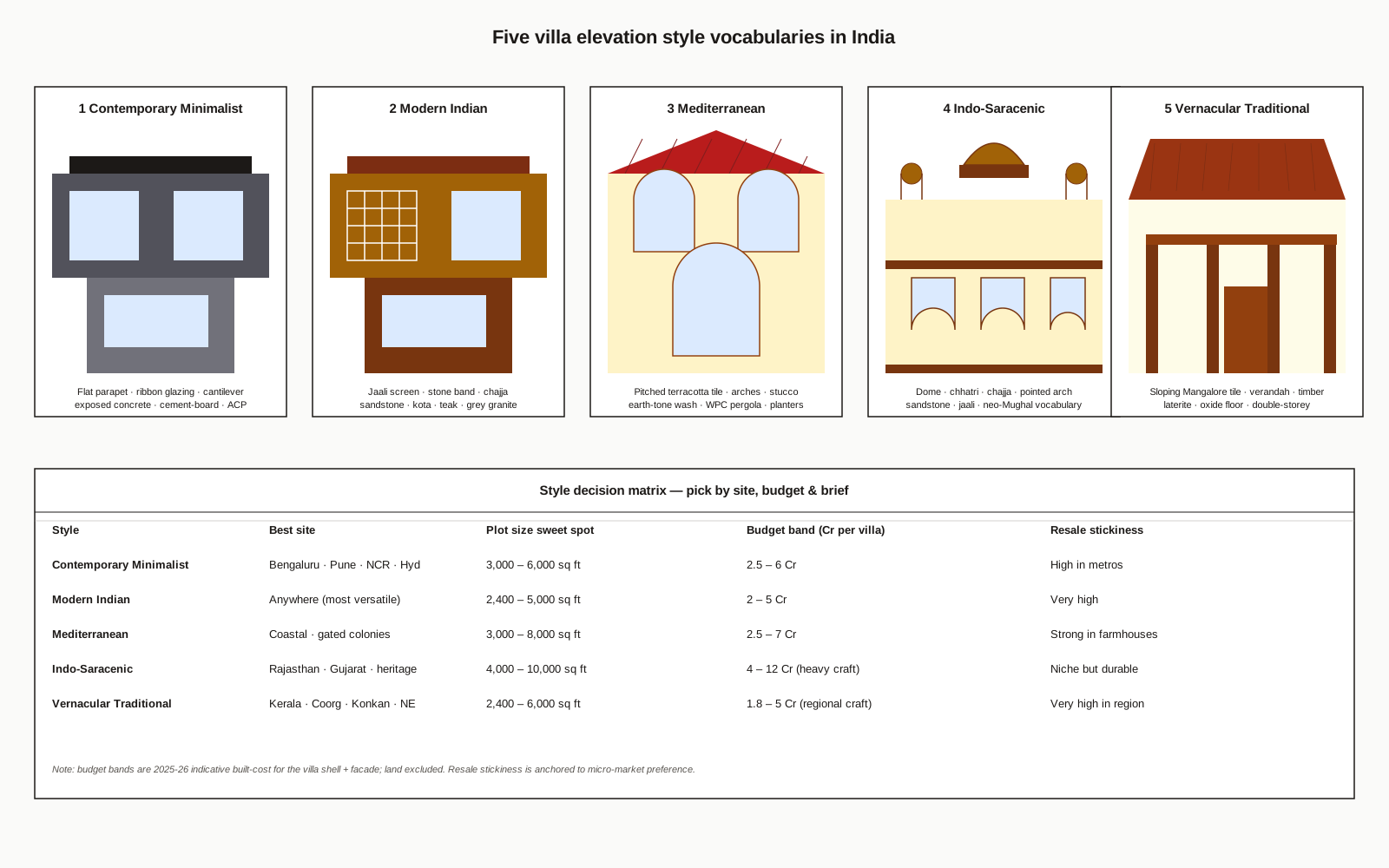
The figure above is the working vocabulary list. Five styles dominate active Indian villa practice in 2026. Pick one as the primary discipline; mixing two reads as wedding-hall pastiche.
1. Contemporary Minimalist
The default for Tier-1 Indian metros in 2026. Signature elements: flat RCC parapet, ribbon glazing, cantilevered first floor, exposed concrete or board-form RCC, cement-board cladding, neutral palette (greys, whites, charcoal), and large-scale single-material elevations. Climate response is integrated through deep chajjas and louvre screens rather than ornament.
Best site: Bengaluru, Pune, NCR, Hyderabad. Plots 3,000–6,000 sq ft.
Budget band: ₹ 2.5 – 6 Cr built-cost shell + facade.
Resale stickiness: very high in metros where the buyer demographic skews tech / corporate; can read cold in Tier-2 markets.
2. Modern Indian
The most-versatile vocabulary, blending contemporary geometry with Indian material craft. Signature elements: jaali screens (custom or terracotta), Dholpur sandstone or Jaisalmer band, deep chajja, Burma teak louvre, neutral palette with one earthen accent. Climate response is the central design feature, not an afterthought.
Best site: Anywhere in India. The most-resale-resilient vocabulary because it reads as "Indian" without being orthodox.
Budget band: ₹ 2 – 5 Cr shell + facade.
Resale stickiness: universally high. The safest commission for a first-time villa client.
3. Mediterranean
The vocabulary of coastal villas and resort-format properties. Signature elements: pitched terracotta tile roof, semicircular and arched openings, stucco render in earthen tones, decorative ironwork, planted balconies, pergolas in WPC or wood. Carries connotations of Italian or Spanish coastal hill towns.
Best site: Goa, coastal Karnataka, Pondicherry, gated communities in Bengaluru/Hyderabad, farmhouse formats around Delhi and Mumbai.
Budget band: ₹ 2.5 – 7 Cr shell + facade.
Resale stickiness: strong in resort and farmhouse formats; weak in pure urban Tier-1 contexts (reads as kitsch in Bengaluru ITPL micro-market, for instance).
4. Indo-Saracenic
The neo-Mughal vocabulary — dome, chhatri (small rooftop cupola), chajja band, pointed arches, jaali, carved sandstone elements. Originally developed by British colonial architects for civic buildings in 19th century India, now reinterpreted for premium and luxury villa work.
Best site: Rajasthan, Gujarat, heritage micro-markets in Hyderabad and Delhi, second-home properties.
Budget band: ₹ 4 – 12 Cr shell + facade (heavy stone craft is expensive).
Resale stickiness: niche but durable — finds its specific buyer reliably.
5. Vernacular Traditional
The regional vocabulary — sloping Mangalore tile roof, deep verandah with timber columns, laterite or oxide-finish base, double-height central courtyard. Each region has its specific variant: Kerala Tharavadu, Coorg homestead, Konkan bungalow, Bengali bari, Naga long-house.
Best site: Kerala, Coorg, Konkan, North-East, hill stations, heritage land.
Budget band: ₹ 1.8 – 5 Cr shell + facade (regional craft is highly variable).
Resale stickiness: very high in the home region; weak outside it.
Cross-link: for the broader modern house design framework that underpins Contemporary Minimalist and Modern Indian villas, see Modern House Design in India.
The Material Cost Matrix — Fifteen Finishes Costed and Compared
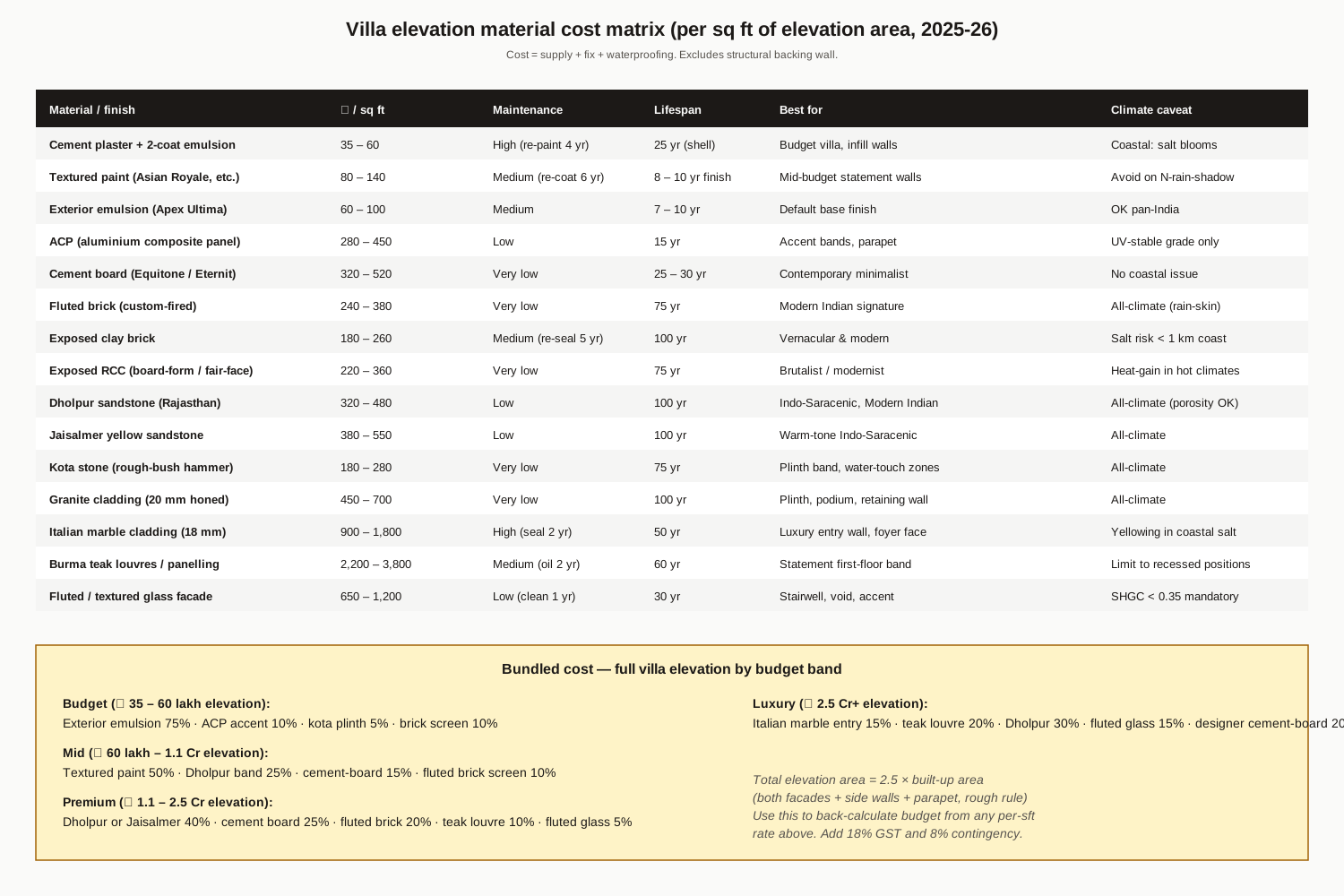
The matrix above is the rate-book. Use it to back-calculate budget from material specification, or vice versa.
How to Read the Matrix
Cost per sq ft of elevation area. Elevation area is roughly 2.5 × built-up area on a typical two-storey villa — counting both facades, two side walls, parapet skirt, and porch faces. A 3,000 sq ft villa has approximately 7,500 sq ft of elevation area.
Maintenance grade. "Very low" means oil/seal once in 5+ years. "Low" means re-paint once in 6–8 years. "Medium" means 4–5 year re-paint. "High" means 3–4 year re-coat and periodic deep-clean.
Lifespan. How long the finish lasts before requiring replacement, not just maintenance. Stone and exposed concrete are essentially building-lifetime materials. Paint finishes are essentially perimeter-spec — they will need full re-coat 4–6 times in the building's life.
The Four Cost Bands — Bundled
The bottom of the figure shows what each budget band actually combines:
- Budget (₹ 35 – 60 lakh for elevation): 75% exterior emulsion, 10% ACP accent, 5% kota plinth, 10% brick screen. The villa reads as "clean and functional."
- Mid (₹ 60 lakh – 1.1 Cr): 50% textured paint, 25% Dholpur band, 15% cement board, 10% fluted brick. Reads as "warm contemporary."
- Premium (₹ 1.1 – 2.5 Cr): 40% Dholpur/Jaisalmer, 25% cement board, 20% fluted brick, 10% teak louvre, 5% fluted glass. Reads as "architect's house."
- Luxury (₹ 2.5 Cr+): 15% Italian marble entry, 20% teak louvre, 30% premium sandstone, 15% fluted glass, 20% designer cement-board. Reads as "trophy commission."
Material Selection Rules of Thumb
1. Max three dominant materials, plus one accent. Four is the cap. Six is the cardinal sin (see Mistakes section below).
2. Heavier on ground, lighter on first floor. Stone and brick belong below; cement-board and glass belong above.
3. Stone bands prefer Indian quarries. Dholpur, Jaisalmer, Kota, Tandur — all carry climate-suitability and patriotic-buyer signal. Italian marble exists for foyer accents, not full facades.
4. Match finish to climate. Coastal salt destroys marble; hot-dry sun destroys textured paint on south face within 5 years. Pick by site, not by mood-board.
5. Specify the back-up wall. A facade is the cladding plus the structural wall behind. Always cost both, not just the surface.
Plot Bylaws, Setbacks, and Height — The Constraint Box
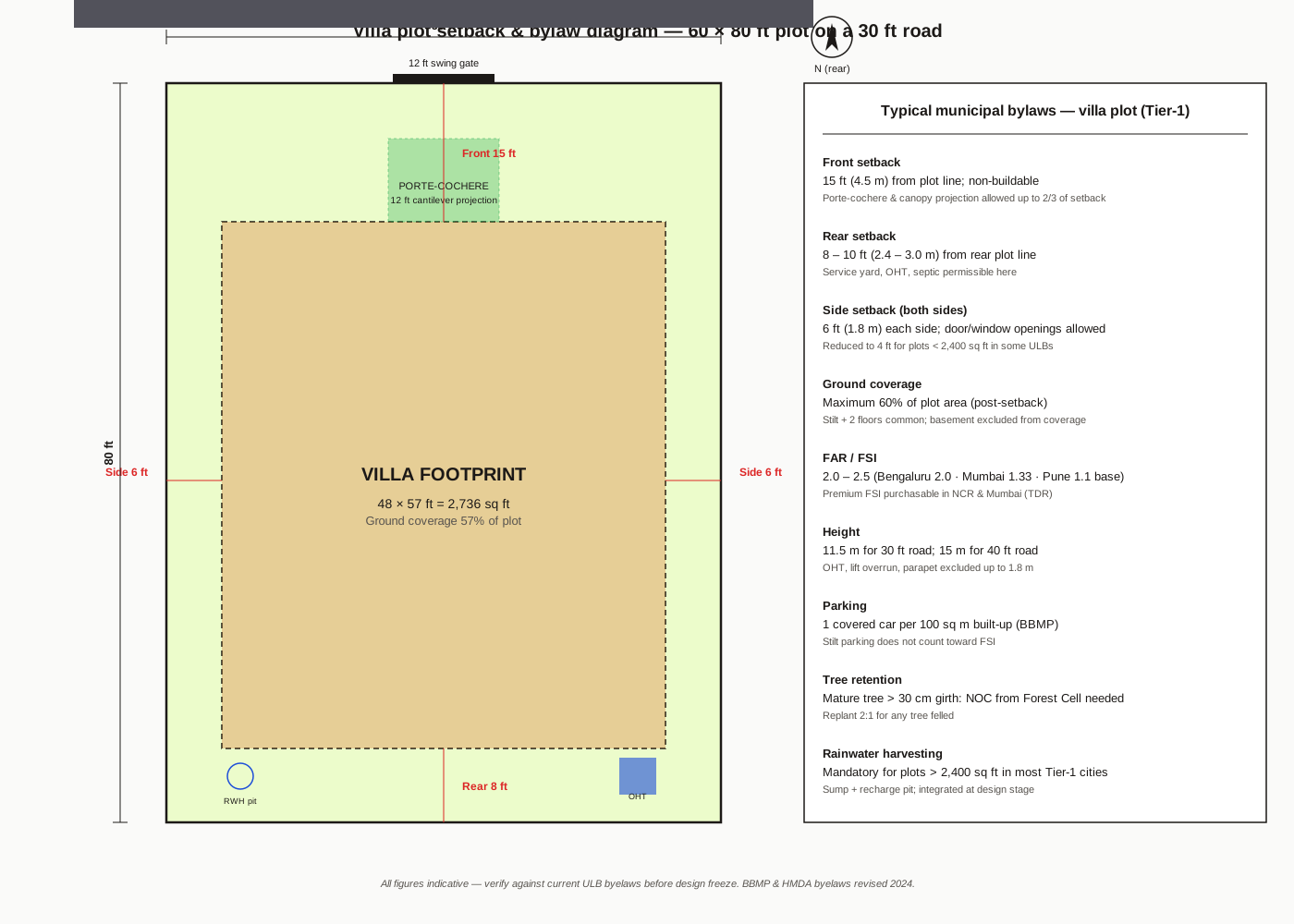
The figure above is the rule-book for a 60 × 80 ft villa plot. Most Indian Tier-1 metropolitan byelaws cluster within ±15% of these numbers; verify against your local ULB before final design.
The Seven Bylaw Levers
| Rule | Bengaluru (BBMP) | Mumbai (MMRDA) | Pune (PMC) | Hyderabad (HMDA) | NCR (DDA) |
|---|---|---|---|---|---|
| Front setback | 15 ft | 18 ft | 15 ft | 15 ft | 15 ft |
| Rear setback | 8 – 10 ft | 8 ft | 8 ft | 6 – 10 ft | 10 ft |
| Side setbacks | 6 ft each | 6 ft each | 6 ft each | 6 ft each | 8 ft each |
| Ground coverage | 60% post-setback | 50% | 50% | 60% | 50% |
| FAR / FSI | 2.0 | 1.33 (base) | 1.1 (base) | 2.5 | 2.0 |
| Height (30 ft road) | 11.5 m | 13.5 m | 11.5 m | 11.5 m | 12 m |
| Parking | 1 per 100 sq m | 1 per 80 sq m | 1 per 100 sq m | 1 per 100 sq m | 1 per 90 sq m |
The byelaws determine the buildable envelope. The architect designs inside this box. Treating the buildable envelope as a constraint to be challenged (variances, condoned violations) is a recipe for OC delays, resale disputes, and bank-loan friction.
Premium-FAR / TDR
Mumbai and Delhi allow purchase of additional FSI through Transferable Development Rights (TDR) or premium-FSI mechanisms. Pricing is volatile (₹ 1,500 – 7,000 per sq ft of additional FSI), but the mechanism lets you build a 4,500 sq ft villa on what would otherwise be a 3,000 sq ft plot allowance. Verify TDR availability before design freeze; retrofitting an extra floor is structurally and bureaucratically expensive.
Tree Retention and RWH
Many Tier-1 cities now mandate retention of any mature tree (girth > 30 cm at 1 m height) on the plot, with NOC required for any felling and 2:1 replacement planting. Rainwater harvesting is mandatory for plots > 2,400 sq ft in BBMP, > 200 sq m in HMDA, > 100 sq m in PMC.
These two rules are increasingly aggressively enforced — the days of "build first, regularise later" are largely over in metros. Plan the OHT, RWH pit, and tree-retention zones at concept stage.
For the broader scope of approvals and OC processes, cross-link to Building a House in India — Step-by-Step.
The Six Common Mistakes — How Villa Elevations Go Wrong
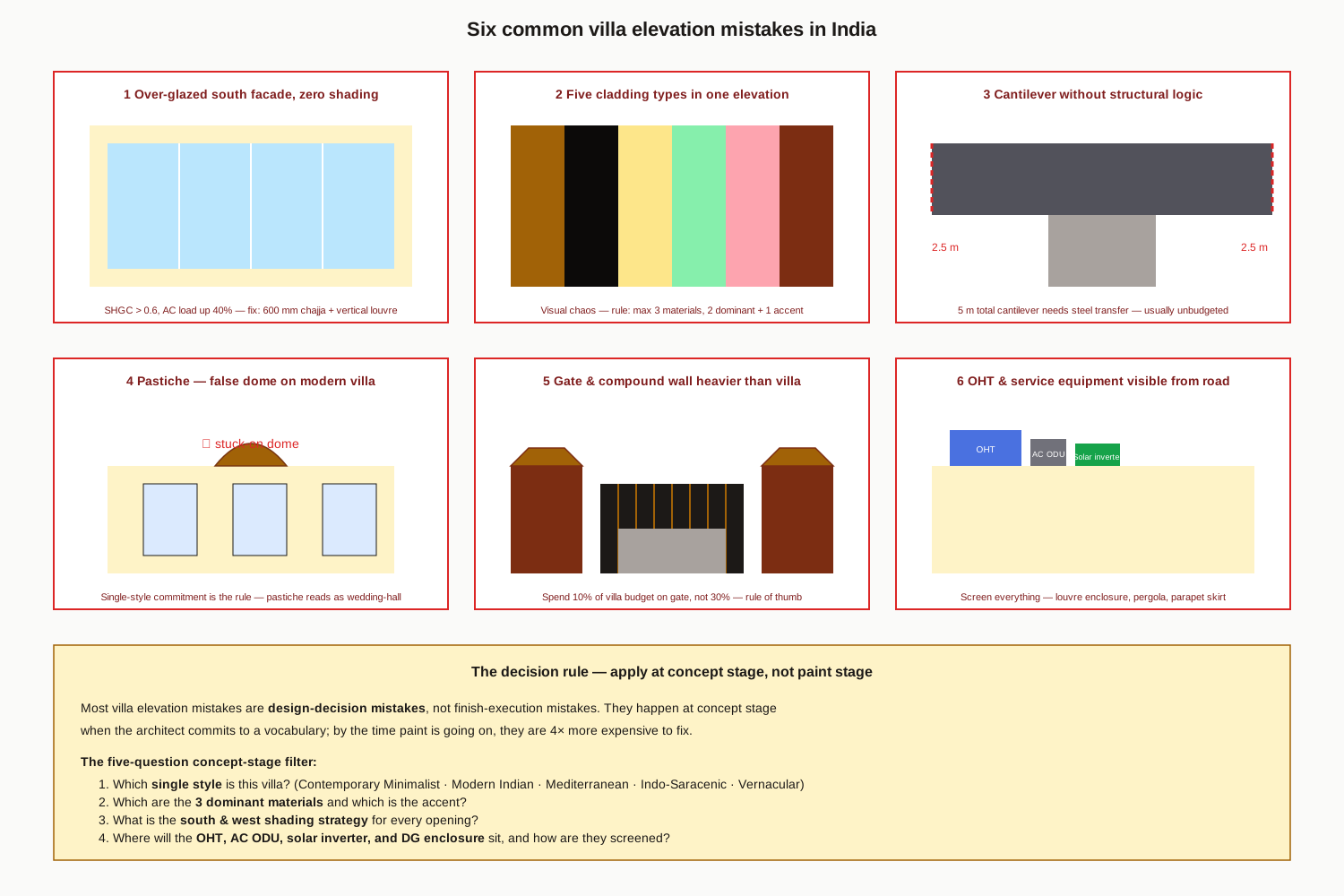
Most villa elevation mistakes happen at concept stage, not execution stage. By the time paint is going on, they cost 4× more to fix.
Mistake 1 — Over-glazed South Facade, Zero Shading
The dominant mistake in Bengaluru and Hyderabad villas built 2018–2024. Architects under-trained in climate design specify glass-dominant elevations facing south, then leave shading "for later" — which never comes. The result: SHGC (solar heat gain coefficient) above 0.6, AC loads 30–40% higher than necessary, summer surface temperatures on the glass touching 55°C.
Fix: 600–900 mm chajja on every south opening; SHGC ≤ 0.35 spec on the glass; vertical louvre system on south-west corner. See the climate adaptation section below.
Mistake 2 — Five Cladding Types in One Elevation
The "everything-pavilion" syndrome. The owner reads design magazines, sees five different beautiful materials, asks the architect for all of them. The result is visual cacophony — the eye has no resting point, no hierarchy, no narrative.
Rule: maximum three dominant materials, plus one accent. Beyond four, the elevation reads as a builders' material display.
Mistake 3 — Cantilever Without Structural Logic
A 2 m cantilever requires a steel transfer girder or 200 mm slab thickening at the back-span. A 5 m total cantilever (2.5 m on each side) requires a full-frame transfer system. Owners and unsophisticated architects routinely specify cantilevers visually without sizing the structure — the result is a costly mid-construction retrofit or a deflected, cracked floor years later.
Rule: any cantilever above 1.2 m needs a structural engineer's note at concept stage, not at execution drawings.
Mistake 4 — Pastiche (False Dome on Modern Villa)
The "wedding-hall" mistake. A villa is detailed as Contemporary Minimalist on three faces, then a Mughal dome is stuck on top of the centre because "Vastu requires it" (it doesn't) or because the family elder wanted a dome. The result reads as costume.
Rule: single-style commitment. Pick one of the five vocabularies and stay within it. Vastu compliance does not require Mughal vocabulary — it requires the eight authoritative rules (see Vastu House Plan for the actual rules).
Mistake 5 — Gate and Compound Wall Heavier Than the Villa
The 30%-on-gate problem. The owner sees a sample villa with a spectacular gate, copies the gate, and ends up with a compound wall that competes with — sometimes dominates — the villa itself. The visual hierarchy inverts.
Rule: the gate-and-compound budget should be 8–12% of villa-shell budget. Beyond 15%, the gate is the building and the building is the accessory.
Mistake 6 — Service Equipment Visible From the Road
The bare blue Sintex tank, the AC outdoor units stuck on the parapet, the solar inverter mounted on the front facade, the DG silencer protruding through the side wall. Each individually is a small ugliness; cumulatively, they destroy the elevation.
Rule: at concept stage, draw the service plant zone separately and screen it. Louvre enclosure, parapet skirt extension, pergola, or rooftop service tower — pick one and integrate.
The Concept-Stage Five-Question Filter
Before any villa elevation goes to detail design:
1. Which single style is this villa? (Contemporary Minimalist · Modern Indian · Mediterranean · Indo-Saracenic · Vernacular)
2. Which are the three dominant materials and which is the accent?
3. What is the south and west shading strategy for every opening?
4. Where will the OHT, AC ODU, solar inverter, and DG enclosure sit, and how are they screened?
5. What is the landscape strategy — anchor tree, hedge, forecourt, path?
Get those five right at concept and the rest is execution.
Climate Adaptation — Villa Elevations Across India's Climate Zones {#climate-adaptation}
A villa elevation that works in Jaipur fails in Chennai. India's five climate zones each demand a different elevation syntax. The principles below extend the Modern House Design in India climate framework to the larger villa scale.
Hot-Dry (Jaipur, Ahmedabad, Jodhpur)
Dominant problem: solar gain on south and west faces; dust-loaded winds; low rainfall but high diurnal swing.
Elevation rules:
- South and west glazing limited to 25% of facade area
- Deep jaali screen on south-west corner; ideally hand-carved sandstone for premium villas, terracotta for mid
- 900 mm chajja on every opening
- Earthen palette: Dholpur sandstone (red), Jaisalmer yellow, mud-tone plaster
- Plinth raised +600 mm above grade (dust line)
- Single deciduous tree on south-west (neem, gulmohar) to shade summer, drop leaves in winter
- White or green roof to reduce roof heat gain
Warm-Humid (Chennai, Mumbai, Kochi, Goa)
Dominant problem: humidity, heavy monsoon, salt-laden coastal air, high mould risk.
Elevation rules:
- Deep verandah on north and west sides — 2.4 to 3.0 m projection
- Pitched roof at 22–30° for rain-shed (or stepped flat with generous overhang)
- Mangalore tile, metal stand-seam, or RCC with deep waterproofing
- Salt-resistant finishes within 1 km of coast (no marble, no mild steel)
- Adjustable louvres between verandah piers for cross-ventilation control
- Stilt or +900 mm plinth in flood-prone micro-markets (Mumbai LGAs, Kerala backwaters)
- Tropical foliage canopy on west — coconut, rain-tree, jacaranda
Composite (Delhi, Lucknow, Bengaluru fringe)
Dominant problem: bimodal — hot summer and cold winter, both significant.
Elevation rules:
- Adjustable louvre system on south and west
- Stone band for thermal mass on ground floor — moderates diurnal swing
- Mid-tone palette (neither too dark nor too light)
- Operable windows for shoulder-season natural ventilation
- Deciduous tree on south for summer shade + winter sun
- Pergola for adjustable shade
- U-value < 0.5 W/m²K on walls
Cold (Shimla, Manali, Leh, Gangtok)
Dominant problem: heat loss, snow load, freeze-thaw, low solar in winter.
Elevation rules:
- South facade 60–70% glazed for passive solar gain
- Double-glazed Low-E units mandatory
- Pitched roof 30–45° for snow shed
- Internal shutter for night-time insulation
- Stone or brick plinth for thermal mass
- Minimum north-facing openings
- Wood cladding for vapour buffering
- U-value < 0.25 W/m²K on walls
Climate-zone selection is the first design decision for any villa elevation. Picking the vocabulary before checking the zone is the architect's equivalent of buying a fountain pen before knowing the paper.
Vastu in Villa Elevation — The Multi-Floor Considerations
Vastu compliance for a villa is identical to the authoritative rules for any house plan — but the multi-floor nature adds three considerations specific to villa scale.
Floor-by-Floor Vastu Stacking
The Vastu Purusha Mandala applies to each floor independently. The master bedroom is SW on the first floor; the puja niche is NE on the ground floor; the kitchen is SE on the ground floor; the OHT is NE on the roof. The vertical alignment of these zones across floors strengthens the Vastu reading.
A classic Vastu-aligned villa has:
- Ground: pooja NE · kitchen SE · master SW · entry E
- First: master SW · kids E or N · family lounge NW
- Roof: OHT NE · solar S · pooja-terrace NE
When the vertical stack respects the zones, the building reads as Vastu-coherent even to a strict consultant.
Staircase Vastu
For villa scale, staircase position carries Vastu weight. The rules:
- Staircase on S, SW, or W side of building plan
- Rising clockwise (N→E→S→W ascending)
- Odd number of risers (15, 17, 19) — total count
- Not directly facing the main door
- Not crossing the geometric centre (brahmasthan) of the plan
Vertical circulation is a major plan element in a villa; getting the stair position right at concept stage is non-negotiable for Vastu compliance.
Terrace Pooja
Many orthodox families add a small terrace pooja at the NE corner of the roof — a 6 × 6 ft uncovered pooja terrace for daily rituals, separate from the ground-floor pooja room. The architect should plan this at concept stage; retrofitting a roof pooja is awkward.
For the full Vastu reference covering plot rules, room directions, and four cardinal reference plans, see Vastu House Plan — Complete Indian Layout Reference.
Landscape Integration — The Forecourt Is Half the Elevation
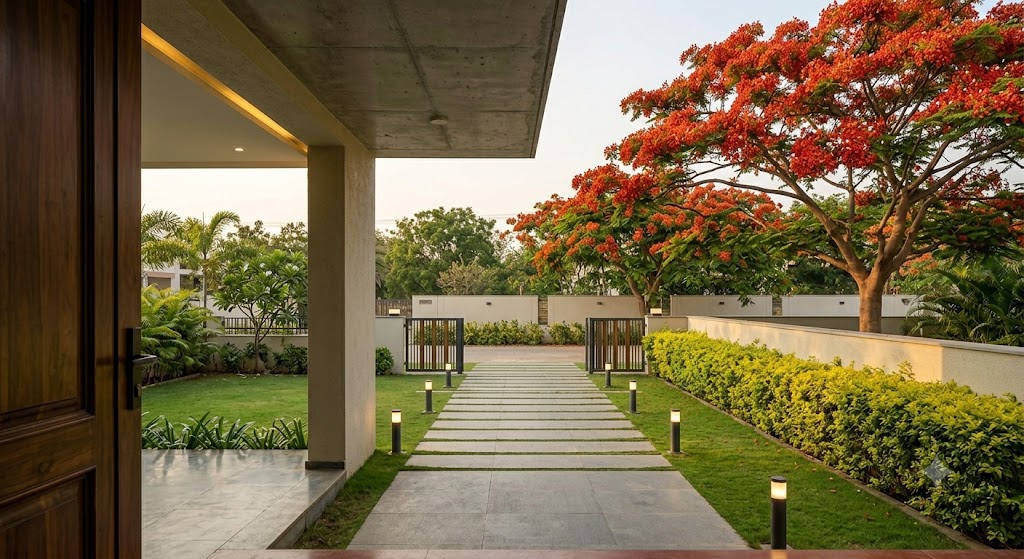
The most-photographed villa elevations on Indian design blogs typically have 40–60% of their image area occupied by landscape, not building. The lawn, the anchor tree, the hedge, the path, the lights — these are not garnish, they are the elevation.
The Six Landscape Decisions
1. Anchor tree position — usually the SW or NW corner of the plot, planted for canopy at maturity, not for current size
2. Mid-storey infill — 2–3 flowering trees (frangipani, magnolia) at mid-height
3. Continuous hedge along compound wall — duranta, croton, ixora — soft-edges the wall
4. Forecourt material — gravel, stone slab, lawn, or hardscape — sets the elevation's foot
5. Path from gate to door — stepping stones or continuous strip, planted edges
6. Lighting — uplights on trees, downlights on path, low-glow on porte-cochère
The landscape budget typically runs 8 to 15% of villa-shell cost, or ₹ 8 – 30 lakh on a typical mid-budget villa. Skipping landscape is the single biggest under-investment in Indian villa work — a ₹ 3 Cr villa with no landscape reads as a ₹ 1.5 Cr villa with no landscape.
The Compound Wall Planting Strip
A 600 mm planting strip along the inside of the compound wall — duranta gold, croton, or pittosporum — softens the wall edge and creates the impression of more land than the compound contains. This is the cheapest visual upgrade in villa landscape: ₹ 200 – 400 per running foot, transformative effect.
Lighting Design — The Night Elevation
The villa elevation has two distinct readings: the day elevation (defined by materials, geometry, shadow) and the night elevation (defined by light source, intensity, colour temperature). Most architects design for the day. Lighting designers, retrofitted late, then create a different night elevation that competes with rather than complementing the day reading.
The Five Night-Elevation Decisions
1. Facade wash — broad floodlight on the main mass, typically 3000 K, 200 lux on facade
2. Accent uplights on architectural features — chajja edge, fluted brick screen, jaali, parapet line
3. Porte-cochère cove lighting — concealed strip illuminating the ceiling underside of the cantilever
4. Tree uplights — narrow-beam at the canopy edge, 2700 K to read as warm
5. Path lights — low-glow, 1.2 m high, illuminating the path edge not the centre
Avoid the landing-strip mistake — equally-spaced 30 W bollards every 1.5 m down the path. It reads as runway, not landscape. Use 6-foot spacing minimum, with random offsets.
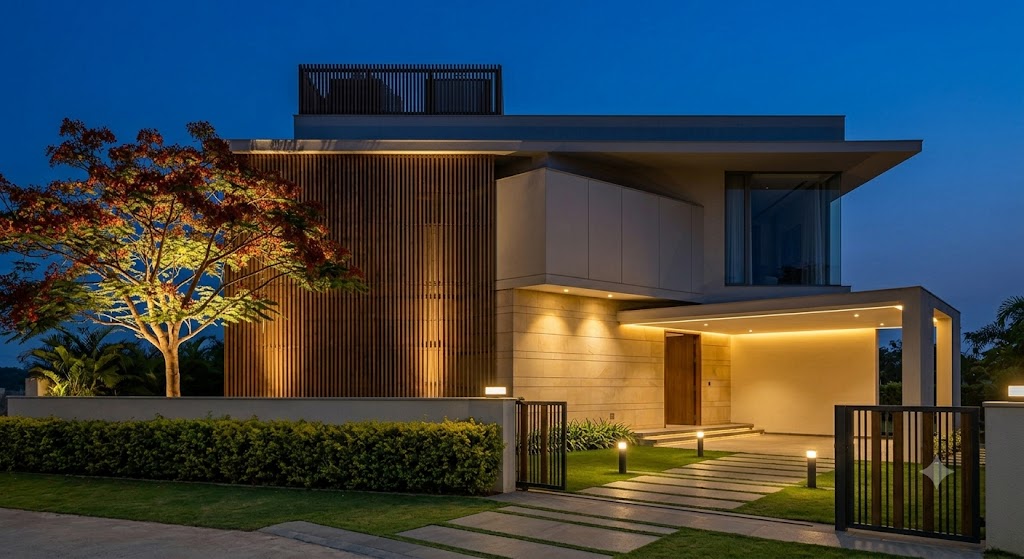
Total lighting load for a typical villa elevation: 800 – 2,500 W, drawing 1.5 – 4 kWh per night-evening (4 hours), or ₹ 200 – 500 per month on the electric bill. Make sure the lighting circuit is on its own contactor with a dusk-to-dawn sensor or app control — pre-wire at carcassing stage.
For the broader interior lighting framework that extends to facade lighting, see Lighting Planner for the room-level lux calculator.
Maintenance and Life-Cycle Costs — What the Villa Costs to Run
Villa elevation costs are not just the construction cost — they include the recurring spend over the building's life. A villa that costs ₹ 2 Cr to build typically costs ₹ 8 – 20 lakh per decade to maintain at facade level. Lifetime maintenance over 50 years can equal or exceed the construction cost.
Decadal Maintenance Cycle
| Decade | Typical Maintenance | Indicative Cost (3,000 sft villa) |
|---|---|---|
| 0–10 yr | Annual cleaning + minor touch-up | ₹ 50,000 – 1.5 L/yr |
| 4–6 yr | Full re-paint of painted faces | ₹ 3 – 8 L (once) |
| 8–10 yr | Re-sealing of brick/stone joints; gate refinish; landscape refresh | ₹ 4 – 10 L (once) |
| 12–15 yr | Major facade refresh — paint, sealants, hardware replacement | ₹ 8 – 20 L (once) |
| 20 yr | Window/glazing replacement; possible cladding refresh | ₹ 15 – 40 L (once) |
| 25 yr | Roof waterproofing + minor structural repairs | ₹ 8 – 25 L (once) |
The high-maintenance villa (heavy paint, marble, mild steel) costs roughly 2× over its life what a low-maintenance villa (cement-board, exposed brick, stainless gate) costs. The selection of facade materials is a 50-year decision.
The Coastal-Salt Penalty
Within 1 km of the coast, salt-laden air corrodes mild steel, yellows marble, blooms efflorescence on plaster, and dulls aluminium. The maintenance multiplier for coastal villas is approximately 1.4×. Material selection must shift to stainless steel, granite, brick, fluted brick — the salt-resistant family.
For coastal humidity management, also see Rainwater Harvesting for the wet-side service integration.
Pre-Construction Checklist for Villa Owners
Before the foundation is poured, the following must be locked:
Site & approvals
- [ ] Plot survey, boundary marking, soil test (SBC, water table, soil class)
- [ ] OC-route approvals confirmed: setback, FAR, height, parking — all bylaw-compliant
- [ ] Tree retention NOC if mature trees on plot
- [ ] Rainwater harvesting pit position locked (avoid foundation interference)
- [ ] OHT, septic, sump positions locked (avoid Vastu and structural conflicts)
Design
- [ ] Single style vocabulary committed (one of the five)
- [ ] Three dominant materials + one accent specified
- [ ] South/west shading strategy drawn for every opening
- [ ] Vertical service screen (OHT, AC, solar) drawn at concept stage
- [ ] Landscape concept plan with anchor tree position drawn
- [ ] Lighting concept plan drawn for night elevation
- [ ] Vastu zones overlaid on plan and confirmed (NE, SE, SW, Centre at minimum)
Engineering
- [ ] Structural engineer sign-off on any cantilever > 1.2 m
- [ ] MEP coordinated (electrical load, water tank size, drainage)
- [ ] Plumbing wall positions locked relative to facade
- [ ] DG and solar capacity sized
Commercial
- [ ] Facade BOQ per matrix in this guide
- [ ] Landscape budget set at 8–15% of shell
- [ ] Lighting circuit on separate contactor planned
- [ ] Contingency 8–10% on facade allocation
Cross-link the broader process to Building a House in India — Step-by-Step Guide for the larger procurement and contractor workflow.
References
1. National Building Code of India (2016). NBC 2016, Part 4 (Fire and Life Safety), Part 11 (Approach to Sustainability). Bureau of Indian Standards.
2. SP 41 (1987). Handbook on Functional Requirements of Buildings. Bureau of Indian Standards, New Delhi.
3. Bureau of Energy Efficiency (2017). Energy Conservation Building Code (ECBC) 2017. Ministry of Power.
4. Council of Architecture (2020). Architectural Practice Bylaws — Revised. New Delhi: CoA.
5. Krishan, A. (2017). Climate Responsive Architecture — A Design Handbook for Energy-Efficient Buildings. TERI Press.
6. Lang, J. (2002). A Concise History of Modern Architecture in India. Permanent Black.
7. Tillotson, G.H.R. (1989). The Tradition of Indian Architecture — Continuity, Controversy and Change Since 1850. Oxford University Press. (Indo-Saracenic vocabulary scholarship.)
8. BBMP Revised Bye-Laws (2024). Building Bye-Laws — Residential & Commercial. Bengaluru Mahanagara Palike.
9. HMDA (2023). Hyderabad Metropolitan Development Authority — Development Control Rules.
10. MMRDA / MCGM (2023). Development Control and Promotion Regulations, Greater Mumbai.
11. Karkhanis, A. (2022). Designing the Contemporary Indian Villa — Material, Climate, Craft. Mapin Publishing.
12. JLL India (2025). Indian Villa Market Report — Tier-1 & Tier-2 Premium Residential.
Author's note: A villa elevation in 2026 India is not a sample-flat catalogue image. It is a 50-year commitment to a piece of land, a neighbourhood, a family pride, and a resale market. The five style vocabularies have all earned their place through use, all have legitimate buyers, all have specific climate fits. The mistake is not picking the "wrong" vocabulary — it is failing to pick one vocabulary and stay within it. Pick the style, pick the materials, pick the climate response, pick the service-screen strategy, pick the landscape, lock all five at concept stage. The rest is execution.
Disclaimer: Cost ranges quoted are 2025-26 indicative for Indian Tier-1 and Tier-2 cities and vary by micro-market, season, and procurement channel. Bylaw figures reflect 2023-24 ULB byelaw revisions and are subject to local amendments — verify against your current municipal byelaws before design freeze. Material lifespan estimates assume competent execution and standard maintenance; outcomes vary with workmanship, substrate quality, and climate exposure. Vastu rules cited follow the framework in Vastu House Plan — Complete Indian Layout Reference; regional practitioner schools may apply additional rules. Studio Matrx, its authors and contributors accept no liability for decisions made on the basis of this guide; engage a licensed architect, structural engineer, MEP consultant, landscape designer, and (if orthodox) a qualified Vastu consultant from your family's tradition for site-specific application.
Export this guide
Related Guides — Deep-dive reading
Designing a Naturally Energy-Efficient Indian Home
Comfort first, gadgets last — passive design, orientation, insulation, ventilation and the climate wisdom that cuts Indian energy bills
SustainabilityVilla Landscape Design — Indian Villa Gardens, Hardscape & Vastu Landscape (2026)
8 landscape zones · Climate-zone tree palette · Vastu landscape · NBC 2016 Part 10 · 1.5 acre worked example
Design StylesIndian House Front Elevation Design
Anatomy, Styles, Proportions, Materials & Bylaws — A Complete Architect's Guide for Indian Homes
Design StylesRelated Tools — Try Free
Brise-Soleil Visualizer
Interactive horizontal-louvre cut-off angle calculator — sun altitude, louvre depth, and spacing inputs with a live shadow preview. Computes θ = arctan(spacing/depth) for façade shading, ECBC envelope compliance, hospital daylight design, and tropical sun-control detailing.
Sun Shading ToolRainwater Tank Sizer
How big should your rainwater tank be? Computes annual harvest, recommended tank capacity in litres, water-bill savings, and payback — for 10 Indian cities.
RWH CalculatorCross-Ventilation Analyzer
Estimate airflow and air changes per hour (ACH) from room size, window areas, layout, and local wind — with NBC 2016 Part 8 compliance check.
Ventilation Calculator