
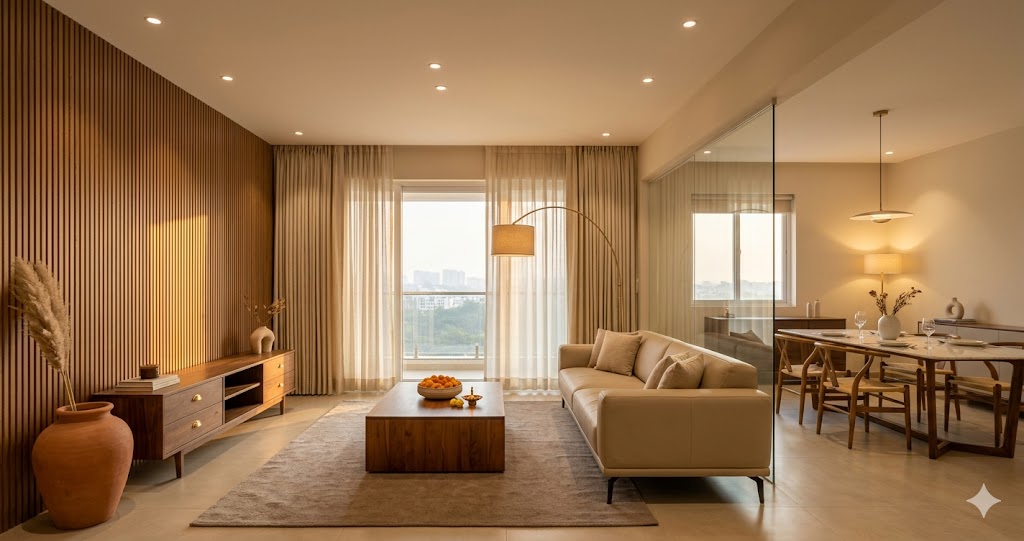
Premium Apartment Interiors — The ₹15-40 Lakh Tier for Indian 3 BHKs (2026)
Above budget-luxury · Below super-luxury · Materials, brands, contractor-tier reality
Premium apartment interiors in 2026 India occupy a specific, well-defined budget tier — ₹15 to ₹40 lakh fit-out on a 1800–2800 sqft 3 BHK or 4 BHK apartment, typically in a project that itself cost ₹2 to ₹5 crore. This is the tier above mid-market builder-finish-plus-upgrades and below trophy super-luxury. It is the tier that absorbs the largest share of metro India's white-collar interior spend in 2026, and it has its own materials menu, its own contractor grade, its own furniture vocabulary, and its own pitfalls.
The buyer is usually a dual-income household in their mid-thirties to late forties — a tech director in Whitefield, a corporate banker in Bandra Kurla Complex, a partner-track lawyer in Gurugram Sector 54 — who has just moved into a Brigade Cornerstone, a Prestige Falcon City, a Sobha Royal Pavilion, a Godrej Splendour, a Lodha Park, a Hiranandani Estate or an Oberoi Sky City. They are interior-committed, not interior-curious — and what they need is a vocabulary for the quiet-luxury, ten-year-material decisions they are about to make.
"We don't want a flashy apartment that screams new money. We want something that looks like it has always been there — quiet, considered, with materials that will still look right in 2036." — a recurring brief from premium apartment buyers in Bengaluru, Mumbai, Pune and Delhi NCR through 2024-2026.
If you are still scoping the project before you reach this tier, read the upstream framing in apartment interior planning India, the tier-below reference in budget luxury interiors, the small-apartment counterpart in compact luxury apartment, and the engagement-model breakdown in choosing an interior designer India.
This guide refreshes every 12 months. Last verified: May 2026 · Next verify: May 2027.
What Premium Apartment Interiors Actually Mean in 2026 India
Premium apartment interiors, in 2026 metro India, refer to a turnkey fit-out budget of approximately ₹700 to ₹1,500 per square foot of carpet area, delivered on a 1800–2800 sqft 3 BHK or 4 BHK. That puts the total interior outlay in the ₹15 to ₹40 lakh window, with the densest concentration around ₹22 to ₹30 lakh. The home it is being fitted into is typically a ₹2 to ₹5 crore apartment in a Grade-A development by Brigade, Prestige, Sobha, Godrej, Lodha, Hiranandani, Oberoi, K Raheja, Embassy or a peer developer.
The tier is defined less by a single hero element and more by a coherent set of upgrades happening simultaneously: engineered timber or stone flooring instead of vitrified tile, veneer wardrobes with soft-close European hardware instead of laminate with Indian hinges, a kitchen with a stone counter and an extractor that actually extracts, lighting on dimmable circuits with three colour temperatures, and a furniture mix that combines two or three serious anchor pieces with carefully chosen mid-tier supporting cast.
Five things premium apartment interiors are NOT in 2026 India:
1. Not super-luxury or trophy interiors. Those start at ₹50 lakh and routinely cross ₹1 crore for a 4 BHK at Lodha World Towers or Oberoi Three Sixty West. The materials menu shifts — book-matched Italian marble slabs, full-import Boffi kitchens, Minotti and B&B Italia anchor furniture, lighting from Flos and Foscarini, custom joinery in figured walnut. That is a different conversation, covered separately in our luxury reference work.
2. Not budget-luxury interiors. Those land in the ₹6 to ₹12 lakh band, covered in budget luxury interiors, and use premium laminate, Indian engineered stone, and Indian-brand modular kitchens. Premium tier swaps each of those for a category-up choice.
3. Not builder-finish apartments with a furniture overlay. A common confusion: a buyer takes possession, keeps the developer-supplied flooring and bathroom fittings, adds ₹15 lakh of furniture and curtains, and calls it premium. It can look fine, but premium implies the shell itself is upgraded — flooring, false ceiling, lighting circuits, wardrobes, kitchen.
4. Not interior design done by the developer's empanelled contractor. Most large developers offer an in-house fit-out service at ₹1,200–1,800 per sqft. These are convenient but use a fixed materials menu, typically operate at mid-market quality with a premium price tag, and rarely deliver the bespoke character that defines the tier.
5. Not import-everything trophy curation. Premium tier in India is, by necessity, hybrid: a 50–70 percent Indian-made spine (carpentry, kitchen carcass, stone, paint, electricals) with 30–50 percent imported or premium-Indian accent pieces (European hardware, Italian or Spanish surfaces, hero furniture, lighting from Sirohi, Klove Studio or Pandit).
The clearest definition: premium apartment interiors in 2026 India are what you specify when you want the apartment to read as considered and durable at first glance, to support a ten-year ownership horizon without dating, and to do so without crossing into the territory where the interior cost approaches the apartment cost.
Why Premium Apartment Interiors Matter Now
Three structural forces have made this tier the most active interior segment in metro India in 2025-2026.
The supply pipeline finally caught up. Between 2023 and 2026, India's Grade-A residential market saw record absorption of premium 3 BHK and 4 BHK stock — Knight Frank India's H2 2025 report noted that the ₹2-5 crore price band accounted for roughly 38 percent of new launches in Bengaluru, Mumbai, Pune, Hyderabad and Delhi NCR combined, with Whitefield-Sarjapur, Kharadi-Hinjewadi, Kokapet-Gachibowli, and Gurugram Sectors 50–67 leading the pack. Each of these apartments needs a fit-out.
The post-COVID work-from-home permanence stuck. Many premium-apartment buyers in 2024-2026 spend two to four days a week on video calls from a home office. That pushed the brief from "show home" to "everyday durable" — better acoustics, better lighting for video calls, better task ergonomics, better materials that look right under both warm evening light and daytime conferencing light.
The rupee-cost gap between mid-market and premium materials narrowed. As Indian manufacturing matured between 2020 and 2025, the cost premium for engineered wood flooring (Action Tesa, Pergo India, Square Foot), veneer (Greenlam Decowood, Centuryply, Archidply), hardware (Hettich Top-line, Hafele Sensys, Blum sold via Indian distributors), and premium modular kitchen carcass (Sleek Studio, Hacker India, Nolte India) compressed sharply. In 2018, going premium roughly doubled the cost over mid-market. In 2026, it adds 50–70 percent — which is what made the ₹15–40 lakh tier viable for a much larger pool of buyers.
The result: a buyer who in 2018 would have done a ₹10 lakh mid-market fit-out and aspirationally watched Houzz India for the things they could not afford, in 2026 does a ₹25 lakh premium fit-out and shops the Pinterest board they actually saved. The market is meeting the aspiration.
The Eight Defining Characteristics
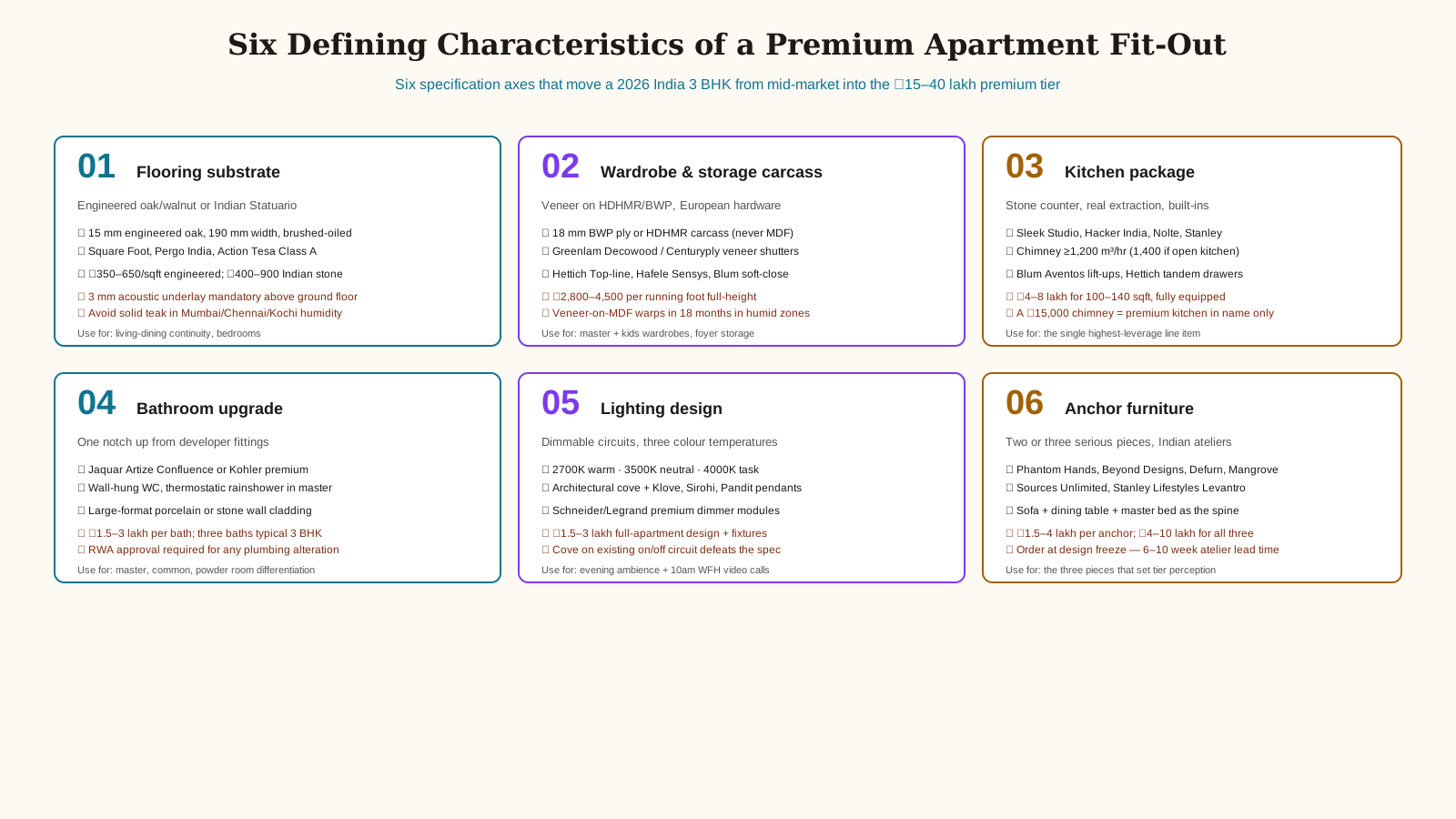
Premium apartment interiors are recognisable not by one signature element but by the consistent upgrade across eight specification axes.
| Characteristic | What it means | India-specific note | Typical cost / constraint |
|---|---|---|---|
| Flooring substrate | Engineered oak / engineered walnut planks, or large-format Italian/Indian Statuario marble in living-dining; SPC or premium engineered in bedrooms | Engineered oak survives Indian humidity better than solid teak in coastal/humid cities; Statuario from Rajasthan is now within 30 percent of Italian Statuario | ₹350–650/sqft installed for engineered oak; ₹450–900/sqft for stone |
| Wardrobe and storage carcass | 18 mm BWP plywood or HDHMR carcass, veneer or premium laminate shutters, soft-close European hinges, internal accessories (Hettich/Hafele/Blum) | Avoid 18 mm MDF for tropical/humid Indian climates; HDHMR (Action Tesa, Greenpanel) is the safer premium spec | ₹2,800–4,500 per running foot for full-height wardrobe |
| Kitchen package | Premium modular kitchen with stone or solid-surface counter, premium chimney (≥1200 m³/hr), built-in hob/oven, Blum Aventos lift-ups | Indian cooking moisture and oil load demands genuinely premium extraction — a ₹40,000 chimney is not optional at this tier | ₹4–8 lakh for a 100–140 sqft modular kitchen, fully equipped |
| Bathroom upgrade | Replace developer fittings with Jaquar Artize or Kohler premium range; wall-hung WC; large-format porcelain or stone walls; rainshower with thermostatic mixer | Most premium developers in 2024-2026 already pre-spec Jaquar Continental or Hindware Italian Collection — the upgrade is usually one notch up | ₹1.5–3 lakh per bathroom, three bathrooms in a typical 3 BHK |
| Lighting design | Dimmable LED on multiple circuits, three colour-temperature scenes (2700K warm / 3500K neutral / 4000K cool for task), architectural cove lighting, decorative pendants over dining and bedside | Indian wiring is rarely pre-spec'd for dimmable circuits — premium tier needs the false ceiling redone with new wiring runs | ₹1.5–3 lakh for full apartment lighting design + fixtures |
| Soft furnishing weight | Wool, sisal or premium viscose rugs (not synthetic); cotton-linen or pure linen drapes (not polyester sheers); down or premium foam upholstery | Wool rugs from Jaipur Rugs, Obeetee or The Carpet Cellar are at price parity with imported equivalents and acoustically superior for Indian apartments | ₹2–5 lakh for soft furnishing across a 3 BHK |
| Furniture anchor pieces | Two or three serious pieces (sofa, dining table, master bed) from premium Indian ateliers (Phantom Hands, Mangrove Collective, Beyond Designs, Defurn, Sources Unlimited, Stanley Lifestyles' Levantro line) | Phantom Hands' sofa programme is regularly specified in this tier; mid-tier supporting pieces from Pepperfry Studio or Westside Home complete the room | ₹4–10 lakh for the three anchor pieces |
| Mechanical/electrical refinements | Acoustic underlay below flooring on upper floors, RO + UV water filtration plumbed to kitchen and master bath, mesh Wi-Fi (Eero, TP-Link Deco, Asus ZenWiFi), smart switches on select circuits | RWA approvals required for any plumbing alteration and for false ceiling drops below the developer-specified minimum | ₹75,000–2 lakh for the MEP refinements |
Read the table as a checklist: a fit-out that upgrades six or seven of these eight axes is decisively in the premium tier. A fit-out that upgrades only three is still in the budget-luxury tier no matter how much the buyer spent.
A Worked Example
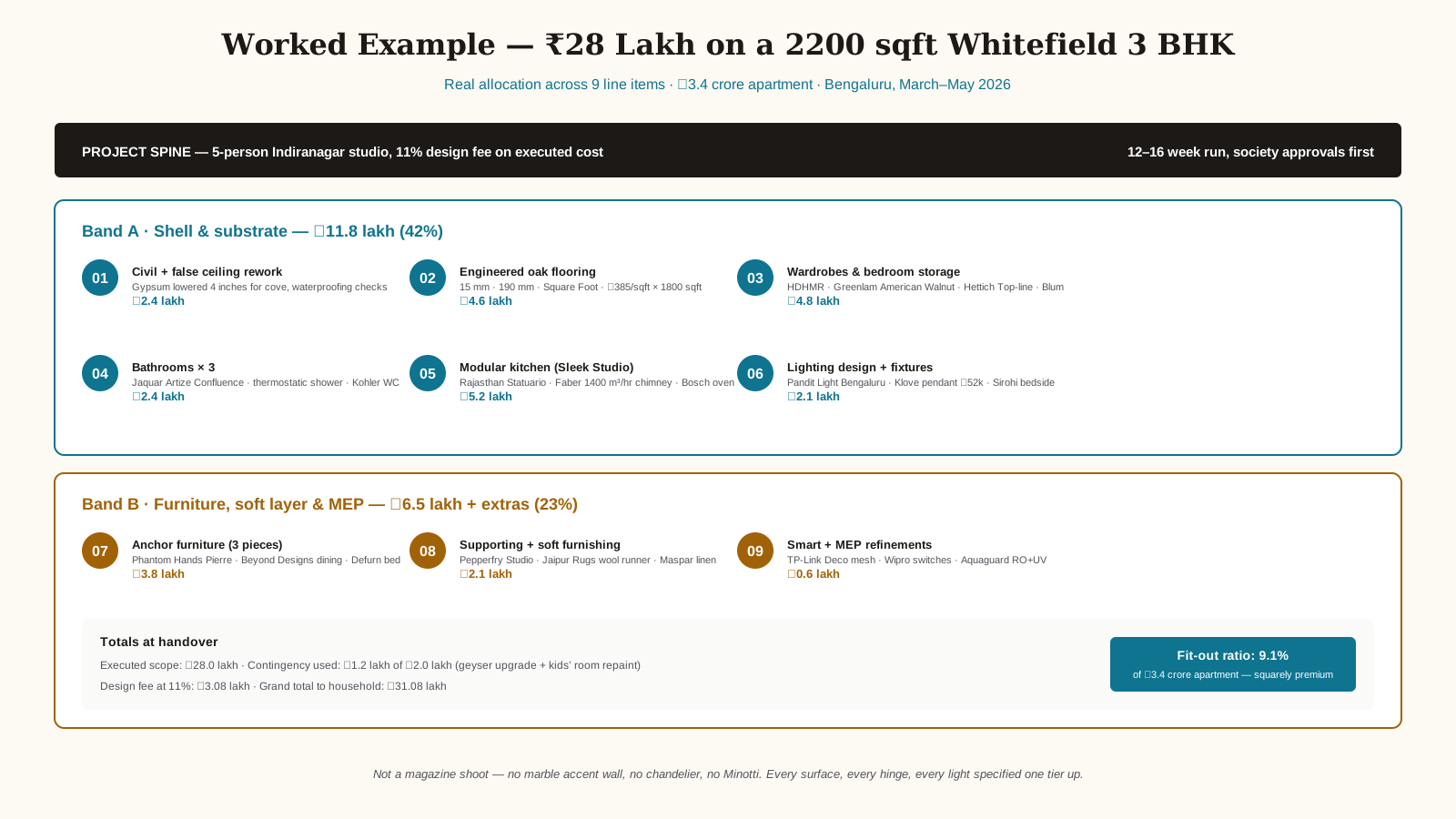
The brief. A 2200 sqft three-bedroom apartment near Phoenix Marketcity Whitefield, Bengaluru, purchased at ₹3.4 crore in late 2024 and ready for fit-out in March 2026. The household: tech director (mid-forties), corporate consultant (early forties), ten-year-old and six-year-old. Interior budget agreed at ₹28 lakh with ₹2 lakh contingency. Brief: "warm minimal, materials that last ten years, no statement chandeliers, no marble accent walls, kid-friendly but not kid-themed." Possession February 2026, designer onboarded January 2026, target move-in early May 2026.
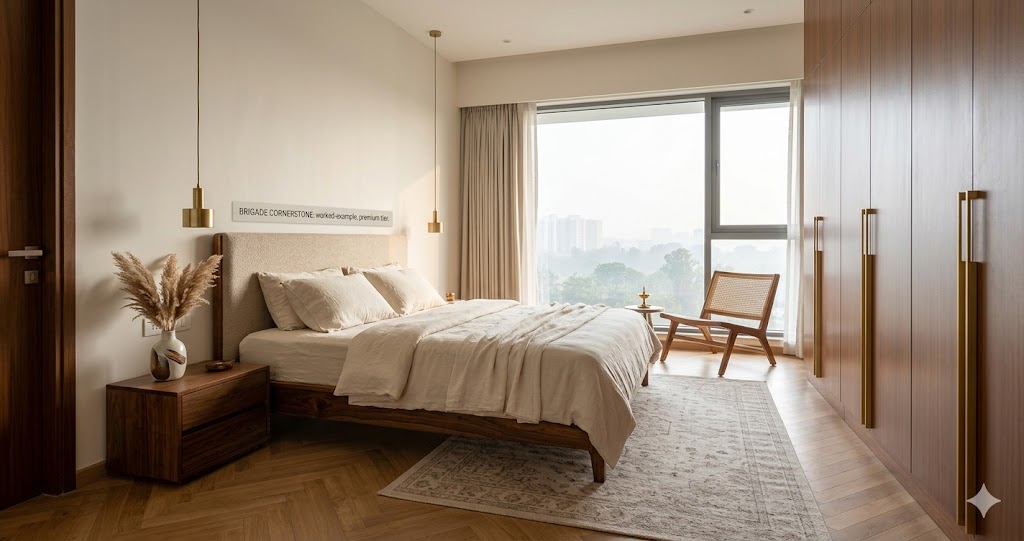
The allocation. The interior designer (a five-person studio in Indiranagar charging an 11 percent design fee on the executed cost) split the ₹28 lakh as follows:
- Civil and false ceiling rework: ₹2.4 lakh. Redoing the developer's gypsum false ceiling in living-dining (lowered 4 inches to run cove lighting), dropped soffit in the master bedroom, waterproofing checks in all three bathrooms.
- Flooring: ₹4.6 lakh. Engineered oak planks (15 mm, 190 mm width, brushed and oiled finish) from Square Foot's Bengaluru showroom at ₹385/sqft installed, covering 1800 sqft carpet area excluding bathrooms.
- Wardrobes and bedroom storage: ₹4.8 lakh. Three full-height wardrobes in HDHMR carcass with Greenlam Decowood American Walnut veneer shutters, Hettich Top-line sliders, soft-close hinges, Hafele pull-out internal accessories. Master with Blum Aventos HF overhead lift-ups.
- Modular kitchen: ₹5.2 lakh. Sleek Studio range with Rajasthan-sourced Statuario counter at ₹600/sqft, Faber 90 cm built-in hob, Faber 90 cm 1400 m³/hr chimney, Bosch built-in oven, Blum Aventos overhead lift-ups, Hettich tandem drawers.
- Bathrooms: ₹2.4 lakh. Replaced developer's Jaquar Continental with Jaquar Artize Confluence line, thermostatic rainshower in master, wall-hung WCs from Kohler in all three.
- Lighting design and fixtures: ₹2.1 lakh. Designed by Pandit Light's Bengaluru office. Dimmable LED on five circuits in living-dining, three in each bedroom, Klove Studio glass pendant over the dining table (₹52,000), Sirohi brushed-brass bedside pendants in the master.
- Anchor furniture: ₹3.8 lakh. Phantom Hands "Pierre" three-seater in undyed cotton-linen at ₹1.95 lakh, Beyond Designs solid-teak dining table with brass inlay at ₹1.10 lakh, Defurn Bengaluru master bed in figured Sapele veneer at ₹78,000.
- Supporting furniture and soft furnishings: ₹2.1 lakh. Two armchairs from Pepperfry Studio, Jaipur Rugs wool runner in the living room, pure-linen drapes from Maspar in master and living, cotton-print drapes from Fabindia in the kids' rooms.
- Smart and MEP: ₹0.6 lakh. TP-Link Deco mesh Wi-Fi, Wipro smart switches on hall and bedroom circuits, Aquaguard RO + UV plumbed to kitchen and master bath.
Total executed: ₹28.0 lakh. Contingency used: ₹1.2 lakh of ₹2 lakh (an under-spec'd geyser upgrade, a kids'-room repaint after colour mismatch). Design fee: ₹3.08 lakh (11 percent of ₹28 lakh). Grand total to household: ₹31.08 lakh against a ₹3.4 crore apartment — a 9.1 percent fit-out ratio, squarely typical for the tier.
What this apartment is not. It is not a magazine shoot. There is no marble accent wall, no chandelier, no Minotti sofa, no statement art wall. It is a quiet, well-resolved, ten-year apartment that reads premium because every surface, every hinge, every light source has been specified one tier up from the default — and the cumulative effect is the tier.
Premium Apartment Interiors vs Adjacent Categories
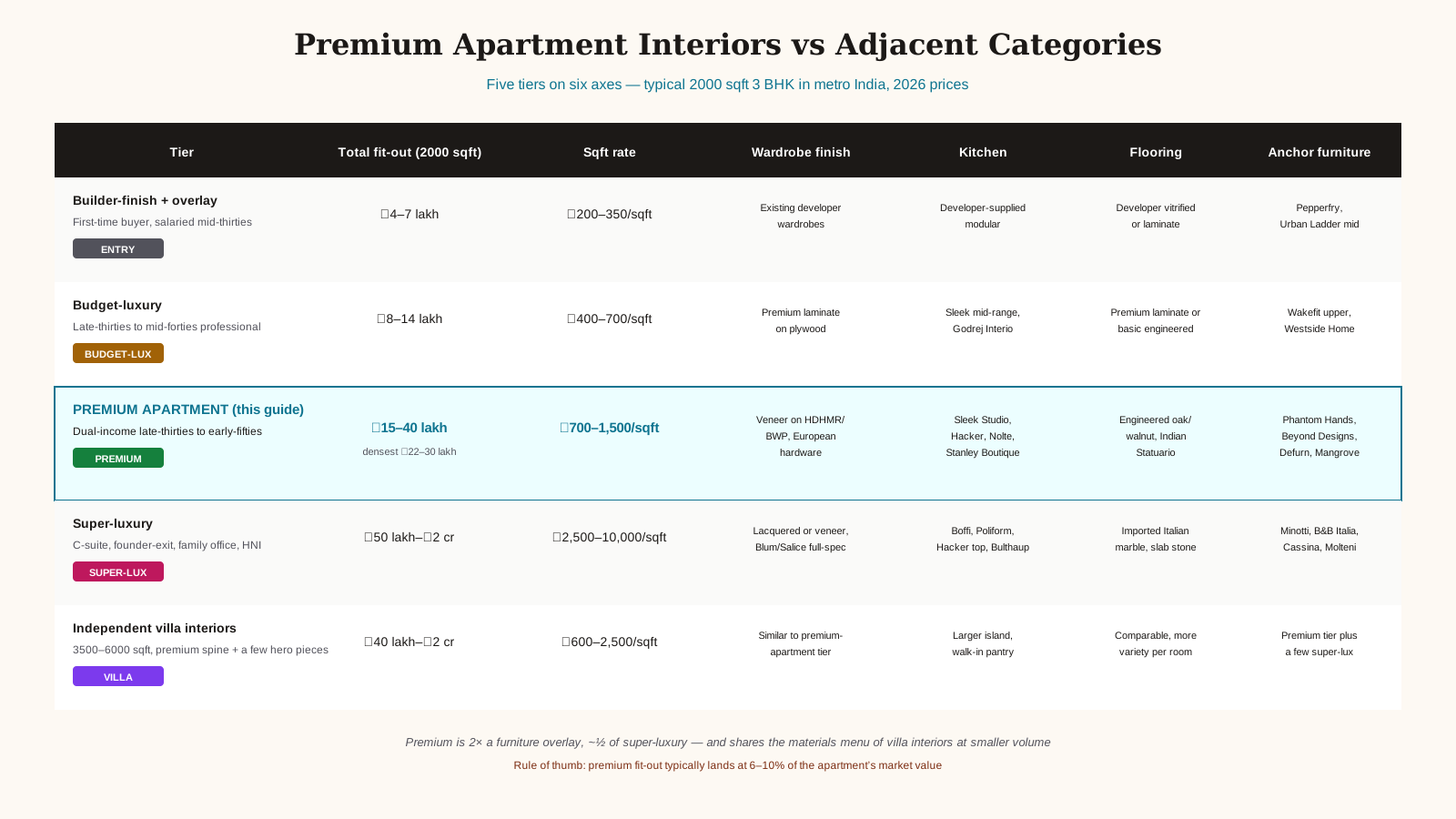
The most common confusion in 2026 India is between premium apartment interiors and four adjacent categories. The table below separates them on the seven axes that matter most.
| Category | Typical fit-out budget (3 BHK, 2000 sqft) | Sqft rate | Wardrobe finish | Kitchen package | Flooring | Anchor furniture |
|---|---|---|---|---|---|---|
| Builder-finish + furniture overlay | ₹4–7 lakh | ₹200–350/sqft | Existing developer wardrobes | Developer-supplied modular | Developer vitrified or laminate | Pepperfry, Urban Ladder mid-range |
| Budget-luxury interiors | ₹6–12 lakh | ₹300–550/sqft | Premium laminate on plywood | Sleek mid-range or Godrej Interio | Premium laminate or basic engineered | Wakefit upper, Westside Home, Pepperfry Studio |
| Premium apartment interiors | ₹15–40 lakh | ₹700–1,500/sqft | Veneer on HDHMR/BWP ply, European hardware | Sleek Studio / Hacker / Hafele premium / Nolte | Engineered oak/walnut, Indian Statuario | Phantom Hands, Beyond Designs, Defurn, Mangrove Collective |
| Super-luxury interiors | ₹50 lakh–₹2 crore | ₹2,500–10,000/sqft | Lacquered or veneer on imported substrate, Blum/Salice full-spec | Boffi, Poliform, Hacker top line, Bulthaup | Imported Italian marble, large-format slab stone | Minotti, B&B Italia, Cassina, Molteni |
| Independent villa interiors | ₹40 lakh–₹2 crore | ₹600–2,500/sqft (over 3500–6000 sqft) | Similar to premium-apartment tier, larger volume | Comparable but with larger island and pantry | Comparable but more variety across rooms | Mix of premium-apartment tier plus a few super-luxury pieces |
Three takeaways. First, premium apartment interiors are at least 2x the cost of a furniture overlay and 2x the cost of budget-luxury — the gap is real and reflects substrate, hardware, and anchor-furniture spend. Second, super-luxury is not just premium with more zeros; it is a different supply chain (largely imported) and a different design vocabulary (largely European-led). Third, premium apartment interiors and villa interiors share a materials menu but differ in volume — a villa stretches the same per-sqft spend over much larger area and so often layers in a few super-luxury hero pieces.
If you are weighing the premium-apartment approach against the calmer aesthetic of warm minimal interiors or the specific Japanese-Scandinavian hybrid of japandi apartment, note that those are aesthetic styles that can be executed at any tier — most premium-apartment 2026 briefs land somewhere in the warm-minimal or japandi style family.
Materials, Finishes and Brand Landscape
The tier is best understood through the actual menu — what gets specified, from which vendor, at what India price, in 2026.
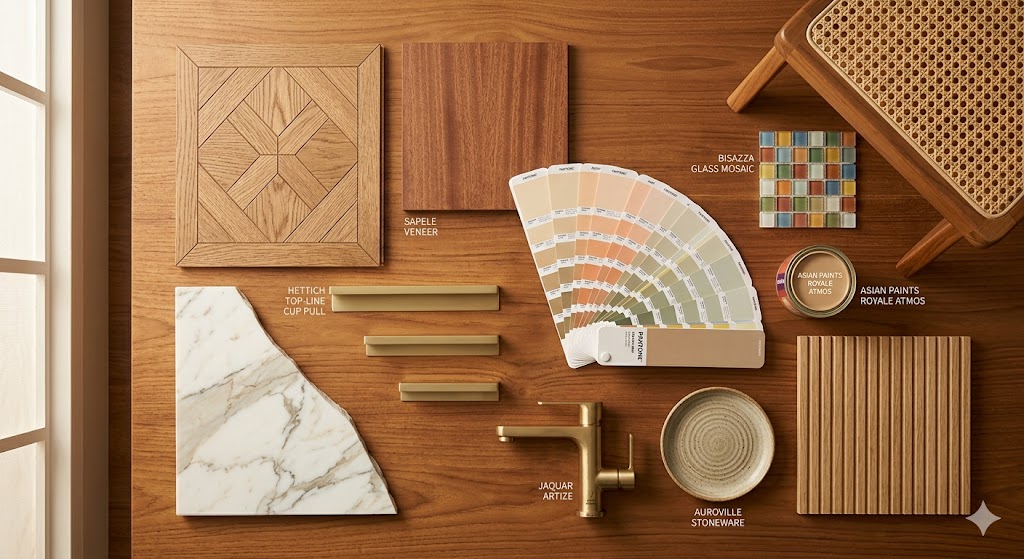
| Category | Premium specification | Indian source | Imported source where relevant | Approximate 2026 India price |
|---|---|---|---|---|
| Engineered wood flooring | 15 mm engineered oak, 190 mm width, brushed and oiled | Square Foot, Pergo India (Quick-Step range), Action Tesa Class A engineered | Kährs (Sweden, via Sources Unlimited), Bauwerk (Switzerland) | ₹350–650/sqft installed |
| Stone for flooring and counter | Indian Statuario (Rajasthan), Indian Carrara substitute, Banswara White, Makrana premium grade | RK Marble, Bhandari Marble Group, Classic Marble Company | Italian Statuario, Calacatta, Carrara (premium import) | ₹400–900/sqft Indian, ₹1,800–4,500/sqft Italian |
| Veneer | Sapele, American Walnut, Smoked Oak, Fumed Eucalyptus, Tay wood | Greenlam Decowood, Centuryply, Archidply, Sainik Mica premium line | Tabu (Italy, via specialist veneer houses in Mumbai) | ₹180–450/sqft for Indian premium veneer |
| Wardrobe and kitchen hardware | Soft-close hinges, tandem drawers, lift-up overheads, Sensys closing | Hettich India (Top-line, Quadro), Hafele India (Sensys, Moovit) | Blum (Aventos, Movento) sold via Indian distributors | Hardware adds ₹350–800 per running foot of wardrobe |
| Bath fittings | Thermostatic mixers, rainshower, wall-hung WC, smart bidet | Jaquar Artize, Kohler India premium range, Hindware Italian Collection | Grohe SPA, Hansgrohe Axor, Duravit (premium import) | ₹35,000–1.2 lakh per bathroom for fittings alone |
| Modular kitchen | Carcass + shutters + hardware + counter as a system | Sleek Studio (Asian Paints), Hacker India, Nolte India, Stanley Boutique Kitchens | Boffi, Poliform Varenna, Bulthaup (super-luxury, rarely at this tier) | ₹4–8 lakh for 100–140 sqft modular kitchen |
| Decorative lighting | Designer pendants, sconces, dimmable architectural | Klove Studio (Delhi), Sirohi, Pandit, IndianShelf premium range, Oorjaa | Flos, Foscarini, Vibia (super-luxury) | ₹15,000–80,000 per fixture for Indian premium |
| Rugs and soft furnishing | Hand-knotted or hand-tufted wool, sisal, premium viscose | Jaipur Rugs, Obeetee, The Carpet Cellar, Maspar drapes, Good Earth | Loloi, Nordic Knots (occasional import) | Wool rug ₹600–2,500/sqft, drapes ₹300–800/running foot |
| Anchor furniture (sofa, dining, bed) | Three serious pieces from premium ateliers | Phantom Hands (Bengaluru), Mangrove Collective (Bengaluru), Beyond Designs (Delhi), Defurn (Bengaluru), Sources Unlimited (Mumbai), Stanley Lifestyles' Levantro line | Cassina, Minotti, Poliform, B&B Italia (super-luxury) | ₹1.5–4 lakh per anchor piece for Indian premium ateliers |
| Smart home, AV, MEP | Mesh Wi-Fi, smart switches, RO + UV, premium chimney | Wipro Smart, Schneider Wiser, Hindware Atlantic geyser, Aquaguard | Lutron (super-luxury), Sonos (audio at this tier) | ₹50,000–3 lakh depending on coverage |
The single most useful insight: in 2026 India, the Indian premium tier (Sleek Studio, Jaquar Artize, Hettich Top-line, Greenlam Decowood, Phantom Hands, Jaipur Rugs) reaches roughly 85 percent of the perceived-quality of the European super-premium tier (Boffi, Hansgrohe Axor, Blum, Tabu, Minotti, Nordic Knots) at 30–45 percent of the cost.
"The smartest premium briefs in 2026 are 70 percent Indian premium, 30 percent imported accent — not 100 percent of either."
That gap is what makes the premium-apartment fit-out viable as a tier — buyers can resolve seven of the eight specification axes with Indian premium and reserve one or two for an imported moment.
For the engagement-model decision that will determine whether you self-execute, hire a turnkey contractor, or hire a design firm with an outside contractor, read choosing an interior designer India.
Eight Pitfalls Common in 2026 India
1. The "premium pricing, mid-market execution" trap. A common failure mode: the buyer hires a contractor charging ₹1,200/sqft, expecting premium-tier output, but the contractor's underlying supply chain (carpenters, hardware vendors, paint subcontractor) is configured for mid-market. The cost lands at premium, the execution lands at mid-market. Mitigation: verify the contractor's last three premium-tier projects; visit one on site; ask which Hettich/Hafele dealer they use and call to confirm the relationship is current.
2. Under-spec'd kitchen extraction. An Indian premium kitchen with a ₹15,000 chimney is a premium kitchen in name only. Indian cooking generates 3–5x the airborne oil and moisture of a typical European cuisine, and at premium tier the chimney must be a minimum 1,200 m³/hr (1,400 m³/hr if the kitchen is open to living-dining). Mitigation: budget ₹35,000–60,000 for the chimney as a non-negotiable line item, and verify the duct routing is short and not heavily bent.
3. Cove lighting added without re-wiring. Adding a 4-inch dropped cove for indirect lighting is a premium-tier signature, but it requires new dimmable circuits run in the false ceiling. Many contractors run the cove but tap into the existing on/off circuit, producing harsh always-bright cove light that defeats the purpose. Mitigation: insist the false ceiling rework includes new dimmable wiring and a dimmer module from Schneider or Legrand premium range.
4. Veneer shutters that warp in 18 months. Veneer on 18 mm MDF, in coastal or humid Indian climates (Mumbai, Chennai, Goa, Kochi, Mangalore), will warp. Premium tier mandates HDHMR (Action Tesa, Greenpanel) or BWP plywood substrate. Mitigation: specify HDHMR or BWP in writing in the contract; refuse MDF for any wardrobe shutter or kitchen panel.
5. Wrong hardware load rating. Soft-close hinges have a weight rating. A 6-foot wardrobe shutter in veneer-on-BWP weighs 12-14 kg and needs heavy-duty hinges (Hettich Sensys 8645, Blum Clip-top Blumotion 110-degree); cheaper hinges will sag within a year. Mitigation: ask the carpenter or contractor for the hinge model number in writing and cross-check against the manufacturer's load chart.
6. Lighting designed only for evening Instagram. Many premium-tier living rooms in 2024-2026 look glorious in 2700K warm light at 9 pm and uncomfortably yellow when used for a 10 am video call. Mitigation: specify three colour temperatures across the apartment (2700K for ambient evening, 3500K neutral for daytime ambient, 4000K for task and the home office area) on separately switched circuits.
7. Vendor-locked modular kitchen that cannot be repaired. Some premium modular kitchens use proprietary carcass dimensions and proprietary hardware. If the brand exits the market or you need a replacement panel in year 4, you are stuck. Mitigation: prefer kitchen brands that use standard cabinet modules and openly-available hardware (Sleek Studio, Hacker, Nolte, Stanley) over proprietary systems.
8. No acoustic underlay below upper-floor flooring. A premium engineered-oak floor on a 14th-floor Brigade or Lodha apartment, without acoustic underlay, will transmit footfall noise to the apartment below — and the resulting RWA complaint can take months to resolve. Mitigation: specify a 3 mm acoustic underlay (cork, foam, or premium acoustic mat) under any engineered flooring above the ground floor; this is also frequently a society rule.
India-Specific Considerations
Premium apartment interiors do not exist in a vacuum. They sit inside the regulatory, climatic, and cultural realities of Indian apartment living.
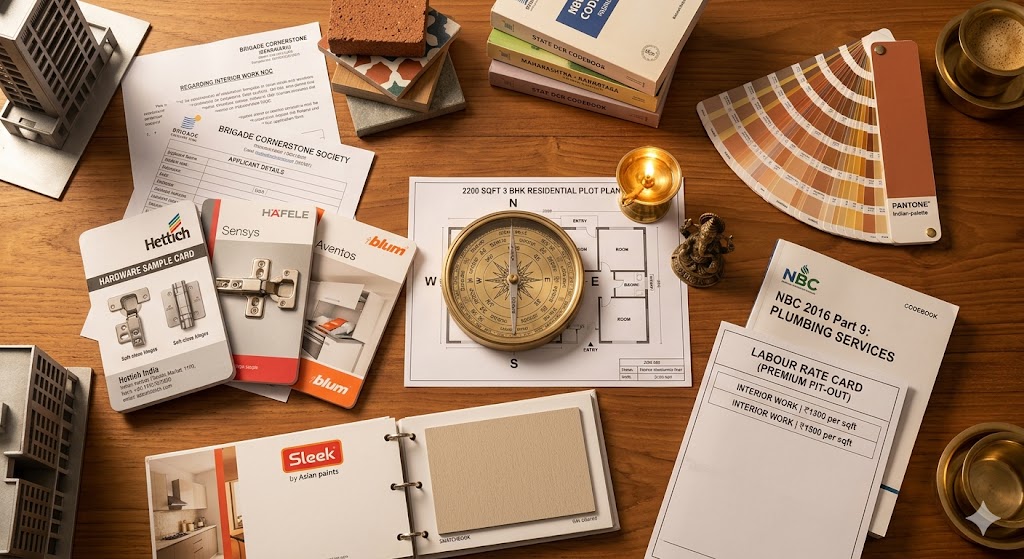
NBC 2016 and IS code touchpoints. The National Building Code 2016 (Part 8, Building Services) governs minimum ceiling heights, electrical safety distances and water/sanitary fittings. Most premium-tier rework — false ceiling drops, additional electrical points, plumbing alterations — must respect a minimum 8'6" finished ceiling height in habitable rooms and the BIS-mandated clearances for electrical and gas. IS 14735 (water service plumbing) is the relevant standard for any plumbing alteration; IS 732 (electrical installations) for the wiring rework. A reputable premium-tier contractor will not need to be reminded of these but it is worth confirming the contract references compliance with the applicable codes.
Society and RWA approvals. Most Grade-A developments mandate prior submission of the fit-out plan with materials list, approval for any plumbing alteration or core-cut, a refundable security deposit (₹50,000–2 lakh typical), defined working hours (commonly 9 am–6 pm, no Sundays), workmen-pass requirements with police verification, and restrictions on noisy work. Budget two to three weeks of calendar time for society approvals before fit-out begins.
DPDP Act 2023 for smart-home elements. If the interior includes smart cameras, smart locks, voice assistants, or app-connected appliances, the DPDP Act 2023 imposes consent and data-handling obligations on the device manufacturer, but the home owner has practical privacy responsibilities too — particularly if domestic help or visitors are recorded. At the premium tier it is increasingly common to (a) keep cameras out of internal living areas and limit them to entry and parking, (b) use a local-network-only smart hub rather than a cloud-only one, and (c) document for the household what is recorded, retained, and shared.
Climate-zone variation. India's five climate zones (per NBC 2016 and ECBC) drive material choices. In hot-dry zones (Delhi NCR, Jaipur, Ahmedabad) prioritise thermal mass and dust resistance — stone-heavy palettes, dust-friendly fabrics. In warm-humid zones (Mumbai, Chennai, Kolkata, Bengaluru, coastal belt) prioritise moisture resistance — HDHMR over MDF, engineered oak over solid teak, mould-resistant paint (Asian Paints Royale Health Shield). In composite climate (Pune, Nashik, parts of Hyderabad), both pressures apply.
Vastu compatibility. Even in the premium tier, where the buyer is often globally exposed and design-literate, Vastu shows up in roughly 60-70 percent of briefs across Bengaluru, Hyderabad, Chennai, Delhi NCR and Pune. The premium-tier resolution is usually: respect the high-leverage Vastu rules (cardinal direction of the master bed, mirror placement, pooja-room orientation, kitchen platform direction) and design freely around them. A good designer at this tier will accommodate Vastu without it dominating the aesthetic, and will not introduce a discordant pooja room into an otherwise minimal apartment — instead opting for a recessed pooja niche, a discreet pooja cabinet in the foyer, or a small dedicated pooja room near the kitchen.
Regional vendor differences. Bengaluru has the deepest pool of premium furniture ateliers (Phantom Hands, Mangrove Collective, Defurn, Stanley Levantro, Sources Unlimited's Indiranagar showroom). Mumbai leads on premium stone and imported material (Bhandari Marble, Classic Marble, Sources Unlimited HQ, Lower Parel design district). Delhi NCR leads on premium hardware and modular kitchen (Hettich India HQ, Hafele India HQ, Sleek Studio flagship, the Kirti Nagar trade hub). Hyderabad and Chennai are largely served by Bengaluru and Mumbai trade. Budget 4-6 weeks extra lead time if specifying an atelier piece outside its home metro.
The Budget Bands for 2026 India
The tier sits within a broader spectrum. The table below covers four bands so you can place your project precisely.
| Tier | Total fit-out (3 BHK, 2000 sqft) | Sqft rate | Wardrobe | Kitchen | Anchor furniture | Typical buyer profile |
|---|---|---|---|---|---|---|
| Entry / builder-overlay | ₹4–7 lakh | ₹200–350/sqft | Developer wardrobes, minor laminate refresh | Developer-supplied | Pepperfry, Urban Ladder mid-range, IKEA | First-time buyer, salaried mid-thirties |
| Budget-luxury | ₹8–14 lakh | ₹400–700/sqft | Premium laminate on plywood, soft-close from Indian brands | Sleek mid-range, Godrej Interio, IFB Cabinets | Westside Home, Pepperfry Studio, Wakefit upper | Salaried late-thirties to mid-forties, urban professional |
| Premium (this guide) | ₹15–40 lakh | ₹700–1,500/sqft | Veneer on HDHMR/BWP, Hettich/Hafele/Blum premium | Sleek Studio, Hacker, Nolte, Stanley Boutique | Phantom Hands, Beyond Designs, Defurn, Mangrove, Sources Unlimited | Dual-income late-thirties to early-fifties, senior corporate / partner-track / founder |
| Super-luxury | ₹50 lakh–₹2 crore+ | ₹2,500–10,000/sqft | Lacquered or imported veneer, full-spec Blum/Salice | Boffi, Poliform, Hacker top line, Bulthaup | Minotti, B&B Italia, Cassina, Molteni | C-suite, founder-exit, family office, HNI |
The 2026 transition between premium and super-luxury is sharper than the transition between budget-luxury and premium. Going from premium to super-luxury roughly triples the cost while delivering perhaps a 25 percent gain in perceived quality — most of the additional spend goes into imported supply chain, designer signature pieces, and concierge-level execution rather than dramatically better materials per se.
A useful rule of thumb: premium apartment interiors typically cost 6 to 10 percent of the apartment's market value. Below 5 percent you are in budget-luxury; above 12 percent you are starting to over-invest relative to the apartment, and the resale-value uplift will be limited unless the apartment itself is in a trophy building.
When Premium Apartment Interiors Are NOT the Right Fit
This tier is not universally correct. Four scenarios where a different approach serves better.
You are buying for short-term hold (under 4 years). If the apartment is being bought primarily as a rental investment, or as a stepping-stone to a villa in 3-4 years, the ₹25 lakh premium fit-out will not be recoverable on resale or rental yield. A budget-luxury fit-out at ₹10 lakh delivers 80 percent of the rental-tenant-attracting effect at 40 percent of the cost.
Your apartment is below 1500 sqft carpet area. Premium-tier specification on a compact apartment runs into diminishing returns — the per-sqft rate is similar or higher, but the small absolute area limits the impact. For sub-1500 sqft apartments, compact luxury apartment covers a more proportionate approach, and the budget tier most apartments at that size can really absorb is closer to ₹10–18 lakh.
The apartment is in a Grade-B or older development. Premium interior on top of a structurally aged shell with leaking common-area plumbing, weak power supply, or persistent water-quality issues is a poor investment. The civil and service rework needed to make the interior premium would add another 30-50 percent to the budget. In these cases either move to a Grade-A development first, or do a budget-luxury fit-out and live with the constraints.
The household has very young children (under 4) and pets. The premium-tier soft-furnishing menu (wool rugs, linen drapes, undyed cotton-linen upholstery) is harder to keep clean than the synthetic-and-leather menu it replaces. For households at peak childcare load with a dog or cat, postpone the premium tier to year 5 or 6 of the children's life.
The 5-Year Trajectory: 2030 Outlook
Three trends will reshape the premium-apartment-interiors tier between 2026 and 2030.
The Indian premium supply chain will close most of the remaining gap to European premium. Already on hardware (Hettich India, Hafele India), modular kitchen (Sleek Studio, Hacker India), and engineered wood (Action Tesa, Square Foot), Indian premium runs at 85-90 percent of European premium quality at 40-50 percent of the cost. Veneer is closing fast. By 2030, the imported share of a typical premium fit-out will likely drop from 25-35 percent to under 15 percent, concentrated in two or three hero moments.
Smart-home spec will become a fifth category alongside flooring, wardrobe, kitchen and lighting. Today smart home is a ₹50,000–3 lakh layer on top of a conventional fit-out. By 2030, voice control, smart switches, mesh Wi-Fi, smart locks, smart cameras and energy monitoring will be specified at design stage, with conduits planned in the false-ceiling phase. Expect ₹2–5 lakh as standard premium smart-home budget by 2030.
Sustainability claims will become specification-grade, not marketing-grade. The current crop of "sustainable" interior options is mostly marketing — opaquely-sourced bamboo, "VOC-free" paint with limited third-party certification, hard-to-trace "FSC-certified" plywood. By 2030, the premium tier will see verified ultra-low-VOC IGBC or GreenPro paint, flooring with documented chain-of-custody, and modular kitchen carcass with declared formaldehyde emission limits (E0 / CARB Phase 2 equivalents common in 2026 imports, reaching Indian manufacture by 2028-2029). See sustainable interiors India for the current state.
Frequently Asked Questions
Q1. What is the difference between premium and luxury apartment interiors in 2026 India?
Premium apartment interiors land in the ₹15-40 lakh fit-out range on a typical 2000-2200 sqft 3 BHK in a Grade-A development, with Indian premium supply chain (Sleek Studio, Hettich, Phantom Hands) and 1-2 European accent pieces. Luxury / super-luxury apartment interiors start at ₹50 lakh and routinely cross ₹1 crore, with substantial European import (Boffi, Minotti, Hansgrohe Axor) and designer-led concierge execution. The aesthetic gap is narrower than the cost gap.
Q2. Is ₹25 lakh enough for a 3 BHK premium interior in 2026?
For a 1800-2200 sqft 3 BHK in a Grade-A Bengaluru, Pune, Hyderabad or Chennai development, ₹25 lakh is firmly within the premium tier and delivers a coherent, ten-year fit-out across all eight specification axes. For Mumbai (where labour rates run 25-30 percent higher) or Delhi NCR (where many imported materials carry a transport premium), the equivalent fit-out lands closer to ₹30 lakh. Add 8-12 percent design fee to either number for the all-in cost.
Q3. How long does a premium apartment interior take to execute?
A typical 1800-2200 sqft premium fit-out runs 12 to 16 weeks from contract signing to handover, assuming society approvals are in place and the design freeze has happened before site work. Premium ateliers like Phantom Hands and Beyond Designs typically need 6-10 weeks of their own lead time and should be ordered at design freeze, not at site handover.
Q4. Should I hire a turnkey contractor or a design firm with an outside contractor?
Both work at the premium tier. A turnkey contractor (someone who quotes per sqft including design) gives you single-throat-to-choke accountability and faster delivery but limits material flexibility. A design firm charging a design fee on top of executed cost, with an outside contractor on a separate contract, gives you more material and vendor flexibility but requires more buyer involvement. For first-time premium-tier buyers, the turnkey route is usually less stressful. For repeat buyers with strong material opinions, the design-firm-plus-outside-contractor route delivers a more bespoke result. See choosing an interior designer India for the deeper comparison.
Q5. What is the right design-fee percentage at this tier?
Independent designers and small studios in 2026 typically charge 8-12 percent of executed cost as design fee at the premium tier. Brand-name studios with magazine reputation (a small set in Bengaluru, Mumbai and Delhi) charge 15-20 percent. Turnkey contractors with in-house design effectively bundle a 5-8 percent design margin into the per-sqft rate. The design fee is worth paying at the premium tier because the material-selection decisions affect total cost by 15-25 percent and the right designer will save more than their fee through better vendor selection.
Q6. Can I use the Studio Matrx tools to plan this myself before bringing in a designer?
Yes — for early-stage scoping. The moodboard builder is useful for converging on a style direction before you brief a designer (a clear moodboard typically cuts the designer's concept-iteration time in half). The furniture planner is useful for checking that the anchor furniture pieces you are considering will actually fit with appropriate clearances. Both are upstream of a designer engagement, not a replacement for one — the premium tier requires hands-on vendor management and site supervision that AI tools cannot deliver in 2026.
Q7. How does the cost vary between Bengaluru, Mumbai and Delhi NCR?
For the same specification, Mumbai typically runs 20-30 percent higher than Bengaluru due to higher labour rates (₹1,800-2,200/sqft vs ₹1,400-1,800/sqft) and material transport costs. Delhi NCR runs 10-15 percent higher than Bengaluru — labour comparable, but many premium materials carry a southbound vs northbound transport differential. Pune is at parity with Bengaluru. The result: a ₹25 lakh Bengaluru fit-out is roughly ₹30-32 lakh in Mumbai and ₹27-29 lakh in Delhi NCR for identical scope.
Q8. Will a premium interior fit-out add value at resale?
In a Grade-A apartment, a premium-tier fit-out typically recovers 40-60 percent of its cost at resale within 3-5 years, and 60-80 percent if sold furnished. It also reduces days-on-market by 30-50 percent, worth another 1-2 percent of asking price in carrying-cost savings. Treat it primarily as use-value investment with partial resale recovery, not as a primary investment thesis.
Q9. Is Vastu-compatible design possible at the premium tier without compromising aesthetics?
Yes — almost every premium-tier designer across Bengaluru, Hyderabad, Chennai, Delhi NCR and Pune in 2026 routinely accommodates Vastu within minimal and contemporary aesthetics. The high-leverage decisions are master-bed cardinal direction, kitchen platform orientation, pooja-room placement, and entrance/mirror positions. Surface Vastu requirements at the brief stage, not after design freeze, when changing direction is expensive.
Q10. What is the right approach for the kids' bedrooms in a premium fit-out?
The most common mistake is over-styling kids' rooms with kid-themed furniture and accent walls that will date within 2-3 years as the child grows. The better premium-tier approach is neutral spec-grade rooms with high-quality storage, neutral wall colour, an engineered-wood floor that wears well, a good study setup, and one or two kid-personality elements (a paint colour on the wardrobe shutter, a rug, a wall-art piece) that can be replaced cheaply every 3-4 years. This keeps the room's bones premium and adaptable while letting the child's personality update on a refresh cycle.
References
1. Knight Frank India. India Real Estate H2 2025: Residential and Office. Mumbai: Knight Frank Research, January 2026.
2. JLL India. Residential Market Outlook 2025. Mumbai: JLL Research India, October 2025.
3. CBRE India. India Residential Market Snapshot: Premium Segment Trends 2024-2025. New Delhi: CBRE Research, December 2025.
4. Anarock Property Consultants. India Residential Report: Premium Housing Demand. Mumbai: Anarock Research, Q4 2025.
5. Bureau of Indian Standards. National Building Code of India 2016, Part 8: Building Services. New Delhi: BIS, 2016 (with 2022 amendments).
6. Bureau of Indian Standards. IS 732: Code of Practice for Electrical Wiring Installations. New Delhi: BIS, 2019.
7. Bureau of Indian Standards. IS 14735: Code of Practice for Water Service in Buildings. New Delhi: BIS, 1999 (with subsequent amendments).
8. Ministry of Electronics and Information Technology, Government of India. Digital Personal Data Protection Act, 2023. New Delhi, August 2023.
9. Bureau of Energy Efficiency, Government of India. Energy Conservation Building Code (ECBC) — Residential 2018. New Delhi: BEE, 2018.
10. India Brand Equity Foundation (IBEF). Indian Real Estate Industry Report. New Delhi: IBEF, December 2025.
11. Magicbricks Research. PropIndex Quarterly Report: Q4 2025. Noida: Magicbricks, January 2026.
12. 99acres Research. Insite Report: Premium Residential Markets in India. Gurugram: 99acres, October 2025.
13. Houzz India. Indian Home Renovation Trends Study 2024-2025. Mumbai: Houzz India, 2025.
14. Indian Green Building Council (IGBC). IGBC Green Homes Rating System Version 3.0. Hyderabad: IGBC, 2020.
15. Confederation of Indian Industry (CII) — Sohrabji Godrej Green Business Centre. GreenPro Ecolabel Standard: Interior Building Materials. Hyderabad: CII-GBC, 2023.
16. Greenlam Industries Limited. Decowood Veneer Technical Catalogue 2025. Noida: Greenlam, 2025.
17. Hettich India. Furniture Hardware Catalogue 2025-26 (Top-line / Quadro / Sensys). Gurugram: Hettich India, 2025.
18. Hafele India. Architectural Hardware Catalogue 2025 (Sensys / Moovit / Aventos India Distribution). Mumbai: Hafele India, 2025.
Related Guides
- apartment interior planning India — upstream planning framework for any apartment interior project
- budget luxury interiors — the tier-below reference at ₹6-12 lakh
- compact luxury apartment — the small-footprint counterpart for under-1500 sqft apartments
- choosing an interior designer India — engagement-model decision-making for the premium tier
- warm minimal interiors — the dominant aesthetic style within the 2026 premium-apartment tier
- japandi apartment — the Japanese-Scandinavian hybrid frequently specified at this tier
Export this guide
Related Guides — Deep-dive reading
Luxury Apartment Design — The ₹2 to ₹15 Crore Tier in Indian Towers (2026)
Super-luxury apartment fit-out · Boffi / Poliform / Minotti · Italian Statuario · Lutron / Crestron
Design StylesPenthouse Design — Top-Floor Luxury in Indian Towers (2026)
DLF Camellias / Lodha Altamount / Oberoi Sky Suites · Private terraces · ₹15-150 crore market
Design StylesThe Design Decisions With the Biggest Cost Consequences
A cost-leverage map of Indian home interiors — the handful of decisions that swing your total budget the most, so you spend your attention where a single choice has an outsized rupee impact.
Cost & MoneyRelated Tools — Try Free
Cross-Ventilation Analyzer
Estimate airflow and air changes per hour (ACH) from room size, window areas, layout, and local wind — with NBC 2016 Part 8 compliance check.
Ventilation CalculatorApartment Interior Planning Checklist
51-item checklist across structural, ceiling, lighting, furniture, storage, electrical, kitchen, bathroom.
ChecklistFalse Ceiling Cost Estimator
Live ₹/sqft across 8 ceiling types — POP, gypsum, designer, metal, PVC, wooden — with cove and spot lighting for 20 Indian cities.
Cost Calculator