

Sustainable Home Electrical: The Efficiency-First Path to a Greener Home
Greening a home's electricity isn't about buying solar first — it's a ladder: reduce the load, use efficient appliances, then generate, store and offset. The hierarchy that gets the most impact per rupee, and how a home's electrical choices shape its carbon footprint.
Ask how to make a home "green" and most people say solar. But solar is step four, not step one. The cheapest, greenest unit of electricity is the one you never use — so a genuinely sustainable home follows a hierarchy: first reduce the demand, then make what's left efficient, then generate clean power, then store and offset it. Skip the early steps and you end up paying to solar-power waste. This guide is the efficiency-first path to a greener home's electricity, and the order that gets the most impact per rupee.
It is the sustainability anchor of the Electrical Knowledge Hub, tying together the energy management, solar and efficiency guides.
The safety line. This guide is about strategy — how to green a home's electricity. The wiring, solar, and any electrical work is a licensed electrician's / installer's job. Sustainability never overrides safety: efficient and safe, always.
The green-electricity ladder
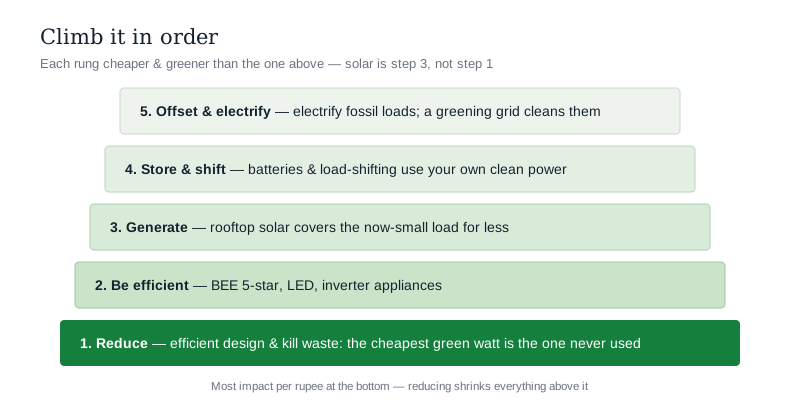
Climb it in order — each rung is cheaper and greener than the one above:
1. Reduce — design out the demand: passive efficient design, good daylight and ventilation, and killing waste (the phantom baseline). The cheapest green watt is the one never needed.
2. Be efficient — for the load that remains, use the most efficient appliances (BEE 5-star, LED lighting, inverter ACs/fridges). Less power for the same comfort.
3. Generate — now that the load is small and efficient, rooftop solar covers more of it for less outlay (a smaller system suffices).
4. Store & shift — batteries and load-shifting use your own clean power and ride time-of-day tariffs.
5. Offset & electrify — electrify remaining fossil uses (cooking, water heating, transport) so a greening grid decarbonises them too.
Why the order matters: reducing and efficiency are cheap and shrink everything above them — a smaller, cheaper solar system then does more. Buying solar for an inefficient home is paying to power waste.
Operational carbon: where a home's emissions come from
A home's electrical carbon footprint is its operational carbon — the emissions from the grid electricity it consumes, since India's grid is still substantially fossil-fuelled:
- Every unit (kWh) you use carries a carbon cost from the grid's generation mix.
- The biggest loads — AC, water heating, refrigeration — dominate the footprint (see energy management).
- Cutting and greening those units is how a home lowers its footprint — estimate yours with the carbon footprint calculator.
As the grid itself gets greener, your electric loads get cleaner automatically — which is why electrifying (rung 5) is a long-term green move.
The frameworks that guide it
Sustainable homes in India are supported by real frameworks worth knowing:
- BEE Standards & Labelling — the star rating that makes efficiency choosable.
- Eco Niwas Samhita (ENS) — BEE's residential building energy code for efficient home design.
- Green-building ratings — IGBC, GRIHA and LEED for homes that want certification.
- Rooftop-solar schemes — PM Surya Ghar and net metering for generation.
These turn "be sustainable" into concrete, ratable actions.
A practical sustainable-electrical plan
1. Design to reduce — orientation, shading, daylight, ventilation, insulation (see efficient design).
2. Specify efficient everything — BEE 5-star big loads, LED lighting, inverter ACs/fridges.
3. Monitor — an energy monitor shows where to cut.
4. Then generate — size rooftop solar to the now-smaller load.
5. Store & shift where it pays; electrify cooking, water heating and transport over time.
6. Aim high if you can — a net-zero home is this ladder taken to its conclusion.
The one-line answer
A sustainable home's electricity follows a hierarchy, in order: first reduce the demand (efficient passive design, killing waste — the cheapest green watt is the one never used), then make the remaining load efficient (BEE 5-star, LED, inverter appliances), then generate clean power with rooftop solar (a smaller system now suffices), then store and shift it, and finally electrify and offset the rest so a greening grid keeps decarbonising your home. Because a home's electrical footprint is the operational carbon of every grid unit it uses, cutting and greening those units — biggest loads first — is what matters. Buying solar for an inefficient home is paying to power waste; climb the ladder in order and you get the most green per rupee.
Where to go next
- Design out the load: Energy-Efficient Home Design Guide.
- The certified path: Green Building Electrical (IGBC/GRIHA) Guide.
- The goal: Net-Zero Energy Home Guide.
- Measure your footprint: Home Carbon Footprint Calculator.
References
- Bureau of Energy Efficiency (BEE) — Standards & Labelling; Eco Niwas Samhita (residential energy code): https://beeindia.gov.in/
- Ministry of New and Renewable Energy (MNRE) — rooftop solar / PM Surya Ghar (verify current terms): https://mnre.gov.in/
- Central Electricity Authority (CO2 Baseline Database for the Indian Power Sector — grid emission factor): https://cea.nic.in/
Emission factors, schemes and codes are published figures that change over time; verify current values with CEA/BEE/MNRE. All electrical and solar work must be done by licensed professionals.
Export this guide
Related Guides — Deep-dive reading
Designing a Naturally Energy-Efficient Indian Home
Comfort first, gadgets last — passive design, orientation, insulation, ventilation and the climate wisdom that cuts Indian energy bills
SustainabilitySmart Home Energy Management in India: Metering, Solar, EV & Load Control
As DISCOM smart meters, time-of-day tariffs, rooftop solar and EV charging arrive together, the Indian home becomes a small power system you can actually manage. A practical, rupee-first guide to seeing, shifting and shrinking your electricity bill.
Smart HomeHome Energy Management: Cut the Bill Without Cutting Comfort
The practical playbook for lowering a home's electricity bill — efficient appliances and the BEE star rating, killing phantom loads, shifting usage to cheaper time-of-day windows, managing peak demand, and the power-quality issues that quietly cost you.
Electrical & WiringRelated Tools — Try Free
Cross-Ventilation Analyzer
Estimate airflow and air changes per hour (ACH) from room size, window areas, layout, and local wind — with NBC 2016 Part 8 compliance check.
Ventilation CalculatorBrise-Soleil Visualizer
Interactive horizontal-louvre cut-off angle calculator — sun altitude, louvre depth, and spacing inputs with a live shadow preview. Computes θ = arctan(spacing/depth) for façade shading, ECBC envelope compliance, hospital daylight design, and tropical sun-control detailing.
Sun Shading ToolElectrical Safety & Load Audit
Home electrical audit — 10 categories, 65+ checkpoints across earthing, RCCB, MCB, wiring, switchboards, appliance circuits, DG/inverter backup.
Safety Audit