
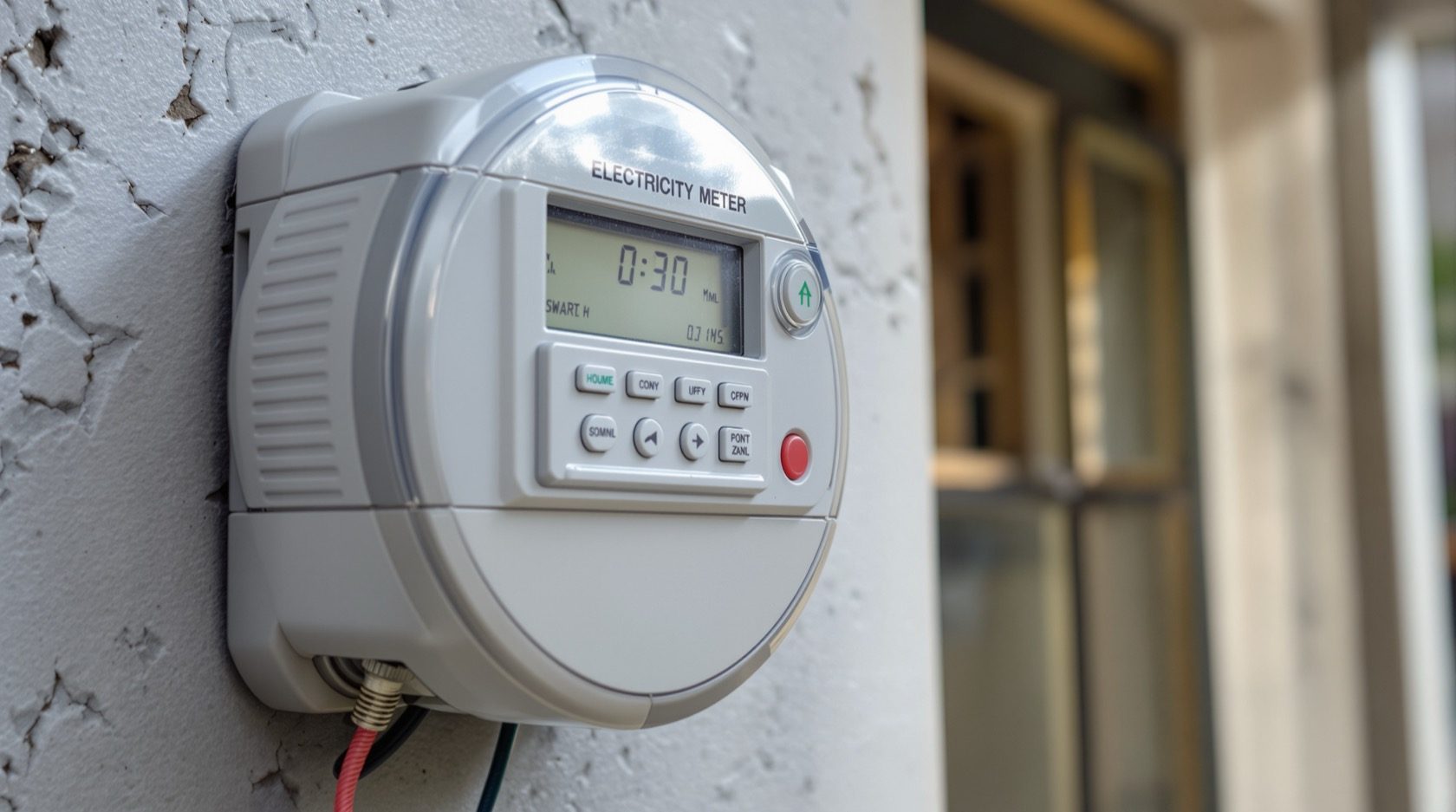
Smart Meters in India: What They Are & What They Mean for You
The utility meter that talks back — how smart meters work, the prepaid and remote-reading features, India's big rollout under the RDSS scheme, time-of-day tariffs and what they mean for your bill, and how smart meters interact with rooftop solar and net metering.
The humble electricity meter is being replaced across India by a smart meter — a digital meter that communicates with the utility, is read remotely, can be recharged like a phone, and can enable time-varying tariffs. It's part of one of the country's largest infrastructure programmes, and it changes how you pay for and think about electricity. This guide explains what smart meters are, what they mean for a homeowner, and how they interact with rooftop solar — without the hype or the fear.
It sits under the home energy management guide and complements home energy monitoring.
The safety line & scope. The smart meter is the DISCOM's equipment, installed by the utility — not something you buy or wire. This guide is an orientation to what it means for you. Smart meters conform to IS 16444. Scheme and tariff details are state-specific and evolving — verify current terms with your DISCOM.
What a smart meter is
A smart meter is a digital energy meter with two-way communication. Beyond measuring your units like the old meter, it:
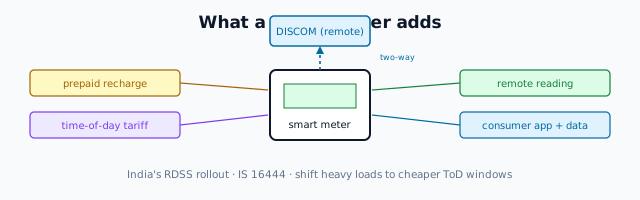
- Reports readings remotely to the utility — no meter reader, no estimated bills, accurate billing.
- Can be prepaid — recharge a balance like a mobile phone, and top up online; consumption draws down the balance.
- Enables time-of-day (ToD) tariffs — different rates at different times of day, because it records when you use power, not just how much.
- Detects outages and tampering and gives the utility better grid visibility.
- Gives you data — many come with an app/portal showing your consumption, helping you manage usage.
It is made to IS 16444 (Part 1 for direct-connected, Part 2 for transformer-operated smart meters).
India's rollout
India is deploying smart meters at large scale, primarily under the Revamped Distribution Sector Scheme (RDSS) of the Ministry of Power, aiming to modernise distribution, cut losses and enable prepaid, accurate billing. The rollout is DISCOM-led and phased, varying by state, so whether and when your home gets one — and the exact prepaid/tariff arrangements — depend on your utility. This is a fast-moving, state-specific area: verify the current status and terms with your DISCOM rather than assuming.
Time-of-day tariffs: the real change for your bill
The feature with the biggest potential impact is the time-of-day (ToD) tariff — electricity costing more at peak hours and less off-peak. India is moving toward ToD tariffs (with solar-hour and peak-hour rates), which a smart meter makes possible. For a homeowner, this creates an opportunity and a discipline:
- Shift heavy loads — running the washing machine, geyser, pump or EV charger in cheaper windows (often solar-rich daytime hours or off-peak night) can cut the bill.
- Avoid peak-hour heavy use where the rate is highest.
- This is exactly the kind of load-shifting the energy management guide covers — and a smart meter is what makes the price signal visible.
Where ToD applies, when you use power starts to matter as much as how much — a genuine behaviour lever.
Smart meters and rooftop solar
If you have (or plan) rooftop solar, the smart-meter interaction matters:
- Net metering needs a bidirectional meter that measures both import and export — smart meters can do this, tallying your solar surplus as credit.
- ToD tariffs plus solar reward using your own solar in the day and shifting loads into solar hours.
- The exact net-metering and smart-meter arrangement is state- and DISCOM-specific — confirm how your utility handles solar with a smart meter.
Common concerns, honestly
- "Prepaid means I'll be cut off" — prepaid smart metering usually includes safeguards (low-balance alerts, grace, and rules against disconnection at odd hours); check your DISCOM's policy.
- Accuracy — smart meters are accurate metering instruments to IS 16444; disputes are far rarer than with estimated readings, and you can see your own data.
- Privacy/data — consumption data is handled under the utility's and applicable data rules; a reasonable concern to be aware of, not a reason for alarm.
The honest position: smart meters are a net positive for accurate billing and give you data and tariff opportunities — with the details depending on your state's rollout and rules.
The one-line answer
A smart meter is a digital, two-way-communicating electricity meter that the DISCOM reads remotely, that can be prepaid like a phone, and that enables time-of-day tariffs — being rolled out across India at scale under the RDSS scheme, state by state. Its biggest practical effect for you is the ToD tariff, which rewards shifting heavy loads to cheaper windows, and its interaction with rooftop solar (bidirectional net metering). It's the utility's equipment to IS 16444; verify your state's prepaid, tariff and solar terms with your DISCOM, and use the data and price signals to manage your bill.
Where to go next
- Managing your consumption: Home Energy Management Guide.
- Seeing where power goes: Home Energy Monitoring Guide.
- Solar and net metering: Rooftop Solar Guide.
- Estimate appliance costs: Appliance Running Cost Calculator.
References
- IS 16444 : Part 1 : 2015 and Part 2 : 2017, AC Static Watthour Smart Meter — Specification, Bureau of Indian Standards.
- Ministry of Power, Revamped Distribution Sector Scheme (RDSS) — smart metering (verify current status): https://powermin.gov.in/
- Time-of-Day tariff and net-metering regulations — your State Electricity Regulatory Commission / DISCOM (state-specific).
Smart-meter rollout, prepaid rules, ToD tariffs and net-metering terms are state-specific and evolving; verify current terms with your DISCOM. Verify any standard's status via the BIS catalogue before relying on it.
Export this guide
Related Guides — Deep-dive reading
Smart Home Energy Management in India: Metering, Solar, EV & Load Control
As DISCOM smart meters, time-of-day tariffs, rooftop solar and EV charging arrive together, the Indian home becomes a small power system you can actually manage. A practical, rupee-first guide to seeing, shifting and shrinking your electricity bill.
Smart HomeHome Energy Management: Cut the Bill Without Cutting Comfort
The practical playbook for lowering a home's electricity bill — efficient appliances and the BEE star rating, killing phantom loads, shifting usage to cheaper time-of-day windows, managing peak demand, and the power-quality issues that quietly cost you.
Electrical & WiringRooftop Solar Approvals & Net Metering in India: The Permissions You Actually Need
The approvals side of putting solar on an Indian roof — not how solar works, but the permissions: the DISCOM net-metering application and feasibility, an empanelled installer, the structural load check, the electrical safety inspection, the PM Surya Ghar subsidy, and metering and commissioning. These are DISCOM, state and MNRE rules — not one national IS code — so amounts and caps change; always confirm the current rule locally.
RoofingRelated Tools — Try Free
Cross-Ventilation Analyzer
Estimate airflow and air changes per hour (ACH) from room size, window areas, layout, and local wind — with NBC 2016 Part 8 compliance check.
Ventilation CalculatorElectrical Safety & Load Audit
Home electrical audit — 10 categories, 65+ checkpoints across earthing, RCCB, MCB, wiring, switchboards, appliance circuits, DG/inverter backup.
Safety AuditSolar Sizing Calculator
Size a rooftop solar system from your monthly electricity use — the kW system, number of panels, roof area and yearly generation.
Solar