
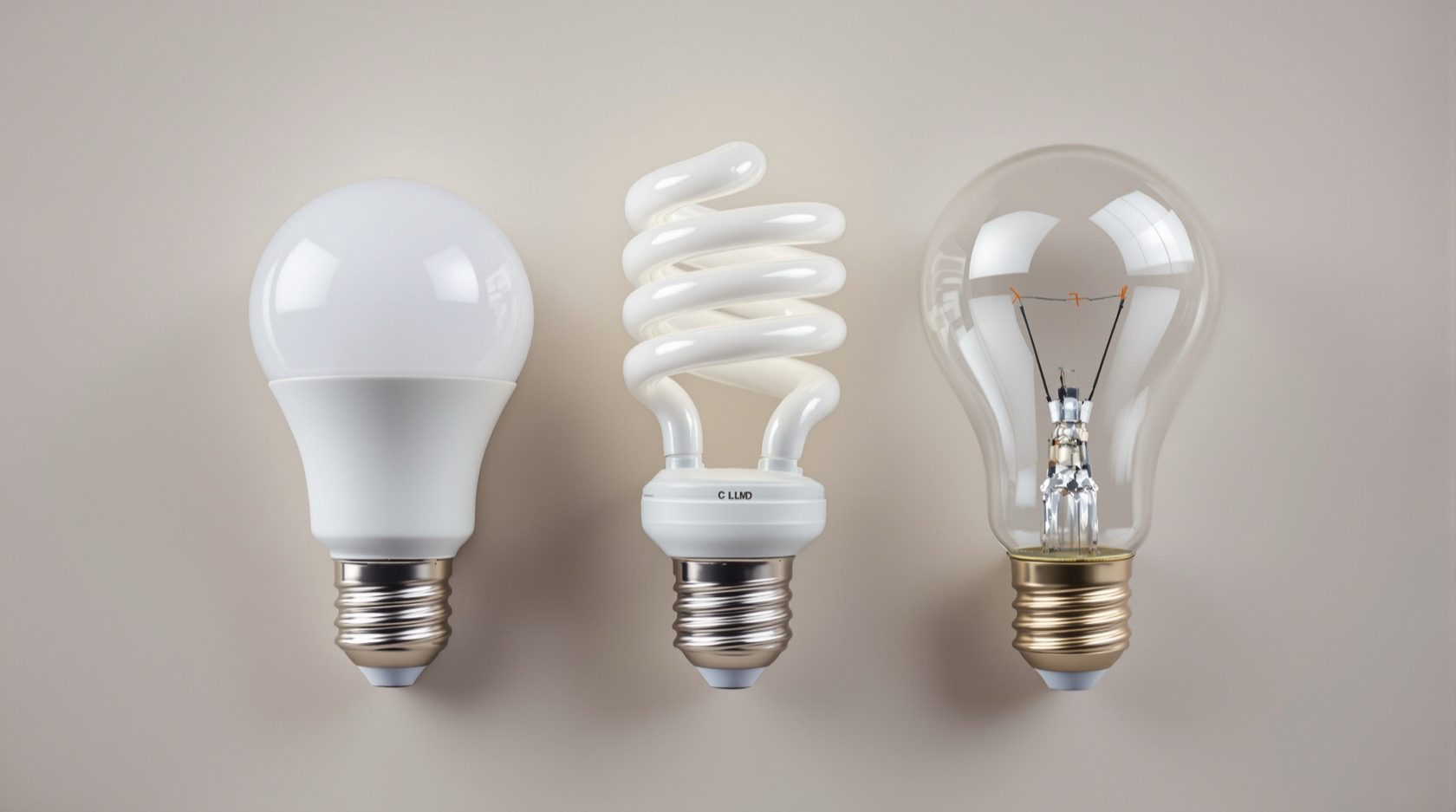
LED vs CFL vs Incandescent: The Home Lighting Comparison
The easiest money a home can save — a clear comparison of LED, CFL and the old incandescent bulb on energy use, lifespan, light quality and running cost, and why, in 2026, LED wins decisively for almost every home fitting.
Few home upgrades pay back as fast, or as certainly, as switching to LED lighting. Yet the choice between LED, CFL and the old incandescent bulb still confuses people — partly because CFLs were themselves sold as the "energy-saving" bulb not long ago. This guide settles it plainly: how the three compare on energy use, lifespan, light quality and running cost, and why LED now wins decisively for almost every home fitting in India.
It is the lighting comparison in the Electrical Knowledge Hub, condensing the LED lighting and lighting design guides into one decision.
The safety line. Bulbs you can change yourself; fixed wiring, fittings and circuits are a licensed electrician's work. Buy quality ISI-marked LEDs (to IS 16102) for the best life and light.
At a glance
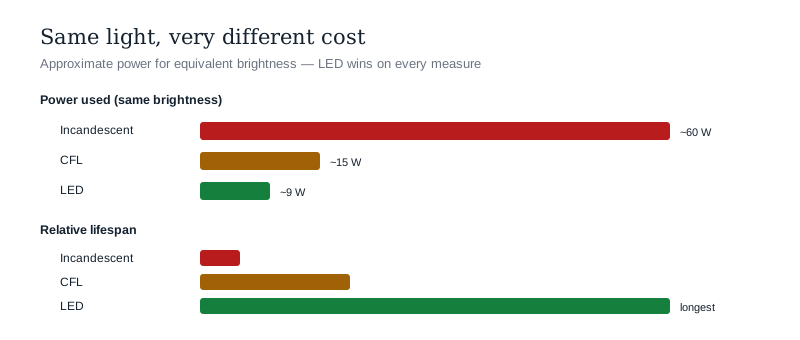
For roughly the same brightness (light output):
| Incandescent | CFL | LED | |
|---|---|---|---|
| Power used | Highest | Medium | Lowest |
| Lifespan | Shortest | Medium | Longest |
| Efficiency | Very poor (mostly heat) | Better | Best |
| Instant full brightness | Yes | Often warms up | Yes |
| Contains mercury | No | Yes (small) | No |
| Running cost | Highest | Medium | Lowest |
| Verdict (2026) | Obsolete | Superseded | The default |
The short version: for the same light, LED uses the least power, lasts the longest, and costs the least to run.
Incandescent — obsolete
The traditional incandescent bulb:
- Wastes most of its energy as heat, not light — very inefficient.
- Shortest lifespan of the three.
- Highest running cost by far.
- Effectively obsolete — there's no good reason to buy one for general lighting today.
CFL — the superseded middle
The compact fluorescent lamp was the previous "energy-saver":
- Much better than incandescent — less power, longer life.
- But beaten by LED on every count — LED uses less power still and lasts longer.
- Downsides — many warm up to full brightness, dislike frequent switching, and contain a small amount of mercury (careful disposal).
- Superseded — LED has overtaken CFL, which is now being phased out of relevance.
LED — the clear winner
The light-emitting diode bulb is today's default:
- Lowest power for a given brightness — the biggest running-cost saving.
- Longest lifespan — many years, far fewer replacements.
- Instant full brightness, tolerates frequent switching, no mercury.
- Available in every colour temperature (see colour temperature & CRI), many dimmable, and in every fitting type.
- The right choice for essentially every home light — see the LED lighting guide.
The running-cost case
The saving is real and fast:
- An LED uses a fraction of the power of an incandescent (and clearly less than a CFL) for the same light — so on a bulb burning several hours a day, the electricity saved quickly exceeds the price difference.
- Multiply across a whole home of bulbs and the yearly saving is substantial.
- Fewer replacements add to the saving and the convenience.
- See exactly how much with the LED savings calculator — it's usually one of the fastest paybacks in the home.
The one-line answer
For the same brightness, LED beats both CFL and incandescent on every measure that matters — it uses the least power, lasts the longest, reaches full brightness instantly, contains no mercury, and costs the least to run. The incandescent bulb is obsolete (mostly heat, short life, high cost); the CFL was a step up but is now superseded by LED on power, life and convenience. In 2026 the decision is simple: fit quality ISI-marked LEDs (to IS 16102) in essentially every home light, choosing the colour temperature to suit each room — it's one of the fastest, most certain paybacks a home offers.
Where to go next
- LED in depth: LED Lighting Guide.
- Getting the light colour right: Colour Temperature & CRI Guide.
- Design the whole scheme: Home Lighting Design Guide.
- See your saving: LED Savings Calculator.
References
- IS 16102 : Part 1 : 2026 (Safety) and Part 2 : 2026 (Performance), Self-Ballasted LED Lamps for General Lighting Services, Bureau of Indian Standards.
- Bureau of Energy Efficiency (BEE), Standards & Labelling programme (star rating): https://beeindia.gov.in/
- IS 732 : 2019, Code of Practice for Electrical Wiring Installations, BIS.
Savings depend on wattages, hours of use and tariff; figures are indicative. Buy quality ISI-marked LEDs to IS 16102; fixed wiring and fittings are a licensed electrician's work. Verify any standard's status via the BIS catalogue before relying on it.
Export this guide
Related Guides — Deep-dive reading
Security Comparison Guide (2026): How to Weigh Any X vs Y Security Choice in India
The master decision framework for comparing security options in India — how to weigh any head-to-head choice across need, cost, performance, reliability, privacy, ease, scalability, maintenance and code, so your context decides the winner rather than a salesperson.
SecurityThe Homeowner's Guide to Lighting Your Home: Start to Finish (2026)
The warm, plain-English capstone for the whole Lighting hub - how to light an Indian home from empty to done, in the order things actually happen, with the one rule that saves you the most money: decide the whole scheme before the electrician wires.
LightingCopper vs CPVC Pipes: Which to Use in India (2026)
A fair, India-first head-to-head: copper is the premium, decades-lasting, heat-proof metal that needs a skilled brazier and costs a fortune; CPVC is the cheaper, corrosion-proof, DIY-friendly plastic that has become the default modern Indian supply pipe. Cost, lifespan, heat, install skill, water quality, theft — and a clear verdict by use-case.
PlumbingRelated Tools — Try Free
Electrical Safety & Load Audit
Home electrical audit — 10 categories, 65+ checkpoints across earthing, RCCB, MCB, wiring, switchboards, appliance circuits, DG/inverter backup.
Safety AuditRoom Lighting Calculator
Estimate the target lux, total lumens and number of LED fixtures a room needs, from its type and size — a general-illumination planning guide.
LightingDesign Style Finder Quiz
Answer 10 visual questions to discover your Indian interior style profile with materials and colours.
Interactive Quiz