
Home Energy Management: Cut the Bill Without Cutting Comfort
The practical playbook for lowering a home's electricity bill — efficient appliances and the BEE star rating, killing phantom loads, shifting usage to cheaper time-of-day windows, managing peak demand, and the power-quality issues that quietly cost you.
Every home wants a lower electricity bill — but the advice is usually vague ("switch off lights") or expensive ("install solar"). This guide is the practical middle: the specific, mostly-free-to-cheap actions that genuinely cut a home's electricity bill without cutting comfort. It ties together efficiency, behaviour, timing and a few technical points into a playbook you can actually follow, grounded in how Indian tariffs and appliances really work.
It is the energy anchor of the smart/energy cluster, drawing on energy monitoring, smart meters and efficient lighting.
The safety line. The measures here are about how you use electricity — appliance choices, habits, timing. Anything involving wiring, the distribution board, power-factor correction or capacitors is a licensed electrician's job. This guide helps you manage consumption, not modify the installation.
Where a home's electricity actually goes
Before cutting, know the targets. In most Indian homes, the big consumers are, roughly in order:
- Air-conditioning — usually the single largest load in AC-using homes.
- Water heating (geysers) — resistive heating is power-hungry.
- Refrigeration — modest power but runs 24×7, so it adds up.
- Lighting and fans — small per unit but numerous.
- The "phantom" baseline — everything on standby, chargers, set-top boxes, idle electronics running around the clock.
Energy monitoring shows your actual split; but knowing the usual suspects tells you where effort pays.
Lever 1: Efficiency — the BEE star rating
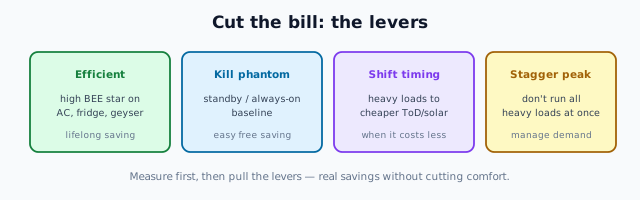
The biggest structural lever is efficient appliances, and India's tool for this is the Bureau of Energy Efficiency (BEE) star rating — more stars means less power for the same work:
- A 5-star AC can use roughly a third less energy than a 1-star one over its life — on the largest load, that's a big saving.
- Inverter (variable-speed) ACs and refrigerators modulate rather than cycle on/off, saving more.
- Efficient fans (including BLDC-motor fans) use far less than old fans.
- LED lighting (from the LED guide) is a fraction of old bulbs.
Efficiency is a one-time decision with lifelong savings — buy the highest star rating you can afford on the big loads (AC, fridge, geyser), where it matters most.
Lever 2: Kill the phantom baseline
The always-on load is invisible and constant — and easy to cut:
- Switch off at the wall (or unplug) devices on standby: TVs, set-top boxes, chargers, idle electronics.
- Use switched sockets and smart plugs to cut power to device clusters when not in use, or schedule them off overnight.
- A phantom baseline running 24×7 costs far more over a year than its small wattage suggests — killing it is one of the easiest real savings.
Lever 3: Timing — shift to cheaper windows
With smart meters and time-of-day (ToD) tariffs spreading, when you use power increasingly affects the bill:
- Run heavy, flexible loads in cheaper windows — washing machine, dishwasher, geyser, water pump, EV charging — often the solar-rich daytime or off-peak night rate.
- Avoid peak-hour heavy use where the rate is highest.
- Even without ToD, running your water pump and heavy loads thoughtfully (and using timers) helps.
- With rooftop solar, shift loads into solar-generation hours to use your own free power.
Lever 4: Manage peak demand
Your maximum demand (the most power you draw at once) can matter for your sanctioned load and, in some tariffs, your charges:
- Stagger heavy loads — don't run the AC, geyser, microwave and iron all at once; spreading them lowers peak demand and avoids tripping.
- This also means you can often manage with a sensible sanctioned load rather than paying for a large one.
Lever 5: Power quality (the technical one)
A few electrical issues quietly cost money or damage appliances — and these are the electrician's domain:
- Voltage fluctuations — low or unstable voltage stresses and shortens appliance life; a stabiliser (or a voltage-managing inverter) protects sensitive/heavy appliances where the supply is poor.
- Power factor — mostly a concern for commercial/industrial tariffs (where poor power factor is penalised), less so for typical domestic flat-rate billing, but relevant for larger homes and covered by the electrician if needed.
- A healthy installation — good connections, correct sizing and no faults — wastes less as heat.
A simple energy-management plan
1. Measure — get a rough picture (bill + optional monitor) of where power goes.
2. Efficient big loads — highest BEE star rating on AC, fridge, geyser; LED everywhere.
3. Kill the phantom baseline — switch off/unplug standby loads; smart plugs to automate it.
4. Shift the timing — heavy flexible loads into cheaper (ToD/solar) windows; avoid peak.
5. Stagger heavy loads to manage peak demand.
6. Protect with a stabiliser where the supply is poor.
7. Consider solar for a structural cut (see the rooftop solar guide).
Done together, these cut a meaningful slice of the bill without sacrificing comfort — which is the whole point.
The one-line answer
Cut a home's electricity bill without cutting comfort by pulling five levers: buy efficient, high-BEE-star appliances on the big loads (AC, fridge, geyser) where it matters most; kill the always-on phantom baseline of standby devices; shift heavy flexible loads to cheaper time-of-day or solar windows; stagger heavy loads to manage peak demand; and protect power quality (a stabiliser where supply is poor) — measuring with an energy monitor to target the effort. Together these deliver real, lasting savings, with rooftop solar as the bigger structural step.
Where to go next
- See where power goes: Home Energy Monitoring Guide.
- The tariff enabler: Smart Meters Guide.
- Efficient lighting: LED Lighting Guide.
- The structural cut: Rooftop Solar Guide.
- Estimate a device's cost: Appliance Running Cost Calculator.
References
- Bureau of Energy Efficiency (BEE), Standards & Labelling (star rating) programme: https://beeindia.gov.in/
- IS 16444 (Parts 1 & 2), AC Static Watthour Smart Meter (time-of-day metering), Bureau of Indian Standards.
- Time-of-Day tariff regulations — your State Electricity Regulatory Commission / DISCOM (state-specific).
- Energy Conservation Act, 2001 and Energy Conservation Building Code (efficiency framework): https://beeindia.gov.in/
Savings are indicative and depend on your usage, tariff, appliances and actions; tariff structures are state-specific and evolving. Any wiring, stabiliser or power-factor work must be done by a licensed electrician. Verify any standard's status via the BIS catalogue before relying on it.
Export this guide
Related Guides — Deep-dive reading
Smart Home Energy Management in India: Metering, Solar, EV & Load Control
As DISCOM smart meters, time-of-day tariffs, rooftop solar and EV charging arrive together, the Indian home becomes a small power system you can actually manage. A practical, rupee-first guide to seeing, shifting and shrinking your electricity bill.
Smart HomeResidential Electrical Systems: The Complete Guide for Indian Homes
How the electricity in an Indian home actually works — from the utility supply and meter through the distribution board, circuits, wiring, earthing and protection, to lighting, safety, energy efficiency, smart controls, solar and backup — written so a homeowner can understand, plan and judge it, and know exactly where a licensed electrician must take over.
Electrical & WiringHVAC Energy Efficiency: Cutting the Biggest Energy Bill in the Building
HVAC often runs half a building's electricity, so trimming it saves the most — the practical measures that cut HVAC energy without cutting comfort: right-sizing, inverter and efficient plant, smart controls and zoning, recovery, good maintenance and sensible set-points.
HVAC & CoolingRelated Tools — Try Free
Electrical Load Calculator
Estimate a home's connected load and realistic maximum demand from its appliances, whether it needs single or three-phase supply, and a suggested main switch rating.
ElectricalRainwater Tank Sizer
How big should your rainwater tank be? Computes annual harvest, recommended tank capacity in litres, water-bill savings, and payback — for 10 Indian cities.
RWH CalculatorSolar Sizing Calculator
Size a rooftop solar system from your monthly electricity use — the kW system, number of panels, roof area and yearly generation.
Solar