
Solar Battery Storage: Is It Worth It for Your Home?
The battery that lets you use your solar power after dark and ride through outages — how solar storage works, why lithium (LFP) suits it, how it is sized, the honest economics of whether storage pays, and when a home genuinely benefits.
Rooftop solar makes power when the sun shines — but your home also needs power at night, and a plain grid-tied system can't help during an outage. A solar battery solves both: it stores your surplus solar energy so you can use it after dark, and it keeps essential loads running through a power cut. The catch is cost — storage adds a significant expense — so the real question is not can you add a battery, but should you. This guide gives the honest answer.
It sits under the rooftop solar guide and the grid-tied vs off-grid guide, and relates to the inverter battery types guide.
The safety line. Solar storage — the battery, the hybrid inverter and its integration — is designed and installed by a qualified solar installer and licensed electrician. Lithium batteries need a proper battery management system (BMS) and correct installation. This guide helps you decide and plan; the work is professional.
What solar storage does
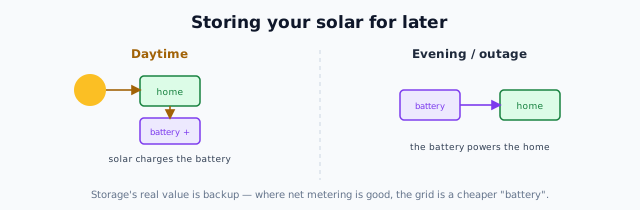
In a plain grid-tied system, surplus solar is exported to the grid during the day (for net-metering credit) and you import from the grid at night. A battery changes that: it stores the daytime surplus so your home uses its own solar in the evening instead of buying from the grid — and, crucially, it can power essential loads during an outage, which grid-tied solar alone cannot.
So a battery does two distinct jobs: time-shift solar energy from day to night (using more of your own generation), and provide backup during power cuts. Which of those matters to you shapes whether — and how big — a battery is worth.
Why lithium suits solar
Solar storage is increasingly lithium (LFP — lithium iron phosphate) rather than lead-acid, because solar cycles a battery daily (charge every day, discharge every evening), and lithium handles that far better:
- Long cycle life — many more daily charge-discharge cycles than lead-acid, so it lasts the years that make storage economic.
- Deep usable capacity — you can use most of its rated capacity, unlike lead-acid.
- High efficiency and compact — less energy lost, wall-mountable, no watering.
- Cost — higher upfront than lead-acid, but its long life and deep usability make it the sensible choice for daily solar cycling. (Lead-acid, from the battery types guide, suits occasional inverter backup better than daily solar cycling.)
Sizing storage
Solar batteries are sized in kilowatt-hours (kWh) of usable energy, to what you want them to do:
- For evening use: enough to cover your evening/night consumption from stored solar — sized to how many units you use after sunset.
- For backup: enough to run your essential loads (lights, fans, fridge, Wi-Fi) for the outage duration you want to cover — the same essential-loads thinking as any backup system.
- Don't oversize: a battery bigger than your evening use or backup need sits half-empty and wastes money. Size to the job.
A hybrid inverter manages the panels, battery and grid together. The solar sizing calculator helps estimate the panel side; battery sizing to your evening/backup need is best confirmed with an installer.
The honest economics: is storage worth it?
This is where honesty matters, because storage is often oversold:
- Storage adds significant cost and, purely on savings, often pays back slower than the panels themselves — especially where net metering already lets you "store" surplus in the grid for credit at a good rate. If your DISCOM's net metering is favourable, the grid is a cheaper "battery" than a physical one for time-shifting.
- Storage's real value is backup — running through the frequent power cuts common in India, which net metering and plain grid-tied solar cannot do. If outages are a genuine daily pain, that resilience is worth paying for.
- The economics improve where net-metering terms are poor (so self-consumption is more valuable), electricity tariffs are high, or you specifically need outage resilience.
The honest rule: add solar storage for backup and resilience, not primarily for savings. If your main goal is to cut the bill and net metering is decent, the panels alone (grid-tied) give the best return; add a battery when riding through power cuts, or poor net metering, justifies the cost.
When a home genuinely benefits
- Frequent, disruptive power cuts: yes — storage (hybrid solar) keeps you running when the grid fails.
- Poor or no net metering in your state: yes — self-consuming stored solar beats exporting it for little.
- You want energy independence / resilience: yes — that's what storage buys.
- Reliable grid + good net metering + goal is savings: often no — grid-tied solar without a battery gives the best payback; the grid stores your surplus for you.
The one-line answer
A solar battery stores your daytime surplus for evening use and — unlike grid-tied solar alone — keeps essential loads running through a power cut, with lithium (LFP) the right chemistry for daily solar cycling. Size it in kWh to your evening consumption and/or the essential loads and outage you want covered, not bigger. But be honest about the economics: storage's real value is backup and resilience, not savings — where net metering is decent, the grid is a cheaper "battery" and grid-tied panels alone pay back fastest, so add storage when frequent outages or poor net metering justify the cost.
Where to go next
- The full solar picture: Rooftop Solar Guide.
- The system-type choice: Grid-tied vs Off-grid vs Hybrid.
- Non-solar backup: Home Backup Power Guide.
- Battery basics: Inverter Battery Types.
References
- IS 16221 (Parts 1–3, IEC 62109), Safety of Power Converters for Use in Photovoltaic Power Systems, Bureau of Indian Standards.
- Ministry of New and Renewable Energy (MNRE) rooftop solar and storage programmes: https://mnre.gov.in/
- PM Surya Ghar: Muft Bijli Yojana (verify current terms): https://pmsuryaghar.gov.in/
- Your State DISCOM net-metering regulations (state-specific).
Storage costs, payback and net-metering terms are indicative and vary widely by state, tariff and time; verify current terms. Design and installation must be by a qualified installer and licensed electrician. Verify any standard's status via the BIS catalogue before relying on it.
Export this guide
Related Guides — Deep-dive reading
Hybrid Solar System Guide for Indian Homes: Solar Plus Battery Backup (2026)
A design and specification guide to the hybrid solar system -- grid-connected solar with a battery that keeps critical loads running through a cut. How it works, how it differs from pure on-grid and off-grid, the components, sizing the battery, the trade-offs, and when hybrid beats an on-grid system with a separate inverter.
Solar & EnergyRooftop Solar for Indian Homes: The Complete Guide
How rooftop solar actually works and pays back — the panels, inverter and net meter, the on-grid, off-grid and hybrid choice, how much roof and money a system needs, the PM Surya Ghar subsidy and net metering, and how to judge a good installation.
Electrical & WiringGrid-Tied vs Off-Grid vs Hybrid Solar: Which to Choose
The decision that shapes your whole solar system — grid-tied for best payback, off-grid for independence, or hybrid for both plus outage backup. How each works, the inverter each needs, why grid-tied solar shuts off in a power cut, and how to choose for an Indian home.
Electrical & WiringRelated Tools — Try Free
Solar CCTV Sizing Calculator
Enter cameras, sun-hours and backup days to get the solar panel wattage, battery Ah and an indicative kit cost for an off-grid camera.
Solar SizingInverter & Battery Calculator
Size a home inverter (VA) and battery (Ah) for the load you want to back up and the hours of backup you need.
Backup PowerSecurity Backup Power Calculator
Size a UPS/inverter and battery to keep CCTV, NVR, router and alarm running through a power cut — load, Ah, VA and cost.
Backup Power