
Smart Home Energy Management in India: Metering, Solar, EV & Load Control
As DISCOM smart meters, time-of-day tariffs, rooftop solar and EV charging arrive together, the Indian home becomes a small power system you can actually manage. A practical, rupee-first guide to seeing, shifting and shrinking your electricity bill.
For decades the Indian home's relationship with electricity was one-way and invisible: power came in, the disc spun, and a bill arrived at the end of the month with a number you could argue about but never explain. That is ending. Four changes are landing at once — DISCOM smart meters rolling out nationwide, time-of-day tariffs that price power differently by the hour, affordable rooftop solar under national schemes, and EV charging that can double a home's load overnight. Together they turn the home from a passive consumer into a small power system with a dashboard, a battery, its own generation and choices about when to run what.
This is the money chapter of the smart home. Where the smart HVAC and climate guide tackled the biggest single load, this guide zooms out to the whole meter: seeing where every unit goes, generating your own, storing it, and shifting flexible loads into the cheapest hours. If you are new to the topic, anchor first with the ultimate guide to smart homes in India; then come back here, because energy management is where the smart home stops being a convenience and starts being an investment.
You cannot cut a bill you cannot see. The first upgrade in energy management is not solar or a battery — it is a meter that tells you the truth, hour by hour.
Why energy management matters now
Two forces make this urgent. First, tariffs are rising and, more importantly, becoming time-varying: regulators are pushing Time-of-Day (ToD) tariffs where evening peak power costs a premium and solar-hour or night power is discounted. Second, the loads themselves are getting bigger and more flexible — an EV, a heat-pump geyser, a second AC — which means when you run them now changes the bill as much as whether you run them.
| Driver | What is changing | Why it matters to your bill |
|---|---|---|
| DISCOM smart meters | Prepaid, remote, interval metering rolling out under RDSS | Enables ToD billing and near-real-time consumption data |
| Time-of-Day tariffs | Peak hours priced higher, solar/night hours lower | Same energy, different cost by hour — shifting saves money |
| Rooftop solar | PM Surya Ghar subsidy makes systems affordable | Self-generated units offset the most expensive grid units |
| EV adoption | Home charging adds 5 to 12 kWh a night | A large, flexible load that must be timed, not just plugged in |
| Battery storage | Falling lithium prices, hybrid inverters | Store cheap or solar energy, use it at peak |
The thread running through all five: flexibility has value. A home that can see its energy and shift its flexible loads captures the difference between the cheapest and most expensive hours — money a passive home simply pays.
Smart metering and DISCOM smart meters
Under the national Revamped Distribution Sector Scheme (RDSS), DISCOMs across India are replacing old meters with smart prepaid meters that record consumption in intervals and communicate it back automatically. For the homeowner this brings prepaid balance visibility, remote readings and — the important part — the interval data that makes ToD tariffs possible. State DISCOMs like BESCOM in Karnataka, MSEDCL in Maharashtra, Tata Power and BSES/Adani in Delhi are at different stages of rollout, but the direction is national and one-way.
The catch: the DISCOM smart meter tells the utility a lot and the homeowner relatively little in real time — the app data is often delayed and coarse. That gap is exactly why a homeowner adds their own monitoring behind the meter, which sees consumption second-by-second and per-circuit.
Whole-home energy monitoring
The single most useful energy upgrade — before solar, before batteries — is a device that clamps onto your incoming mains and shows total household draw in real time. These use a CT (current transformer) clamp around the main cable and a small Wi-Fi module. The names sold or usable in India include Sense, Shelly EM / 3EM, and inverter-brand monitors; many hybrid solar inverters also include whole-home monitoring built in.
What you gain is visibility that changes behaviour: you see the 2 kW jump when the geyser fires, the phantom 150 W that never sleeps, the moment both ACs and the EV overlap and threaten your sanctioned load. That last point matters in India, where exceeding your sanctioned kW can trip the mains or attract penalties — a monitor with alerts is cheaper than an upgrade to your connection.
| Monitoring level | Device type | Cost | What it tells you |
|---|---|---|---|
| Whole-home | CT clamp on mains (Shelly EM, Sense) | ₹6,000 to ₹18,000 | Total draw, peaks, phantom load, over-limit alerts |
| Per-circuit | Multi-channel CT (Shelly 3EM) | ₹8,000 to ₹20,000 | Kitchen vs AC vs EV, circuit by circuit |
| Per-appliance | Smart plug with metering | ₹700 to ₹1,800 each | One device's exact consumption |
| Generation | Solar inverter monitoring | Built into inverter | kWh generated, exported, self-consumed |
Smart plugs and appliance-level metering
Where a CT clamp shows the whole house, a metering smart plug shows one appliance exactly — and lets you switch and schedule it. Wipro, Havells, Syska, TP-Link Tapo and Zebronics all sell metering plugs in India for ₹700 to ₹1,800. Put one on the geyser, the washing machine, the second fridge or the EV granny charger and two things happen: you learn what each really costs, and you can schedule it into cheap hours automatically.
A worked example many Indian homes will recognise: a 2 kW storage geyser left on a wall switch might run four hours a day; a metering plug reveals it and a schedule cuts it to a 45-minute pre-bath heat — often a ₹200 to ₹400 monthly saving from one ₹1,200 plug. For the switching-and-scenes layer that ties plugs into routines, the home automation guide covers hubs and voice control.
Rooftop solar and net vs gross metering
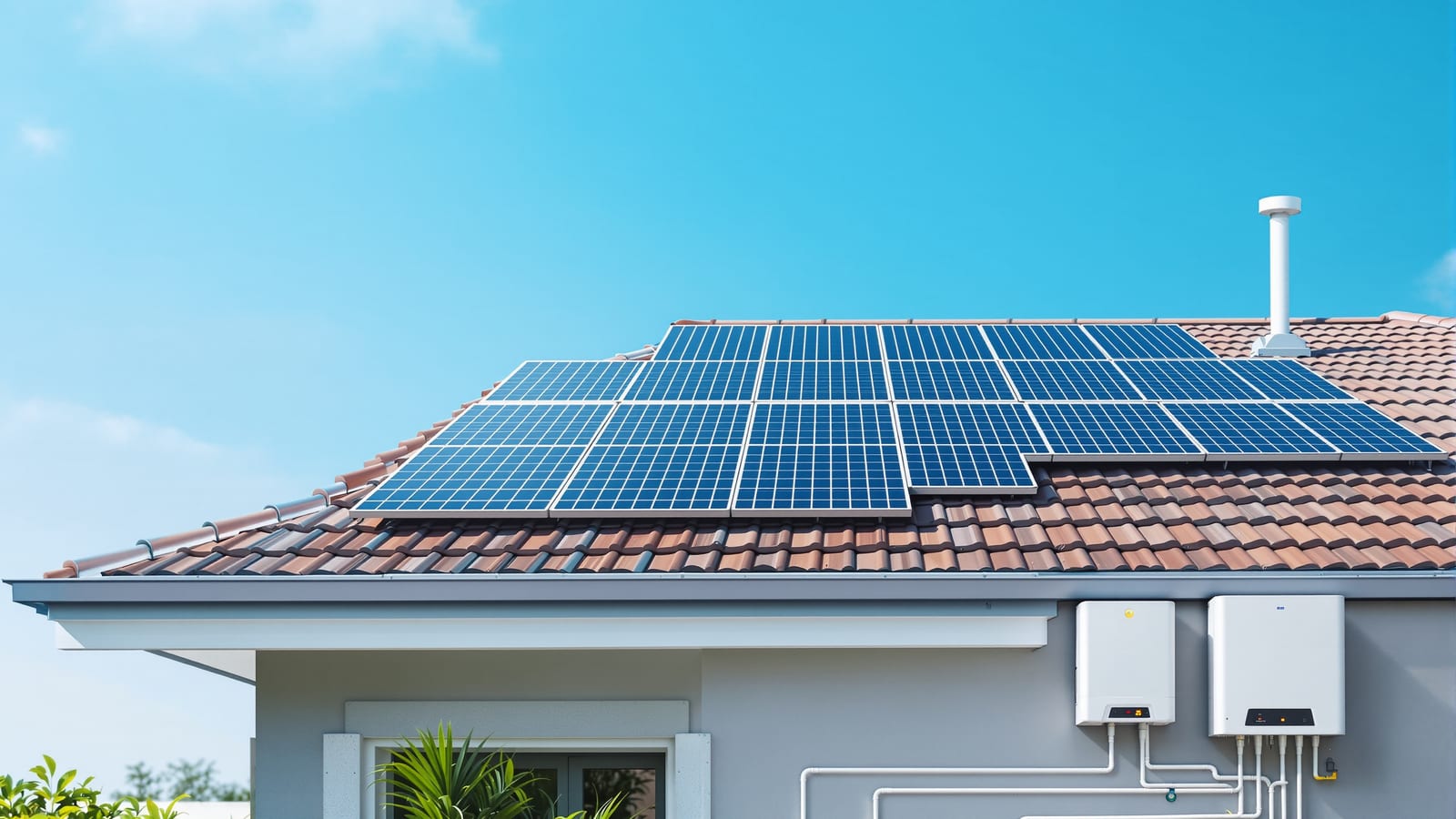
Solar is where energy management turns from saving pennies to shifting the economics of the home. Under PM Surya Ghar: Muft Bijli Yojana (administered via MNRE), residential rooftop solar carries a central subsidy — currently up to ₹78,000 for a 3 kW-plus system — that has transformed payback from a decade to roughly three to five years in most states.
The crucial choice is the metering arrangement, because it decides what your exported units are worth:
| Arrangement | How it works | Best when |
|---|---|---|
| Net metering | Exported units offset imported units 1:1 on your bill; you are billed on the net | You consume much of your generation; standard for homes |
| Gross metering | All generation is sold to the DISCOM at a fixed feed-in tariff; you buy all your consumption separately | Feed-in tariff is attractive and self-consumption is low |
| Net billing / net feed-in | Export credited at a set rate (often lower than retail), import at retail | Increasingly common as the middle path |
For most homes, net metering is the friend — every solar unit you consume directly avoids a retail-priced grid unit, and the surplus spins your meter backward. The engineering rule follows from this: size the system to your consumption, orient panels for peak yield, and — this is where the smart home comes in — shift flexible loads into the solar window so you self-consume as much as possible rather than exporting at a lower rate.
The figure below shows the flows in a modern solar-plus-storage home, all passing through the meter that decides what each unit is worth.
Battery storage
A battery lets you break the link between when energy is cheap and when you use it — store solar surplus or cheap night power and spend it during the priced-up evening peak. Modern hybrid inverters (Luminous, Deye, Growatt, Sungrow) manage a lithium battery, solar and grid together and are configurable to charge on off-peak tariff and discharge on peak.
The honest caution: batteries in India still rarely pay for themselves on tariff arbitrage alone at current price spreads — a residential lithium bank adds ₹80,000 to ₹2,50,000. Their real value today is backup during outages and maximising solar self-consumption, with tariff savings as a bonus. Buy a battery for reliability first and treat the bill saving as secondary until ToD spreads widen.
EV charging and load management
An EV is the single largest new load most Indian homes will ever add — a car charging at 3.3 kW for four hours draws more than the rest of the house combined. Handled naively, it blows past your sanctioned load and charges at peak tariff. Handled smartly, it is the most valuable flexible load you own, because a car sitting in the parking overnight does not care when it charges, only that it is full by morning.
Smart EV charging brings three controls that matter in India:
- Scheduled / off-peak charging — chargers from Tata Power EZ Home, Statiq, Exicom and others let you start charging at the cheapest hour automatically, or align with your solar surplus on a work-from-home day.
- Dynamic load management — the charger reads whole-home draw and throttles itself so the total never trips the mains when the AC and geyser are also running.
- Solar-matched charging — advanced setups charge the car only from surplus solar, effectively fuelling the car for the cost of exported units you would otherwise sell cheaply.
Together these turn a scary load into a well-behaved one, and this is precisely the whole-home coordination the smart home design guide argues should be planned into the wiring from the start.
Peak, off-peak and load shifting
The heart of energy management is a single idea: run flexible loads when power is cheapest. ToD tariffs and solar generation create windows — cheap night, cheap solar noon, expensive evening peak — and the flexible loads (EV, geyser, washing machine, dishwasher, pool/booster pump) can be moved into them without any loss of comfort. Fixed loads (lights, fridge, the AC you need at 3 p.m.) stay put; the flexible ones shift. The timeline below shows the pattern.
Automations that cut the bill
Software turns these windows into savings automatically, so you are not watching the clock. The rules worth building:
- Off-peak EV charging: the charger starts at 23:00 and stops at 05:00, or whenever the ToD tariff is lowest, and only charges to 80 percent on weeknights.
- Solar-surplus diversion: when the inverter reports export above 1 kW, a metering plug fires the geyser or the pool pump so the surplus is consumed at home instead of exported cheaply.
- Peak-hour shed: during the priced-up evening window, non-essential loads (geyser, second fridge, dishwasher) are locked out and a dashboard nudge reminds the family to hold heavy use.
- Over-limit protection: if total draw nears your sanctioned load, the EV charger throttles first, protecting the mains without anyone noticing.
You can model the effect of any of these before spending, using the smart home energy savings calculator, and budget the hardware with the smart home cost calculator. For the lighting-side scheduling that complements load shifting, the smart lighting guide is the companion piece, and the full spend picture lives in the smart home cost guide.
Payback, honestly
Energy management spans a wide cost range, and the payback varies just as widely. Here is an honest tiering.
| Layer | Typical cost | Realistic payback | Verdict |
|---|---|---|---|
| Whole-home monitor + metering plugs | ₹8,000 to ₹25,000 | 6 to 18 months | Buy first — behaviour change alone repays it |
| Rooftop solar (3 to 5 kW, post-subsidy) | ₹1.2 to ₹2.5 lakh | 3 to 5 years | The core investment; strong once sized right |
| Smart EV charger with load management | ₹25,000 to ₹55,000 | Value in safety + off-peak, hard to isolate | Essential if you own an EV |
| Battery storage | ₹80,000 to ₹2.5 lakh | Often 8 years-plus on tariff alone | Buy for backup, not arbitrage, today |
The pattern is consistent: monitoring pays back fastest, solar pays back solidly, batteries pay back slowly. Sequence your spending in that order and every stage funds a little of the next.
Where to begin
Start by seeing the truth — a whole-home monitor and two or three metering plugs, for under ₹25,000, will change how your family uses power within a month. Add rooftop solar when the roof and finances allow, sizing it to your real consumption and orienting flexible loads into the solar window. Treat a battery as backup insurance, and if you own an EV, make its charger smart from day one so it becomes your best flexible load rather than your worst peak. Managed this way, the Indian home stops being a meter that surprises you and becomes a system you run.
For the biggest single load inside that system, read the companion smart HVAC and climate guide; for the overall architecture that ties monitoring, solar and EV into one app, return to the home automation guide.
References
- MNRE — PM Surya Ghar: Muft Bijli Yojana (rooftop solar scheme) — official portal for residential rooftop solar subsidy and registration.
- Ministry of Power / RDSS — smart metering programme — national scheme behind DISCOM smart meter rollout.
- Central Electricity Authority (CEA) — reports and standards — official data on generation, distribution and connection standards.
- Ministry of Power — Time-of-Day tariff and consumer rules notification — regulatory basis for ToD tariffs and prosumer rights.
- BESCOM — net metering and rooftop solar for consumers — example state DISCOM guidance on net metering procedures.
- Bureau of Energy Efficiency (BEE) — appliance star ratings — efficiency labels that determine each appliance's baseline consumption.
Export this guide
Related Guides — Deep-dive reading
Smart Plugs: The Cheapest Way Into a Smart Home (India Guide)
What a smart plug does, the best and worst things to plug into it, the load-rating warning that matters most, energy-monitoring models, Wi-Fi vs Zigbee, scheduling and automations, safety, and brands with real Indian prices.
Smart HomeSmart Geysers & Water Heaters in India: The Biggest Energy Saver in Your Home
The water heater is one of the largest single loads on an Indian electricity bill — and the easiest to tame. This guide covers what makes a geyser smart, why scheduling saves the most, the 16A smart-plug retrofit and its caveat, storage vs instant, BEE star ratings, hard-water descaling, safety, real energy-savings math, and brands with prices.
Smart HomeSmart Water Monitoring India: Track Bathroom Usage, Catch a Running Toilet, Cut the Bill (2026)
A clamp-on or inline flow sensor turns your water line into a dashboard — litres per shower, a toilet that never stops filling, a hidden drip you would never hear. This is the honest India-first guide to smart water monitoring: how sensors meter each fixture, the apps and alerts, tie-ins with auto shut-off valves, and the real rupee cost against the bill it saves.
BathroomsRelated Tools — Try Free
Cross-Ventilation Analyzer
Estimate airflow and air changes per hour (ACH) from room size, window areas, layout, and local wind — with NBC 2016 Part 8 compliance check.
Ventilation CalculatorStamp Duty Calculator — All Indian States
Stamp duty + registration charges for all 28 states and 8 UTs — gender concessions, urban/rural variants, metro cess built in.
Stamp DutyAccess-Control Battery-Backup Calculator
Size the standby battery so an access system keeps running through a power cut, with an egress life-safety note.
Battery Backup