
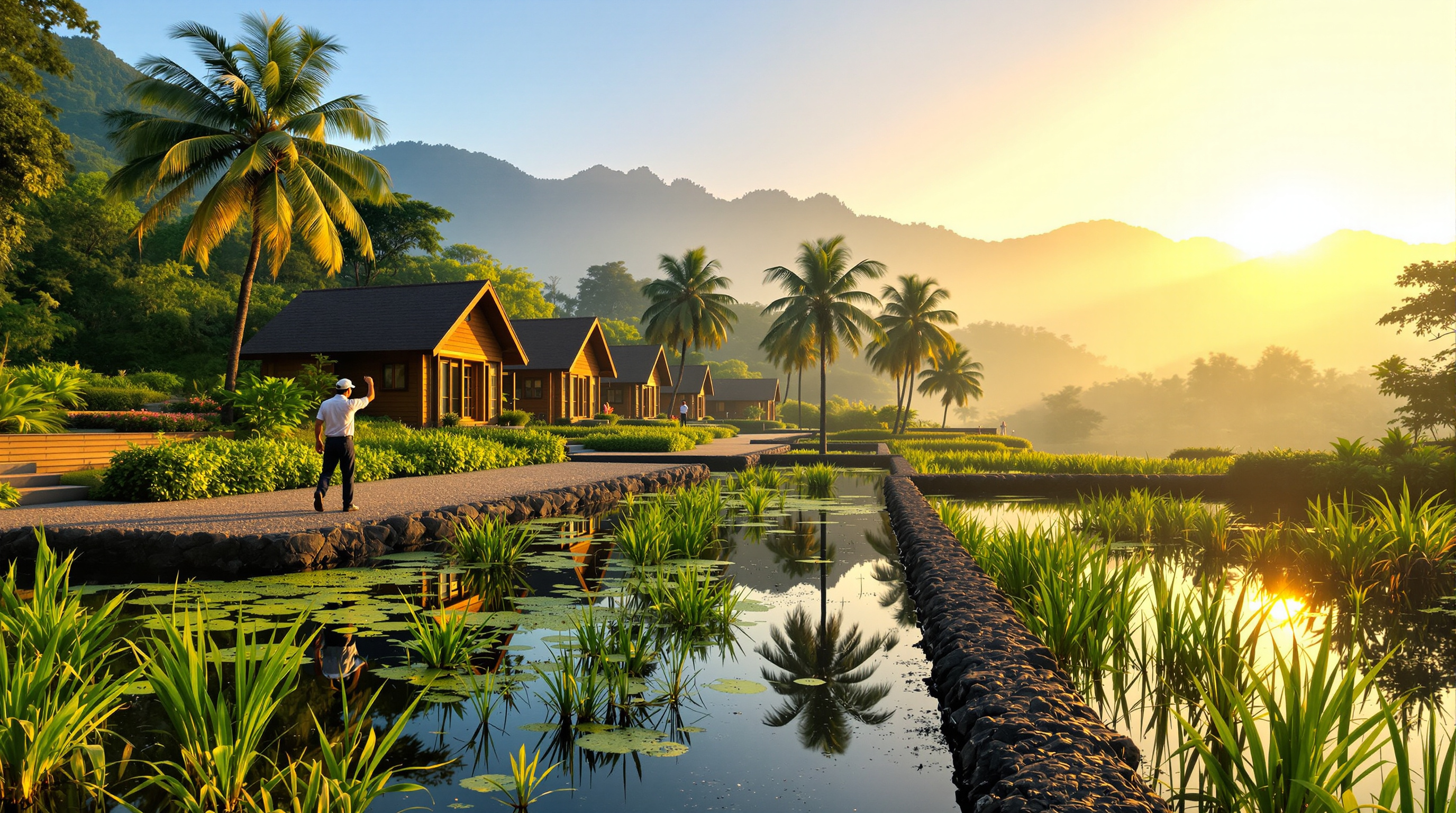
STP for Resorts: Remote, Scenic, Sustainable Sewage Treatment
Why resort sewage treatment plants are a category of their own — off-grid, in fragile ecosystems, swinging between empty weekdays and packed festival weekends — and how to design one that stays clean, quiet and green year-round.
A resort sells one thing above all: the feeling of untouched nature. Which makes its sewage the most awkward guest on the property. There is usually no municipal sewer within twenty kilometres, no tanker service willing to climb the ghat road, and a lake, river or forest sitting right where any spill would do the most damage. The resort has to clean every drop of its own wastewater, on its own land, with its own staff — often on a diesel-backed power supply and with a load that vanishes on a wet Tuesday and doubles on a long weekend. This is what makes an STP for resorts a category of its own, not just a smaller version of a city hotel plant.
A resort STP has to be invisible, odourless, resilient to wild swings in occupancy, and beautiful enough to sit inside a property whose whole value is the scenery. Very few building types demand all four at once.
This guide walks through the resort wastewater profile, the treatment technologies that actually suit remote scenic sites, how to size for a load that breathes, and the reuse and compliance decisions that separate an eco-resort that means it from one that greenwashes.
The resort wastewater profile

Resort sewage is domestic in character — much closer to a home or hotel than to an industrial ETP — but three features set it apart.
1. Violent seasonal and weekly swings. A hill or beach resort may run at 20% occupancy midweek in the off-season and 100%-plus during Diwali, Christmas–New Year, or the wedding season. Flow can swing 5:1 or more across the year. A plant sized only for the peak sits half-starved for months; one sized for the average drowns on the weekends. This variability, more than raw size, is the defining design problem.
2. High per-guest water use. A resort guest is not a frugal one. Long showers, bathtubs, pools, spas, extensive landscaping and laundry push consumption to 250–450 litres per person per day, far above the ~135 LPCD of a home. Kitchens and banquets add a heavy dose of oil, grease and food solids. Run your own numbers through the Water Consumption Calculator before assuming a figure.
3. Sensitive receiving environment. The treated water — and any failure — lands in exactly the ecosystem the resort is selling: a backwater, a coral coast, a Ghats stream, a wildlife buffer. Discharge norms are effectively stricter here in practice, and reputational risk is total. One foaming outfall photographed by a guest can undo a decade of eco-branding.
| Parameter | Typical resort raw sewage | Why it matters here |
|---|---|---|
| Flow variability | 3:1 to 6:1 seasonal | The core sizing headache — plant must handle both extremes |
| Per-guest flow | 250–450 LPCD | Higher than homes; pools, spa, laundry, landscaping |
| BOD | 250–400 mg/L | Kitchens & banquets push it up; needs robust biological stage |
| Oil & grease | High | Restaurant-heavy load; demands serious grease interception |
| Reuse demand | Very high | Large landscapes, water features — reuse can exceed sewage generated |
Which STP technology suits a resort — and why
The remote, staff-light, scenery-first setting rewards technologies that are forgiving of load swings, low on power, quiet, and ideally green to look at. Three families dominate.
Nature-based systems (constructed wetlands)
For low- to mid-sized resorts on generous land, a constructed wetland — reed beds of gravel and plants like canna and phragmites that filter and digest sewage as water percolates through the root zone — is often the ideal fit. After a compact primary stage (settler or anaerobic baffled reactor), the wetland does the biological work with almost no power, no blowers, minimal skilled operation, and it looks like a garden rather than a plant. It shrugs off flow swings, produces little sludge, and doubles as landscape. The trade-offs: it needs land (roughly 1–3 m² per person), it is slower and larger than a packaged tank, and it is less suited to the very highest peak loads. For a scenic, off-grid property that has land to spare, nothing else aligns so neatly with the brand.
MBBR and SBR packaged plants
Where land is tight or peaks are sharp, an engineered compact plant makes more sense:
- MBBR — the biofilm on floating carriers is remarkably tolerant of shock and starvation loads, making it the workhorse choice for resorts with big weekly swings. It recovers quickly when a full house arrives after a quiet week.
- SBR — batch operation gives excellent, consistent effluent and can be programmed to run fewer cycles at low occupancy, saving power in the off-season. Good where discharge norms are strict.
- MBR — produces the highest-quality, near-pathogen-free reuse water in the smallest footprint, ideal where treated water feeds swimming-friendly features or where the plant must hide in a tiny basement. The catch: membranes are power-hungry and demand skilled upkeep — a real liability on a remote site with rotating staff.
A common and sensible pattern is a hybrid: a robust MBBR or SBR core for reliability, polishing into a constructed wetland or planted gravel filter that adds a green buffer, extra safety margin, and the visible eco-story guests notice. To see the underlying biology these all share, read how an STP works and the treatment process flow.
Sizing: design for the breath, not the average
The cardinal rule of resort STP sizing is to plan for the peak but survive the trough.
- Size the plant to peak occupancy (full house plus banquet/event guests plus staff), not annual average — under-sizing shows up as untreated overflow on exactly the busy weekends when guests are watching.
- Protect the biology against starvation. Long low-occupancy spells starve the microbial culture. MBBR carriers and constructed wetlands ride this out far better than conventional activated sludge, which can crash. Design in the ability to recirculate and keep the biomass alive between rushes.
- Oversize the equalisation tank. A generous buffer tank is the single cheapest fix for swing — it flattens the banquet-night surge and feeds the biology steadily. On resort projects, err large.
- Modular trains help. Two smaller parallel units let you run one in the off-season and both at peak, matching power draw to load — a big saving on a diesel-backed site.
Translate headcount into a capacity in KLD with the STP Capacity Calculator, and estimate the raw sewage volume with the Sewage Generation Calculator. For the parameters the design must hit — BOD, COD, TSS — see the wastewater characteristics primer.
Reuse: the resort's quiet superpower
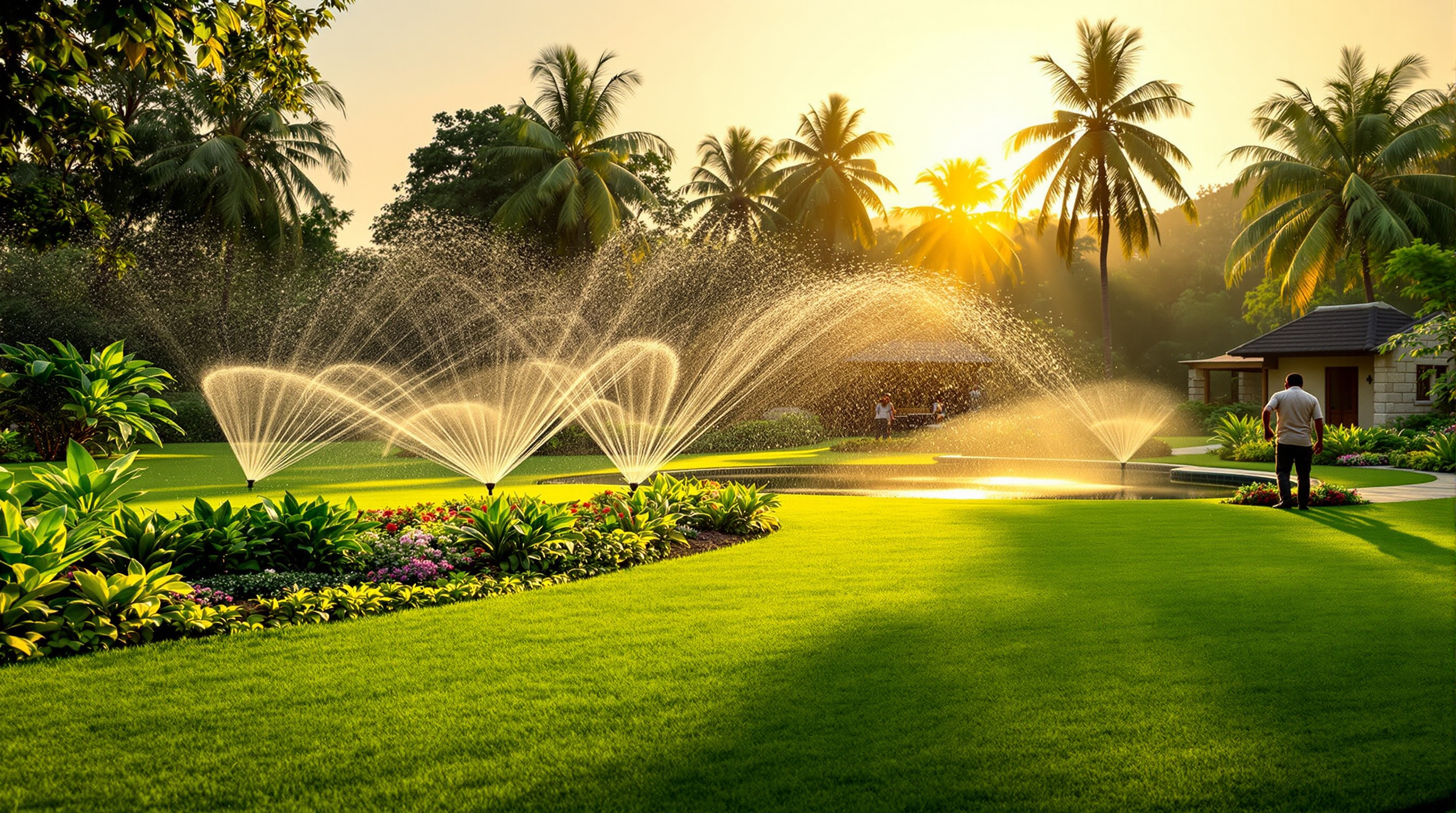
Resorts have the best reuse economics of any building type, because their demand for non-potable water is enormous — often larger than the sewage they generate. Treated water routinely covers:
- Landscape and lawn irrigation — sprawling gardens, golf turf, orchards; the biggest sink by far.
- Water features — ponds, cascades and fountains that reinforce the scenic brand.
- Toilet flushing via a dual-plumbing line.
- Cooling towers and vehicle/common-area washing.
- Groundwater recharge, restoring the aquifer under the property.
Because a resort can consume every drop it treats, a well-run resort STP can approach zero liquid discharge — no outfall, no norm-exceedance risk, no tanker bills, and a genuine, defensible sustainability claim. That is the eco-brand made real rather than painted on. Guests who came for untouched nature are, in effect, watering the very gardens they admire.
Compliance and eco-branding
Resort STPs fall under the same CPCB / State Pollution Control Board framework as other buildings, with directionally stricter effluent expectations because of the sensitive receiving waters. In practice that means aiming for BOD well under 10 mg/L, TSS under 20 mg/L, robust disinfection (UV is preferred over chlorine near waterbodies and reused water), and — often — designing for the reuse-and-recharge route that avoids surface discharge entirely. Keep the consent-to-operate, monitoring logs and flow records current; scenic-zone and coastal-regulation clearances add scrutiny a city hotel never faces.
Common mistakes on resort STPs
- Sizing to average occupancy — the plant overflows every festival weekend.
- Choosing high-tech membranes for a low-skill remote site — MBR without a competent operator becomes an expensive, clogged liability.
- Ignoring off-season starvation — the biology dies during the monsoon lull and takes weeks to recover for the season opener.
- Under-designing grease interception — banquet kitchens choke the biology; resorts need serious oil-and-grease traps.
- Treating the STP as ugly infrastructure to hide rather than a landscape and story to showcase — the wetland-garden approach turns a cost centre into a brand asset.
- No power redundancy — on a diesel-backed site, blowers stopping for hours will crash a conventional plant.
The bottom line
An STP for a resort is a design in tension: it must be tough enough for a 5:1 load swing, simple enough for remote staff, gentle enough for a fragile ecosystem, and handsome enough to sit in a landscape that guests pay to admire. Get the technology honest to the site — nature-based where there is land, MBBR or SBR where peaks are sharp, a hybrid where you want both — size for the peak while protecting the biology through the trough, and route almost everything back into the gardens. Do that and the sewage plant stops being the awkward guest and becomes part of the story the resort is selling.
For neighbouring building types, compare with STP for hotels and STP for farmhouses, or browse the full Sewage Treatment Plants guide library.
Export this guide
Related Guides — Deep-dive reading
STP for Hotels: High Per-Guest Loads, FOG & Water Reuse Explained
Why hotel wastewater is heavier and swingier than an apartment's, which STP technology (MBBR vs MBR) actually fits, how to size for peak occupancy, and where the treated water pays for itself — in laundry, cooling and landscape.
Sewage Treatment PlantsConstructed Wetlands & Root Zone Systems: Natural STPs Explained
How engineered gravel beds planted with reeds and canna clean sewage using roots and microbes instead of blowers and motors — the low-energy, low-maintenance natural STP, and exactly where it fits in India.
Sewage Treatment PlantsSTP for IT Parks & Campuses: Central-Plant Design, Reuse & Redundancy Guide
How to plan a campus-scale sewage treatment plant for a multi-building IT park in India — the daytime flow pattern, the right technology, sizing for a central plant, and a reuse network feeding landscape, flushing and cooling towers.
Sewage Treatment PlantsRelated Tools — Try Free
Rainwater Tank Sizer
How big should your rainwater tank be? Computes annual harvest, recommended tank capacity in litres, water-bill savings, and payback — for 10 Indian cities.
RWH CalculatorSewage Generation Calculator
Estimate the daily sewage a building generates and its peak flow in KLD from occupancy, LPCD, sewage return factor and peak factor.
STP CalculatorSTP Capacity Calculator
Size a sewage treatment plant in KLD from your building's occupancy — water demand, sewage generated and recommended STP capacity.
STP Calculator