
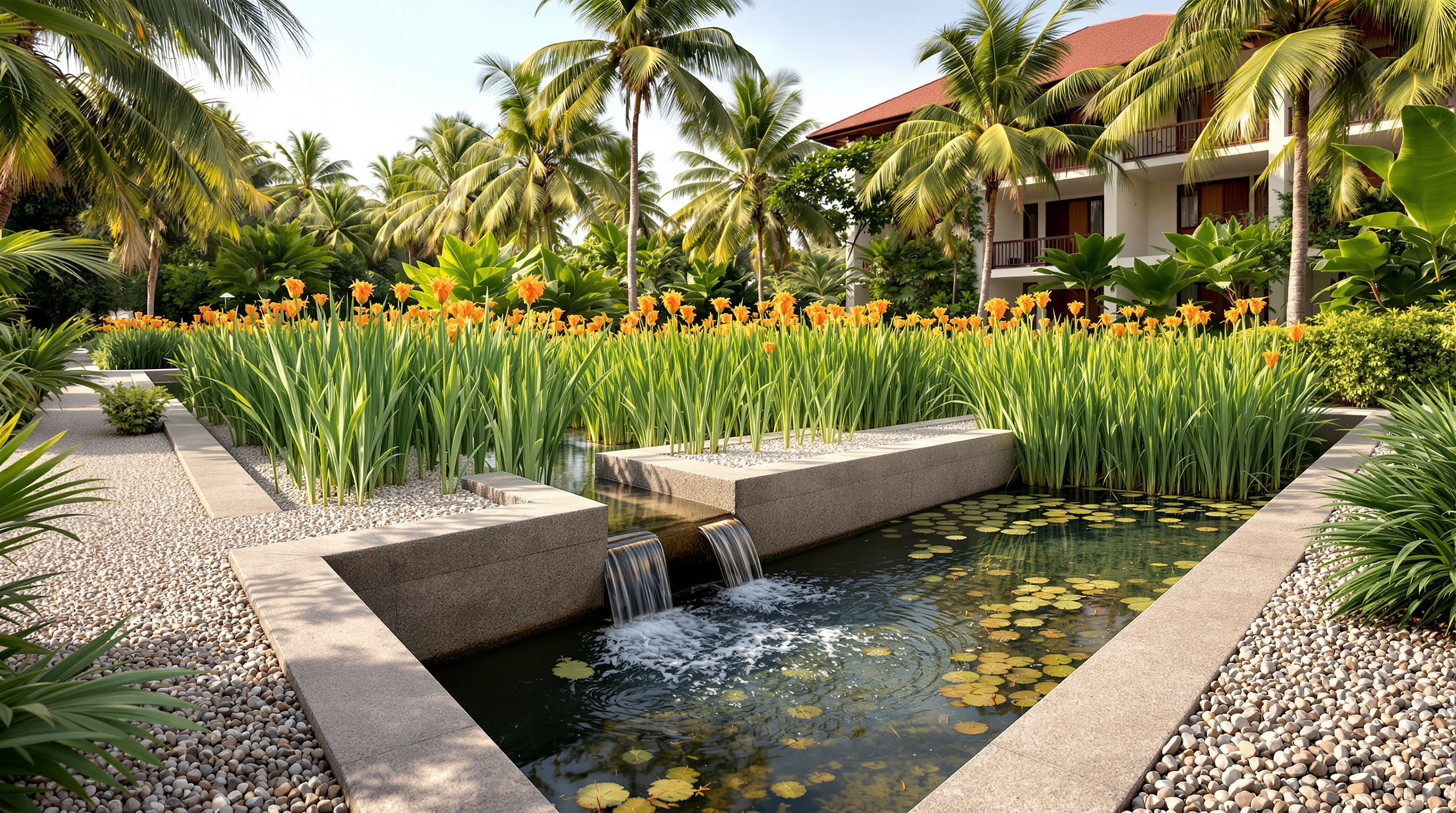
Constructed Wetlands & Root Zone Systems: Natural STPs Explained
How engineered gravel beds planted with reeds and canna clean sewage using roots and microbes instead of blowers and motors — the low-energy, low-maintenance natural STP, and exactly where it fits in India.
Most sewage treatment plants clean water by force. They pump air through tanks with electric blowers, run pumps around the clock, and fight the pollution with machinery and horsepower. A constructed wetland does the same job — turning foul sewage into clean, reusable water — but by working with nature instead of overpowering it. It is, quite literally, a garden that treats sewage: a shallow bed of gravel and sand, planted with reeds and canna, through which the wastewater seeps while the roots, the gravel and the microbes clinging to both quietly consume the waste.
For the right site, this is one of the most elegant answers in wastewater engineering. No blowers humming in a basement, electricity bills near zero, a maintenance crew that looks more like a gardener than a plant operator — and an outlet that looks like a landscaped water feature rather than industrial infrastructure. This guide explains how a constructed wetland works, the two main types, the honest trade-offs, and exactly where it belongs.
A constructed wetland is not a marsh that happens to clean water. It is an engineered treatment reactor that happens to look like a marsh — sized, lined, layered and planted on purpose so that roots and biofilm do the work a blower would otherwise do.
What a constructed wetland actually is
Nature has always cleaned water in wetlands. When a stream passes through a reed marsh, it comes out cleaner — the plants slow the flow, particles settle, and a dense community of microbes living on the roots and soil digest the organic matter. A constructed wetland (sometimes called a root zone treatment system or reed bed) takes that natural process and engineers it into a controlled, predictable STP.
The bed is not just a hole full of plants. A properly designed system is a layered structure:
- An impermeable liner (clay or HDPE membrane) at the bottom, so sewage never leaks into the groundwater below.
- A bed of graded gravel and sand — the medium the water flows through and the surface the microbes colonise.
- Wetland plants rooted into the gravel — typically Phragmites (common reed), Typha (cattail), Canna and Cyperus in Indian conditions — chosen because they push oxygen down into their roots and tolerate being permanently waterlogged.
- Carefully designed inlet and outlet structures that spread the flow evenly and control the water level.
Crucially, a wetland is almost never the first thing the sewage meets. Raw sewage is far too strong and full of solids to pour straight onto a gravel bed — it would clog. So a constructed wetland is nearly always paired with a pre-treatment step: a settling tank, a septic tank, or an anaerobic reactor such as a UASB that removes the bulk of the solids and organic load first. The wetland then does the biological polishing. This pairing is the heart of many decentralised wastewater treatment (DEWATS) systems.
Surface flow vs subsurface flow
There are two fundamentally different ways to run water through a wetland, and the choice defines everything about how the system performs, looks and smells.
Free water surface (FWS) flow wetlands look like a natural pond or marsh: the water flows over the surface of the soil, open to the air, among the stems of the plants. They are cheap to build and excellent for polishing — giving already-treated water a final clean-up before reuse or discharge. But because the sewage is exposed, they can attract mosquitoes and odour if fed water that is too strong, and they need more land.
Subsurface flow (SSF) wetlands — the true root zone systems — keep the water below the surface of the gravel, so you never see or smell the sewage; the top of the bed is just a dry-looking garden of reeds. These are the workhorses for actual sewage treatment. They come in two arrangements:
- Horizontal subsurface flow (HSSF) — water enters one end and creeps horizontally through the gravel to the outlet. Simple, robust, no moving parts.
- Vertical flow (VF) — water is dosed onto the top and drains vertically down through the bed, pulling air in behind it. This forces far more oxygen into the system, which makes it much better at converting ammonia (nitrification) and lets you treat more sewage on less land.
| Feature | Surface flow (FWS) | Horizontal subsurface (HSSF) | Vertical flow (VF) |
|---|---|---|---|
| Water visible on top? | Yes — open water | No — hidden in gravel | No — hidden in gravel |
| Mosquito / odour risk | Higher | Low | Low |
| Oxygen supply | Surface air only | Limited | High (air drawn in) |
| Ammonia / nitrogen removal | Modest | Modest | Strong |
| Land needed | Highest | High | Lower |
| Best used for | Final polishing, ponds | Robust general treatment | Nitrification, tight sites |
| Complexity | Lowest | Low | Needs a dosing pump/siphon |
Many well-designed systems combine types — for example a vertical bed followed by a horizontal bed — to get both strong nitrogen removal and reliable polishing in one train.
How the plants and microbes actually clean the water
It is a common misconception that the reeds "drink" the pollution. The plants matter, but the real workforce is microbial. Here is what each part contributes:
- The gravel and biofilm. Every stone in the bed is coated with a slimy film of bacteria — the biofilm. As sewage seeps past, these microbes eat the dissolved organic matter (the BOD) exactly as the bacteria in a conventional aeration tank do. The gravel is simply an enormous surface area for them to live on.
- The roots. Wetland plants have evolved to pump oxygen down through hollow stems into their roots. This creates tiny oxygen-rich zones deep in the waterlogged bed, letting aerobic microbes thrive where there would otherwise be none — and giving the biofilm somewhere to anchor.
- Filtration. The bed physically strains out suspended solids as water threads through the gravel, dropping TSS sharply.
- Nutrient uptake. The plants genuinely absorb some nitrogen and phosphorus as fertiliser — a minor but real contribution — and harvesting the reeds periodically removes it from the system.
- Natural die-off. Long residence times and sunlight (in surface systems) kill off a large share of pathogens.
The net result, from a good design, is treated water with BOD and TSS comfortably in single or low double digits — meeting reuse and discharge norms — produced with essentially no energy input.
The real selling point: energy and running cost

This is where constructed wetlands win decisively. A conventional activated sludge or MBBR plant runs blowers and pumps continuously; electricity is the single largest line in its operating budget, and a breakdown of the blower means the plant fails within hours.
A subsurface wetland has:
- Near-zero energy demand. A horizontal-flow bed on a sloping site can run on gravity alone; even a vertical bed needs only a small intermittent dosing pump. Electricity cost is a rounding error.
- No blowers, no continuous mechanicals to break down, so no operator watching dials at 2 a.m.
- Very low, low-skill maintenance — inlet cleaning, occasional reed harvesting, watching the water level. A gardener can be trained to run it.
- Long life and resilience. A well-built bed lasts decades and shrugs off flow variations and short overloads that would upset a mechanical plant.
For a remote resort, a rural campus or a village where a tanker of diesel and a trained STP operator are both hard to come by, that resilience is worth more than any efficiency number.
The catch: land
Nothing is free. What a constructed wetland saves in energy, it spends in land. As a rough directional figure, a subsurface system needs on the order of 1–3 square metres of bed per person served, depending on type and climate — far more footprint than a compact packaged STP that fits in a basement. Vertical-flow beds shrink this; surface-flow systems need even more.
That single trade-off decides almost every siting question. Where land is cheap and available, a wetland is superb. In a dense urban high-rise on an expensive plot, it is usually a non-starter — the roof and basement STP wins. Performance can also dip in a cold winter (microbial activity slows), and beds can clog over years if pre-treatment is skimped on, requiring the gravel to be rested or replaced.
Where constructed wetlands fit best

Match the technology to the site, and the answer becomes obvious:
- Resorts and eco-hotels — land is available, guests value the green story, and a landscaped reed bed beats a humming plant room.
- Villages and peri-urban clusters — no reliable power or skilled operators, but plenty of land; this is the classic DEWATS use case.
- Campuses, schools and institutions — large grounds, a maintenance gardener already on staff, and an appetite for a visible sustainability showpiece.
- Polishing existing STP output — a surface-flow wetland downstream of a conventional plant lifts the effluent to a higher reuse grade cheaply.
- Highway facilities, farmhouses and nature retreats — off-grid sites where low energy and low attendance matter most.
Pros and cons at a glance
| Advantages | Limitations |
|---|---|
| Very low energy — often gravity-fed | Needs substantial land (1–3 m² per person) |
| Very low operating cost | Not suited to dense urban / high-rise plots |
| Low-skill, gardener-level maintenance | Slower to start up (plants must establish) |
| No blowers/mechanicals to fail | Performance dips in cold weather |
| Robust to flow surges and overloads | Can clog if pre-treatment is inadequate |
| Doubles as landscaping / habitat | Harder to "boost" capacity later |
| Long service life, decades | Needs a good liner to protect groundwater |
The bottom line
A constructed wetland is a genuine sewage treatment plant that trades machinery for biology: an engineered, lined, gravel bed planted with reeds, fed by pre-settled sewage, in which biofilm and roots drive the pollution down to reuse quality using almost no electricity. Its one real cost is land — and where land is available and power or operators are not, it is often the smartest, most durable and most beautiful STP you can build.
To place it in the wider family of treatment options, start from the pillar guide, What is a Sewage Treatment Plant?, and browse the full Sewage Treatment Plants library. And when you are ready to size any system — wetland or conventional — the STP Capacity Calculator turns your headcount into a treatment capacity in litres per day, the number every design, including a reed bed, begins from.
Export this guide
Related Guides — Deep-dive reading
Root Zone Treatment Systems: The Low-Energy Reed-Bed STP Explained
How subsurface-flow planted gravel beds use reed roots and microbes to treat sewage with almost no electricity — how they work, what they cost in land, and where a root zone treatment system actually fits in India.
Sewage Treatment PlantsAnaerobic Baffled Reactor (ABR): The Low-Energy Heart of DEWATS Explained
A series of baffled compartments where sewage snakes up and down beneath a blanket of anaerobic sludge, destroying pollution with no power, no moving parts and almost no attention — how the baffles and sludge blanket work, why DEWATS schemes across India are built around it, and why it always needs a polishing step to finish the job.
Sewage Treatment PlantsUpflow Anaerobic Sludge Blanket (UASB): Anaerobic Sewage Treatment Explained
The no-oxygen reactor where sewage flows up through a blanket of granular sludge, destroying pollution while producing biogas and using almost no energy — how the sludge blanket and gas-solid separator work, why Indian municipal STPs favour it, and why it always needs an aerobic polishing step.
Sewage Treatment PlantsRelated Tools — Try Free
Rainwater Tank Sizer
How big should your rainwater tank be? Computes annual harvest, recommended tank capacity in litres, water-bill savings, and payback — for 10 Indian cities.
RWH CalculatorLandscape Cost Calculator
Estimate a garden's cost — hardscape, softscape, lawn, irrigation, lighting and annual upkeep — by area, tier and city.
Budget CalculatorWindow Cleaning Cost Calculator
Estimate professional window cleaning cost per visit and per year by access and frequency.
Window Calculator