
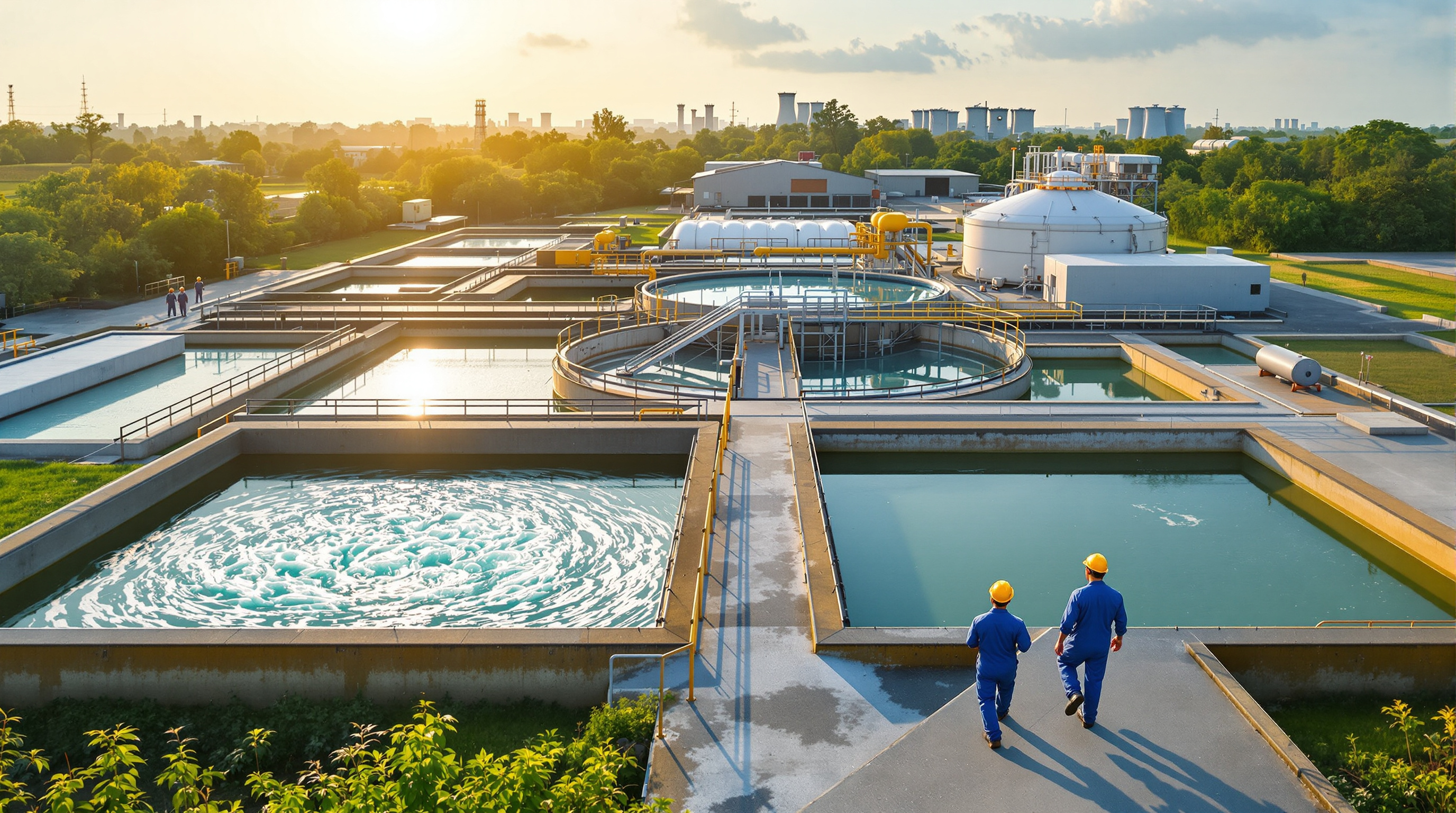
STP for Industrial Parks & SEZs: Treating Worker & Canteen Sewage the Right Way
Industrial estates and SEZs need a common STP for the domestic sewage of thousands of workers and canteens — kept strictly separate from the trade effluent that goes to a CETP or ETP. Here is how to profile, size, treat and reuse it.
Mention "effluent treatment" and an industrial estate, and everyone's mind jumps to chemicals, dyes, acids and heavy metals. But an industrial park is also a small city of people. A single mid-sized SEZ can house tens of thousands of workers who use toilets, wash their hands, and eat in canteens that cook thousands of meals a day. That everyday human wastewater is domestic sewage, not trade effluent — and it needs its own dedicated system: a common Sewage Treatment Plant (STP), run entirely separately from whatever handles the factory process water.
Getting this split right is the single most important decision in planning water infrastructure for an industrial park. Mix the two streams and you contaminate a perfectly treatable sewage flow with chemistry your biological plant cannot digest — and you inflate the load on your expensive effluent plant with water that never needed it.
In an industrial park, sewage and effluent are two different animals. The STP handles the people; the ETP or CETP handles the process. Keep the pipes, the plants, and the compliance paperwork separate from day one.
Two separate worlds: STP vs ETP vs CETP
Before sizing anything, get the vocabulary straight, because these three get muddled constantly and the mistake is expensive.
- An STP treats domestic sewage — toilet, washroom, canteen and bathing water. It is a biological plant built for organic load: BOD, COD, TSS and pathogens. This guide is about the STP.
- An ETP (Effluent Treatment Plant) treats a single unit's trade effluent — the chemically loaded process water specific to that industry.
- A CETP (Common Effluent Treatment Plant) is a shared ETP that several small and medium units in an estate pipe their trade effluent into, so they don't each need their own.
The clean rule India's pollution-control framework works to: domestic sewage goes to the STP; trade effluent goes to the ETP/CETP; the two networks never join upstream. A textile or pharma unit's process water carries dyes, solvents or heavy metals that would poison the microbial culture an STP depends on. If you want the deeper contrast, STP vs ETP and septic tanks walks through why domestic-grade biology can't cope with industrial chemistry.
So an industrial park typically runs two parallel water systems: a common STP for the whole estate's sewage, and a CETP (or individual ETPs) for trade effluent. This guide is only about the first.
The wastewater profile of an industrial park

An industrial park's sewage is unusual, and the profile drives every downstream design choice.
It is shift-driven and spiky. Unlike an apartment complex with a gentle morning-and-evening rhythm, a factory estate empties and fills on shift changes. Two or three sharp peaks a day — start of shift, lunch, end of shift — with canteen kitchens dumping a heavy slug of greasy, high-BOD water in a two-hour lunch window. Flow can swing from a trickle at 3 a.m. to a torrent at 1 p.m.
Canteen load is the wild card. Mass-catering kitchens produce sewage far stronger than domestic washrooms — high in oil, grease and organic matter, often pushing raw BOD well above the 250–350 mg/L you'd expect from ordinary sewage. Grease is the enemy of biological plants, so oil-and-grease removal is not optional here.
Headcount is huge but water use per head is modest. Workers are on site 8–9 hours, not living there. Per capita sewage generation is lower than a residence but the sheer numbers make the total flow large.
| Source | Character | Design implication |
|---|---|---|
| Worker toilets & washrooms | Standard domestic sewage, but sharp shift peaks | Large equalisation buffer essential |
| Canteen kitchens | High BOD/COD, heavy oil & grease | Dedicated grease traps before the plant |
| Amenities / offices | Light, steady domestic load | Blends into the base flow |
| Trade effluent | Chemical, industry-specific | Never enters the STP — CETP only |
The takeaway: the STP must absorb violent flow swings and a grease-heavy organic load, from a large but transient population.
Which STP technology suits — and why
Because flow is spiky and organic load is high, the technology has to be robust to shock loads and forgiving of surges. Three approaches dominate for industrial parks:
- MBBR (Moving Bed Biofilm Reactor). The workhorse choice. The MBBR process grows biomass on floating plastic media, so it holds a large, resilient microbial population in a compact tank and shrugs off load swings better than a plain suspended-growth plant. Good fit for the shift-peak reality of an estate.
- SBR (Sequential Batch Reactor). The SBR process treats sewage in timed batches in one tank, which makes it excellent at handling variable inflow and producing consistent, low-BOD output — attractive where the treated water will be reused to a tight standard.
- Extended-aeration ASP. A conventional Activated Sludge Process run in extended-aeration mode is proven and cheap to operate at large scale, though it needs more land and a bigger aeration tank.
Where treated water will be reused inside factories — for cooling towers, floor washing or process make-up demanding very low turbidity — an MBR (Membrane Bioreactor) polishing stage or a downstream ultrafiltration train produces near-clear water, at higher capex and power cost. Whatever the core technology, the treatment train follows the same four-stage logic: screen and equalise, settle, aerate and biologically digest, then filter and disinfect. See the full process flow for the stage-by-stage journey.
One non-negotiable for this building type: a generously sized equalisation tank at the front. It is the buffer that turns three violent daily peaks into a steady feed the biology can handle calmly. Under-size the equalisation tank and no downstream technology will save you.
Sizing the plant
Sizing starts with headcount, not floor area. For an industrial park you estimate total occupancy across all shifts, apply a per-capita sewage generation figure appropriate to a workplace (workers on site generate less than residents — often in the 30–45 LPCD range for domestic use, versus 90–135 LPCD for a home), then add the canteen contribution separately based on meals served.
A worked sequence:
1. Water consumption first. Estimate demand with the Water Consumption Calculator, separating worker domestic use from canteen use.
2. Convert to sewage. Roughly 80% of domestic water supplied returns as sewage — the Sewage Generation Calculator does this quickly for a given headcount.
3. Size the STP. Feed the flow into the STP Capacity Calculator to land on a treatment capacity in KLD, then add headroom for future occupancy as the park fills up.
Because occupancy in an SEZ ramps up over years as plots are allotted, design in phasing. A common pattern is a modular plant sized for full build-out but commissioned in streams, so you aren't aerating a near-empty tank on day one — a real problem, because a biological plant running far below design load struggles to keep a healthy culture alive.
Reuse: where the treated water goes

An industrial park is the ideal place to reuse treated sewage, because it has thirsty non-potable demands right next door:
- Cooling-tower make-up for centralised HVAC and process chillers — often the single largest reuse.
- Toilet flushing across the estate via a dual-plumbing line.
- Landscape irrigation for the wide green buffers SEZs are required to maintain.
- Road and floor washing, dust suppression on internal roads.
- Groundwater recharge of the surplus.
A well-run common STP recovers 80–85% of the sewage it receives as reusable water, which in a large estate is lakhs of litres a day of tanker water avoided — a direct operating saving on top of the compliance benefit. Zero-liquid-discharge estates route the STP output into the water balance so almost nothing leaves the fence line.
Compliance and the common mistakes
The regulatory frame is straightforward in principle: treated sewage must meet CPCB/State-Board discharge or reuse norms, the STP and CETP are permitted and monitored separately, and larger plants increasingly carry online effluent monitoring. The mistakes are where projects come undone:
- Cross-connecting sewage and trade effluent. The cardinal sin. One misrouted pipe from a process area into the sewage line can shock the STP's biology dead overnight. Separate the networks physically and colour-code them.
- Ignoring canteen grease. Skipping proper oil-and-grease traps ahead of the plant chokes the biology and coats the media. Mass-catering kitchens need serious grease interception.
- Under-sizing equalisation. Designing for average flow instead of shift peaks. The plant then surges and under-performs at exactly the busy hours it exists to handle.
- A plant running under load early. Commissioning a full-build-out STP for a half-empty park starves the culture. Phase it.
- Treating the STP as a "build and forget" asset. A biological plant is a living system — it needs a trained operator, steady power for the blowers, and regular sludge removal. Estates that don't budget for O&M end up with a compliant-on-paper plant that doesn't work.
The bottom line
A common STP is the quiet, essential twin of the CETP in any industrial park or SEZ. Its job is narrow and clear: take the domestic sewage of a large, shift-driven, canteen-heavy working population; keep it strictly apart from trade effluent; treat it with a shock-tolerant biological process fronted by strong equalisation and grease removal; and return most of it as reusable water to an estate that has every use for it. Get the STP-versus-ETP split right on day one, size for peaks and for the park's growth, and budget for real operation — and the estate's people-water problem is solved for good. Start with the Sewage Treatment Plants guide library and the STP Capacity Calculator to turn your projected headcount into a plant.
Export this guide
Related Guides — Deep-dive reading
Pharmaceutical Wastewater Treatment: Why It Needs an ETP, Not an STP
Pharma effluent carries high COD, toxic and refractory compounds, swinging pH and traces of active drug ingredients — a load that overwhelms a domestic STP. Here is what makes it so hard to treat, and the ETP train engineers build to handle it in India.
Sewage Treatment PlantsSTP for IT Parks & Campuses: Central-Plant Design, Reuse & Redundancy Guide
How to plan a campus-scale sewage treatment plant for a multi-building IT park in India — the daytime flow pattern, the right technology, sizing for a central plant, and a reuse network feeding landscape, flushing and cooling towers.
Sewage Treatment PlantsSTP for Shopping Malls: Mixed Loads, Big Reuse
Why a mall's wastewater is unlike any other building's — a punishing mix of food-court grease, washroom peaks and huge cooling-tower thirst — and how to size, site and choose an STP that turns all of it back into usable water in the basement.
Sewage Treatment PlantsRelated Tools — Try Free
Sewage Generation Calculator
Estimate the daily sewage a building generates and its peak flow in KLD from occupancy, LPCD, sewage return factor and peak factor.
STP CalculatorRainwater Tank Sizer
How big should your rainwater tank be? Computes annual harvest, recommended tank capacity in litres, water-bill savings, and payback — for 10 Indian cities.
RWH CalculatorApartment STP Planner
Plan an apartment complex sewage treatment plant from flats and occupancy — get population load, sewage flow, recommended STP capacity in KLD, treatment technology and approximate space.
Planner