
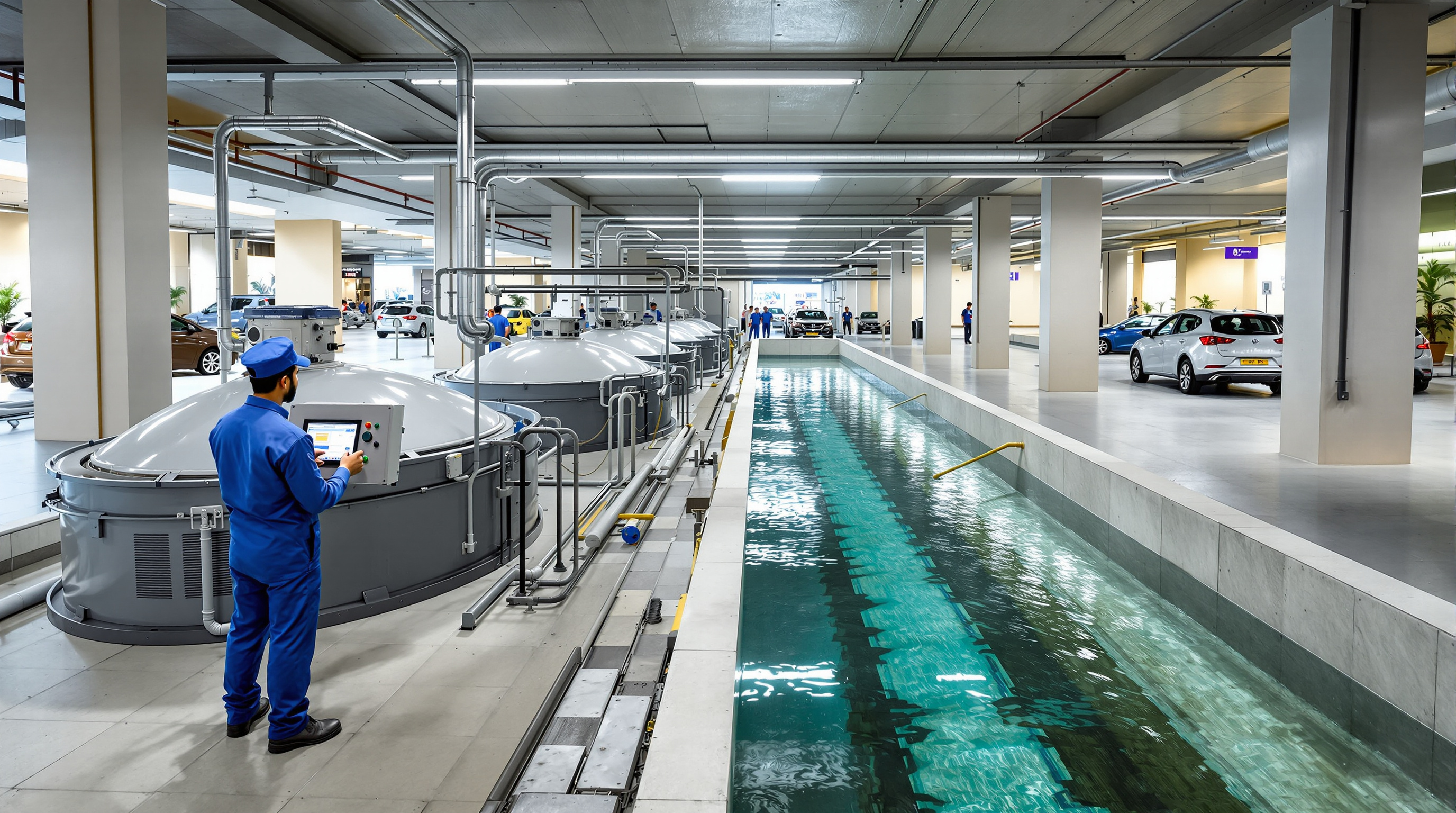
STP for Shopping Malls: Mixed Loads, Big Reuse
Why a mall's wastewater is unlike any other building's — a punishing mix of food-court grease, washroom peaks and huge cooling-tower thirst — and how to size, site and choose an STP that turns all of it back into usable water in the basement.
A shopping mall is, from a wastewater engineer's point of view, several very different buildings stacked on one plot. A food court behaves like a busy restaurant. The washrooms behave like a stadium that fills and empties in waves. The multiplex, the hypermarket, the salons and the central air-conditioning each add their own signature to the drain. Feed all of that into one pipe and you get a wastewater profile that is stronger, greasier and far spikier than any apartment or office block ever produces — and, at the same time, a building with an enormous appetite for reused water sitting right on top of it.
That combination is exactly why an STP for shopping malls is one of the more interesting design problems in the field. Get it wrong and you get grease-choked tanks, effluent that fails norms during peak hours, and a plant that runs half-empty on weekday mornings. Get it right and the same building that generates the mess also swallows almost all of the clean water back — in its cooling towers, its flushing and its landscape.
A mall doesn't produce sewage evenly. It produces almost nothing on a Tuesday forenoon and a torrent on a Saturday evening — and the food court delivers grease loads a domestic STP was never built to digest. Design for the peak and the grease, or the plant will fail exactly when the mall is fullest.
The mall wastewater profile: mixed, greasy and spiky
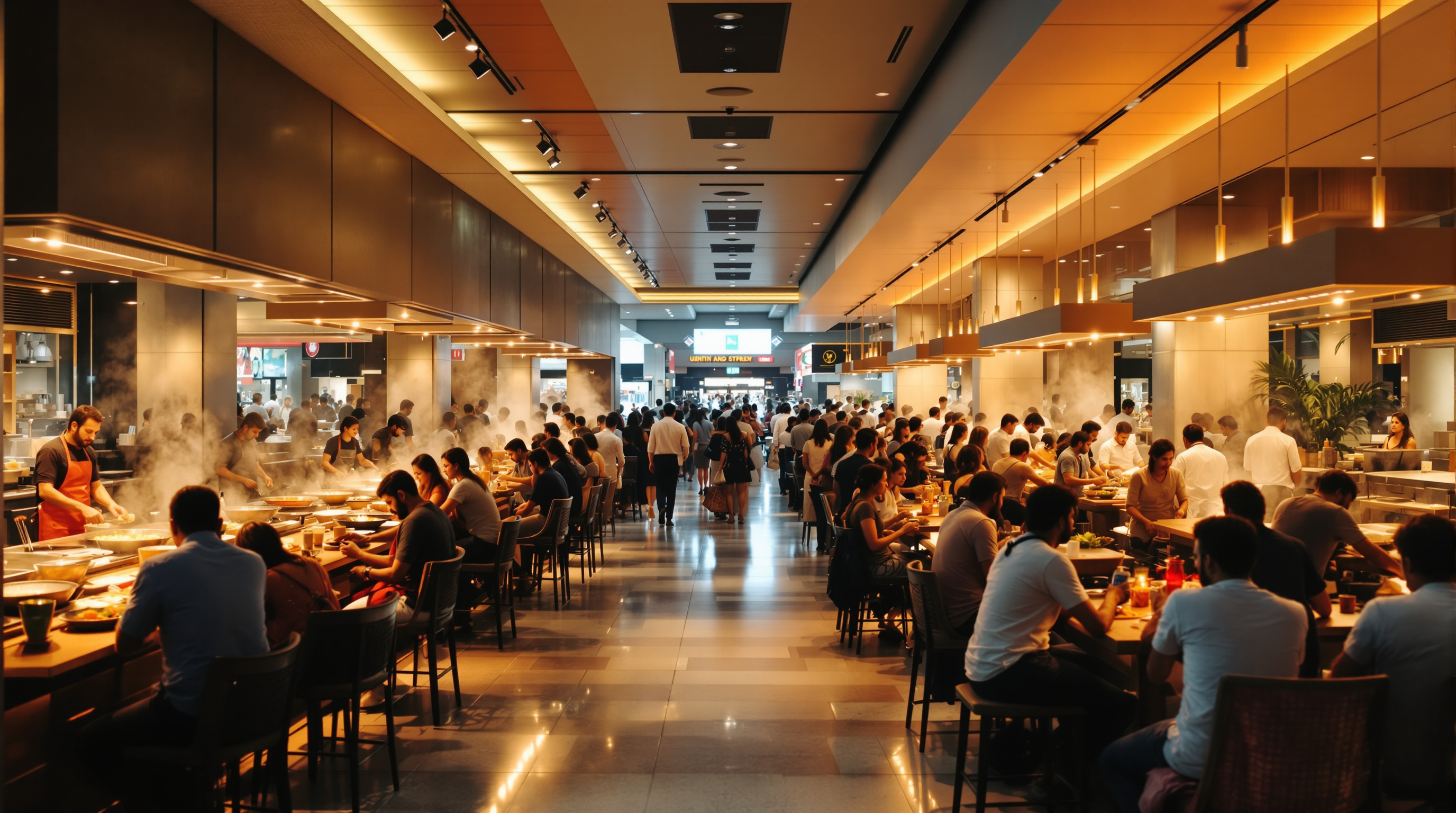
Start with what makes a mall different. Three characteristics dominate every design decision.
1. A violently peaky flow. Footfall drives everything, and mall footfall is not constant. A large mall can see 60–70% of its daily flow arrive in the Friday-to-Sunday window, and within a day the load concentrates around lunch, evening and closing. The washrooms empty in synchronised waves after a film ends. The result is a peak-hour flow several times the daily average — an equalisation problem before it is a treatment problem.
2. High-strength food-court effluent. The food court is the villain. Kitchen wastewater carries oil, grease, food solids and a BOD often two to three times that of domestic sewage. Left untreated it coats pipes, blinds media and starves the biological process of oxygen. Any STP for restaurants fights this battle; a mall fights it at ten kitchens at once, all discharging into a shared line.
3. A relatively low resident load, huge transient load. Unlike an apartment block, almost nobody lives here. The load is generated by visitors and staff who use washrooms and eat, but rarely bathe or wash clothes. So the sewage is comparatively concentrated — less dilute greywater, more toilet and kitchen waste per litre — which pushes the incoming BOD and COD higher again. If you are still fixing the vocabulary of these numbers, the wastewater characteristics primer on BOD, COD, TSS and pH is the place to start.
Sizing: footfall, not headcount
Most STP sizing begins with occupancy. For a mall that logic breaks, because "occupancy" is a moving target that triples on weekends. Sizing is instead built from fixture-based and footfall-based demand, cross-checked against water consumption.
The standard route is to estimate design footfall, apply a per-visitor water figure (a mall visitor typically consumes far less than a resident — on the order of 10–15 LPCD for washroom use), add staff on a higher per-head figure, and add the food-court kitchens separately at their own high rate. The water consumption calculator and the sewage generation calculator let you build that stack quickly; the STP capacity calculator then converts it into a plant capacity in KLD.
A rough shape of the demand stack for a mid-to-large Indian mall:
| Load source | Typical basis | Character of the flow |
|---|---|---|
| Visitor washrooms | ~10–15 LPCD × design footfall | Extreme peaks, low strength |
| Staff & retail employees | ~45 LPCD × headcount | Steady through mall hours |
| Food-court kitchens | High per-outlet, fixture-based | High grease, high BOD |
| Common-area & housekeeping | Floor-area based | Modest, steady |
| Cooling-tower make-up | Demand side, not a source | The big reuse sink |
Two sizing rules matter more here than almost anywhere else. Oversize the equalisation tank — a mall needs far more balancing volume than a residential project of the same KLD, because the job of equalisation is to flatten those weekend and post-show peaks into a flow the biology can handle calmly. And do not size on average flow alone; check the plant against peak-hour hydraulic load so it does not overflow when the mall is fullest.
Which technology suits a mall
The peaky, greasy, space-constrained nature of a mall points firmly toward compact, robust, load-tolerant systems. The realistic choices:
- MBBR (Moving Bed Biofilm Reactor) — the workhorse for many malls. Its biofilm-on-media design shrugs off shock loads and flow swings better than a plain suspended-growth system, and it is compact enough for a basement. See how MBBR works.
- SBR (Sequential Batch Reactor) — handles variable flow well by treating in timed batches, and gives a high-quality effluent from a small footprint. Read the SBR guide.
- MBR (Membrane Bioreactor) — the premium option where reuse quality must be very high (cooling towers reward low turbidity) and space is tight, since it needs no separate clarifier. It produces near-tertiary effluent but costs more to run and demands disciplined operation. See the MBR guide.
Whatever the core technology, the extended aeration and activated-sludge family principles still apply, and every mall STP shares the same non-negotiable front end: serious grease pre-treatment. Individual grease traps at each kitchen outlet, a central oil-and-grease trap on the food-court line, and generous equalisation must all sit ahead of the biology. Skimp on this and no technology downstream will save you.
The payoff: cooling-tower reuse and strong economics
Here is where a mall turns its wastewater liability into an asset. A fully air-conditioned mall runs large cooling towers that evaporate water continuously, and their make-up demand is enormous — often the single largest water use in the building. Treated STP water, polished to a low BOD, TSS and turbidity, is ideal cooling-tower make-up.
Line up a mall's reuse sinks and the picture is unusually favourable:
- Cooling-tower make-up — the headline sink, capable of absorbing a large share of the plant's output every day.
- Toilet flushing — piped back on a separate dual-plumbing line.
- Landscape and common-area washing — driveways, basements, planters.
- Groundwater recharge for any genuine surplus.
Because the reuse demand (cooling + flushing) is so large and runs whenever the mall is open, a well-run mall can approach near-zero freshwater discharge, recovering the great majority of what it consumes. That is a direct, monthly saving against tanker and municipal water — the reason the reuse economics for malls are among the strongest of any building type, echoing the logic laid out in why every modern building needs an STP.
Basement siting and the compliance angle
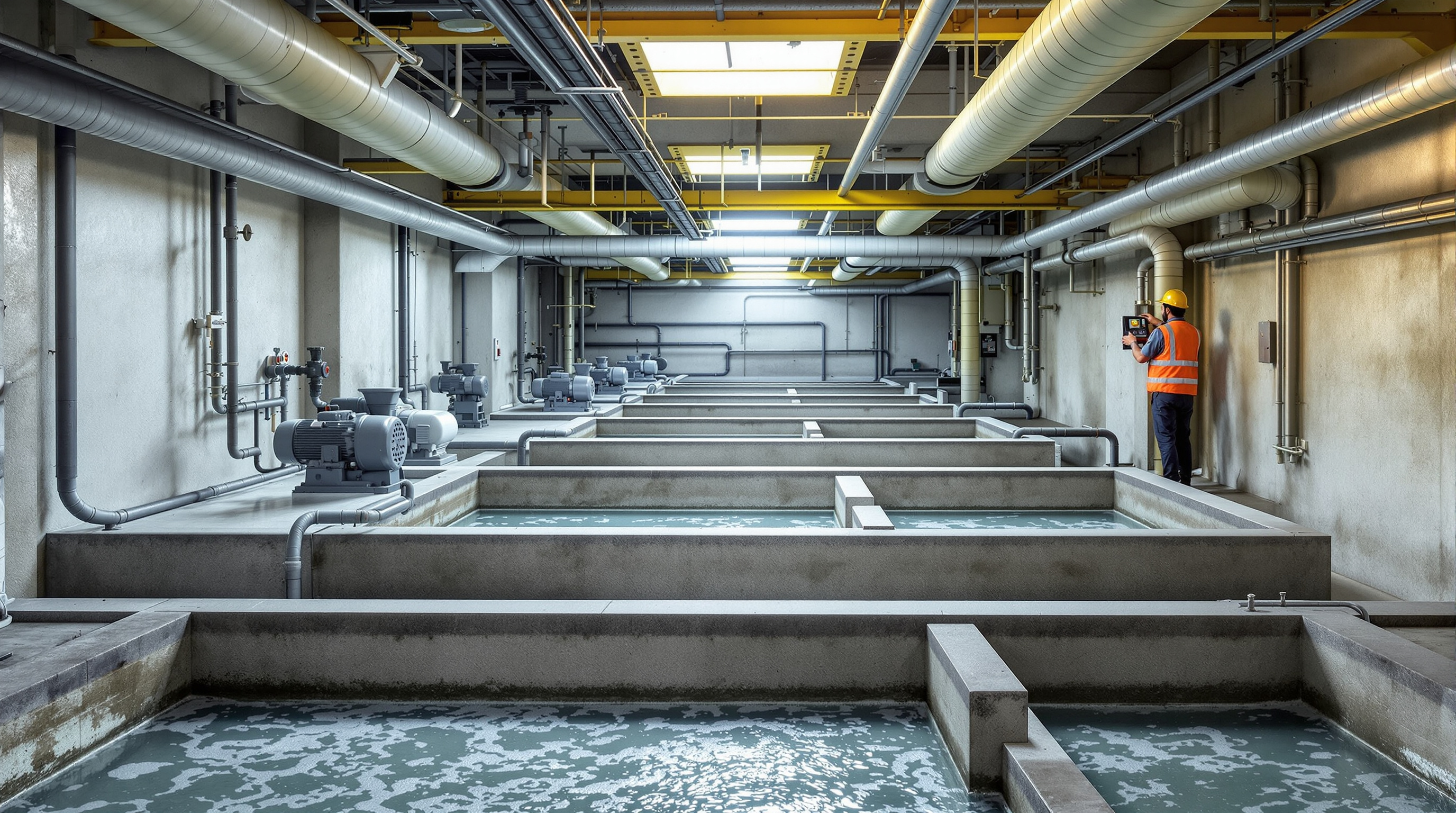
Mall STPs almost always live in the basement, tucked among the parking and services. That drives a set of practical requirements: forced ventilation and odour control so the plant never taints the retail floors above, acoustic treatment of blowers, adequate headroom for tank access and de-sludging, and a clear sludge-removal route. Because the plant sits under an occupied, high-value building, odour and noise containment are design requirements, not afterthoughts.
On compliance, a mall is a large commercial establishment and falls squarely within the consent regime of the State Pollution Control Boards under CPCB direction, with NBC provisions governing the plumbing and dual-piping. The effluent must meet the prescribed reuse and discharge standards, and — critically for a mall — it must meet them during peak footfall, not just on average. Design margin, robust pre-treatment and honest peak-flow sizing are what keep a mall inside its consent conditions on a packed Saturday night.
The common mistakes
- Under-designing equalisation. The most frequent failure. Too little balancing volume and every weekend peak blows straight through the plant.
- Treating the food court as ordinary sewage. Inadequate grease interception is the second great killer — grease chokes media, blinds membranes and crashes the biology.
- Sizing on average flow. Ignoring the peak-hour multiplier produces a plant that overflows exactly when the mall is fullest.
- Forgetting odour and noise. A basement plant under a retail floor that smells or drones is a commercial problem, not just an engineering one.
- Ignoring the reuse plumbing early. Dual piping and cooling-tower tie-ins must be designed into the building from day one; retrofitting them later is painful and expensive.
The bottom line
A mall hands its STP the hardest brief in commercial wastewater — a greasy, high-strength, wildly peaky flow — and then, in the same breath, offers the best reward, a cooling-tower and flushing demand large enough to swallow nearly all of the treated water back. Meet the brief with strong grease pre-treatment, oversized equalisation, a shock-tolerant technology like MBBR, SBR or MBR, and disciplined basement siting, and the mall's mess becomes its water supply.
From here, two next steps. To place the mall alongside its commercial cousins, compare the approaches for an STP for office buildings, an STP for hotels and an STP for IT parks in the wider Sewage Treatment Plants guide library. And to put a number on your own project, spend a minute with the STP Capacity Calculator — for a mall, run it at peak footfall, not the daily average.
Export this guide
Related Guides — Deep-dive reading
STP for High-Rise Buildings: Solving the Vertical Challenges
Why an STP in a tower is a different animal from one in a low-rise block — sharp peak flows, a basement site starved of air and light, treated water that has to be pumped forty floors up, and odour and fire clearances that decide whether the plant gets signed off at all.
Sewage Treatment PlantsSTP for Office Buildings & IT Offices: Sizing, Reuse & Design Guide
Why office STPs need lower per-person LPCD, a weekday-only flow strategy and a generous equalisation tank — plus which technology suits, how to size it, and where flushing and cooling-tower reuse pay for themselves.
Sewage Treatment PlantsSTP for Hotels: High Per-Guest Loads, FOG & Water Reuse Explained
Why hotel wastewater is heavier and swingier than an apartment's, which STP technology (MBBR vs MBR) actually fits, how to size for peak occupancy, and where the treated water pays for itself — in laundry, cooling and landscape.
Sewage Treatment PlantsRelated Tools — Try Free
Cross-Ventilation Analyzer
Estimate airflow and air changes per hour (ACH) from room size, window areas, layout, and local wind — with NBC 2016 Part 8 compliance check.
Ventilation CalculatorSewage Generation Calculator
Estimate the daily sewage a building generates and its peak flow in KLD from occupancy, LPCD, sewage return factor and peak factor.
STP CalculatorSTP Capacity Calculator
Size a sewage treatment plant in KLD from your building's occupancy — water demand, sewage generated and recommended STP capacity.
STP Calculator