
STP for Schools, Colleges & Universities: A Campus Design Guide
Why educational-campus sewage swings hard between packed term-time days and empty vacations, which STP technology handles that rhythm, how to size for peaky daytime flow, and how to reuse treated water on grounds — with O&M simple enough for a campus caretaker.
A school, college or university is one of the most distinctive sewage generators an engineer will ever size a plant for. Its wastewater does not trickle out steadily the way an apartment block's does. It arrives in violent bursts — hundreds or thousands of people flushing toilets in the ten minutes between periods, then near-silence overnight, on weekends, and for weeks at a stretch during vacations. Design an STP for a campus as if it were a residential building and you will build something that floods at 11 a.m. and starves in May. Getting the stp for educational institutions right is almost entirely about respecting that rhythm.
A campus STP is sized by its worst fifteen minutes, not its daily total. The whole design problem is smoothing a sharp, term-time, daytime peak into a flow the biology can digest — then keeping the microbes alive through the long, dry vacation when almost no sewage arrives.
This guide walks through the wastewater profile of educational campuses, the technologies that suit them, how to size and reuse, the compliance basics, and the mistakes that catch out first-time campus designs. If you are new to how these plants work at all, start with what is a sewage treatment plant and how does an STP work, then come back.
The campus wastewater profile: peaky, seasonal, and split two ways
Three features define educational-campus sewage, and each one drives a design decision.
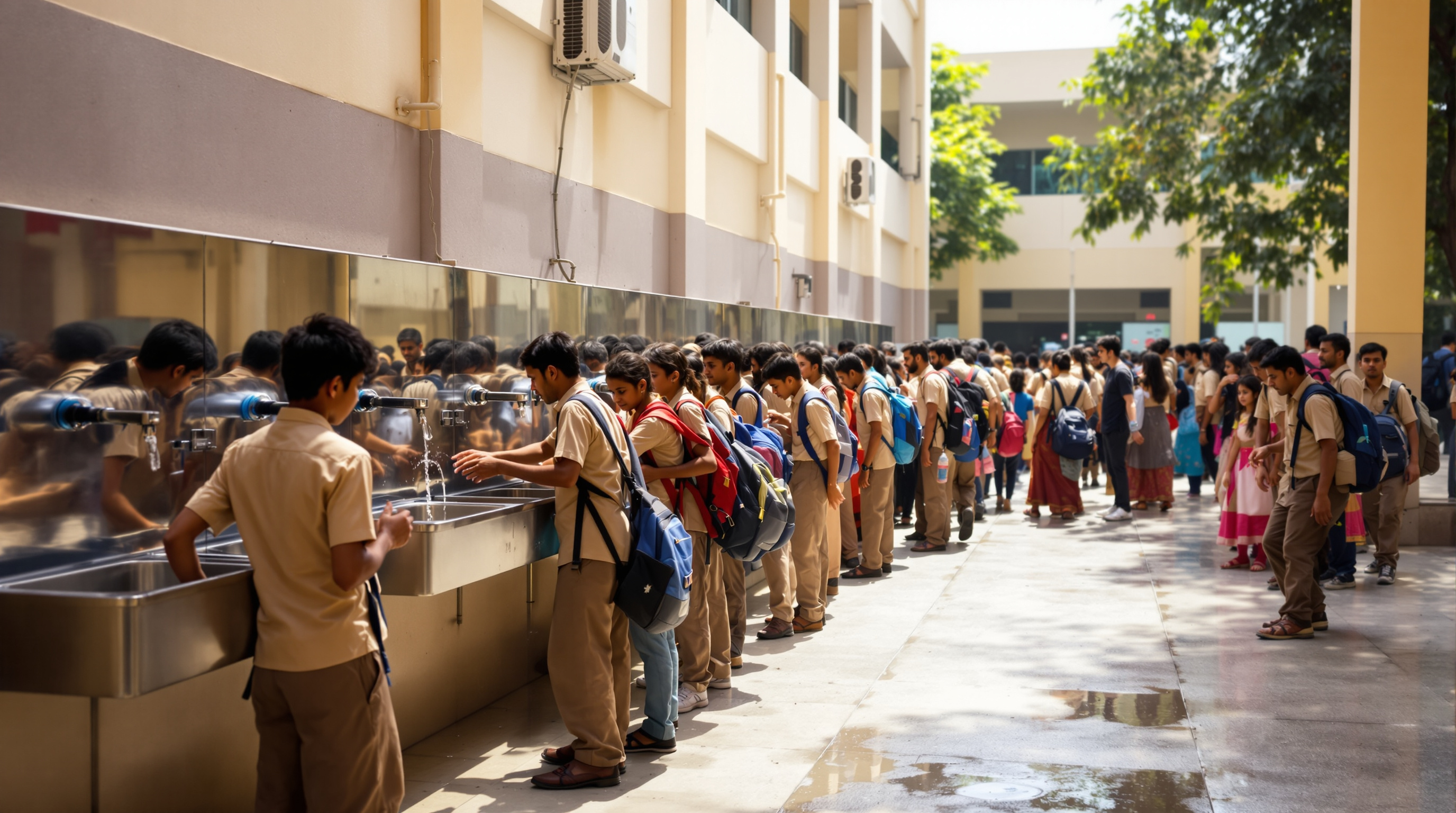
1. A brutal daytime, term-time peak. In a day-scholar school, essentially the entire day's sewage is produced between roughly 8 a.m. and 3 p.m., concentrated further into the short recess and lunch windows when everyone uses the toilets at once. The instantaneous peak flow can be three to five times the average — far peakier than a hotel or an apartment block. This is the single most important fact in the whole design.
2. Deep seasonal troughs. Summer and winter vacations, plus every weekend and public holiday, drop the load to a fraction of design flow — sometimes to zero for a residential-free day school. Biological plants hate this. The microbial culture needs a steady diet of organic matter; starve it for six weeks and it dies off, and the plant needs days to recover when term resumes.
3. A day-scholar vs boarding split. This changes everything about load:
- Day scholars contribute only the flushing, hand-washing and canteen water of school hours — a low per-head volume but concentrated into that daytime spike.
- Boarders / hostellers live on site and behave like residents: bathing, laundry, kitchen, round-the-clock toilet use. Their per-head sewage volume is several times a day scholar's, and it is spread more evenly across 24 hours.
A large university is usually a blend — day scholars, hostels, staff quarters, a mess, labs and sports facilities — and each block has its own signature. For the underlying numbers on what each population contributes, the Water Consumption Calculator and the Sewage Generation Calculator translate headcounts into litres.
Typical design allowances
Indian practice (directionally following NBC / CPCB water-supply norms) uses per-head allowances something like the table below. Treat these as planning figures, not gospel — confirm against your local authority and actual fixtures.
| Population type | Typical water demand (LPCD) | Sewage generated (~80%) | Flow pattern |
|---|---|---|---|
| Day scholars (school/college) | 20–45 | 16–36 | Sharp daytime peak, term only |
| Resident students (hostels) | 120–135 | ~95–110 | 24-hour, term only |
| Staff quarters | 100–135 | ~80–110 | Residential, year-round |
| Day staff / faculty | 20–45 | 16–36 | Daytime, term only |
Note the special contaminants a campus can throw at a plant: canteen and mess kitchens deliver oil, grease and food solids (a properly sized oil and grease trap is non-negotiable), and science, chemistry or biology labs can send small volumes of solvents, reagents or heavy metals into the drains. Lab waste is not domestic sewage — it should be segregated and neutralised separately, never dumped raw into a biological STP that is built only for organic load.
Which STP technology suits a campus — and why
The technology question is dominated by one need: surviving the peaks and the starvation without a full-time operator. That points firmly toward robust, buffered, biofilm-based or batch systems over delicate ones.
- MBBR (Moving Bed Biofilm Reactor) is the workhorse choice for most schools and colleges. The biomass grows attached to floating plastic media, so it clings on through low-flow vacation periods far better than free-floating sludge, and it shrugs off shock loads. It is compact and forgiving. See MBBR explained.
- SBR (Sequencing Batch Reactor) handles the intermittent, batchy nature of campus flow elegantly — it treats in timed cycles, so an empty tank between batches is normal rather than a crisis. Good where flow is very peaky and land is tight. See SBR.
- Extended-aeration / ASP variants are proven and cheap to run but their free-floating culture is the most vulnerable to vacation starvation; workable for large residential universities with steady year-round hostel load. See the activated sludge process.
- MBR (Membrane Bioreactor) gives the highest-quality reuse water in the smallest footprint, but the membranes demand skilled upkeep and steady flow — usually overkill and too maintenance-heavy for a school caretaker. Reserve it for prestige universities with an O&M contract. See MBR.
For a fuller technology comparison, the Sewage Treatment Plants hub lays out every process side by side.
Whatever the core, one component matters more on a campus than almost anywhere else: a generously oversized equalisation tank. This is the buffer that catches the recess-time flood and releases it to the aeration tank at a steady rate the microbes can actually digest. On a residential building you might size equalisation for a few hours; on a peaky day school, size it to hold a large share of the day's flow so the biology sees a gentle stream instead of a tidal wave.
Sizing: design for the peak, protect against the trough
A campus STP is sized in litres per day (KLD), but the tank volumes are driven by peak flow. The workflow:
1. Count each population separately — day scholars, boarders, staff, faculty — and apply its own LPCD allowance. Do not use a single blended figure.
2. Sum to average daily flow, then apply a peak factor well above residential norms (campuses commonly justify 3–4x on the peak hour). The STP Capacity Calculator does the headcount-to-KLD conversion in a minute.
3. Oversize equalisation to flatten that peak — this is where campus designs live or die.
4. Plan for phased growth. Schools add sections and colleges add courses; a plant that is exactly right today is undersized in three years. Build in modularity or spare hydraulic capacity.
A word of caution against the opposite error: do not size for the packed peak and forget the empty trough. A plant that is enormous for its average flow will sit half-starved most of the time. The art is a right-sized biological core fed by a large buffer.
Reuse: the campus is the perfect customer for its own water

Educational campuses are almost the ideal place to reuse treated water, because they own exactly the things that consume it:
- Sports grounds, lawns and gardens — often acres of them, thirsty year-round, and irrigable with treated water.
- Toilet flushing via a dual-plumbing line — the single biggest indoor reuse.
- Cooling towers for central AC in auditoriums and larger buildings.
- Groundwater recharge across the open campus land.
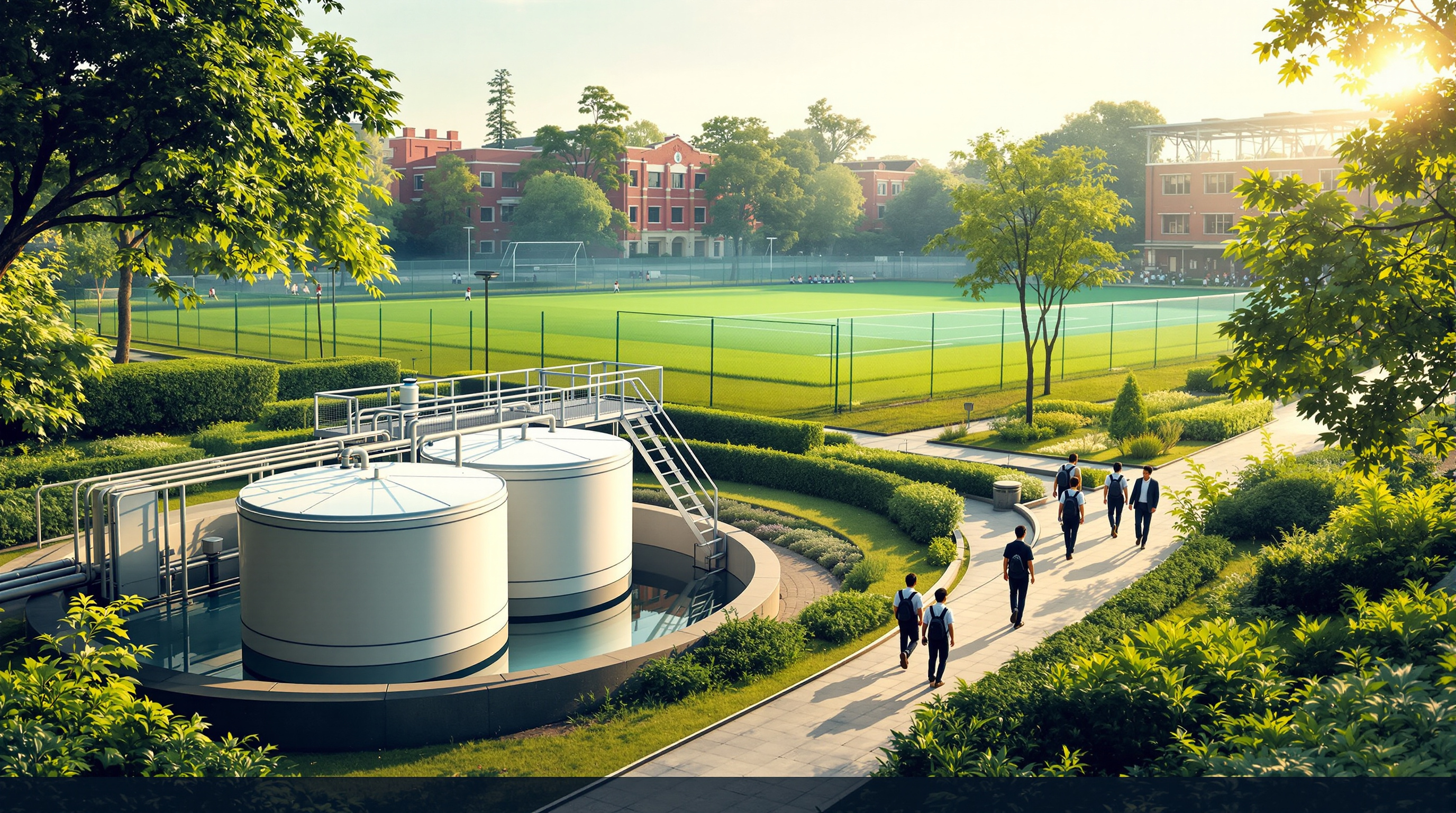
A well-run campus STP can recover 80–85% of consumption, which on a large university is lakhs of litres a month kept off the tanker bill. There is a second dividend unique to this building type: the plant is a teaching asset. A transparent, well-signposted STP becomes a living lesson in the water cycle, microbiology and sustainability — many NAAC- and green-rated institutions actively showcase theirs. That eco and pedagogical value is worth designing in, not hiding in a basement. To go further on reuse, see home greywater recycling systems for the plumbing principles that scale up.
Compliance and the O&M reality
Most medium and large campuses fall above the threshold that makes an on-site STP mandatory under state pollution-control board rules, and treated water must meet discharge/reuse norms before it leaves site or touches the grounds. Consent-to-operate, occupancy approvals and green-building credits all hinge on it — the reasoning is laid out in why every modern building needs an STP.
But the defining O&M truth of a campus is this: there is rarely a trained plant operator. The STP is minded by the same maintenance staff who look after the generator and the pumps. So the design must be genuinely low-skill and robust — simple controls, clear SOPs, automated dosing where possible, and a technology (MBBR, SBR) that tolerates neglect and recovers from vacation shutdowns. An annual maintenance contract with the vendor is the norm, not a luxury.
Common mistakes on campus STPs
- Sizing to daily average, ignoring the recess peak — the classic failure that causes overflows and untreated bypass at lunchtime.
- Undersized equalisation — no buffer, so every peak is a shock load.
- Vacation starvation killing the culture — no plan to keep microbes fed (recirculation, partial feed, or a starvation-tolerant technology) during long breaks.
- Blending day-scholar and boarder loads into one figure — wildly wrong volumes and patterns.
- Dumping lab and mess-kitchen waste raw into a domestic STP — segregate labs; trap the grease.
- Specifying delicate, high-skill technology (MBR) for a site with no operator.
- No phasing headroom — the campus grows and the plant cannot.
Get the peak, the buffer and the O&M right, and a campus STP becomes exactly what an educational institution should model for its students: infrastructure that closes its own water loop, cheaply and reliably. For deeper reading on the underlying processes, browse the full STP guide library.
Export this guide
Related Guides — Deep-dive reading
STP for Hotels: High Per-Guest Loads, FOG & Water Reuse Explained
Why hotel wastewater is heavier and swingier than an apartment's, which STP technology (MBBR vs MBR) actually fits, how to size for peak occupancy, and where the treated water pays for itself — in laundry, cooling and landscape.
Sewage Treatment PlantsSTP for IT Parks & Campuses: Central-Plant Design, Reuse & Redundancy Guide
How to plan a campus-scale sewage treatment plant for a multi-building IT park in India — the daytime flow pattern, the right technology, sizing for a central plant, and a reuse network feeding landscape, flushing and cooling towers.
Sewage Treatment PlantsApartment STP Planning Guide: Sizing, Space & Compliance
How to plan a sewage treatment plant for an apartment complex — sizing it from occupancy, choosing the right technology, finding space for it, plumbing it for reuse, and keeping it compliant and running for years.
Sewage Treatment PlantsRelated Tools — Try Free
Sewage Generation Calculator
Estimate the daily sewage a building generates and its peak flow in KLD from occupancy, LPCD, sewage return factor and peak factor.
STP CalculatorRainwater Tank Sizer
How big should your rainwater tank be? Computes annual harvest, recommended tank capacity in litres, water-bill savings, and payback — for 10 Indian cities.
RWH CalculatorDaily Water Consumption Calculator
Estimate a building's total daily water consumption in KLD from occupancy and LPCD, with the end-use split across bathing, flushing, washing, kitchen and drinking.
Water Calculator