
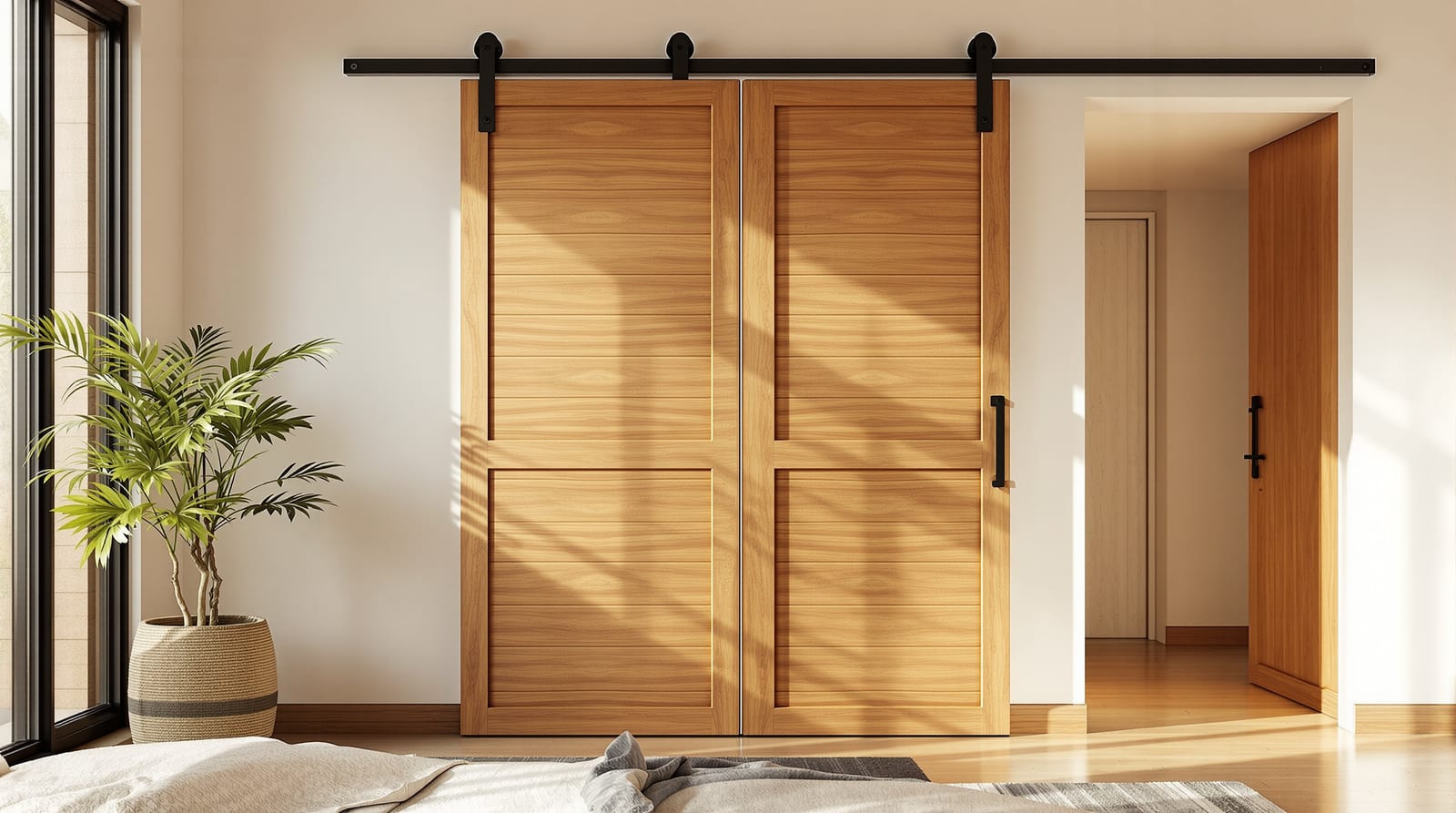
Barn Doors in India (2026): Sliding Top-Hung Doors for Bedrooms, Bathrooms & Small Homes
How top-hung sliding barn doors work, where they save space, what they cost in rupees, and their real privacy and soundproofing limits for Indian interiors.
A barn door is the simplest space-saving trick in interior design: instead of swinging into the room, the leaf hangs from rollers on an exposed track above the opening and slides sideways onto the wall beside it. No floor channel, no swing arc eating a metre of usable floor — which is exactly why barn doors have moved from rustic farmhouses to compact Indian flats, where every square foot of a 2BHK is fought over. This guide covers how the top-hung hardware actually works, where it genuinely saves space (and where it does not), leaf materials, single versus bypass layouts, and the privacy and soundproofing limits you must accept before you commit. For the full door landscape, see the complete guide to home doors in India and the types of doors comparison.
How a top-hung sliding barn door works
A barn door has no hinges and, crucially, no bottom track set into your floor. The entire weight of the leaf hangs from two roller hangers (also called trolleys or carriages) that ride along a steel track fixed to the wall above the opening. You slide the leaf left or right by hand; it parks flat against the adjacent wall when open.
The hardware kit you buy has a handful of parts that each do one job:
- Track: a flat steel bar (typically 6-8 mm thick) or a tubular rail, mounted horizontally above the door. Its length must be at least twice the door width so the leaf can clear the opening fully. Powder-coated matte black is the popular finish; stainless and brushed nickel suit modern interiors.
- Roller hangers: two wheeled carriages bolted to the top edge or top face of the leaf. They carry the load and let it glide. Sealed ball-bearing rollers run quieter and last longer than cheap nylon wheels.
- Track stoppers / end caps: small blocks that stop the leaf from rolling off either end.
- Floor guide: a small pin or channel at the bottom, fixed to the floor or to the wall skirting, that stops the leaf swinging away from the wall. It does NOT carry weight — it only keeps the bottom edge in plane. This is the only floor contact, and it is unobtrusive, unlike a sliding door with a recessed bottom channel.
- Anti-jump discs / wall spacers: keep the leaf a fixed gap off the wall and stop it lifting off the track.
- Handle: usually a flush pull or a ladder-style bar, since a barn door has no space for a projecting knob on the wall side.
Because all the load is overhead, the wall above the opening must be able to carry it. On a solid brick or RCC wall this is straightforward — you fix a backing rail or a timber header board across the studs/wall and bolt the track to that, spreading the load. On a hollow gypsum/drywall partition you MUST add a concealed timber or steel backer behind the board before fixing, or the track will tear out. Tell your carpenter the leaf weight up front; a solid teak door can weigh 30-45 kg.
Where a barn door saves space — and where it does not
A standard 900 mm hinged bedroom door sweeps a quarter-circle of roughly 0.9 m radius. That is close to 0.6 sq m of floor you can never put furniture in, plus the clearance you instinctively leave so the door does not bang the bed or wardrobe. A barn door reclaims all of it — nothing swings.
This makes barn doors excellent for:
- Bedrooms where a wardrobe, study table or bed crowds the doorway.
- Bathrooms and en-suites in compact flats (with the privacy caveats below).
- Study, home-office and store rooms, where a swing door collides with a desk or shelving. See our notes on a home-office door and store-room door.
- Walk-in wardrobes and utility nooks, where bypass barn doors close off open shelving.
- Pooja alcoves, as a sliding screen that tucks away during aarti and closes for privacy.
But there is one hard requirement people miss: the barn door needs clear, flat wall beside the opening as wide as the door itself. The leaf parks on that wall, so you cannot have a switchboard, light switch, framed photo, wardrobe shutter or another doorway in the parking zone. If the wall next to your bathroom door is where the geyser switch lives, the barn door will cover it. Where you have NO free adjacent wall, a pocket door (which slides into the wall cavity) is the better space-saver, and a plain sliding door on a wall track behaves similarly to a barn door. Before you decide, it is worth measuring the room and the swing/clearance properly — our students' walkthrough on how to measure a small room shows the method.
Single vs bypass (double) barn doors
There are two common layouts:
- Single leaf: one door, one track, parks on one side. Best for openings up to about 1100-1200 mm where you have wall to one side. This is the default for bedrooms and bathrooms.
- Bypass (double): two leaves on two parallel tracks (or a double-track kit), each sliding past the other in opposite directions. Used for wide openings — wardrobes, a wide study or a room divider — where you do not have wall on one side wide enough to park a single big leaf. Bypass leaves overlap slightly, so at any time only half the opening is clear; you cannot have both halves open at once the way a French or double door opens.
A bi-parting "barn" look (two leaves meeting in the middle and sliding to opposite walls) also exists but needs wall on BOTH sides equal to each leaf — generous for most Indian flats.
Leaf materials for Indian conditions
The track hardware is material-agnostic; what changes is weight, cost, finish and how the leaf behaves in our climate. Because the door hangs free and is handled by sliding, warping and weight matter more than for a hinged door.
| Leaf material | Indicative cost (leaf only) | Weight | Best for | Watch-outs |
|---|---|---|---|---|
| Flush + laminate (factory, IS 2202) | ~₹1,200-4,000 per shutter | Light-medium | Bedrooms, study, budget builds | Laminate edges can chip; seal all edges against monsoon swelling |
| MDF (membrane/PVC finish) | ~₹120-300/sq ft finish over board | Medium | Modern flat-panel, painted looks | MDF swells badly if it meets water — never for a bathroom in a damp zone |
| Solid wood / panelled | ~₹10,000-25,000+ per shutter | Heavy (30-45 kg) | Rustic and statement doors | Needs a stronger track and wall backer; check roller load rating |
| Teak (Burma/CP) | ~₹800-1,500+/sq ft | Heavy | Premium, carved or jali leaves | Costly; pair with sealed ball-bearing rollers |
| Glass (toughened, IS 2553) | from ~₹450-1,200/sq ft framed | Heavy | Modern, study, bathroom (frosted) | Use frosted/laminated for privacy; needs glass-rated clamps |
Costs are indicative, vary by city and vendor, and exclude the track kit, fitting and 18% GST. For a deeper material decision, see the door materials comparison and, for damp areas, the best door material for India. A glass-leaf barn door overlaps with our glass doors guide.
For a rustic look, carpenters build a plank-and-batten or Z-brace leaf in sal, mango or reclaimed teak. For a modern look, a clean flush leaf in a matte laminate or PVC membrane with a slim bar handle reads minimalist. For a Japanese shoji-style screen, a light timber frame with translucent acrylic or rice-paper-effect laminate gives a soft glow — popular as a pooja or study divider.
Inline diagram — top-hung track, roller and leaf
The honest limitations: gap, privacy and sound
A barn door is a surface-mounted slab covering an opening — it does not seal into a frame like a hinged door. That creates real trade-offs you should accept knowingly:
- Perimeter gap: the leaf sits a few millimetres off the wall and there is a gap at the top, sides and bottom. Light, smell, smoke and sound leak through. There is no rebated frame and no threshold seal unless you add brush seals.
- Privacy and locking: a standard barn door has no mortise lock. You get a sliding latch or a hook-and-eye at best, which makes it weak for a primary bathroom in a joint family or for any door you need to lock from both sides. For a bathroom, many homeowners prefer a proper hinged or bathroom door with a thumb-turn lock and treat the barn door as a secondary or aesthetic choice.
- Soundproofing: because of the perimeter gap, a barn door is the WORST common door type for sound. Do not use one between a bedroom and a TV room if quiet matters. If acoustics are the goal, read soundproof doors for India — a sealed, gasketed hinged door wins every time.
- Draughts and AC: the gap leaks conditioned air, so a barn door on an AC bedroom is slightly less efficient than a sealed door.
You can narrow these gaps — wall spacers tight to the wall, brush seals along the edges, a leaf 50-75 mm wider and taller than the opening so it overlaps generously — but you will never match the seal of a framed door.
Hardware quality and what it costs in India (2026)
The single biggest determinant of whether a barn door feels premium or rattly is the track-and-roller kit, not the leaf. Cheap kits use thin pressed steel and nylon wheels that go noisy within months; good kits use a thick flat-bar track and sealed ball-bearing rollers with a soft-close damper.
Indicative 2026 pricing (varies by city and vendor; add 18% GST):
| Item | Indicative cost |
|---|---|
| Budget track + roller kit (light leaf, nylon wheels) | ₹2,500-5,000 |
| Mid track kit (steel bar, ball-bearing rollers) | ₹5,000-12,000 |
| Premium kit (heavy-duty, soft-close, stainless) | ₹12,000-25,000+ |
| Flush/laminate leaf | ₹1,200-4,000 |
| Solid wood / teak leaf | ₹10,000-25,000+ |
| Fitting / installation labour | ₹800-3,000 per door |
| Wall backer board + fixing | ₹500-2,000 |
So a typical mid-range single barn door in a 2BHK lands around ₹12,000-25,000 all-in (mid kit + flush laminate leaf + fitting), while a rustic solid-wood statement door with a premium soft-close kit can cross ₹40,000-60,000+. A bypass (double) layout roughly doubles the kit and leaf cost. For the wider price picture see the door cost guide for India and the door cost calculator.
Buy the kit to a stated load rating above your leaf weight (a 45 kg teak door on a 30 kg-rated kit will sag and bind). Insist on a soft-close damper for bedrooms — without it a heavy leaf slams the end stopper.
Barn door vs pocket door vs swing door
| Factor | Barn (top-hung sliding) | Pocket door | Swing (hinged) |
|---|---|---|---|
| Floor swing space | None | None | ~0.6 sq m wasted |
| Needs free adjacent wall | Yes, full door width | No (hides in wall cavity) | No |
| Privacy / sealing | Weak (perimeter gap) | Moderate | Best (framed, sealed) |
| Soundproofing | Poorest | Moderate | Best |
| Locking options | Latch/hook only | Edge-pull lock available | Full mortise lock |
| Install in existing wall | Easy (surface-mounted) | Hard (needs cavity, best at construction) | Easy |
| Indicative all-in cost | ₹12,000-60,000+ | Often higher (cavity frame) | ₹5,000-25,000+ |
| Best use | Bedrooms, study, statement, small flats | Bathrooms, where no parking wall | Where seal/lock/sound matter |
In short: choose a barn door when you want the space-saving and the look, have a clear adjacent wall, and can live with the gap. Choose a pocket door when there is no parking wall but you can build a cavity. Keep a swing door where privacy, locking or sound are non-negotiable.
Frequently asked questions
Do barn doors lock for a bathroom?
Not securely. A standard barn door takes only a sliding latch or hook-and-eye, not a mortise lock. For a main bathroom in a joint-family home, most homeowners fit a proper hinged bathroom door with a thumb-turn and use a barn door only for a dressing area or secondary loo.
Can a barn door go on a gypsum partition wall?
Only if you add a concealed timber or steel backer behind the board to carry the load — the whole door weight hangs from the track, and screws into bare gypsum will tear out. On brick or RCC walls, fix a header board and bolt the track to that.
Do barn doors warp in Indian monsoon humidity?
A free-hanging leaf shows warping more than a framed door, so material matters. Use a sealed factory flush door (IS 2202) or well-seasoned solid wood with all edges sealed; avoid raw MDF in damp or coastal homes, where it swells. See the best door material for India.
How much wall do I need beside the opening?
At least the full width of the door leaf, clear of switches, frames, wardrobes and other openings — that is where the door parks when open. If you do not have it, consider a pocket door instead.
Are barn doors good for soundproofing a bedroom?
No. The perimeter gap makes them the leakiest common door for sound and smell. If quiet matters, choose a sealed hinged door — see soundproof doors for India.
Export this guide
Related Guides — Deep-dive reading
Guest Room Door in India: Privacy, Quiet and Smart Picks Without Overspending (2026)
How to choose a guest bedroom door for an Indian home - privacy and acoustics so visitors feel comfortable, but budget-sensible for a room used only now and then: solid-core flush for quiet, panel or laminate for looks, the right privacy lock, simple soundproofing, and a finish that matches the rest of your doors - with picks ranked and indicative rupee costs.
Home Doors & EntrancesDoor Installation Cost in India 2026: Fitting Labour ₹ Per Door + Hardware, City Variance & GST
A focused 2026 guide to what it actually costs to fit a door in India — carpenter labour per door for flush, panel, heavy main and sliding shutters, plus hinges, mortise lock, tower bolt and closer hardware ₹ ranges, with worked bedroom and main-door totals.
Home Doors & EntrancesDouble Doors in India (2026): Two-Leaf Entrances, Proportions, Hardware & Cost
When a double-leaf door makes sense for Indian main entrances, pooja rooms and master suites, plus active/inactive leaf hardware, the Vastu note on even panels, security at the meeting stile and the rupee premium over a single door.
Home Doors & EntrancesRelated Tools — Try Free
Door Cost Calculator
Estimate the all-in cost of a door — leaf, frame, hardware, fitting and GST — by type, material and size.
Door CalculatorAcoustic Privacy (STC) Visualizer
Indian healthcare acoustic visualizer — compare wall assemblies and noise sources, see received SPL after STC attenuation, and check FGI 2018 / IS 1950 / NABH speech-privacy compliance with live dual-canvas waveform.
Acoustic ToolDoor Material Comparison Tool
Compare 2–4 door materials on cost, durability, maintenance, security and moisture resistance.
Comparison Tool