
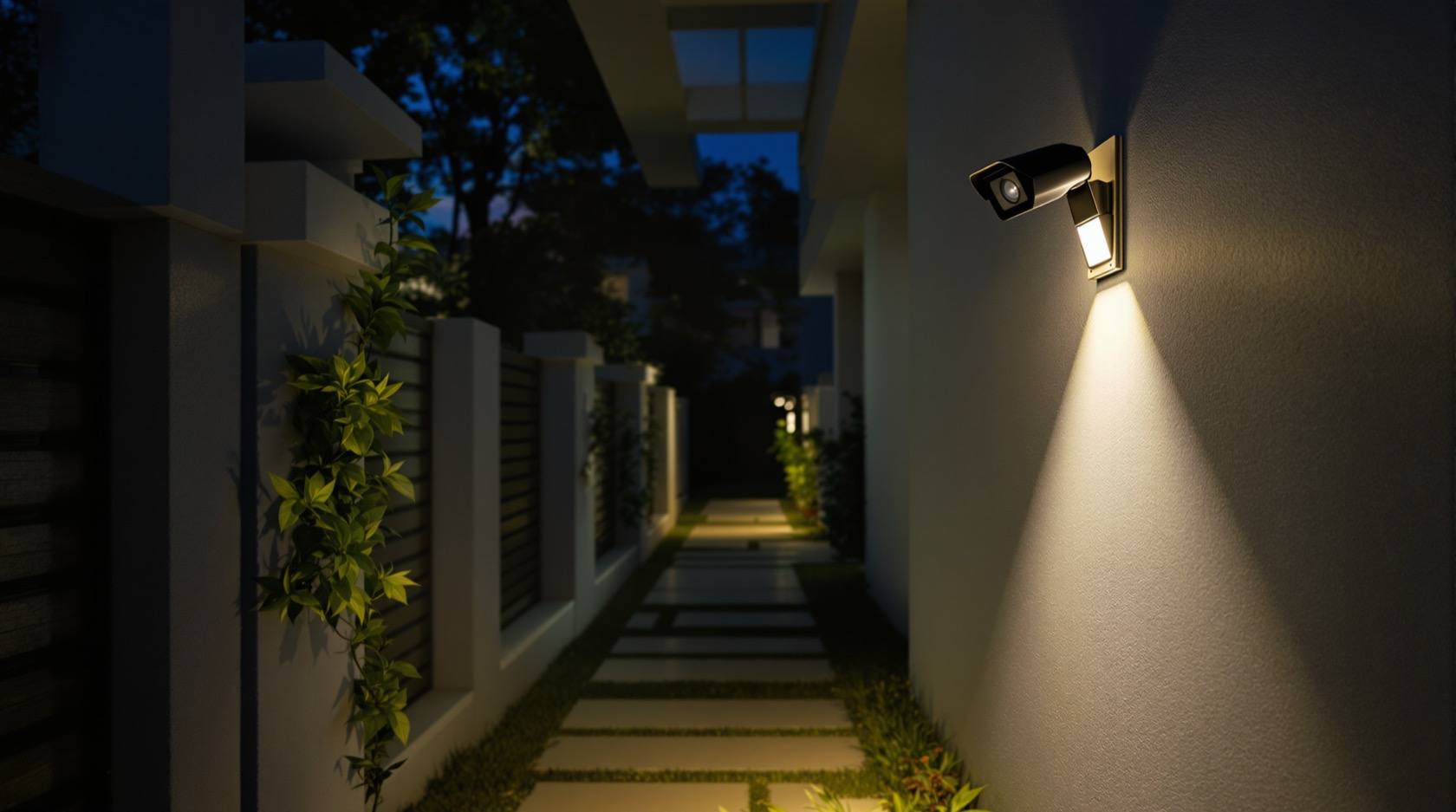
Security Lighting Integration for Smart Homes in India (2026): Making Light an Active Part of the Response, Not Just a Fixture
How to wire smart lighting into the security system so a sensor or camera can light an intruder for the camera to see, the alarm can throw every light full-on, and away-mode can fake occupancy — all built on a reliable base that keeps working when the hub, the network or the power drops.
Most homes treat security lighting as furniture: a lamp on a pole, a floodlight over the gate, switched on at dusk and forgotten. That is fine as far as it goes — steady light does deter, and a well-lit boundary is worth having. But once you have a smart security system — sensors, cameras, an alarm, a hub tying them together — light can stop being a passive fixture and become an active part of the response. A perimeter sensor can throw a floodlight on the moment someone crosses the line, so the intruder is suddenly lit and the camera can actually see them. The alarm can slam every light in the house to full brightness the instant it trips, disorienting an intruder, waking the household and shouting to the neighbours that something is wrong. While you are away, the same lights can fake a lived-in evening. This is security lighting integration: wiring the lights into the security logic so they do work, not just glow.
This guide is about the integration — how smart lighting and the security system work together. It is deliberately not a lighting-design manual: the craft of security lighting itself — how bright, how aimed, how to avoid glare and dark shadows, where to place a floodlight so it helps the camera instead of blinding it — lives in its own set of guides, and this one defers to them rather than repeating them. Here the question is narrower and just as important: once the lights are good, how do you make the security system use them well, and how do you do it without building something that goes dark the moment the hub, the network or the mains drops?
This guide sits under the complete guide to smart home security pillar. For the lighting craft itself — lux, aiming, glare, placement — see the security lighting design guide, motion-activated security lighting and dusk-to-dawn security lighting.
Scope & safety. This guide helps you plan and coordinate how smart lighting supports your defensive security system; it is strictly about protecting your own home, never about defeating anyone else's. Smart is convenience, not a guarantee — a light that only responds because a hub told it to is dark the moment the hub, the internet or the power drops, which in India is an everyday event. So the golden rule here is graceful degradation: keep a reliable, non-smart lighting BASE (dusk-to-dawn and standalone motion) that works with no smart layer at all, and let the smart automation only ADD on top. Every connected bulb and driver is an attack surface and, if it reports usage, a data collector under the Digital Personal Data Protection Act, 2023. Life-safety is never smart-only: smart bulbs may help light an escape path, but they do not replace a certified emergency-lighting system, and no lighting scene may ever disable a certified fire-alarm or trap anyone. All mains wiring, floodlight circuits and certified emergency/fire lighting are licensed-professional work — you specify and decide. Verify any standard's current status before relying on it. Educational guidance, not legal or security-consulting advice.
What integrating light with security actually buys you
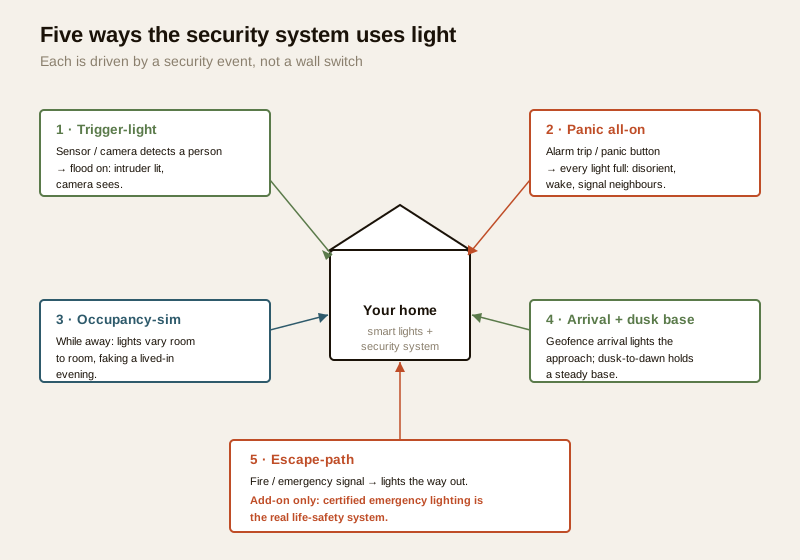
A steady lamp on a pole deters by being on. Integrated lighting does more, because it can change in response to what the security system detects. The value comes from turning light into part of the reaction — a thing that happens because a sensor tripped, a camera saw a person, or the alarm went off — instead of a fixture that only ever sits at one setting. Five uses are worth building, and each ties into a part of the system you may already have.
Two of them are the headline moves — the ones that most change how your home behaves under threat — so they get their own sections below. The other three round out the set.
Sensor- and camera-triggered light: so the camera can actually see
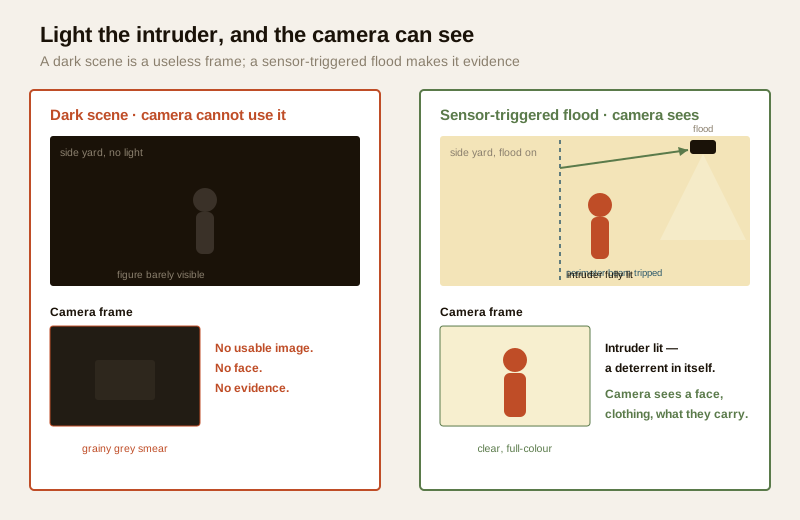
Here is the single most useful integration, and the one people most often miss. A camera is only as good as the light falling on the scene. A perimeter that is dark when someone crosses it gives you a black frame, a blur, or grainy night-vision that a court and a control-room operator can do little with. Now connect a light to the trigger: the moment a perimeter motion sensor fires, or an AI camera detects a person crossing the boundary, the floodlight snaps on. In one action you get two benefits: the intruder is suddenly, startlingly lit — a deterrent in itself, because being lit up means being seen — and the camera's view flips from a useless dark frame to a bright, usable, full-colour one that shows a face, clothing and what they are carrying.
A few things to plan for when you build this:
- Trigger the light from the security detection, not just the light's own PIR. A standalone motion floodlight already exists and is valuable (keep it — it is part of your base). Integration adds a second path: the alarm sensor or the camera's person-detection also commands the light. That means the light responds to the security event, in step with the alarm arming and the camera recording, not just to any passing cat.
- Aim the light for the camera, not against it. A floodlight pointed back toward the camera blinds it with glare and silhouettes the intruder into a black shape. This is the "light for the camera, not against it" rule, and it is a design question — how and where to place and aim the floodlight so it lights the subject without dazzling the lens — so follow the security lighting design guide for the craft. Integration only decides when the light fires; design decides where it points.
- Let the camera see in the dark anyway. The triggered flood is the ideal, but the camera should still have its own night vision as a fallback, so that if the light fails to fire you are not blind. Belt and braces.
- Mind alert fatigue and the neighbours. A flood that blazes on at every stray movement all night trains you to ignore it and annoys the lane. Tie the aggressive full-flood to genuine security detection (a real person on the boundary), and let the gentler dusk-to-dawn base carry the routine hours.
Alarm and panic lighting: every light full-on when it matters
The second headline move is dramatic and simple: when the alarm trips — or you hit a panic button — every light in the house goes to full brightness at once. This is a lighting scene wired into the alarm, and it does three jobs simultaneously. It disorients an intruder, who expected to work in the dark and is now standing in a fully lit house that has plainly noticed them. It wakes and guides the household, turning a confusing, frightening middle-of-the-night alarm into a lit path — you can see the stairs, the exit, the children's rooms — instead of stumbling in the dark. And it signals the neighbours: a house that suddenly lights up like a stadium at 2 a.m., with the siren sounding, is impossible to ignore, and a watching neighbour is exactly the response you want.
Build this as part of the panic and alarm scene, alongside the siren:
- Make it part of the panic scene, not a separate button. A single panic trigger — a physical button, an app control, a keypad duress code — should fire the whole response at once: siren on, all lights full, cameras recording, alert sent. Wiring this together is exactly what security automation scenes are for, and the lighting is one line in that scene.
- Full and steady beats a strobe for most homes. A flashing strobe can be disorienting to everyone, including a panicking household and anyone with a photosensitive condition. For most homes, bright and steady everywhere is the safer, clearer choice — it lights the escape and exposes the intruder without adding chaos. Decide deliberately.
- Do not let the panic scene fight life-safety. Lighting the house on a break-in alarm is good. But the alarm/panic lighting scene must never interfere with a certified fire-alarm or its evacuation logic — the two must coexist, with fire life-safety always taking priority. See the fire section below and the section's security and fire-alarm integration guidance.
- Have a manual override. You must be able to force every light on (and off) with a physical switch, not only through the app, in case the hub is down at the exact moment you need the lights.
The other three integrations: occupancy, arrival and escape
Occupancy simulation while away. The oldest deterrent, modernised: while the house is empty, the lights vary room to room in a randomised, lived-in pattern so a watcher reads the house as occupied. This is a whole discipline of its own — how to avoid the cheap-timer tell, and the non-light signs that give an empty house away — covered in occupancy simulation. For integration, the point is simply that the same smart lights that serve the alarm and the camera also run the away-mode scene, driven by the away/armed state.
Arrival, geofence and dusk-to-dawn as base scenes. As your phones leave and return, the system knows whether the house is occupied — that is geofencing for home security. Tie lighting to it: as you arrive home late, the approach and porch light so you are not fumbling at a dark gate; as everyone leaves, the away lighting takes over. Underneath all of it sits the plainest, most reliable layer of all — a dusk-to-dawn base that simply keeps the boundary and entrances lit through the dark hours whether or not anything smart is working.
Path and egress lighting on an emergency trigger. On a fire or emergency signal, lights along the route to the exit can come on to help people find their way out. This is genuinely useful — but it comes with a hard caveat that gets its own section, because a smart bulb is not a life-safety device.
| Integration | Trigger | What the light does | Ties into |
|---|---|---|---|
| Triggered flood | Perimeter sensor / camera person-detection | Snaps on so the intruder is lit and the camera sees | Smart sensors, AI CCTV |
| Panic / alarm lighting | Alarm trip or panic button | All lights full-on: disorient, wake, signal | Automation scenes, sirens |
| Occupancy simulation | Away / armed state | Varies room to room to fake occupancy | Occupancy simulation, geofencing |
| Arrival + dusk base | Geofence arrival; dusk-to-dawn | Lights the approach; holds a steady base | Geofencing; base lighting |
| Escape-path lighting | Fire / emergency signal | Lights the route out (add-on, not the system) | Emergency lighting, fire-alarm |
The reliability discipline: a base that never fails dark
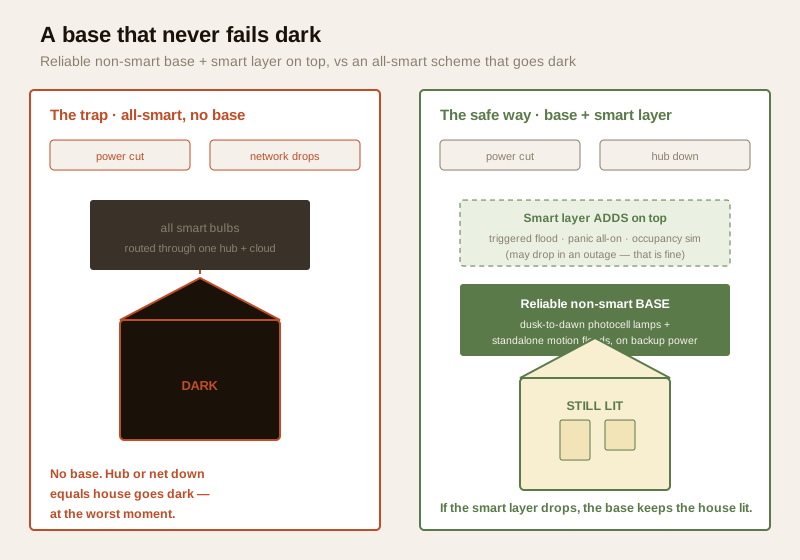
This is the part that separates a professional integration from a fragile toy, and it is the thread that runs through everything above. A smart light that fails offline must never leave you dark. The whole point of security lighting is that it is there when you need it — and you need it most in exactly the conditions where smart things break: a power cut, an internet outage, a hub crash, a firmware bug, a flat battery in a wireless switch. If your entire lighting scheme lives inside the smart layer, then a six-hour load-shedding cut or a router reboot takes your security lighting down with it, and the house goes conspicuously dark at the worst possible moment.
The discipline, in order:
- Build a reliable non-smart base first. The security lighting that matters — the dusk-to-dawn boundary and entrance lamps, the standalone motion floodlights — should work as plain, dumb, self-contained fixtures with no dependence on a hub, an app or the internet. A photocell dusk-to-dawn lamp turns itself on at dark; a standalone PIR floodlight fires on its own. These keep working when everything smart is down. This base is your floor, and it must never be smart-dependent.
- Let smart automation only ADD to the base. The triggered flood, the panic all-on, the occupancy scene — these are additions on top of the reliable base. When the smart layer is up, you get all the clever active behaviour. When it drops, you fall back to a house that is still sensibly lit, not one that is dark. This is graceful degradation, and it is the whole game.
- Never let a clever scene turn the security lights OFF. This is the subtle failure. A "movie night" scene, a "goodnight, all off" routine, a mis-fired automation or a bug can accidentally switch off the very lights that are meant to be guarding the house. Ring-fence the security-critical lights so that ordinary convenience scenes cannot extinguish them — the boundary and entrance lighting should not be collateral damage of an "all off" command.
- Put the critical bits on backup power. A dusk-to-dawn lamp is only reliable if it has power. Key security lights, the hub and the router on an inverter or UPS line mean a routine power cut does not black out the house. (Mains and inverter wiring is licensed-electrician work — specify it, do not DIY it.)
- Keep the hub local where you can. Scenes that run on a local smart security hub keep firing through an internet outage; scenes that depend on a distant cloud server stop when the connection drops or the vendor kills the service. Prefer local execution for anything security-critical.
- Test the failure, not just the feature. It is easy to demo the triggered flood on a good day. The real test is: pull the internet, simulate a power cut, and check that the base lighting still lights the house. If it does not, you have built a toy, not a security system.
The rule of thumb: if the smart system were switched off tomorrow, would the house still be sensibly lit at night? If the honest answer is no, you have inverted the design — fix the dumb base first, then add the smart cleverness on top.
Light for the camera, not against it — still applies
One design rule is worth flagging even though its detail belongs elsewhere: an integrated light must help the camera, not fight it. A floodlight aimed into the lens washes the frame out and turns the intruder into a black silhouette against the glare — you get a bright, useless image. The triggered-flood integration is only worth building if the light is placed and aimed so it lights the subject the camera is watching, from a direction that does not dazzle the lens. That is a lighting-design question — angle, height, beam, glare control — and it is covered properly in the security lighting design guide. Integration decides when the light fires; design decides where it points. Get both right, or the triggered flood defeats itself.
Life-safety: smart bulbs light the path, certified emergency lighting saves lives
The escape-path integration is genuinely useful, and it is also where the honest caveat is sharpest. Lighting the route to the exit when a fire alarm sounds helps people get out — but a smart bulb is not a life-safety device, and it must never be treated as one.
- Certified emergency lighting is the real system. Purpose-built emergency lighting is designed to come on and stay on when the mains fails, from its own battery, tested and maintained to a standard, so that an escape route is lit even in a power failure during a fire. That is the system that saves lives, and it is the one that must be present. See emergency lighting. Smart bulbs, which typically go dark the instant the mains drops, cannot do this job and must not be relied on for it.
- Smart escape-path lighting is a helpful add-on, never a substitute. By all means have the smart lights along the corridor come on when the alarm sounds — it is a genuine help on top of the certified system. But it is additional, not the life-safety provision. If the two ever conflict, the certified emergency system governs.
- Never let a security scene compromise evacuation. The break-in panic lighting, the away scenes, any automation — none may disable, dim or override the fire-alarm and its evacuation logic. Fire life-safety always wins. Plan the interaction so the security lighting supports getting out and never obstructs it — the ground covered in fire escape planning and the section's security and fire-alarm integration.
- This is licensed work. Certified emergency and fire lighting is designed, installed and maintained by qualified professionals to the National Building Code (SP 7 : 2026) and the relevant fire standards. You specify that it must be present; you do not improvise it with smart bulbs.
The line to hold: smart lighting can make an escape easier to see; only certified emergency lighting can be relied on to be there when the mains dies in a fire.
Key takeaways
- Integration turns light into an active part of the response, not just a fixture — a sensor or camera can light an intruder so the camera actually sees them, the alarm can throw every light full-on, and away-mode can fake occupancy.
- Sensor-/camera-triggered flood is the highest-value move: it lights the intruder (a deterrent) and flips the camera's view from a useless dark frame to a usable, full-colour one — but aim the light for the camera, not against it (a design question).
- Panic/alarm lighting — every light to full brightness the moment the alarm trips or a panic button is hit — disorients an intruder, wakes and guides the household, and signals the neighbours; build it into the panic scene alongside the siren, with a manual override.
- The reliability discipline is the whole game: keep a reliable non-smart base (dusk-to-dawn, standalone motion) that works with no hub or internet, and let smart automation only ADD on top — a smart light that fails offline must never leave you dark. Never let a clever scene switch the security lights off, and put the critical lights on backup power.
- Life-safety is never smart-only: smart bulbs can help light an escape path, but certified emergency lighting is the real life-safety system and must not be replaced by them; no security lighting scene may ever disable a fire-alarm or obstruct evacuation.
Where to go next
- Complete guide to smart home security — the pillar that frames lighting as one integrated part of a whole smart-security design.
- Security lighting design guide — the craft of security lighting: brightness, aiming, glare and placement (including light for the camera, not against it).
- Motion-activated security lighting and dusk-to-dawn security lighting — the reliable non-smart base that keeps working when the smart layer drops.
- Smart sensors and AI-powered CCTV — the detection that triggers the flood so the camera can see.
- Security automation scenes and smart sirens — building the panic scene that throws every light on with the siren.
- Occupancy simulation and geofencing for home security — away-mode lighting and arrival lighting driven by who is home.
- Smart security hubs — the local brain that keeps security scenes running through an internet outage.
- Emergency lighting, fire escape planning and security and fire-alarm integration — the certified life-safety lighting that smart bulbs support but never replace.
- Home security risk scorecard — map where your home is dark, unwatched, or over-relying on a single smart layer before you add integration.
References
- Digital Personal Data Protection Act, 2023 (Government of India) — connected bulbs, drivers and hubs that report usage or presence are handling personal data; change default passwords, patch firmware, and keep away/geofence state private. Verify the current text and rules at the official source before relying on specifics.
- Matter, Zigbee, Z-Wave, Thread and Wi-Fi — the connectivity standards that let lighting scenes run locally on a hub rather than depending on a cloud server; described generically here, verify the current capabilities of your own devices rather than trusting marketing versions.
- National Building Code of India, SP 7 : 2026 (Bureau of Indian Standards) — for the fire and life-safety touchpoints (certified emergency lighting for escape routes; no security scene may disable a fire-alarm or obstruct evacuation); verify the current edition and the relevant fire-lighting provisions via the BIS catalogue: https://www.services.bis.gov.in/
- BIS / BEE (Bureau of Indian Standards; Bureau of Energy Efficiency) — for luminaire safety and energy labelling of the fixtures you specify; treat generically and verify current marks and ratings on the actual product.
- General crime-prevention and security-lighting practice — lighting an intruder for detection, deterrence by exposure, and layered "base plus additions" reliability — drawn from established, non-proprietary guidance; treat as principles to adapt to your own home, not guarantees.
This is an educational overview, not legal or security-consulting advice. Security lighting integration is a defensive measure for your own home; light that responds to detection deters and helps the camera, but it is never a barrier on its own, and it must sit on a reliable non-smart base that keeps the house lit when the smart layer, network or power fails. Smart bulbs do not replace certified emergency lighting, and no lighting scene may disable a fire-alarm or obstruct evacuation. All mains wiring, floodlight circuits and certified emergency/fire lighting are qualified professional tasks — you specify and decide, and engage a licensed professional. Verify any standard's current status via the BIS catalogue and the DPDP Act text before relying on them.
Export this guide
Related Guides — Deep-dive reading
Security Fire Alarm Integration in India (2026): Smart Alerts, Certified Systems, Fail-Safe Egress
The most important sentence a smart-home designer can say about fire is also the least profitable: a smart-home smoke sensor or fire notification is a helpful add-on, not a substitute for a certified fire-alarm system. This guide draws the line hard — life-safety detection and alarm belongs to the NBC-governed certified system — and then covers the genuinely useful, correctly-scoped automations the smart layer can add on a verified fire signal: unlock for egress, open the gate for the fire tender, light the escape path, stop the away-scene, and notify everyone loudly. All of it fail-safe. None of it in the way of the system that actually saves lives.
SecurityOccupancy Simulation in India (2026): Making an Empty Home Look Lived-In While You Travel — the Smart Way, Not the Cheap Timer
The oldest burglary deterrent, modernised. How smart scenes turn lights, a TV and the blinds on and off in a realistic, randomised pattern that mimics real life — and the non-light tells (piled post, a dead-shut curtain, the holiday photo you posted) that give an empty house away no matter how clever the lighting.
SecurityGeofencing Home Security in India (2026): Convenience Without the Trap
A geofence is a virtual boundary around your home; your phone crossing it can arm the alarm as the last person leaves and light the place up as you arrive. This guide explains the genuinely useful security uses, and the honest caveats: never let a phone's location alone unlock your door, never make a geofence the only thing that arms your home, and treat continuous family tracking as sensitive data.
SecurityRelated Tools — Try Free
Security Backup Power Calculator
Size a UPS/inverter and battery to keep CCTV, NVR, router and alarm running through a power cut — load, Ah, VA and cost.
Backup PowerCross-Ventilation Analyzer
Estimate airflow and air changes per hour (ACH) from room size, window areas, layout, and local wind — with NBC 2016 Part 8 compliance check.
Ventilation CalculatorHome Security Risk Scorecard
Score your home across six security layers — perimeter, entry points, lighting, detection, alarm and habits — and get a prioritised action plan.
Security Scorecard