
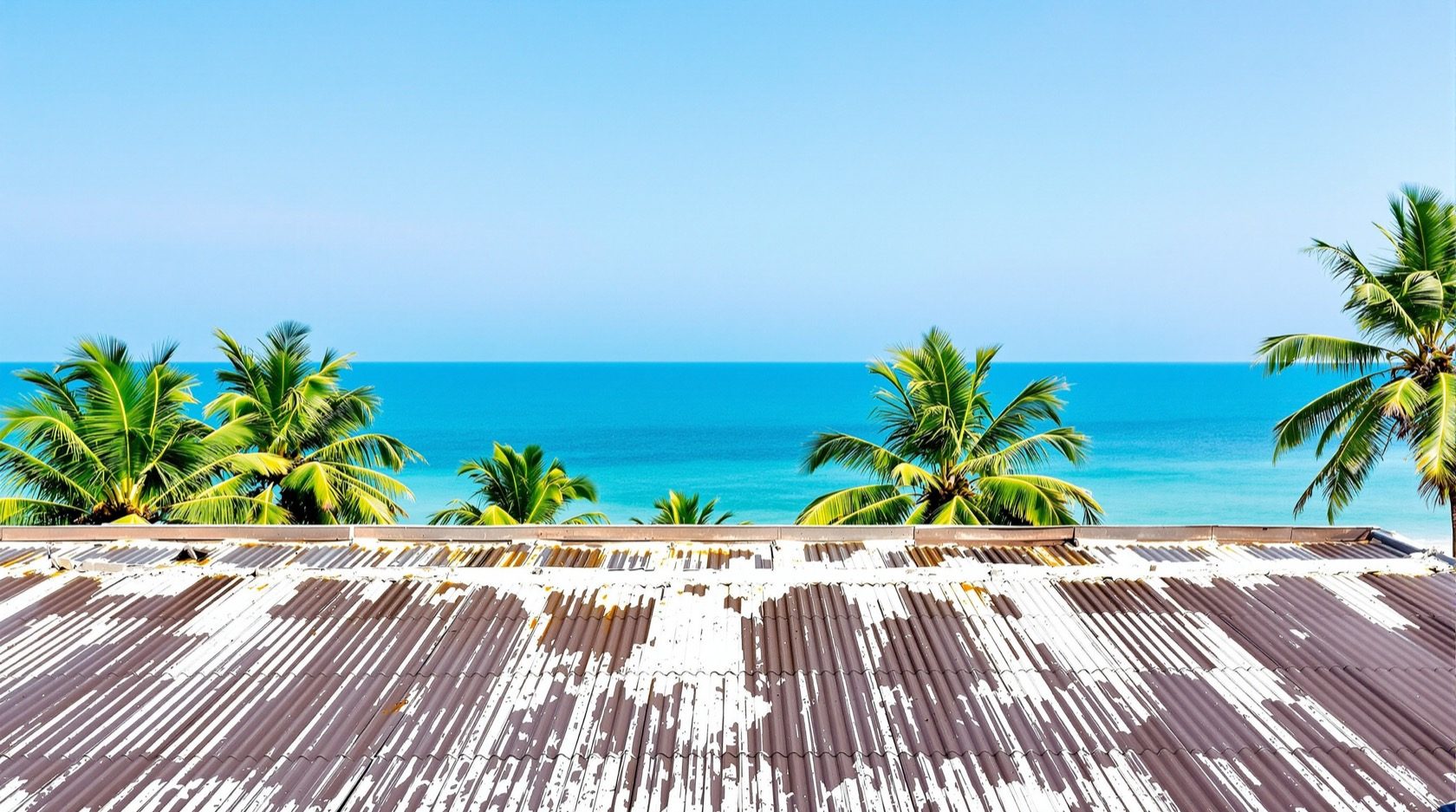
Roofing for Coastal & Saline Areas
Within a few kilometres of the sea — Chennai, Mumbai, Goa, coastal Kerala, Vizag, the Konkan — salt-laden air makes corrosion the roof's relentless enemy. A plain-language guide to materials, fasteners, coatings and upkeep that survive the coast.
If you live within a few kilometres of the sea — Chennai, Mumbai, Goa, coastal Kerala, Visakhapatnam, Mangaluru, the whole Konkan strip — your roof faces an enemy inland homes never meet: salt. The air carries fine chloride-laden spray that settles on every surface and, wherever it touches unprotected steel, eats it. A metal roof that lasts forty years in Bengaluru can rust through in a handful of years on the coast; fasteners weep orange streaks; flashings crumble; and reinforcement inside concrete quietly corrodes. Corrosion, not rain, is the coastal roof's defining problem — though heat, humidity, heavy monsoon and cyclones pile on top of it.
This guide is part of the Roofing Knowledge Hub and builds on The Ultimate Guide to Roofing Systems. It is the corrosion-specific companion to Roof Selection for Indian Climates, which places the warm-humid coast among India’s five zones. Here we go deep on the one thing the coast does differently: it corrodes. We cover why salt air destroys ordinary roofs, which materials survive, the fasteners and flashings that fail first, coatings and re-coating, protecting the concrete beneath, and the washdown habit that doubles a coastal roof’s life.
Scope & safety. This guide helps you understand, plan, choose and judge a roof for a saline, coastal setting. Coastal India also sits in the cyclone and heavy-monsoon belt, so wind-uplift, snow-free load and any seismic design are code-mandated qualified structural-engineering work — a structural engineer must size the roof-to-wall tie-downs and the structure to IS 875 (Part 3) and the relevant codes. Specifying and applying coatings, working at height and confirming corrosion-grade materials are professional work too. Nothing here replaces a site-specific design or an on-site professional.
Why coastal air destroys an ordinary roof
Sea spray does not need to reach the roof as visible water. It travels as an invisible aerosol of tiny salt droplets, and it settles everywhere — heaviest in the first 500 m from the shoreline, still significant several kilometres inland, and worst on the seaward face of the house. That thin, ever-present salt film is what changes everything.
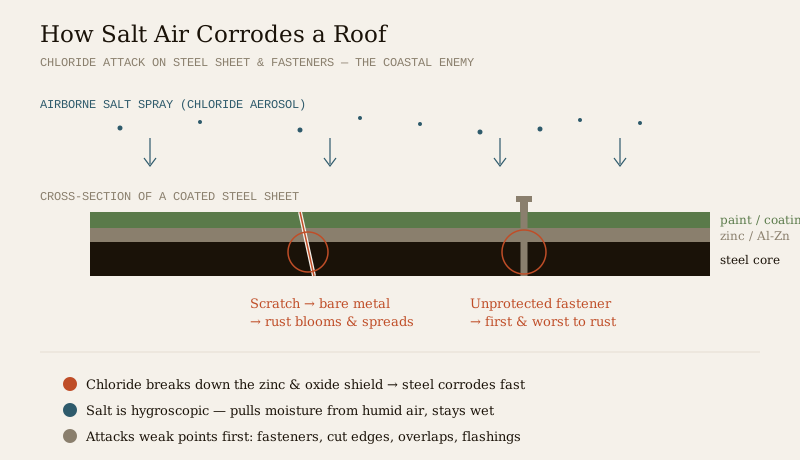
Three things make salt so destructive to a roof:
1. Chloride attack on steel. Ordinary steel rusts anywhere, but chloride ions accelerate the reaction dramatically and keep it going. They break down the protective oxide and zinc layers that would otherwise shield the metal, so corrosion that would take decades inland races ahead on the coast. Any exposed steel — a scratch, a cut edge, a drilled hole, a worn coating — becomes a starting point.
2. Humidity keeps it wet. Salt is hygroscopic: it pulls moisture out of humid coastal air, so the film on the roof stays damp long after rain has stopped. Corrosion needs moisture, and salt guarantees a permanent supply. Heat and constant wet-dry cycling speed the decay further.
3. It attacks the weak points first. Corrosion concentrates at fasteners (small, highly stressed, often a different, less noble metal), cut edges and overlaps (where the protective coating is thinnest or broken), and flashings and valleys (where salt and water collect). A roof rarely fails as a whole sheet; it fails at these details, then spreads — and rust-stained streaks down the walls are the first warning.
The practical consequence is simple and non-negotiable: on the coast you cannot use bare, unprotected or lightly-galvanised steel and expect it to last. Every material and every fastener has to be chosen for its corrosion resistance first, and its looks and price second. This is the single biggest way a coastal metal roof differs from an inland one.
Materials that survive the coast
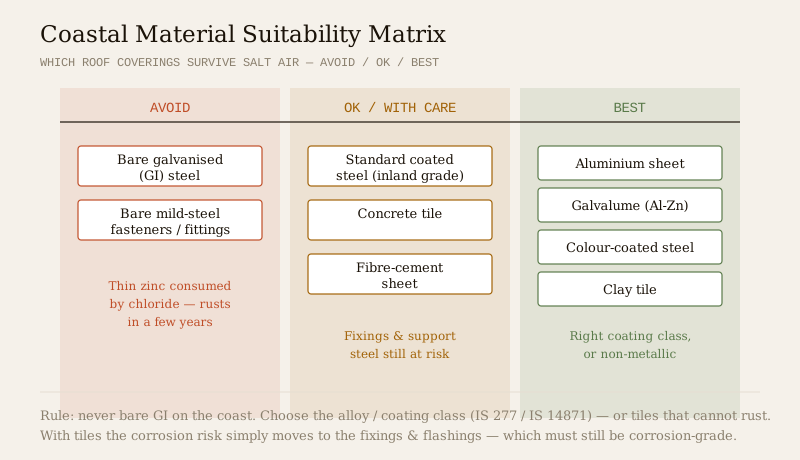
Corrosion resistance sorts roofing materials into “avoid”, “acceptable with care” and “best” for a saline setting. The headline rule: avoid bare galvanised (GI) steel; prefer aluminium, high-grade Galvalume or colour-coated steel of the right coating class, or non-metallic coverings such as clay and concrete tiles.
| Roofing material | Coastal verdict | Why | Notes for the coast |
|---|---|---|---|
| Bare galvanised (GI) steel | Avoid | Thin zinc coating is consumed fast by chloride; rusts in a few years near the sea | The classic coastal mistake — do not specify plain GI sheet within a few km of the shore |
| Aluminium sheet | Best | Forms its own stable self-healing oxide; naturally very corrosion-resistant in salt air | Lightweight, long life; pair with compatible (aluminium/stainless) fixings, never plain steel |
| Galvalume / AZ-coated steel (Al-Zn) | Best (right class) | Aluminium-zinc coating far outlasts plain zinc in chloride; the coastal metal workhorse | Specify a heavy coating class and a marine-grade paint system; protect cut edges |
| Colour-coated steel (PPGL) | Best (right class) | Galvalume base + a tough paint layer adds a second barrier to salt | Choose a coating/paint grade rated for coastal/severe environments; touch up scratches promptly |
| Clay & concrete tiles | Best / OK | Non-metallic — immune to chloride corrosion of the covering itself | Excellent coastal choice; the corrosion risk shifts to the fixings and any metal battens/flashing |
| Fibre-cement sheet | OK | Non-metallic body resists salt | Fixings and support steel still corrode; seal and maintain |
| Bare mild-steel fasteners / fittings | Avoid | Small, stressed, quick to rust and to stain everything around them | Replace with stainless steel (see next section) |
Two things follow from the table. First, non-metallic coverings sidestep the corrosion of the sheet entirely — a clay or concrete tile roof simply cannot rust, which is why tiled roofs are a coastal tradition from the Konkan to Kerala. The corrosion problem does not vanish, though; it moves to the fasteners, battens and flashings, which must still be corrosion-grade. Second, if you want metal, choose the alloy or coating, not just “steel sheet” — aluminium or a properly-classed Galvalume/colour-coated steel, never bare GI. The coating class (how heavy the metallic coat and how tough the paint) is what decides whether a coated-steel roof lasts thirty years or ten on the coast, so it must be written into the specification.
Fasteners, flashings and the details that fail first
A coastal roof almost never fails as a sheet. It fails at the small metal parts — and the smallest, most stressed part of all is the fastener. Get the details wrong and even a perfect sheet is undone.
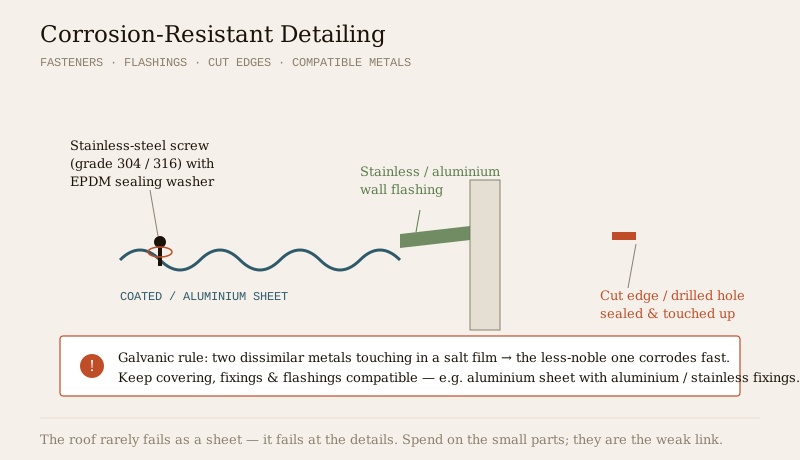
- Fasteners must be stainless steel. On the coast, use austenitic stainless-steel (grade 304, or 316 for the harshest first-line-of-sea exposure) screws and bolts, with a sealing washer (EPDM) that keeps water out of the hole. Plain or lightly-plated steel screws are the commonest coastal failure — they rust, weep stains, lose grip and let water and wind in. The fasteners are a tiny fraction of the roof cost and the biggest single point of failure; never economise here.
- Avoid dissimilar-metal contact (galvanic corrosion). When two different metals touch in the presence of a salt-water film, the less-noble one corrodes faster. So do not put plain-steel screws through an aluminium sheet, or let copper run-off wash onto Galvalume. Keep the covering, fixings and flashings compatible — aluminium sheet with aluminium/stainless fixings; coated steel with matched fasteners.
- Flashings, valleys and gutters are salt traps. These collect spray and slow-draining water, so they corrode first. Use corrosion-resistant flashing (aluminium, stainless or a matched coated steel), and keep gutters and downpipes and the roof drainage in the same corrosion-grade family. Detail them to drain fully — standing salty water is the worst case.
- Protect every cut edge and hole. The factory coating is broken wherever a sheet is cut or drilled, exposing bare metal to salt. Cut edges, drilled holes and site damage must be sealed or touched up with a compatible protective coating — a step that is routinely skipped and routinely regretted.
These are exactly the details a good roof maintenance regime keeps an eye on, and the ones a pre-monsoon roof inspection should target on a coastal home.
Coatings, coating class and re-coating
For a metal roof, the coating is the roof’s life. Salt does not attack the steel it can’t reach, so everything depends on keeping an unbroken protective layer between the chloride and the metal.
- Specify the coating class up front. For coated steel, that means a heavy metallic coating (a high Al-Zn or zinc mass, expressed as g/m²) and a paint system (PPGL) rated for a coastal / severe / marine environment. Manufacturers publish environment ratings; the coast needs the top ones, not the standard inland grade. This is a specification decision, not a site decision — write it into the order. The relevant Indian material standards are IS 277 (galvanised steel sheet) and IS 14871 (Galvalume / aluminium-zinc-alloy coated steel); the coating class within them is what matters for the coast — verify the current edition and the right class with a professional.
- Re-coating is scheduled maintenance, not a repair. Even the best coastal coating weathers. Plan to inspect the surface, touch up scratches early, and re-coat before the base metal is exposed — the interval is shorter on the coast than inland. Re-coating an intact surface is cheap; replacing a rusted-through sheet is not.
- Reflective / cool coatings do double duty. A light, reflective cool-roof coating both protects the metal and cuts the heat load of the warm-humid coast — a sensible pairing where sun and salt both attack.
Protecting the concrete beneath — chloride and reinforcement
Corrosion on the coast is not only a metal-roof problem. In an RCC roof or a concrete parapet, chloride is the great enemy of the steel reinforcement inside the concrete. Salt penetrates the concrete over years, reaches the rebar, and corrodes it; the rust expands, cracks and spalls the concrete off — the tell-tale coastal “concrete cancer” with rusty stains and flaking cover.
The defences are the same ones a structural engineer designs for a marine environment: dense, low-permeability concrete, adequate cover over the reinforcement (thicker on the coast), sound waterproofing that keeps salt water off and out, and prompt repair of any crack that lets chloride in. IS 456 sets exposure categories and cover requirements, and a coastal site sits in a severe / very-severe exposure class — which the engineer must design to. For the homeowner, the practical rule is: keep the waterproofing sound, never let salt water pond on the slab, and treat any rust-staining or spalling as a signal to call a professional early.
Wind, humidity and the hazards that pile on
Salt rarely arrives alone. The Indian coast is also the country’s cyclone and heavy-monsoon belt, and a coastal roof must answer all of it together.
| Coastal hazard | What it does to the roof | The response |
|---|---|---|
| Salt-laden air | Corrodes metal covering, fasteners, flashings, rebar | Corrosion-grade materials, stainless fixings, coatings, washdown |
| Cyclonic wind (east coast, Gujarat) | Uplift tears off poorly-anchored sheets and roofs | Engineered tie-downs & fixing pattern to IS 875 (Part 3) — an engineer’s job |
| Heavy monsoon | Intense rain, wind-driven water, overwhelmed drains | Adequate slope, deep overhang, oversized drainage, sound waterproofing |
| Heat + humidity | High roof temperatures, permanent damp, mould | Reflective cool surface, insulation, ventilation |
Two of these deserve their own guides, because on the coast they combine with salt to raise the stakes. Wind uplift in a cyclone is a structural problem — the roof-to-wall connection and the fixing pattern must be engineered, and a corroded fastener is a fastener that lets go in the next storm, so corrosion and wind are linked. See the siblings Roofing for Cyclone & High-Wind Areas and Roofing for Heavy-Monsoon Areas, and the overview Climate-Resilient Roofing, which ties the coastal hazards together.
Maintenance — the washdown that doubles a coastal roof’s life
The single cheapest thing you can do for a coastal roof is wash the salt off. Salt only corrodes while it is sitting on the surface; rinse it away and the clock resets.
- Rinse with fresh water periodically — especially the seaward faces, gutters, valleys and flashings where salt concentrates. In many coastal homes a monsoon does part of this naturally, but the dry-season salt build-up is exactly when a deliberate fresh-water washdown pays off.
- Inspect the details, not just the sheets. Check fasteners for rust and weeping stains, cut edges and overlaps for early corrosion, flashings and gutters for pitting, and the concrete for spalling. Fix small things early — touch up a scratch, replace a rusting screw, reseal a flashing — before they become a leak.
- Time it around the monsoon. A pre- and post-monsoon check catches wind and water damage and the fresh salt the storms leave behind. Keep the roof maintenance and pre-monsoon inspection habit that every Indian roof needs, tuned to the coast’s extra salt burden.
A coastal roof is never “fit and forget”. But a right-material, right-fastener roof that is rinsed and inspected will outlast a cheaper one many times over — and cost far less across its life.
The one-line answer
On the coast, corrosion is the enemy, not just rain — salt-laden air relentlessly attacks steel, so never use bare galvanised (GI) steel; choose aluminium, a high-grade Galvalume or colour-coated steel of the right coating class (IS 277 / IS 14871), or non-metallic clay and concrete tiles, fix everything with stainless-steel fasteners, use corrosion-resistant flashings and compatible metals, protect the RCC and its reinforcement with dense concrete, good cover and sound waterproofing, and wash the salt off and inspect the details as routine — while an engineer sizes the roof against the coast’s cyclonic wind and heavy monsoon to code.
Where to go next
- The whole subject in one map: The Ultimate Guide to Roofing Systems.
- Place the coast among the zones: Roof Selection for Indian Climates.
- The other coastal hazards: Roofing for Cyclone & High-Wind Areas · Roofing for Heavy-Monsoon Areas · Climate-Resilient Roofing.
- The materials in depth: Metal Roofing Guide · Clay Roof Tiles Guide.
- Keep it going: Roof Maintenance Guide · Pre-Monsoon Roof Inspection.
- The whole library: Roofing Knowledge Hub.
References
- IS 277: Galvanized Steel Sheets (Plain and Corrugated) — specification, including zinc coating classes; and IS 14871: Continuously Pre-painted / Aluminium-Zinc alloy (Galvalume) coated steel sheets — the coating class governs coastal durability. Bureau of Indian Standards; verify the current edition via the BIS catalogue.
- IS 875 (Part 3): Design Loads (Wind) for Buildings and Structures — governs roof design against cyclonic and high coastal winds. Bureau of Indian Standards.
- IS 456: Plain and Reinforced Concrete — Code of Practice, including exposure categories and cover for severe / very-severe (coastal, marine) environments that protect reinforcement from chloride. Bureau of Indian Standards.
- National Building Code of India (SP 7), Bureau of Indian Standards — Part 6 (Structural Design); verify the current edition via the BIS catalogue: https://www.services.bis.gov.in/
This is an educational overview. Structural design, wind-load calculation, coating specification, waterproofing application and any work at height are qualified professional work — engage a structural engineer and a licensed roofing contractor for your coastal project, and verify any standard’s current status via the BIS catalogue before relying on it.
Export this guide
Related Guides — Deep-dive reading
Roofing for Cyclone & High-Wind Areas
On India's east coast and the Gujarat seaboard, wind, not rain, is the roof's deadliest enemy. Cyclonic wind tries to peel the roof off like a wing. A plain-language guide to why roofs fly away and the engineered tie-downs — the continuous load path from covering to foundation — that keep them on.
RoofingThe Metal Roofing Guide
The fast, light, long-spanning roof — GI, Galvalume and colour-coated steel, aluminium, standing-seam, stone-coated and insulated panels; the profiles and coatings; and the four things that make or break metal in India — coastal corrosion, condensation, rain noise and heat. Plain language, India-grounded.
RoofingClimate-Resilient Roofing
India’s weather is getting more extreme — fiercer downpours, longer heatwaves, stronger cyclones, more erratic seasons. A climate-resilient roof is designed for the worst case, not the average, with layered and redundant defences. A plain-language, forward-looking synthesis of the whole hazard cluster.
RoofingRelated Tools — Try Free
Monsoon-Readiness Checklist
Pre-rain home audit across 9 categories — terrace, drains, waterproofing, electrical, HVAC, pest, vehicles, documents.
Seasonal AuditCross-Ventilation Analyzer
Estimate airflow and air changes per hour (ACH) from room size, window areas, layout, and local wind — with NBC 2016 Part 8 compliance check.
Ventilation CalculatorMaterial Decision Framework (M-Score)
Score 30+ Indian construction materials across cost, durability, climate fit, maintenance, and sustainability.
Materials