
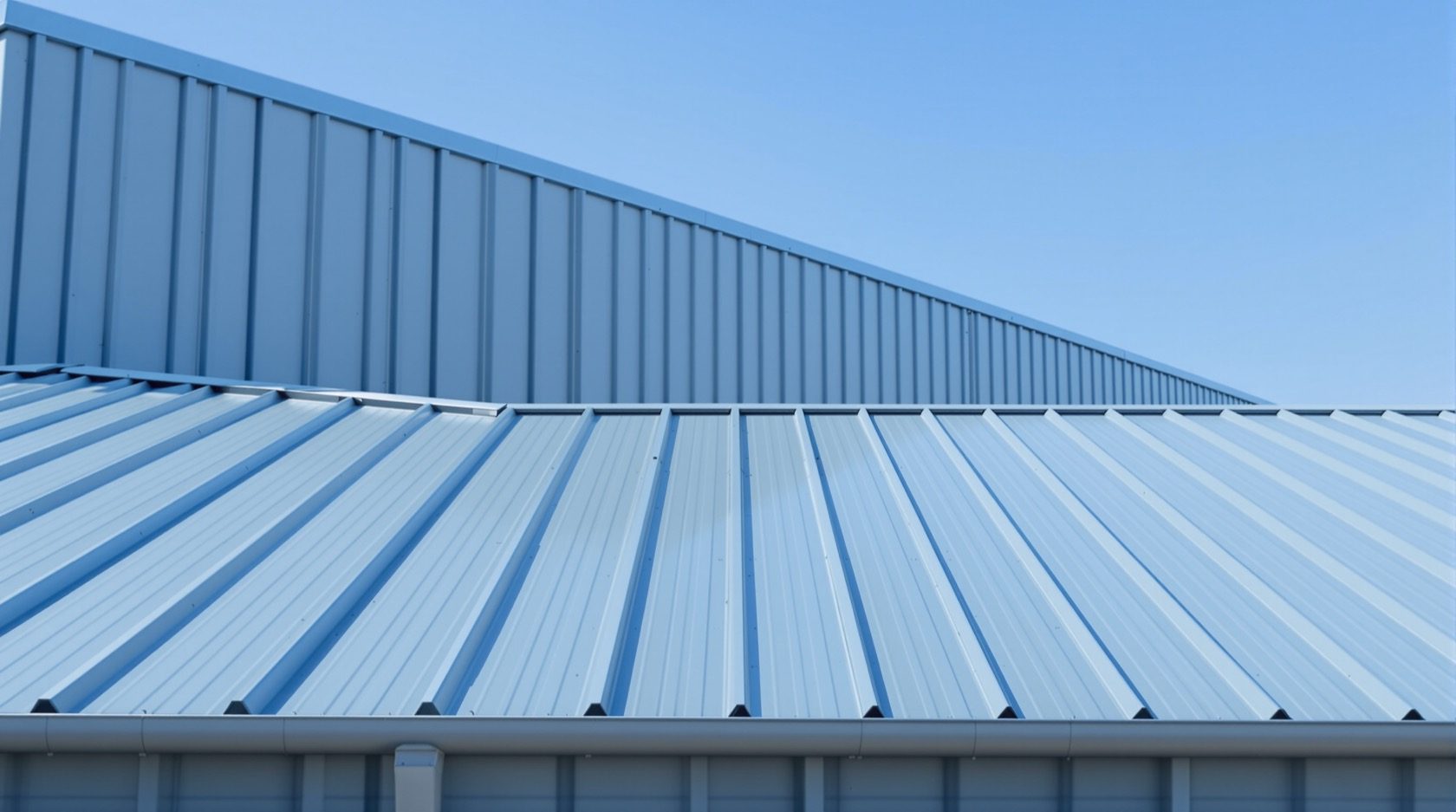
The Metal Roofing Guide
The fast, light, long-spanning roof — GI, Galvalume and colour-coated steel, aluminium, standing-seam, stone-coated and insulated panels; the profiles and coatings; and the four things that make or break metal in India — coastal corrosion, condensation, rain noise and heat. Plain language, India-grounded.
Metal roofing is the fast one. Where a tiled roof goes up unit by unit and an RCC slab takes weeks to cast and cure, a metal roof arrives as long sheets that a crew screws down in days. It is light, so it needs less structure and spans far on widely spaced purlins; it sheds water at pitches too shallow for tile; and it sheds snow beautifully, which is why it is the practical standard across the Himalaya. From factory sheds and railway platforms to hill homes, farmhouses, porches and increasingly stylish modern houses, metal is everywhere in India — and mostly misunderstood.
This is the metal deep-dive of the Roofing Knowledge Hub and a companion to The Ultimate Guide to Roofing Systems. It sits alongside the sloping roof design guide, because metal is almost always a pitched-roof covering. The goal here is to cut through brand names and jargon: to explain the material families (what the sheet is actually made of), the profiles and coatings, and above all the four things that decide whether a metal roof in India lasts forty years or rusts and roars in five — corrosion, condensation, rain noise and heat.
Scope & safety. This guide helps you understand, plan, choose and judge a metal roof. Sizing the structure and purlins, calculating wind-uplift loads and specifying the fixings and tie-downs that resist them, detailing the sealing and flashing, and any work at height are qualified professional work for a structural engineer and a licensed roofing contractor. Wind uplift on light sheet roofs is a code-mandated calculation, not a guess — nothing here replaces a site-specific design or an on-site professional.
Why metal — and where it wins
Metal is not a premium look-at-me choice so much as an engineering answer. Its advantages are concrete:
- It is fast. Large sheets cover ground quickly; a roof that would take weeks in tile or concrete goes on in days. On a tight programme, that matters.
- It is light. A metal roof weighs a fraction of a tiled or concrete one, so the structure beneath it can be lighter and cheaper — a real saving, and a genuine advantage in seismic zones where mass up high is a liability.
- It spans far. Because the sheets are stiff and light, they sit on purlins spaced widely apart, which suits large clear roofs — sheds, halls, verandahs, car porches — without a forest of supports.
- It runs at a low pitch. Long sheets with few joints stay watertight at pitches far shallower than tile: profiled sheet from about 5°–10°, standing-seam from as little as 3°. That opens up low, modern rooflines.
- It sheds snow and heavy rain. Water and snow slide off a smooth metal slope fast, which is why metal is the Himalayan default and a strong performer anywhere rain is intense.
The trade-offs are equally real, and they are the whole reason this guide exists: bare metal corrodes, especially in coastal salt air; a cold sheet sweats underneath in humid weather; rain on an unlined sheet is loud; and a bare metal roof gets searingly hot in the sun. Every one of these has a well-understood fix — the right coating, a vapour control layer, and insulation — and the rest of this guide is really about getting those fixes right.
The material families — what the sheet is actually made of
Strip away the brand names and metal roofing comes down to a few base materials and, on the steel ones, a protective metallic coating. This is the single most important thing to understand, because the base metal and its coating decide how long the roof survives.
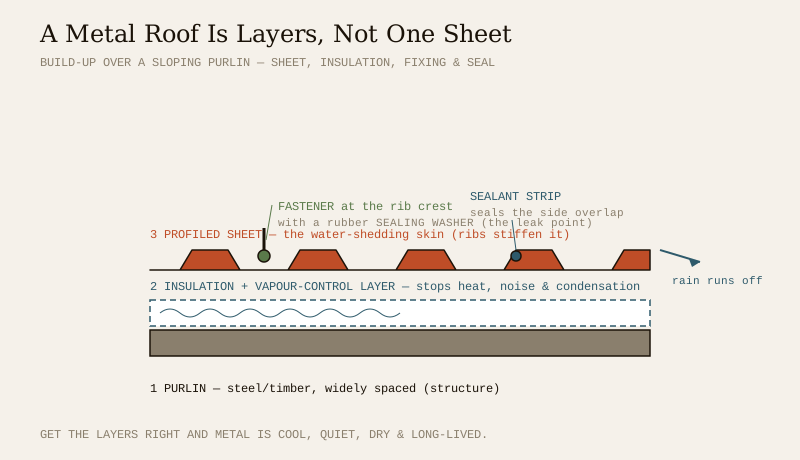
Nearly all "metal roofs" in India are coated steel. Steel is strong and cheap but rusts, so it is protected by a metallic coating applied at the mill, and often a coloured paint layer on top of that:
| Family | What it is | Corrosion resistance | Typical use in India |
|---|---|---|---|
| GI (galvanised iron) | Steel with a zinc coating | Basic — poor in salt air | Sheds, low-cost roofs; avoid bare GI near the coast |
| Galvalume / AZ (aluminium-zinc) | Steel coated with ~55% aluminium + zinc | Much better than plain GI | The modern workhorse for sheds, homes, hills |
| Colour-coated / PPGI / PPGL | GI or Galvalume + a baked paint layer | Good — paint shields the metal | Homes, branded roofs, any coloured roof |
| Aluminium sheet | Solid aluminium (no steel) | Excellent — self-protecting oxide | Coastal & corrosive settings; costs more |
| Stone-coated steel tiles | Galvalume pressed to a tile shape, stone-chip finish | Good, with a tiled look | Homes wanting a tile look with metal weight |
| Insulated (sandwich) panels | Two metal skins bonded to a PUF / PIR foam core | As per the skin; insulated by design | Where heat & noise control matter from the sheet itself |
The base metal matters more than the colour. A handsome painted sheet on a poor substrate near the sea will still rust from the cut edges and fixings; the colour is cosmetic and protective, but the metallic coating underneath is what buys the years. The headline rule for India: plain GI is fine inland and for utility roofs, but move to Galvalume or colour-coated Galvalume for a home, and to aluminium (or a heavily-coated, well-detailed system) anywhere near the coast. The zinc and aluminium-zinc coatings on steel sheet are covered by Indian standards — IS 277 for galvanised steel sheet and IS 14871 for coated sheet — while corrugated sheet is dealt with in IS 459; verify current editions via the BIS catalogue.
Aluminium deserves a special mention. Because it protects itself with a natural oxide film, aluminium does not rust and is the quiet hero of genuinely corrosive settings — coastal, chemical and industrial. It costs more per square metre and is softer (it dents), but on a seafront home it can outlast a steel sheet several times over. For most inland homes, colour-coated Galvalume is the sweet spot of cost, life and looks.
The profiles — corrugated, trapezoidal, standing-seam and more
The profile is the shape rolled or pressed into the sheet. It is not decoration: the ribs and corrugations stiffen a thin sheet so it can span, and the shape of the joint between sheets decides how watertight the roof is and how low a pitch it can run.
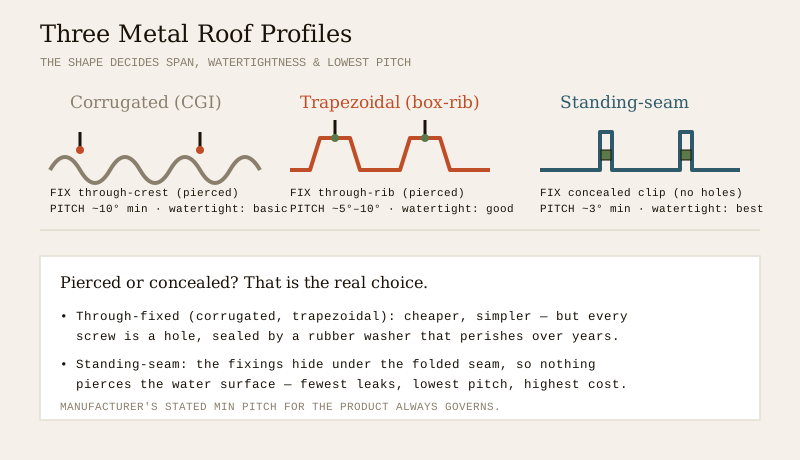
- Corrugated (CGI / sinusoidal). The classic rippled wave, familiar from every old shed and platform. Cheap, simple, endlessly available, and fixed with screws driven through the crest of the wave. It works but is the most basic option; the pierced fixings are the weak point.
- Trapezoidal (box-rib). The modern standard for sheds and homes: tall, flat-topped box ribs give a stiffer sheet that spans further and sheds water cleanly. Also through-fixed at the ribs, but the deeper profile and better side-lap make it more watertight than corrugated. This is what most "colour-coated roofing sheet" is today.
- Standing-seam. The premium system: adjacent sheets are joined by a raised vertical seam that is folded or clipped together, with the fixings hidden under the seam (concealed-fix). Because nothing pierces the water-shedding surface, it is the most watertight metal roof and runs at the lowest pitch — the choice for low-slope, architectural and high-rainfall roofs.
- Stone-coated tiles & profiled panels. Pressed steel shaped to mimic clay tiles or shingles, finished with bonded stone chips for a matte, tile-like look and a quieter, less "tinny" surface — metal performance with traditional character.
| Profile | Fixing | Minimum pitch* | Watertightness | Character |
|---|---|---|---|---|
| Corrugated (CGI) | Through-fixed (crest) | ~10° | Basic | Utility, traditional shed |
| Trapezoidal | Through-fixed (rib) | ~5°–10° | Good | Modern, crisp, common |
| Standing-seam | Concealed clip / seam | ~3° | Best | Sleek, architectural |
| Stone-coated tile | Fixed to battens | ~12°–15° | Good | Tile look, metal weight |
\Indicative — the manufacturer's stated minimum pitch for the specific product and lap always governs, confirmed by the roofing contractor for your rainfall and exposure.*
The through-fixed profiles (corrugated, trapezoidal) are cheaper and simpler but rely on a rubber sealing washer at every screw — and a screw hole is a hole, so those washers are the roof's most common long-term leak point. Standing-seam avoids piercing the surface entirely, which is why it costs more and leaks less. For a shallow-pitch or a really wet site, the extra cost of standing-seam is often money well spent.
The four India issues — corrosion, condensation, noise and heat
Almost every complaint about metal roofs in India traces back to one of four issues. Each is solvable; the failures are failures of specification, not of metal itself.
1. Corrosion — the coastal killer
Salt air is brutal on bare and lightly-coated steel. Within a few kilometres of the sea, chloride-laden air attacks zinc coatings, and the roof begins to rust at its most vulnerable points first: the cut edges, the fixing holes, the overlaps where moisture sits, and any scratch in the coating. The defences, in order: choose the right base metal (aluminium, or a high-coating-mass Galvalume — never bare GI on the coast); specify a proper paint system on top; keep dissimilar metals apart (an incompatible fastener will corrode away against the sheet); and detail edges and laps to drain, not to trap water. Inland, ordinary Galvalume or colour-coated steel is perfectly durable; it is specifically the coast, and heavy-industry pollution, that demand the upgrade.
2. Condensation — the roof that rains inside
A metal sheet is thin and conducts heat fast. On a clear night it cools quickly, and warm, humid indoor air touching its cold underside condenses into water — which then drips as if the roof were leaking, though not a drop got in from above. This "phantom leak" baffles homeowners. The cures are an anti-condensation layer — insulation or a vapour-control membrane on the underside of the sheet — and ventilation of the roof cavity so moist air can escape. Any well-built metal roof in a humid Indian climate must be designed against condensation from the start; it is not an optional extra.
3. Rain noise — the drumming roof
Rain on a bare metal sheet is loud — the thin skin acts like a drum. It is charming for an afternoon and maddening at 3 a.m. through a monsoon. The fix is mass and soft layers between the rain and your ears: an insulation layer under the sheet (glass wool, an air gap, or a foam-core panel) absorbs the drumming, and a false ceiling below adds a second barrier. An insulated sandwich panel, with its foam core, is quiet by design. A metal roof over a living space should always be insulated — for the noise as much as the heat.
4. Heat — the sun-struck sheet
Bare metal in the Indian sun gets ferociously hot and radiates that heat straight down into the rooms below. The answer is the same insulation layer that solves the noise, plus a reflective, light-coloured or high-SRI coating on top to bounce the sun off before it is absorbed — the same logic as a cool roof. A dark, uninsulated metal roof over a bedroom is a mistake; a light, insulated one is comfortable. See the future roof insulation guide for the over-purlin and under-purlin options.
There is a fifth, structural issue that belongs to the engineer: wind uplift. A light roof is easy for wind to peel off, so the fixings, their spacing, and the tie-down of the whole roof to the structure are sized to the wind loads in IS 875 (Part 3) — the single most important structural detail on any sheet roof, and non-negotiable in cyclone-prone coastal and eastern regions.
Lifespan, cost and maintenance
Metal roofing spans a wide range because the word covers everything from a cheap GI shed sheet to an architectural aluminium standing-seam roof.
| System | Indicative life* | Relative cost | Notes |
|---|---|---|---|
| Bare GI sheet | 10–20 yr | Lowest | Utility only; short life near the coast |
| Galvalume sheet | 20–35 yr | Low–moderate | The value workhorse |
| Colour-coated Galvalume | 25–40 yr | Moderate | The home standard; warranties on the paint |
| Standing-seam (steel) | 30–50 yr | High | Fewest leaks, lowest pitch |
| Aluminium | 40–50+ yr | High | Coastal & corrosive settings |
| Insulated sandwich panel | 25–40 yr | High | Insulation built in |
\Indicative service life with correct specification, detailing and maintenance — real life depends on the base metal, coating mass, climate (especially proximity to the sea) and upkeep.*
Metal is refreshingly low-maintenance when specified right, but it is not fit-and-forget:
- Re-tighten and re-seal fixings periodically — the rubber washers on through-fixed sheets are the commonest leak source and perish over years of sun.
- Touch up scratches and cut edges promptly, especially near the coast; a bare scratch is where rust starts.
- Clear leaves and debris from the valleys, gutters and laps — trapped moisture and organic matter accelerate corrosion.
- Watch the overlaps and flashings at ridges, walls and penetrations — these junctions, not the open sheet, are where a metal roof leaks.
- Never walk a metal roof casually — sheets dent and get slippery; access is for a professional with proper safety gear.
Compare the covering head-to-head with its main rival in tile roof vs metal roof, and see the family of sheet products in the roofing sheets guide.
Choosing a metal roof for your environment
The single best predictor of which metal roof you need is where you are — specifically how corrosive the air is and how heavy the rain.
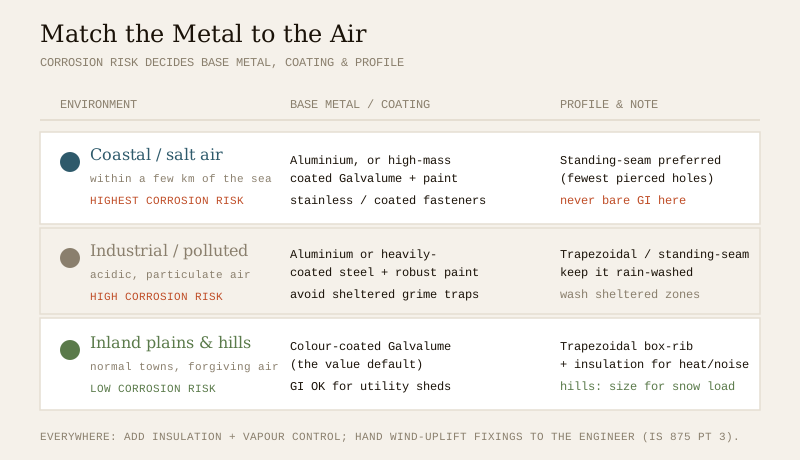
- Coastal / salt air (within a few km of the sea). Corrosion rules everything. Choose aluminium or a high-coating-mass, thickly-painted Galvalume; prefer standing-seam to minimise pierced fixings; use compatible stainless or coated fasteners; detail every edge and lap to drain. Bare GI is a false economy here.
- Industrial / polluted air. Acidic, particulate-laden air is nearly as aggressive as salt. Favour aluminium or heavily-coated steel with a robust paint system, and keep the roof washed by rain (avoid sheltered zones where grime builds up).
- Inland plains, hills and normal towns. The forgiving majority of India. Colour-coated Galvalume in a trapezoidal profile is the well-rounded default — durable, good-looking and affordable — with insulation added for heat and noise. In the snowy hills, metal's fast shedding is a positive; keep the pitch and fixings sized for snow load.
Everywhere, add the insulation and vapour-control layer for condensation, noise and heat, and hand the fixing pattern and wind tie-down to the engineer. Get the base metal right for your air and the layers right for your comfort, and metal is one of the best-value roofs in India.
The one-line answer
Metal roofing is the fast, light, long-spanning covering for sloping roofs — sheds, homes, hills and industry — and the choice really comes down to two questions. First, what is the sheet made of: plain GI for utility and inland, Galvalume or colour-coated steel for a home, and aluminium (or a heavily-coated, standing-seam system) anywhere near the coast, where salt air is the great destroyer. Second, what profile: through-fixed corrugated or trapezoidal for value, concealed-fix standing-seam for the lowest pitch and fewest leaks. Then solve metal's four home truths — corrosion (right metal and coating), condensation (a vapour-control layer and ventilation), rain noise (insulation and a false ceiling) and heat (insulation and a reflective coating) — and hand the wind-uplift fixings to a structural engineer. Do that, and a metal roof is fast, affordable and good for decades.
Where to go next
- The whole subject in one map: The Ultimate Guide to Roofing Systems.
- Metal is a pitched-roof covering: Sloping Roof Design Guide.
- The head-to-head decision: Tile Roof vs Metal Roof.
- The other coverings: Clay Roof Tiles Guide · Roofing Sheets Guide.
- Keep it cool and quiet: Roof Insulation Guide · Cool Roof Guide.
- The whole library: Roofing Knowledge Hub.
References
- National Building Code of India (SP 7), Bureau of Indian Standards — Part 6 (Structural Design) and Part 3 (General Building Requirements); verify the current edition via the BIS catalogue.
- IS 277: Galvanised Steel Sheets (Plain and Corrugated) — Specification (base metal and zinc coating) — Bureau of Indian Standards.
- IS 14871: Continuously Pre-painted / Metallic-coated Steel Sheets and Coils — Specification (colour-coated and coated sheet) — Bureau of Indian Standards.
- IS 459: Corrugated and Semi-corrugated Asbestos Cement Sheets — Specification (profiled sheet roofing) — Bureau of Indian Standards.
- IS 875 (Part 3): Design Loads (Wind) for Buildings and Structures — governs wind uplift and fixing of sheet roofs — verify current status via the BIS catalogue: https://www.services.bis.gov.in/
This is an educational overview. Selecting a corrosion grade for a specific site, sizing the structure and purlins, calculating wind-uplift loads and specifying the fixings and tie-downs, detailing sealing and flashing, and any work at height are qualified professional work — engage a structural engineer and a licensed roofing contractor for your project, and verify any standard's current status via the BIS catalogue before relying on it.
Export this guide
Related Guides — Deep-dive reading
Roofing for Coastal & Saline Areas
Within a few kilometres of the sea — Chennai, Mumbai, Goa, coastal Kerala, Vizag, the Konkan — salt-laden air makes corrosion the roof's relentless enemy. A plain-language guide to materials, fasteners, coatings and upkeep that survive the coast.
RoofingTile Roof vs Metal Roof: Which Should You Choose?
The definitive head-to-head for an Indian sloping roof — clay and concrete tiles against metal sheet, compared on upfront and lifecycle cost, lifespan, weight, heat, rain noise, looks, speed, span, coastal corrosion, repair and resale, with a clear verdict on which to choose and when. Plain language, India-grounded.
RoofingHow to Choose a Roof
The homeowner's decision guide — the order to decide in (climate and rainfall first, then use, structure, covering, and only then cost and looks), a plain checklist to score your options, the trade-offs that matter, and the mistakes buyers make. Plain language, India-grounded, decisive.
RoofingRelated Tools — Try Free
Cross-Ventilation Analyzer
Estimate airflow and air changes per hour (ACH) from room size, window areas, layout, and local wind — with NBC 2016 Part 8 compliance check.
Ventilation CalculatorMaterial Comparison Sheet
India's interior material cheatsheet — plywood, finishes, hardware, countertops, paints, waterproofing.
Reference GuideMonsoon-Readiness Checklist
Pre-rain home audit across 9 categories — terrace, drains, waterproofing, electrical, HVAC, pest, vehicles, documents.
Seasonal Audit