
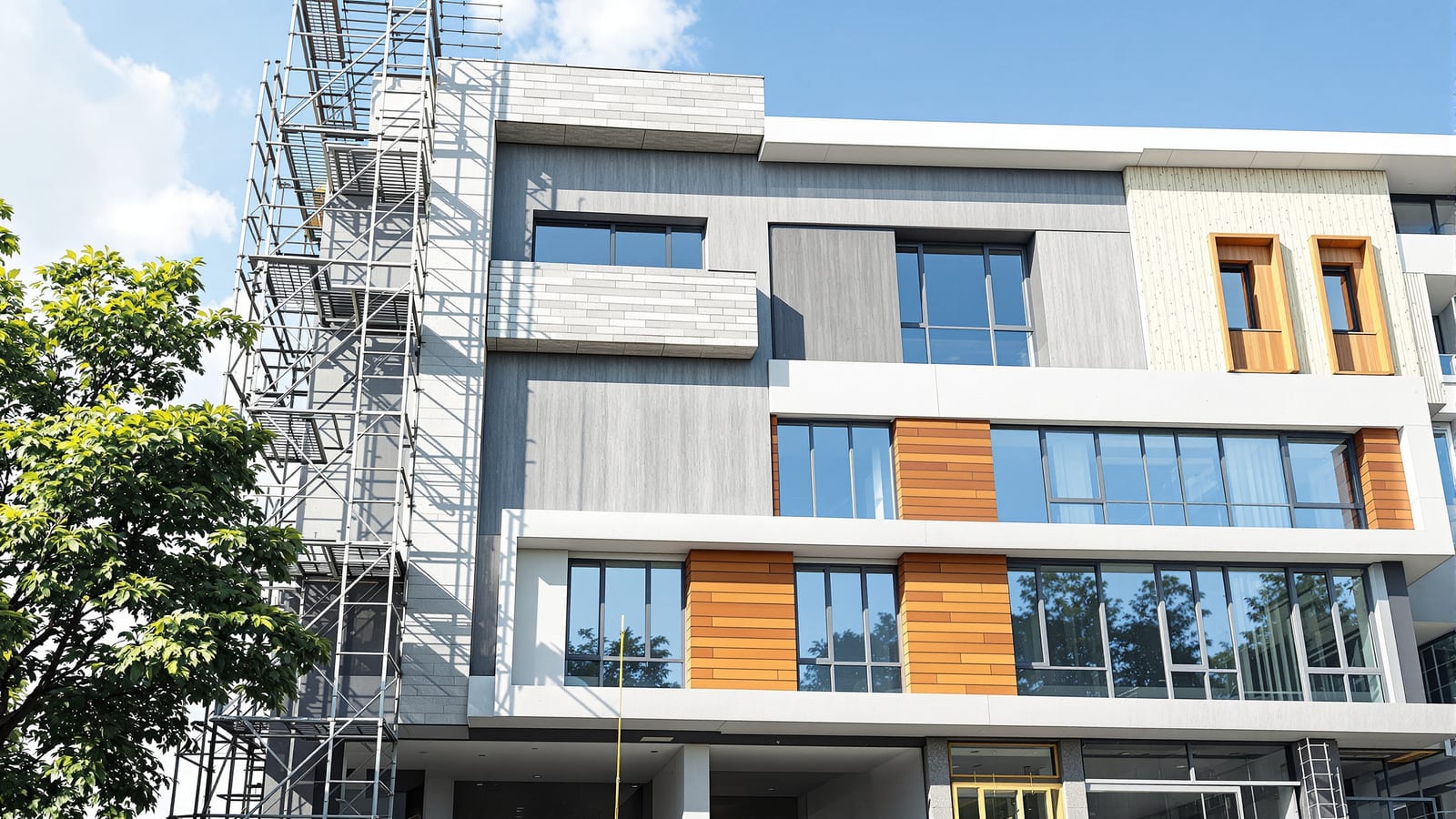
Facade Cost in India: A Per-Sq-Ft Cost & Specification Guide (2025-2026)
A candid, system-by-system breakdown of what every facade material actually costs per square foot in India — from ₹40 painted render to ₹2,500+ structural glazing — plus what drives the price and how to compare quotes fairly.
The first question every client asks an architect or facade contractor is the same: "So what will the facade cost?" And the honest answer — the one that makes people uneasy — is "it depends, by about ten times." A simple plastered-and-painted wall can be wrapped for ₹40-120 per square foot. A premium structural-glass or imported-stone skin on the same building can cross ₹2,000-2,500 per square foot. Same wall, same area, same city — a tenfold spread driven entirely by the system, the grade, and how it is fixed.
That is why a single "facade cost per sq ft in India" number is close to meaningless. The number only becomes useful once you nail down three things: which system (render, ACP, stone, glass, terracotta, porcelain), which grade of that material, and what scope the rate covers (bare supply, or supply-and-install with the sub-frame, scaffolding and finishing included). Change any one of those and the rate moves by hundreds of rupees. This guide demystifies that ten-times range, gives you realistic 2025-2026 Indian bands for every major facade system, and shows you where the hidden money is.
This is part of our Building Facades series — the "compare the costs" capstone that ties together the material-by-material guides. If you have read types of facades and the deep dives on render and plaster, exposed brick, stone and masonry, glass curtain wall, metal and ACP, terracotta rainscreen, concrete and GFRC, fibre-cement and HPL, porcelain and ceramic or brise-soleil and louvres, this guide puts price tags next to all of them so you can budget and compare like for like.
1. The vocabulary of a facade quote
Before any number means anything, you need the words. A facade quote is full of terms that look casual but change the price by a factor of two or three.
Facade area is the vertical face you are cladding — measured in square feet of wall surface, not floor. It is completely different from carpet area (usable floor inside) or built-up area (floor plus walls). A compact three-storey home can have far more facade than its floor area suggests, because the facade is the skin wrapped around the whole envelope. Always confirm whether a rate is quoted per sq ft of facade (correct) or loosely per sq ft of built-up area (a red flag).
Rate per sq ft of facade is the headline number — but it is only honest if you know what it includes. Supply means the material delivered to site, nothing more. Supply-and-install (often called turnkey) means material plus the sub-frame (the aluminium or MS framework that holds a rainscreen or glazing system off the wall), fixings, labour, sealants and finishing. The gap between "supply" and "turnkey" for a stone or glass system can be 40-100% of the supply price — the sub-frame and skilled installation are that significant.
A BOQ (Bill of Quantities) is the itemised list that should accompany any serious quote: line by line for material, sub-frame, fasteners, scaffolding/access, sealing, and so on. GST on a facade works contract is generally 18% — facade supply-and-fix is treated as a works-contract service. A design or consultant fee (an architect or specialist facade consultant) is typically extra. Escalation is the price rise over a long project. Lifecycle or maintenance cost is what the facade costs you to keep over 20 years, not just to build. And value-engineering is the legitimate craft of getting the look you want for less by mixing materials intelligently.
2. The centrepiece: indicative ₹/sq ft installed ranges (2025-2026)
Here is the table everyone comes for. These are indicative installed (supply-and-fix) market ranges for India, 2025-2026 — they vary widely by city, project scale, building height, material grade and brand. Treat them as planning bands, not quotes. The high end of each system reflects premium grade, imported material, complex geometry or tall-building access.
| Facade system | Indicative ₹/sq ft installed | What drives the high end | Lifecycle note | Guide |
|---|---|---|---|---|
| Plaster + paint (render) | ₹40-120 | Premium textured/elastomeric paint, multiple coats | Repaint every 5-7 yrs | Render |
| Textured / stone-spray render | ₹80-250 | Designer textures, mineral coatings | Recoat ~7-10 yrs | Render |
| Exposed brick | ₹120-350 | Wire-cut/handmade brick, fair-faced workmanship | Very low; near-permanent | Exposed brick |
| ACP (aluminium composite panel) | ₹160-450 | FR-grade core, PVDF coat, branded panel, MS/Al sub-frame | Recoat/replace ~10-15 yrs | Metal & ACP |
| Fibre-cement board | ₹150-500 | Through-coloured premium board, ventilated sub-frame | Repaint/seal periodically | Fibre-cement & HPL |
| HPL / compact laminate | ₹250-700 | Exterior-grade panels, concealed fixing | Low; wipe-clean | Fibre-cement & HPL |
| Natural stone cladding | ₹250-1,500+ | Imported granite/limestone, thick slabs, mechanical anchors | Very low; decades | Stone & masonry |
| Porcelain / sintered slab | ₹300-1,200+ | Large-format slabs, undercut anchors, sub-frame | Very low; wipe-clean | Porcelain & ceramic |
| GFRC / precast concrete | ₹400-1,200 | Custom moulds, deep reveals, fixing brackets | Low; occasional seal | Concrete & GFRC |
| Terracotta rainscreen | ₹600-1,500+ | Imported large-format tiles, aluminium carrier system | Low; near-permanent skin | Terracotta |
| Glass curtain wall / structural glazing | ₹800-2,500+ | Unitised system, laminated/DGU acoustic glass, spider fittings | Cleaning access cost; sealant ~15-20 yrs | Glass curtain wall |
| Brise-soleil / louvre (add-on) | ₹300-1,200 | Aluminium/timber-look fins, motorised or angled | Periodic clean; long life | Brise-soleil & louvre |
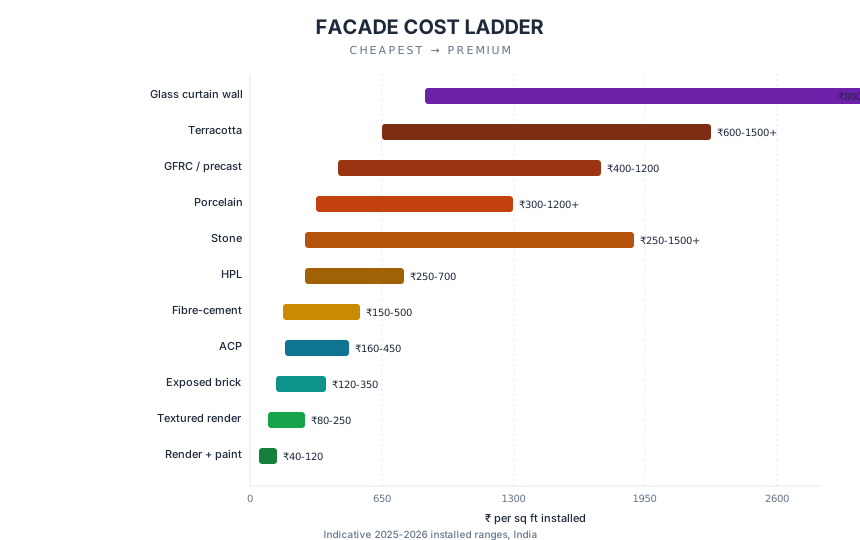
Read the table as a ladder, not a list. The cheap rungs (render, brick) are wall finishes applied to the structure itself. The expensive rungs (terracotta, porcelain, glass) are engineered rainscreen or glazing systems hung off a sub-frame — you are paying for the carrier system and the engineering as much as the visible material.
3. What actually drives the cost
Two quotes for "ACP cladding" can differ by ₹200/sq ft, and both can be honest. Here is what moves the needle.
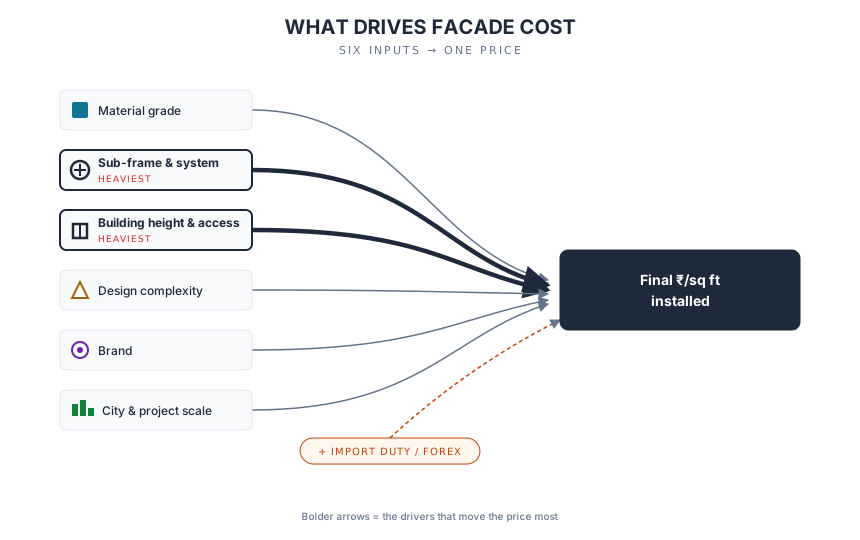
Material grade. Within every system there is a budget-to-premium spread. ACP runs from thin economy panels to fire-rated PVDF-coated branded sheets that cost two to three times more. Stone runs from local Kota or sandstone to imported Italian limestone. Grade alone can double the rate.
Sub-frame and system. This is the most underestimated driver. A rainscreen or glazing facade needs an aluminium or MS framework, brackets and fasteners behind the visible skin — often 30-60% of the installed cost. Cheap quotes that "forget" the sub-frame are the single most common trap.
Building height and access. Cladding a single-storey home off ladders is cheap. Cladding the same material at the eighth floor needs scaffolding, swing-stages or cradles, and the access cost can add ₹50-200/sq ft on its own. Height is a multiplier on everything.
Glass spec and openings. For glazed facades, the glass itself — single vs laminated vs double-glazed (DGU), low-E coatings, acoustic interlayers — swings the price enormously, and openable vents cost far more than fixed panes.
Design complexity. Flat, repetitive panels are cheap to fabricate and fix. Curves, parametric patterns, deep reveals, mitred corners and custom GFRC moulds all add fabrication and wastage cost.
Brand, city and scale. Branded systems carry a premium; metro cities cost more than tier-2 towns; and a large project amortises fixed costs (mockups, engineering, mobilisation) across more area, so per-sq-ft rates fall with scale. Import duty and forex lift the price of imported stone, terracotta and glazing hardware.
4. How facades are measured and billed
This is where quotes quietly diverge. Facade area is measured as the gross vertical wall surface. The honest question is how openings (windows, doors) are treated: some contractors deduct them fully, some deduct only above a threshold size, and some bill the gross wall (no deduction) on the argument that cut panels around openings create wastage. None of these is wrong, but they must be stated — otherwise a "lower rate" on a no-deduction basis can cost more than a "higher rate" with full deduction.
A fair BOQ itemises: the cladding material (with grade and brand), the sub-frame (section size and metal), fasteners and brackets, sealants and gaskets, scaffolding/access, and finishing/cleaning. GST at ~18% on the works-contract value should be shown as a separate line, not buried. A specialist facade consultant or design fee, where used, is extra.
Here is the core honesty point: the cheapest quote is almost always the one missing the sub-frame or the scaffolding, or quoting bare supply against a rival's turnkey number. Two quotes are only comparable when both include identical scope — same grade, same sub-frame, same access, same GST treatment. Always ask each bidder to confirm, in writing, that sub-frame, fixings, scaffolding and GST are included.
5. Lifecycle cost: cheap can be expensive
Upfront rate is half the story. The other half is what the facade costs you to keep looking good over 20 years — and this can flip the ranking completely.
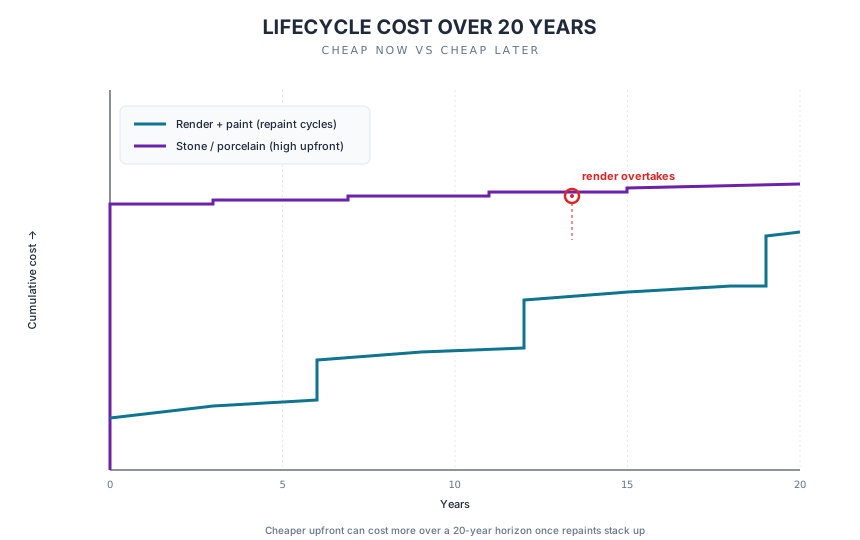
A render-and-paint facade is the cheapest to build, but exterior paint in Indian sun and monsoon typically needs recoating every 5-7 years, each time with scaffolding and labour. Over 20 years that is three or four repaints — and the cumulative cost, plus the access each time, can quietly exceed the one-time cost of a stone, porcelain or terracotta skin that needs almost nothing.
By contrast, natural stone, porcelain, GFRC and terracotta are high upfront but near-flat afterwards — occasional cleaning, the odd resealing, no repainting. Glazed facades sit in between: the glass lasts, but sealant joints need attention around 15-20 years, and the cleaning access (cradles, rope access) is a recurring operating cost on a tall building. The smart budgeting move is to compare facades on 20-year total cost, not just build cost. Our facade maintenance and durability guide goes deeper on the upkeep side.
6. The honest case: how to budget and compare quotes
Start by setting a realistic ₹/sq ft band for your ambition, not a single figure. Be honest about the look you want and where it sits on the ladder above: a comfortable mid-range home facade might budget ₹250-500/sq ft; an aspirational stone-and-glass street face will need ₹800-1,500+/sq ft. Multiply your band by your facade area (not floor area) for a sanity-check total.
Then get like-for-like quotes. Send every bidder the same specification — same material grade, same sub-frame expectation, same access scope — and insist each one itemises sub-frame, scaffolding, GST and design as separate lines. When the lines are visible, you can actually compare. Beware the lowest bid: nine times out of ten the cheapest number is cheap because it has dropped the sub-frame, assumed no scaffolding, or quoted supply against everyone else's turnkey. A bid 30% below the pack is not a bargain — it is a missing line item that will reappear as a variation later.
Finally, value-engineer by mixing. You almost never need the same material everywhere. Put the premium skin — stone, terracotta, glazing — on the visible street face where it earns its keep, and use economical render, fibre-cement or ACP on the rear and side elevations that nobody photographs. A well-mixed facade can deliver 80% of the visual impact at 50% of an all-premium budget. This is the single most effective lever an experienced architect pulls on a facade budget.
7. A worked budgeting example
Imagine a four-storey home with roughly 4,000 sq ft of facade area. An all-render scheme at ₹100/sq ft builds for about ₹4 lakh — but with four repaints over 20 years, the lifecycle cost climbs well past that. An all-stone scheme at ₹900/sq ft builds for ₹36 lakh, near-flat afterwards. The value-engineered route — premium stone (₹900) on the ~1,200 sq ft street face, ACP (₹300) on ~1,000 sq ft of secondary faces, and quality render (₹120) on the ~1,800 sq ft of rear and sides — lands around ₹16-17 lakh, gives the building its expensive face where it counts, and keeps long-term upkeep modest. That is the spread the whole guide is about: same building, three honest budgets, chosen by where you spend, not by chasing the lowest rate.
What this means for you
There is no honest single answer to "what does a facade cost per sq ft in India," and anyone who gives you one without asking about system, grade and scope is guessing. The real answer is a ladder from roughly ₹40 to ₹2,500+ per square foot, and your job as a client is to choose your rung deliberately. Decide the look, set a realistic band, measure the actual facade area, and demand itemised, like-for-like quotes that include the sub-frame, scaffolding and GST. Compare on 20-year cost, not just build cost — because cheap render repainted five times can lose to one-time stone. And let an architect value-engineer the mix so your money lands on the face that matters. Do that, and the ten-times range stops being frightening and becomes a menu you can actually budget from.
Sources
- Indian facade-contractor and manufacturer price bands for ACP, structural glazing, stone, terracotta, fibre-cement and HPL cladding (supplier listings and manufacturer price guides, 2025-2026) — all figures indicative market ranges, not fixed quotes.
- ACP installed-rate ranges (panel plus fitting), branded manufacturer pricing guides, 2025-2026 — indicative.
- Structural glazing / curtain-wall rates (entry-level to premium unitised), Indian facade-engineering supplier listings, 2025-2026 — indicative.
- Stone cladding and terracotta rainscreen supplier listings (supply vs installed), 2025-2026 — indicative.
- GST works-contract rate (~18%) on construction and facade services — Indian GST rate references, 2025-2026.
- CPWD DSR-style rate logic for measurement and itemised BOQ practice (facade area, sub-frame, scaffolding, finishing as separate items).
- Studio Matrx material guides (linked throughout) for the per-system technical and durability detail behind each cost band.
Export this guide
Related Guides — Deep-dive reading
Porcelain, Ceramic & Sintered-Stone Facade Cladding in India: A Practical Guide
Thin large-format porcelain and sintered-stone slabs can clad a building with the look of marble, concrete or weathered steel at a fraction of stone's weight — but on a facade, the fixing system is a life-safety decision, not a finish choice.
Building FacadesThe Truth About Cost Per Square Foot
Why a ₹/sqft interior quote is the most misleading number in Indian home costing — and how to convert it into a real BOQ
Cost & MoneyCompound Wall Cost in India: Materials, Labour and What Drives the Price (2026)
An honest, indicative cost-literacy guide to what a boundary wall really costs in India — why the price swings so much (material first, then height, foundation, finish, gate and site), the full cost stack most people forget, how the wall is measured, and where to trim without cutting the wrong corner. Relative bands, not quotes — get local numbers.
Compound WallsRelated Tools — Try Free
Brise-Soleil Visualizer
Interactive horizontal-louvre cut-off angle calculator — sun altitude, louvre depth, and spacing inputs with a live shadow preview. Computes θ = arctan(spacing/depth) for façade shading, ECBC envelope compliance, hospital daylight design, and tropical sun-control detailing.
Sun Shading ToolWindow Cleaning Cost Calculator
Estimate professional window cleaning cost per visit and per year by access and frequency.
Window CalculatorCross-Ventilation Analyzer
Estimate airflow and air changes per hour (ACH) from room size, window areas, layout, and local wind — with NBC 2016 Part 8 compliance check.
Ventilation Calculator