
Resort and Villa Doors in India: Opening the House to the View (2026)
How to specify doors for resorts and luxury villas in India - the large stacking-slider or folding glass wall that opens to deck, pool, garden or sea, coastal-corrosion-resistant materials and hardware, carved-teak entrances for a sense of place, insect mesh and smart locks for keyless guest stays - with the driver behind each choice and indicative per-door costs.
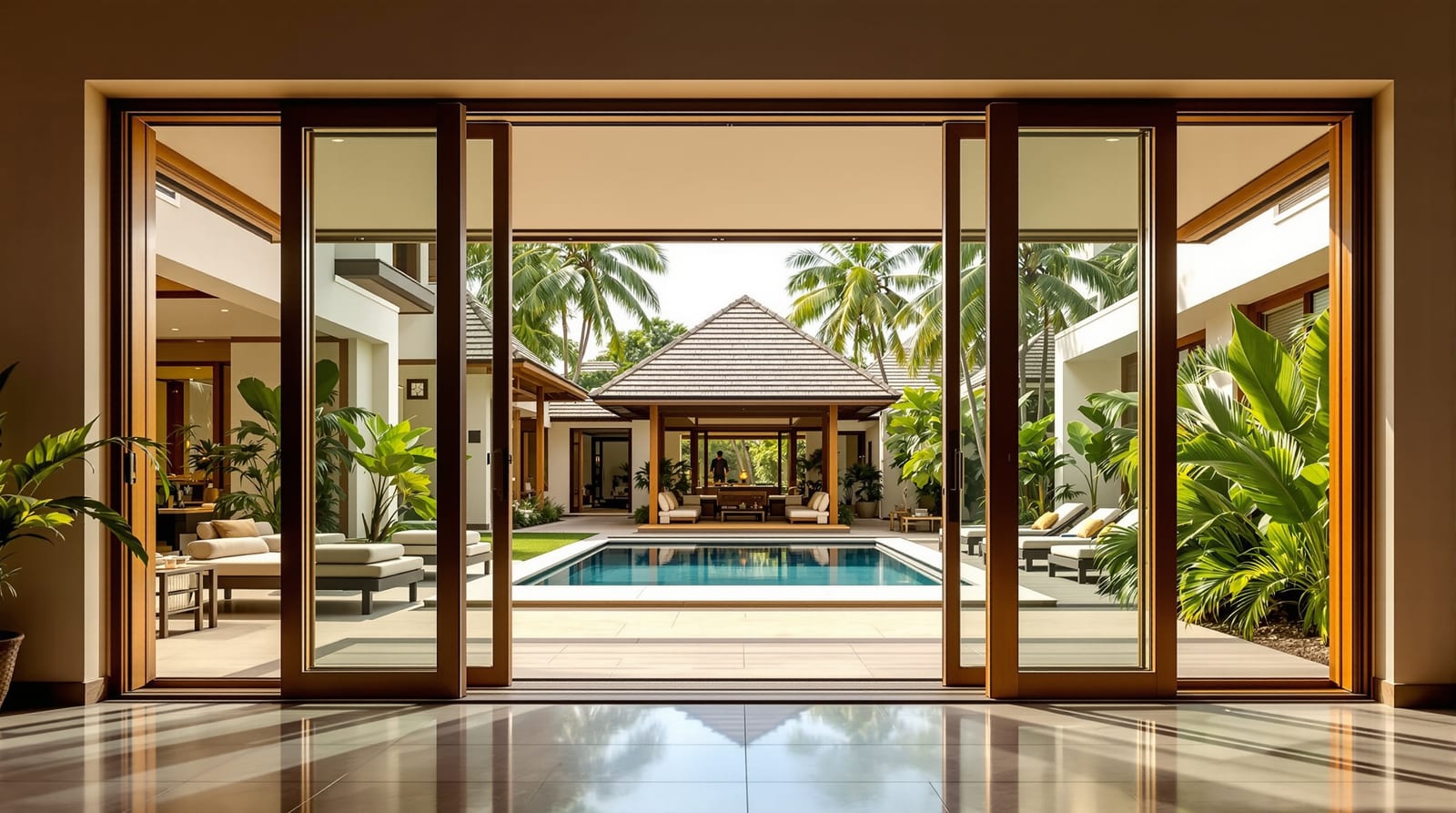
The whole point of a resort or a luxury villa is the view, the breeze and the blur between inside and out - the moment you step from a cool living room straight onto a warm pool deck or a sea-facing verandah. The door makes or breaks that moment: a narrow hinged leaf with a fly-screen frame interrupts it; a six-metre run of glass that slides into the wall completes it. But the same door has to survive salt spray in Goa, lashing Konkan monsoon and 95 percent Kerala humidity - and keep mosquitoes, intruders and the afternoon sun out while it does. This guide ranks the doors that suit Indian resorts and villas space by space, then covers coastal corrosion, insect protection, security for remote properties and keyless guest access, with indicative per-door costs behind each choice.
What a resort or villa door has to do that an ordinary house door does not
Specifying for a villa or resort is a different brief from a city apartment. Five demands dominate, and they often pull against each other:
- Indoor-outdoor flow and the view. The signature move is a wall of glass that opens almost completely - stacking, sliding or folding away - so the living space and the deck, pool, garden or sea read as one. Frame sightlines, minimise the number of interruptions, and keep thresholds flush so guests walk straight through.
- Coastal and humid durability. Sea air, monsoon driving rain and constant humidity corrode ordinary steel hardware, swell untreated timber and pit cheap aluminium. Everything from the frame alloy to the smallest screw must be corrosion-resistant - marine-grade.
- Sun and heat control. Big glass facing west or the sea is a heat trap. Specify good glass (low-E, double-glazed where budget allows), deep overhangs and the ability to ventilate without throwing the doors wide.
- Insect protection. You cannot open a villa to the garden at dusk in India without mosquitoes. Integrated insect mesh - retractable or sliding - is not an afterthought; it is part of the door system.
- Security for an often-remote, often-empty property. Holiday villas sit empty between stays and frequently in isolated locations. Large glass needs laminated panes, multipoint locks and, for keyless guest turnover, smart access.
- A sense of place. Alongside the disappearing glass, the arrival door - the entrance - is where local craft earns its keep: a carved teak leaf, a Chettinad-style panelled door, Goan louvres. It signals "you have arrived somewhere", not "you have checked into a chain".
These drivers - not a single product - decide the door for each part of the villa. For the door logic across other building types, see the doors by space guide for India.
The signature: large opening glass to deck, pool, garden or sea
This is the door that defines the property. Three mechanisms dominate, each opening the wall differently:
1. Stacking / lift-and-slide doors (the default for villas). Multiple large glass panels slide and stack against each other or into a pocket, clearing most of the opening. Lift-and-slide gear raises the heavy leaf off its seals to glide, then drops it onto a weather-tight seal when closed - the smoothest, best-sealed option for big spans. This is the workhorse of Indian villa and resort design: wide, low-threshold, excellent views, good weather sealing. The full mechanism is covered in stacking and sliding doors in India; for the everyday two- and three-panel version see sliding doors in India.
2. Pocket sliders (the fully-disappearing wall). Panels slide right into a cavity built inside the wall, so when open there is no glass visible at all - the cleanest indoor-outdoor connection money buys. Demands wall depth planned at construction and meticulous detailing; superb where you want the opening to vanish entirely onto a pool deck.
3. Bi-fold / folding glass walls (the concertina). Panels hinged together fold and stack like a concertina to one or both sides, opening 90 percent of the aperture. More frame visible when closed than a slider, but the opening is more complete and the panels can fold fully clear. See bi-fold doors in India and folding doors in India for how they run and seal.
For a deck or pool that you want open and walked-through all day, stacking and lift-and-slide doors usually win on smoothness, sealing and low maintenance. For the architectural drama of a wall that disappears, pocket sliders are unmatched. Bi-folds suit narrower openings or where you want the entire aperture clear.
When the wall is open, the room and deck are a single space; when closed and on its lift-and-slide seal, the same wall is weather-tight against monsoon rain. That dual job - vanishing and sealing - is exactly why the mechanism and the hardware grade matter so much in a coastal villa.
Materials: surviving salt, sun and monsoon
A villa door's material is a durability decision first and a looks decision second. In order of how well they cope with the Indian coast:
- Powder-coated marine-grade aluminium. The standard frame for large sliding and folding glass in resorts. Slim sightlines, strong over big spans, and - with a marine-grade powder-coat or anodising - good corrosion resistance near the sea. Confirm the alloy and coating warranty for coastal sites. See aluminium doors in India.
- uPVC. Excellent for humidity and salt - it simply does not corrode - plus good thermal and acoustic performance and low maintenance. Frames are bulkier than aluminium and very large spans need steel reinforcement, but for villa sliders and casements in coastal Kerala, Goa or the Konkan, uPVC is a smart, low-fuss choice. See uPVC doors in India.
- Treated / seasoned teak. The material of the entrance and of warm interiors. Properly seasoned, oil-finished teak is naturally durable and ages beautifully, but near the sea it needs sheltering overhangs and an annual oil or marine-varnish refresh. Reserve solid teak for the arrival door and feature interiors, not exposed sliding walls. See teak wood doors in India.
- WPC and FRP. Wood-plastic composite and fibre-reinforced plastic shrug off water, termites and rot entirely - ideal for bathrooms, outdoor showers, pool changing rooms and back-of-house in a humid resort, where real timber would suffer.
- Toughened / laminated glass infill. Whatever the frame, specify toughened glass; laminated for security and for any overhead or fully-frameless run. Low-E or double-glazing tames sea-facing heat and glare.
For a side-by-side of how each material behaves in damp, salty, hot conditions, see door materials comparison for India.
Marine-grade hardware - the part that fails first
On the coast it is rarely the door that fails - it is the hardware. Ordinary mild-steel rollers, screws and locks rust within a season near the sea, jamming sliders and seizing locks. For any coastal villa or resort, insist on:
- Stainless steel grade 316 (marine grade) for handles, rollers, hinges, screws and lock bodies - not the cheaper 304, which still spots near salt water.
- Sealed stainless rollers and tracks on sliders, rated for the panel weight, with stainless or brass running gear.
- Multipoint locking on large sliding and entrance doors - several bolt points along the leaf, not a single centre latch - for both security and weather sealing.
- Marine-finish handles and pulls - 316 stainless, marine brass or coated finishes warrantied for coastal exposure.
- Stainless or composite weatherstripping and brush seals that resist salt and UV.
The general specification logic lives in the door hardware guide for India; the rule for the coast is simply "go up a grade and confirm 316".
The arrival door: local craft and a sense of place
While the garden-facing wall disappears into glass, the entrance does the opposite - it announces the place. This is where resorts and villas spend on character:
- Carved or panelled teak for a grand, regional entrance - Chettinad-style panelled doors, Goan-Portuguese louvred leaves, Kerala temple-influenced carving, Rajasthani brass-studded shutters. A solid teak entrance leaf runs from roughly 18,000 to 60,000 and well beyond for hand-carved heritage work; see teak wood doors in India.
- Pivot doors for a wide, dramatic, contemporary arrival.
- Double doors for symmetry and a generous opening on a grand villa.
- Engineered-wood or veneered leaves where you want the teak look at lower cost and better dimensional stability in humidity.
The brief for the entrance is the inverse of the deck wall: it is the one door that should feel weighty, crafted and rooted in the region. For the design grammar of the front door, see main door design in India.
Recommended doors by villa space - suitability and cost
Costs are indicative 2026 supply-and-fit figures per door (or per running metre of opening where noted), before 18 percent GST, varying by size, glass grade, frame finish, hardware grade and city. Coastal marine-grade hardware adds roughly 10-25 percent over standard.
| Villa space | Recommended door | Why (the driver) | Indicative cost |
|---|---|---|---|
| Living to pool deck / sea | Lift-and-slide or stacking glass slider, marine-grade aluminium or uPVC | Wide view, walk-through flow, weather-tight seal, low threshold | 18,000-55,000 per panel; large runs 1.5-6 lakh+ |
| Living wall to disappear | Pocket slider into wall cavity | Fully vanishing wall, cleanest indoor-outdoor read | 25,000-60,000 per panel + cavity works |
| Narrower deck / garden opening | Bi-fold / folding glass wall, aluminium or uPVC | 90 percent clear opening, panels fold fully aside | 14,000-40,000 per panel |
| Main entrance | Carved / panelled solid teak, or pivot | Sense of place, arrival statement, security | 18,000-60,000+ (teak); pivot 40,000-1.5 lakh+ |
| Bedroom to private balcony | French or sliding glass door, marine hardware | Light, view, private outdoor access | 14,000-40,000 |
| Bathroom / outdoor shower / pool change | WPC, FRP or uPVC | Total water and termite resistance | 4,000-16,000 |
| Verandah / sit-out with insects | Sliding or hinged door with integrated insect mesh | Open to breeze, keep mosquitoes out | mesh add-on 4,000-15,000 per opening |
| Back-of-house / staff / utility | Flush or WPC, durable hardware | Robust, low-cost, moisture-tolerant | 3,000-12,000 |
| Stairwell / between blocks (resort) | Fire-rated steel or treated timber, self-closing | IS 3614 fire compartmentation, egress | 12,000-45,000+ |
Insect protection - opening up without the mosquitoes
A villa you cannot open at dusk is a villa half-used. Build insect protection into the door system from the start:
- Sliding or pleated mesh panels that run alongside the glass sliders, so the opening can be screened while the breeze passes.
- Retractable / roll-away mesh that disappears into a side cassette when not needed - the neatest option for a clean view.
- Magnetic or hinged mesh doors on secondary and back doors.
- Specify fine stainless or fibreglass mesh (corrosion-resistant near the sea) and a track that is easy to clean of leaves and salt.
The full options, mesh grades and fitting are in mosquito mesh doors in India. Treat the mesh as integral to the slider, not a bolt-on, so the screens stack and seal as cleanly as the glass.
Security and keyless access for remote and rented villas
Holiday villas and resort units are emptier, more remote and have more guest turnover than a normal home - which changes the security brief:
- Laminated glass in large sliders and any ground-level glass: it holds together when struck, defeating the smash-and-slide-the-latch attack.
- Multipoint locking along the leaf of sliders and entrance doors, with anti-lift blocks so a slider cannot be jacked off its track.
- Smart / keyless locks for guest stays. For a rented villa or resort room, a keyless smart lock lets you issue a time-limited PIN or app key per guest, eliminate physical key handover and revoke access at checkout - the same model resorts use for hotel doors in India. Choose corrosion-resistant, weather-rated units for coastal entrances.
- Grilles where genuinely needed on remote ground-floor service openings, in a powder-coated or stainless finish so they survive the salt.
Smart access transforms operations for a rented villa: no caretaker waiting with keys, no lost-key call-outs, a clean audit of who entered when. Pair it with laminated glass and multipoint hardware so convenience does not cost security.
Sun, heat and the monsoon
Big glass on the coast is a thermal and water challenge, so handle it at design stage:
- Glass: specify low-E and, where budget allows, double-glazed units on sea- and west-facing walls to cut heat and glare without darkening the room.
- Shade the glass: deep verandahs, overhangs, pergolas and louvres do more than any glass coating, and they are the regional vernacular for a reason.
- Drain and seal: lift-and-slide seals, a slight outward floor fall and a proper sill drain keep monsoon rain out of a flush threshold.
- Ventilate without opening wide: louvred or tilt-and-turn secondary openings let you air the villa overnight without leaving a six-metre wall ajar.
The energy logic behind glass and sealing is covered in energy-efficient doors in India.
Do and don't
- Do lead the design with the view: put the largest, smoothest-opening glass where the deck, pool, garden or sea is.
- Do specify 316 marine-grade stainless hardware on any coastal villa - it is the part that fails first.
- Do build insect mesh into the slider from the start, not as a bolt-on.
- Do use uPVC, WPC or FRP in wet and humid spaces where timber would swell or rot.
- Do fit laminated glass and multipoint locks on remote and rented properties, with smart locks for guest turnover.
- Don't use solid teak for exposed sliding walls or bathrooms - reserve it for the sheltered entrance and dry interiors.
- Don't accept standard mild-steel rollers and screws near the sea - they will seize within a season.
- Don't put unshaded west- or sea-facing glass without low-E glazing and an overhang - the room will overheat.
Frequently asked questions
What is the best door for a coastal villa in India?
For the main view-facing opening, a lift-and-slide or stacking glass door in marine-grade powder-coated aluminium or uPVC, with toughened or laminated glass and grade 316 stainless hardware. It gives the wide indoor-outdoor opening villas are built for while surviving salt and monsoon. Reserve solid teak for the sheltered entrance, and use WPC or FRP in wet areas.
What material resists sea air and humidity best for villa doors?
uPVC and FRP do not corrode at all and are the safest choices for the most exposed and wet positions. Marine-grade powder-coated or anodised aluminium is the standard for large glass sliders and folding walls. Treated teak is beautiful but needs shelter and annual oiling near the coast, so keep it to the entrance and dry interiors. See the door materials comparison for India for a full breakdown.
How do I open a villa to the garden without letting mosquitoes in?
Build insect mesh into the door system: sliding or pleated mesh panels that run alongside the glass sliders, or retractable mesh that rolls into a side cassette. Use fine stainless or fibreglass mesh that resists coastal corrosion. See mosquito mesh doors in India for the options, mesh grades and fitting.
Are smart locks suitable for a rented holiday villa?
Yes - they are ideal. A keyless smart lock lets you issue a time-limited PIN or app key for each guest stay, avoid physical key handovers and revoke access at checkout, exactly as resorts manage hotel-room doors. For coastal villas, choose a weather-rated, corrosion-resistant unit and pair it with laminated glass and multipoint locking for proper security on a remote, often-empty property.
How much does a large sliding glass door cost for a villa in India?
Indicatively, a marine-grade aluminium or uPVC lift-and-slide glass door runs about 18,000 to 55,000 per panel supply-and-fit, so a wide multi-panel run reaches roughly 1.5 to 6 lakh and beyond - before 18 percent GST, varying by size, glass grade, frame finish and hardware grade. Coastal 316 stainless hardware adds about 10 to 25 percent. For room-by-room interior choices, see the interior doors by room guide for India.
Export this guide
Related Guides — Deep-dive reading
The Complete Home Door Guide for Indian Homes (2026): Types, Materials, Cost, Security & Vastu
Everything an Indian homeowner needs to specify the right door for every opening — from main entrance to bathroom — with real 2026 prices, IS/NBC standards and Vastu sense.
Home Doors & EntrancesFrench Doors for Indian Homes: Glazing, Security, Cost & Monsoon Sealing
The double-leaf glazed door that opens a living room to a balcony or garden - where it works, how to specify the glass, frame and seals, what it costs, and how it stacks up against sliding and bi-fold.
Home Doors & EntrancesFrench Windows (India): Full-Height Glazed Doors to Balcony and Garden
Full-height, side-hinged, double-leaf glazed windows that open like doors onto a balcony, deck or garden, light, access and classic elegance, plus the monsoon threshold detail that makes or breaks them.
Windows & GlazingRelated Tools — Try Free
Door Material Comparison Tool
Compare 2–4 door materials on cost, durability, maintenance, security and moisture resistance.
Comparison ToolWindow Material Comparison Tool
Compare uPVC, aluminium, wood, steel and composite windows on cost, life, upkeep and insulation.
CompareWindow Grill Design Selector
Pick a window grille style and material by priority — security, looks, budget, view — and estimate cost.
Window Tool