
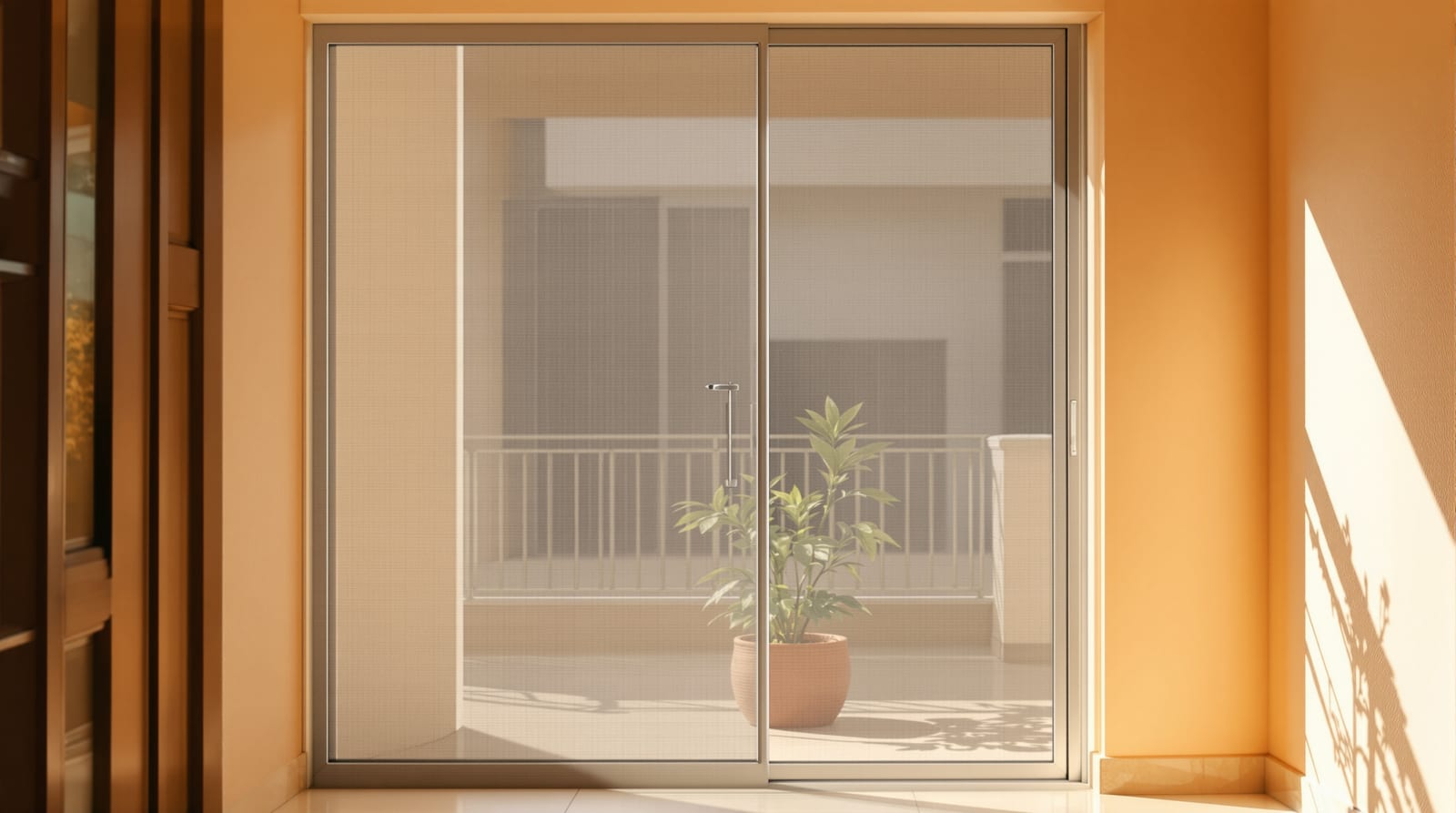
Mosquito Mesh Doors in India (2026): Types, Mesh Materials, Cost & Fitting Guide
Hinged, sliding, pleated and magnetic insect-screen doors for Indian homes — choosing the right mesh and frame for dengue, monsoon and pets.
In a country where dengue, malaria and chikungunya cases spike with every monsoon, a mosquito mesh door is not a luxury accessory — it is basic preventive infrastructure. It lets you keep doors and balconies open for cross-ventilation through humid Chennai or Mumbai evenings without inviting the Aedes mosquito that breeds in the very water collecting on your sill. The challenge is that "mosquito net door" covers half a dozen very different products, from a simple openable mesh shutter to a spring-loaded retractable pleated screen, each with its own mesh material, cost and failure mode. This guide breaks down every type, what mesh to specify, what it should cost per square foot, and how to fit and care for it through an Indian monsoon.
For where mesh doors sit in the broader picture, see the complete guide to home doors in India and types of doors in India. Mesh almost always works alongside another door, so it pairs naturally with balcony doors, sliding doors and safety grill doors.
Why a dedicated mesh door beats loose netting
Stick-on velcro nets and curtain rods are cheap, but they sag, tear and stop sealing within a season. A purpose-built mesh door runs in a track or hinges on its own frame, so it closes flush and self-seals every time someone walks through. That matters: a mosquito only needs a finger-width gap. A proper mesh door also keeps out lizards, houseflies and the post-monsoon swarm of flying termites (alates) that chew through loose nylon. For families with infants or elderly members vulnerable to vector-borne disease, the difference between a sealed track and a flapping curtain is the whole point.
The five types of mosquito mesh door
Indian retailers and fabricators broadly offer five formats. The right one depends on the opening (main door, balcony slider, or beside a window), how often you pass through, and your budget.
| Type | How it works | Best for | Indicative cost (mesh + frame, fitted) |
|---|---|---|---|
| Hinged / openable frame | Aluminium frame on hinges, opens like a second door | Main doors, single-leaf openings | ₹250–450 / sq ft |
| Sliding mesh panel | Runs on the same multi-track as a sliding glass/aluminium door | Balcony and patio sliders | ₹300–550 / sq ft |
| Pleated / plisse retractable | Accordion-folded mesh slides sideways and folds flat | Wide openings, frequent passage, low-profile look | ₹500–1,200 / sq ft |
| Magnetic curtain mesh | Two mesh halves snap shut on magnets after you pass | Renters, quick DIY, low budget | ₹400–1,500 per set |
| Roll-up / retractable spring | Mesh winds into a side or top cassette like a roller blind | Doors used occasionally, neat storage | ₹600–1,100 / sq ft |
Costs are indicative and vary by city, mesh grade and section weight; add roughly 18% GST and ₹800–2,000 fitting labour per door.
Hinged / openable mesh frame
The workhorse. A slim powder-coated aluminium frame carries the mesh and swings on hinges beside your main wooden or steel door. It is robust, easy to clean, and takes heavier meshes like stainless steel. The trade-off is swing space — it needs clearance like any hinged door, so check the swing arc the way you would for any leaf (the small-space measuring lesson is a useful primer).
Sliding mesh panel
If you already have a sliding glass or aluminium door on a multi-track frame, the cleanest solution is an extra mesh panel in the outermost channel. It slides aside when not needed and costs little because it reuses the existing track. This is the default for balcony and living-room sliders.
Pleated / plisse retractable
The premium choice. The mesh is pleated like an accordion and pulled across the opening on top and bottom guide rails, folding completely flat into a 40–60 mm cassette when open. It suits wide openings up to 3–4 m, gives an almost frameless view, and disappears when you do not need it. The cord-and-pulley mechanism is the part that wears, so buy a brand with spares.
Magnetic curtain mesh
The renter's friend: two mesh halves hung from a self-adhesive or tack-on strip, held shut by a vertical row of magnets. You walk through and they snap closed behind you. Cheap, removable, and fine for a bedroom or kitchen door — but they offer no real durability, sag in humidity, and pets defeat them quickly.
Roll-up / retractable spring
Mesh rolls into a spring-loaded cassette and pulls out like a roller blind, vertically or horizontally. Neat and unobtrusive, ideal for a door you only screen seasonally. The spring and channel guides are the wear points; coastal salt air can stiffen them, so a stainless or marine-grade mechanism is worth it near the sea.
Mesh materials: the choice that actually matters
The frame format gets the attention, but the mesh fabric decides how long the door lasts, how clearly you see through it, and whether your dog destroys it in a week.
| Mesh material | Durability | Visibility | Pet resistance | Best use | Notes |
|---|---|---|---|---|---|
| Fibreglass | Moderate (5–8 yrs) | Good | Low | Windows, low-traffic doors | Cheapest, non-corroding, but tears and sags |
| Polyester (coated) | Moderate | Good | Low–moderate | Budget doors, pleated screens | Flexible, washable; UV-degrades over years |
| Aluminium | Good | Very good | Moderate | Main and balcony doors | Rust-free, holds shape; dents if knocked |
| Stainless steel 304 | Excellent (10–15 yrs) | Good | High | Main doors, coastal, pet homes | Strongest; resists cutting, salt and claws; costliest |
| Pet-grade / heavy PVC-coated polyester | Very good | Moderate | Very high | Homes with cats and dogs | Thicker strand, slightly darker view |
A few practical rules for Indian conditions:
- Coastal homes (Goa, Kerala, Chennai, Mumbai seafront): insist on SS 304 mesh and a marine-grade aluminium or stainless frame. Ordinary galvanised mesh pits and bleeds rust within two monsoons of salt air.
- Pets: go straight to SS 304 or a heavy pet-grade polyester at the bottom 600 mm where claws strike; some fabricators fit a kick-plate and pet mesh only on the lower band to save cost.
- Visibility vs strength: fine fibreglass gives the clearest, least-grey view but is the first to tear; stainless is slightly darker but near-indestructible. For a balcony where you want an unobstructed view, aluminium mesh is the best balance.
Where each type suits
- Main door: hinged openable frame with aluminium or SS 304 mesh. It is robust, takes daily slamming, and can carry a small lock so the mesh door secures the entrance for ventilation while the main wooden door stays open. Pair it with thinking about overall door security.
- Balcony / living-room slider: sliding mesh panel in the existing multi-track, or a pleated screen for a wide opening. See balcony doors.
- Window-adjacent and small openings: roll-up or fixed fibreglass mesh, since traffic is low and a slim profile matters.
- Bedroom / kitchen on a rental: magnetic curtain mesh — cheap, removable, no drilling deposit lost.
Pleated and sliding mesh: how the mechanism works
The pleated screen is pulled by a magnetic latch across top and bottom rails; releasing it lets a tensioned cord fold the mesh back into the side cassette. The sliding panel simply rides the outer channel of a multi-track aluminium frame, parking behind the glass when not in use.
Fitting on existing frames
Most homes retrofit mesh rather than plan it. Three common situations:
- Existing wooden door frame (chowkat): a hinged aluminium mesh frame screws directly onto the chowkat beside the leaf. The fabricator measures the rebate and makes a frame to fit; allow 5–7 days. This is the most common main-door retrofit.
- Existing sliding aluminium frame with a spare track: just order a mesh panel sized to the channel — the cheapest upgrade of all.
- Sliding frame with no spare track: you need a pleated or roll-up screen surface-mounted to the wall around the opening, since there is no channel for a sliding panel.
Measure the clear opening at three points (tops and bottoms of openings rarely match in Indian masonry), and tell the fabricator whether the door opens in or out and which side is hinged. Factory-made aluminium frames are more uniform and longer-lasting than a local carpenter's improvised job, though the carpenter route is cheaper for a one-off.
Cleaning and monsoon care
Mesh clogs with dust, then with the fine grime that monsoon humidity bakes onto it. Maintenance keeps both visibility and airflow:
- Monthly: vacuum with a brush head or wipe with a dry microfibre cloth, both sides.
- Quarterly / pre-monsoon: detach (or wipe in place) and wash with mild soapy water and a soft sponge; never scrub hard mesh sideways or you splay the weave.
- Tracks: brush out grit and run a dry silicone spray on sliding channels — sand and damp seize cheap rollers within a season.
- Coastal: rinse SS mesh with fresh water periodically to clear salt deposits before they pit.
A torn fibreglass panel is usually re-meshed by the same fabricator for ₹150–300 / sq ft rather than replacing the whole frame.
Pet-proof options
Cats and dogs are the number-one killer of mosquito mesh. Options, cheapest to best:
1. Pet-grade PVC-coated polyester — thicker strand, claw-resistant, slightly darker. Good value.
2. Lower-band reinforcement — normal mesh above, SS 304 or an acrylic kick-plate on the bottom 500–600 mm where paws and claws strike.
3. Full SS 304 mesh — effectively pet-proof and the longest-lived, at the highest cost.
For dogs that push at doors, a hinged or sliding aluminium frame survives better than a magnetic curtain, which they simply nose through.
Brands and where to buy
Recognisable names in the Indian market include Phifer and Saint-Gobain (mesh fabric), and door-system brands such as Magic (mesh systems), Classic, Premium, and numerous regional aluminium fabricators who make hinged and sliding frames to size. Pleated and retractable systems are often imported or made by specialist insect-screen firms. For a one-off main door, a good local aluminium fabricator is usually the most cost-effective; for a whole flat or coastal home, a branded SS 304 system is the safer long-term buy.
Frequently asked questions
Which mosquito mesh is best for an Indian main door?
A hinged openable aluminium frame with stainless steel 304 mesh. It takes daily use and slamming, resists rust through the monsoon, and stands up to pets and forced entry far better than fibreglass. Aluminium mesh is the value alternative if there are no pets.
How much does a mosquito mesh door cost per square foot?
Indicative 2026 ranges, varying by city and vendor: basic openable or sliding mesh ₹250–550 / sq ft, and pleated or retractable screens ₹500–1,200 / sq ft, plus roughly 18% GST and ₹800–2,000 fitting labour per door.
Can I fit a mesh door without changing my existing door?
Yes. A hinged aluminium mesh frame screws onto your existing wooden chowkat beside the main leaf, and a sliding mesh panel drops into a spare channel on an aluminium sliding frame. Only frames with no spare track need a surface-mounted pleated or roll-up screen.
Is fibreglass or stainless steel mesh better?
Fibreglass is cheaper, non-corroding and gives the clearest view, but tears and sags in 5–8 years. Stainless steel 304 lasts 10–15 years, resists cutting, salt and claws, and is the right choice for coastal homes, main doors and pet households despite the higher cost.
How do I stop my dog tearing the mesh?
Use a pet-grade PVC-coated polyester or SS 304 mesh, or reinforce only the bottom 500–600 mm with stainless mesh or a kick-plate. Choose a hinged or sliding frame over a magnetic curtain, which pets defeat instantly.
Export this guide
Related Guides — Deep-dive reading
Window Screens and Meshes Guide for India
The full mesh catalogue — fibreglass to SS304 to nano-fibre PM2.5 — with weave density, frame formats, real costs and the airflow trade-off
Windows & GlazingSliding Door Track Cleaning: Easy DIY Fix (India 2026)
Why Indian sliding doors get stiff — dust, grime and hard-water scale in the track — and the step-by-step clean-dry-lubricate routine that fixes it.
Home Doors & EntrancesStacking Sliding Doors for Indian Homes: Multi-Panel Open-Wall Guide (2026)
How 3-6 panel stacking sliders create a near-full open wall to your balcony or garden, the multi-track aluminium systems, weight and glass limits, weather seals, costs, and how they compare to bi-folds.
Home Doors & EntrancesRelated Tools — Try Free
Cross-Ventilation Analyzer
Estimate airflow and air changes per hour (ACH) from room size, window areas, layout, and local wind — with NBC 2016 Part 8 compliance check.
Ventilation CalculatorWindow Grill Design Selector
Pick a window grille style and material by priority — security, looks, budget, view — and estimate cost.
Window ToolWindow Cleaning Cost Calculator
Estimate professional window cleaning cost per visit and per year by access and frequency.
Window Calculator