
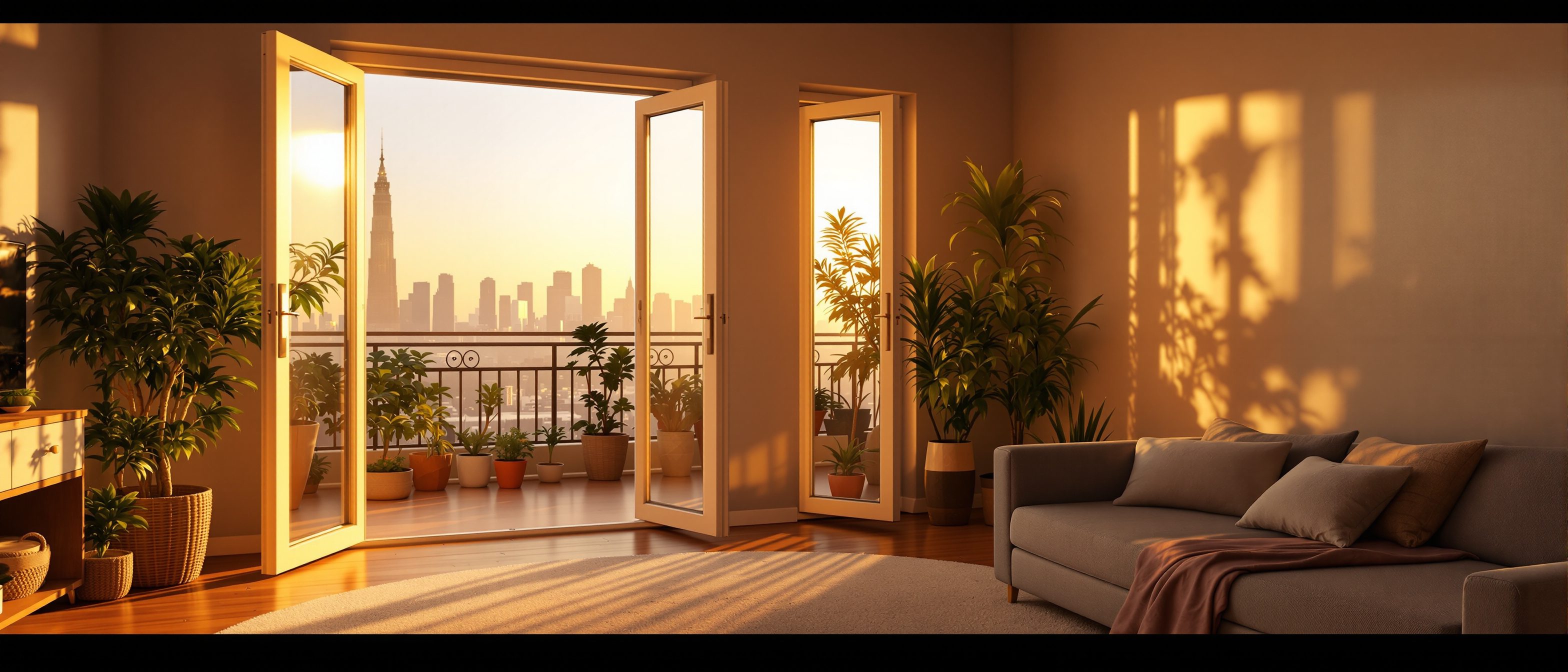
French Windows (India): Full-Height Glazed Doors to Balcony and Garden
Full-height, side-hinged, double-leaf glazed windows that open like doors onto a balcony, deck or garden, light, access and classic elegance, plus the monsoon threshold detail that makes or breaks them.
French windows are the most romantic piece of fenestration you can put in a home, and one of the most practical. They are full-height, side-hinged, double-leaf glazed units that swing open like a pair of doors directly onto a balcony, deck or garden. You get a flood of daylight, a clear walk-through to the outdoors, and an unmistakably classic, elegant face for the room. In an Indian home they reward you most where a living room, master bedroom or dining space meets a usable outdoor edge.
This guide is the dedicated deep-dive on French windows. For the quick combined introduction to all your fenestration, see our broad overview, Windows and Doors Design in India; here we go much deeper on operation, the rain-sill detail that makes or breaks a monsoon, security, glazing and the real cost band.
What exactly is a French window
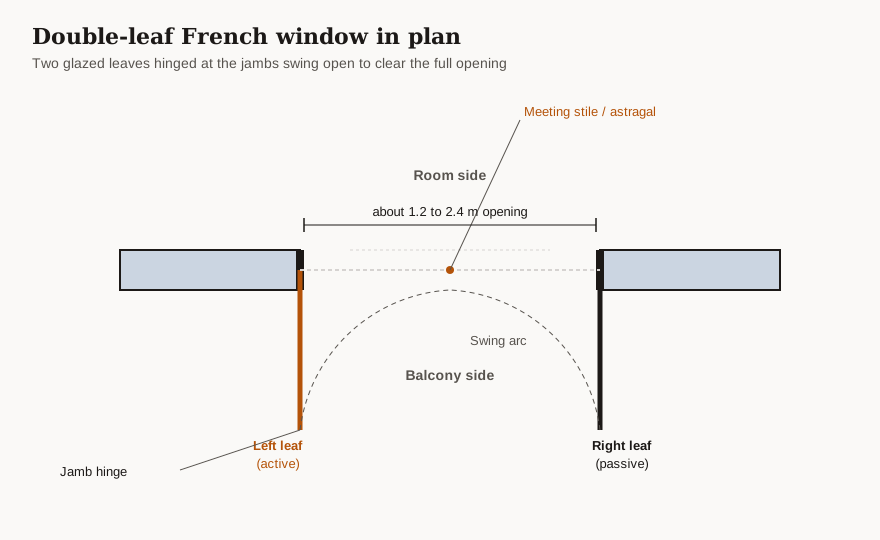
The defining trait is the pair of full-height hinged leaves. Each leaf is a slim glazed frame; together they meet at the centre and, when both are opened, leave an unbroken doorway. Because they reach the floor (or a low sill) and open wide, they straddle the line between a window and a door, which is why fabricators and architects often call them French doors interchangeably.
A French window is, in plain terms, a window you can walk through. That dual nature, light plus access, is the whole point.
It is easy to confuse three full-height glazed types, so fix the difference before you brief a fabricator:
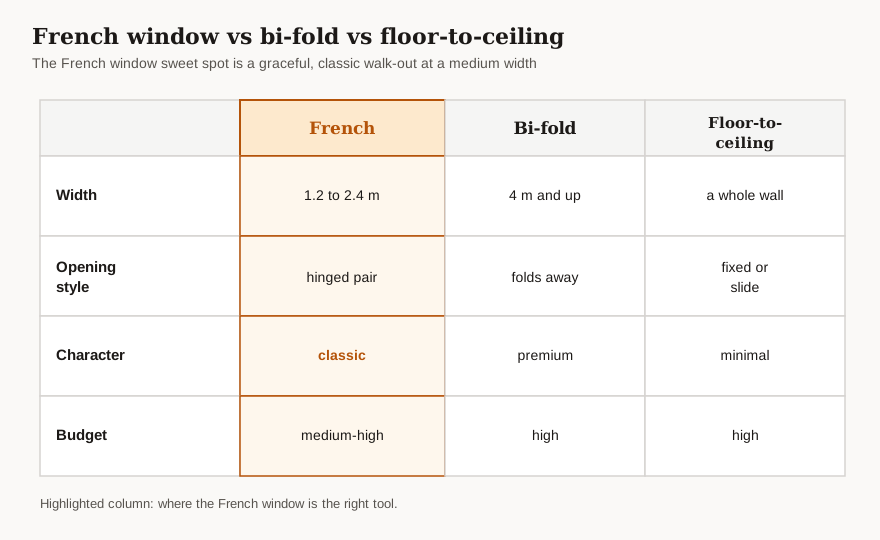
| Type | What it is | Opens? | Character |
|---|---|---|---|
| French window | A pair of side-hinged leaves | Yes, swings like doors | Classic, elegant |
| Bi-fold / folding | Many panels that concertina to one side | Yes, opens a whole wall | Premium, contemporary |
| Floor-to-ceiling | Full-height glass, fixed or sliding | Fixed or slides; no walk-through swing | Minimal, view-led |
The short version: a French window is a pair of hinged leaves; a bi-fold folds many panels to clear a full opening; floor-to-ceiling is fixed or sliding full-height glass. If your opening is roughly 1.2 to 2.4 metres wide and you want a graceful, traditional walk-out, the French window is the right tool. For a 4-metre-plus wall that should vanish entirely, look at bi-folds.
Single leaf, double leaf, and which way it swings
Most French windows are double-leaf (two operable leaves). A single-leaf version exists for narrower openings, often paired with a fixed glazed sidelight. Decide three things early:
- In-swing or out-swing. Out-swing leaves do not eat indoor floor space and seal better against driving rain, because wind pressure pushes the leaf onto its gaskets. In-swing leaves are easier to clean and operate from inside and keep the balcony clear, but they steal interior room and can be pushed open by storm gusts. For monsoon-facing walls, out-swing is usually the safer default.
- Active and passive leaf. In a double-leaf unit one leaf (active) is used daily; the second (passive) is held shut by flush bolts top and bottom into the head and threshold, and is released only when you want the full opening.
- Astragal or rebated meeting stiles. Where the two leaves meet, a rebated profile or an astragal moulding closes the gap. This joint is the weak point for both air and water, so it must carry good gaskets.
Ventilation behaviour
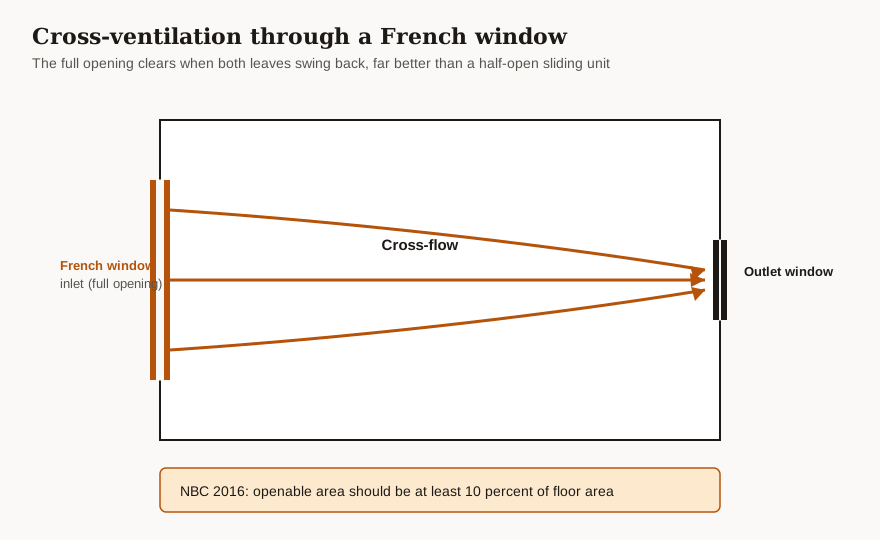
A French window ventilates beautifully because the entire opening clears when both leaves swing back, far better than a sliding unit that only ever exposes half its width. That makes it an excellent inlet or outlet for cross-ventilation: pair it with an opening on the opposite or adjacent wall and you pull a strong breeze through the room. NBC 2016 sets the familiar rule of thumb that openable area should be at least one-tenth (10 percent) of floor area for habitable rooms; a double-leaf French window comfortably clears that on its own. To size the airflow for your specific room, run the numbers in our cross-ventilation analyzer, and read cross-ventilation in Indian homes for placement strategy.
The threshold, the sill and monsoon rain
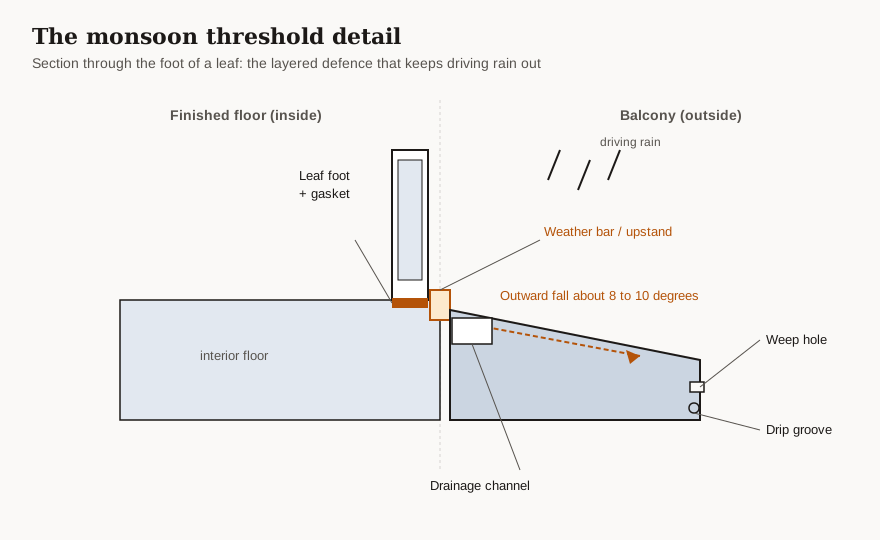
This is the single most important detail in an Indian French window, and the one most often botched. Because the leaves reach the floor, there is no high sill to stop water; the threshold sits almost level with the finished floor, so wind-driven monsoon rain can sheet straight in.
A well-detailed threshold solves this with layers:
- A low upstand or weather bar at the leaf foot, with a continuous gasket that compresses when the leaf shuts.
- An outward fall on the external sill (a slope of around 8 to 10 degrees) so water runs away from the room, not toward it.
- A drainage channel or rebate outside the threshold with weep holes to carry away anything that gets past.
- A drip groove under the external sill nose so water drips clear instead of tracking back along the underside.
For an out-swing leaf you can also add a small storm threshold; for a flush, step-free in-swing threshold (kinder for elderly users and prams) you must work harder on the drainage channel because you have lost the upstand. Always brief the fabricator on monsoon exposure for that specific elevation.
Security
Because a French window is a ground- or balcony-level walk-through, treat its security like a door, not a window:
- Multi-point locking. A good system throws bolts at the head, the sill and the centre stile from a single handle turn, so the leaf is pinned along its full height. This is far stronger than a single central latch.
- Shoot bolts on the passive leaf into solid timber or steel anchors, not just into a soft frame.
- Toughened (tempered) glass is the safety minimum for full-height panes; it is four to five times stronger and shatters into blunt granules. Laminated glass, with its PVB interlayer, is the security upgrade, because it holds together when struck and resists a break-and-reach attack, while also cutting noise and UV.
- Hinge-side security pins so the leaf cannot be levered off its hinges from outside.
Frame and glazing choices
| Frame | Why it suits a French window | Indicative cost |
|---|---|---|
| uPVC | Best all-round value, good thermal and acoustic insulation, termite and rust proof, steel-reinforced for the leaf height | ₹250 to ₹800/sqft |
| Aluminium (thermally broken) | Slim sightlines, very strong for tall leaves, modern look; insist on a thermal break | ₹350 to ₹3,000/sqft |
| Wood (timber) | The classic, warm, heritage French-door look; needs sealing against monsoon and costs 2.5 to 4 times uPVC over 10 years | ₹500 to ₹1,500/sqft+ |
On glass, full-height leaves should be toughened or laminated for safety, and almost always a DGU (double glazed unit) for thermal and acoustic comfort. In India's heat, specify a Low-E coating with a low SHGC so you keep daylight while rejecting solar heat. Remember the energy code: a French window raises your window-to-wall ratio, and the Eco-Niwas Samhita 2018 then demands a minimum VLT for that WWR band while holding the wall envelope RETV at or below 15 W/m squared, which low-SHGC spectrally selective glass helps you meet. Our pillar, Types of Home Windows in India, maps these glazing selectors (VLT, SHGC, U-value) across every window type.
Cost band
French windows sit in the medium-to-high band. The hardware (two sets of hinges, multi-point locks, flush bolts), the safety glass and the threshold detailing all add up. Expect the unit to cost in line with a premium window of the same frame and glass, plus a specialty fitting premium of roughly ₹500 to ₹800/sqft for the careful threshold and alignment work, against around ₹200/sqft for an ordinary window install. These are indicative June 2026 figures; always confirm with itemised quotes from your fabricators, because city, brand, leaf height and glazing swing the number widely.
Pros and cons
| Pros | Cons |
|---|---|
| Full opening clears for excellent ventilation and walk-through access | Swinging leaves need clear floor or balcony space |
| Classic, elegant, timeless look | Threshold and monsoon detailing is demanding |
| Floods the room with daylight | Higher cost than sliding or fixed windows |
| Strong indoor-outdoor connection to balcony or garden | Security must be engineered like a door |
| Easy to size for the 10 percent NBC ventilation rule | Large glass area raises WWR, demanding better glazing under ENS |
Choose this if / avoid if
Choose a French window if: you have a living room, master bedroom or dining space that opens onto a balcony, deck or garden; the opening is roughly 1.2 to 2.4 m wide; you want a classic, elegant walk-out with generous light and air; and you have floor or balcony clearance for swinging leaves.
Avoid (or rethink) if: the wall faces driving monsoon rain with no overhang and you cannot detail the threshold properly; the opening is very wide and you really want the whole wall to disappear (choose a bi-fold instead); you want full-height glass with no walk-through and minimal frames (choose floor-to-ceiling); or floor space is too tight for any swing (a sliding unit suits better).
For daylighting strategy around large glazed openings, see natural light planning for Indian homes.
References
- IS 1948 (Specification for aluminium doors, windows and ventilators), BIS: https://law.resource.org/pub/in/bis/S03/is.1948.1961.pdf
- IS 1081 (Code of practice for fixing and glazing of metal doors and windows), BIS: https://law.resource.org/pub/in/bis/S03/is.1081.1960.pdf
- IS 3362 (Code of practice for natural ventilation of residential buildings), BIS: https://law.resource.org/pub/in/bis/S03/is.3362.1977.pdf
- BIS Guide for Using NBC 2016: https://www.bis.gov.in/wp-content/uploads/2022/08/Booklet-Guide-for-Using-NBC-2016.pdf
- Eco-Niwas Samhita 2018 (BEE / ECBC for residential buildings): https://ecbc.in/econiwas.html
- uPVC windows price per sq ft 2026, Building and Interiors: https://buildingandinteriors.com/upvc-windows-price-per-sq-ft-india-2026-cost-guide/
Export this guide
Related Guides — Deep-dive reading
Floor-to-Ceiling Windows (India): Maximum Light, and the Heat Trade-Off
Full-height glazing for Indian homes — how to win the daylight and view without losing the energy code, comfort or safety.
Windows & GlazingFolding and Bi-Fold Windows (India): Open a Whole Wall to the Outdoors
Multiple glazed panels that concertina to one side, dissolving a whole wall onto your terrace or garden — and the monsoon threshold detailing that makes or breaks them.
Windows & GlazingFrench Doors for Indian Homes: Glazing, Security, Cost & Monsoon Sealing
The double-leaf glazed door that opens a living room to a balcony or garden - where it works, how to specify the glass, frame and seals, what it costs, and how it stacks up against sliding and bi-fold.
Home Doors & EntrancesRelated Tools — Try Free
Cross-Ventilation Analyzer
Estimate airflow and air changes per hour (ACH) from room size, window areas, layout, and local wind — with NBC 2016 Part 8 compliance check.
Ventilation CalculatorWindow Size Calculator
Get the right window size, glazing area and openable area for any room using NBC daylight rules.
Window ToolBrise-Soleil Visualizer
Interactive horizontal-louvre cut-off angle calculator — sun altitude, louvre depth, and spacing inputs with a live shadow preview. Computes θ = arctan(spacing/depth) for façade shading, ECBC envelope compliance, hospital daylight design, and tropical sun-control detailing.
Sun Shading Tool