
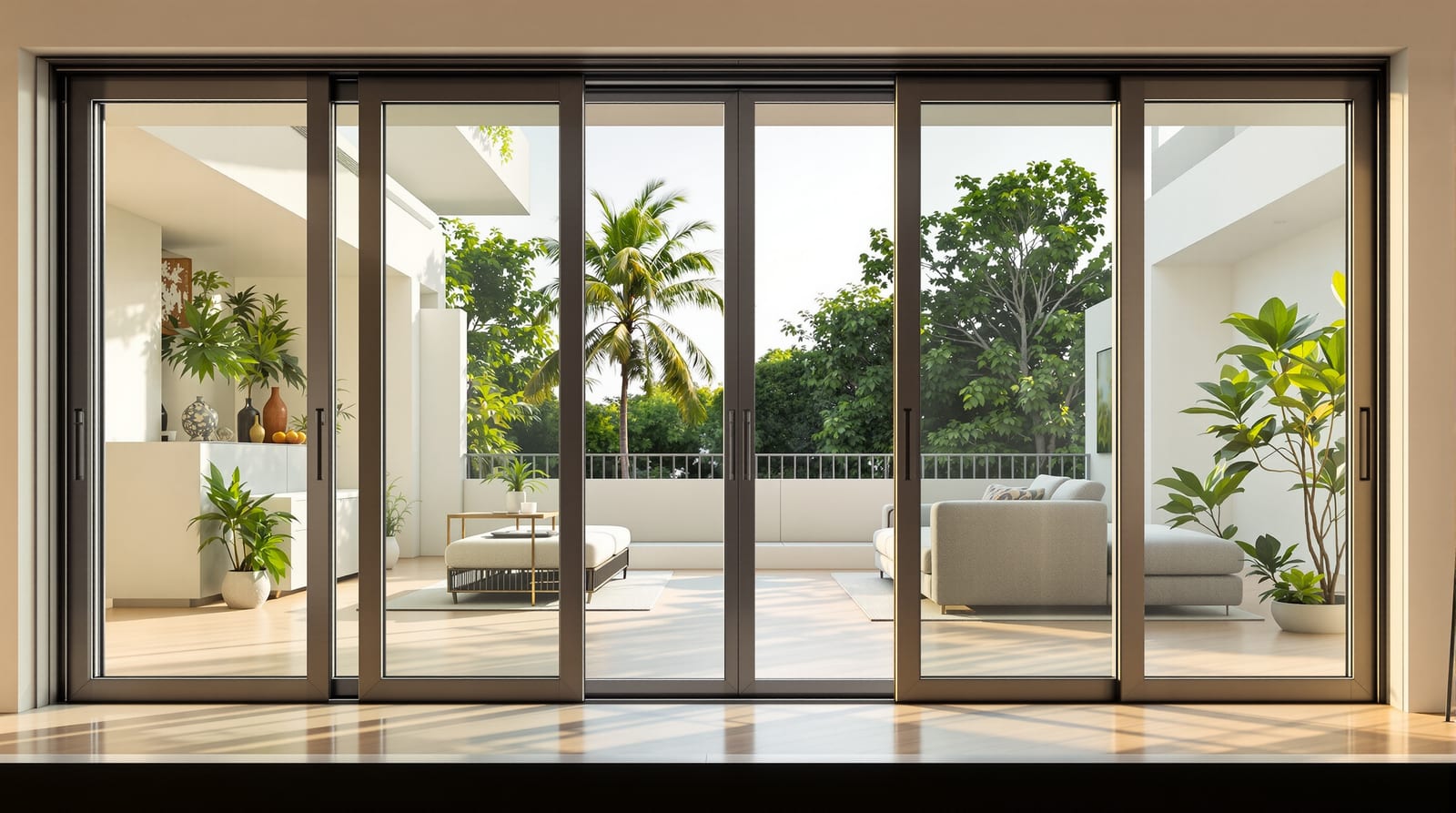
Stacking Sliding Doors for Indian Homes: Multi-Panel Open-Wall Guide (2026)
How 3-6 panel stacking sliders create a near-full open wall to your balcony or garden, the multi-track aluminium systems, weight and glass limits, weather seals, costs, and how they compare to bi-folds.
A two-track sliding door can only ever open half the wall — one leaf always parks behind the other. A stacking sliding door breaks that ceiling: it runs three, four, even six glass panels on parallel tracks so they slide and collect behind one another at one end, clearing 75-90% of the opening. The result is the thing most Indian homeowners actually want from a "big glass door" — the living room and the garden, or the family room and the balcony, becoming one space when the panels disappear. This guide is about that specific system: how the multi-track gear works, what the panel weight and glass do to the price, how it behaves in our monsoon and coastal air, and the honest trade against a bi-fold. For the general slider, start with our sliding doors guide; for the system-by-system money picture see sliding door cost in India.
What "stacking" actually means
In a normal 2-track slider, one panel is fixed (or both move) on two tracks, so at best you open half the width. A stacking (also called multi-slide, slide-and-stack, or multi-track) door puts each panel on its own track. Panel 1 slides until it meets panel 2, nudges it along, that pair meets panel 3, and so on, until the whole set is parked as a tight stack at one jamb. Because nothing has to fold or swing, the panels stay flat against the wall when open — you can stack them inside an end wall pocket and make the opening look completely frameless.
Two layout variants matter when you plan:
- Same-side stacking — all panels collect at one end. Simplest, cheapest, and the usual choice for a balcony or a corner where one side has a return wall to hide the stack.
- Bi-parting (split) stacking — panels split from the centre and stack at both ends, leaving a clear opening in the middle. Looks dramatic across a wide living room but needs more track and costs more.
A close cousin is the telescopic slider, where panels move at proportional speeds so one pull opens the lot — common on automatic entrance doors and worth knowing if you want a powered version (see automatic sliding doors).
The system: tracks, profiles, rollers and glass
A stacking door is really a kit of four things, and the spec of each decides whether it glides for fifteen years or jams after one monsoon.
Multi-track bottom rail. Each panel needs a track, so a 4-panel same-side door has a 4-track sill. More tracks means a deeper, wider bottom frame — typically 100-180 mm depending on panel count and brand. This is the part that collects dust, hair and grit in Indian homes, so a stainless or anodised track with a drainage channel is not optional near a balcony.
Aluminium profiles. Stacking systems are almost always aluminium (occasionally uPVC for smaller, lighter sets), because the slim sightlines and structural stiffness of aluminium let each panel carry large glass without sagging. Branded systems — think the multi-track ranges from Schueco, Reynaers, Aluplast, Fenesta, Tostem/Lixil, and Indian fabricators building on Jindal or Hindalco extrusions — offer thermal-break profiles (an insulating barrier inside the frame) that cut heat gain and stop condensation. For a hot climate the thermal-break version is the meaningful upgrade.
Rollers and the weight problem. This is the heart of the system. Each leaf can weigh 40-120+ kg once you glaze it, and that whole load rides on the rollers. Cheap nylon rollers on a heavy panel is the single most common failure you will see — they flat-spot, the panel drops, and it starts dragging. Insist on steel or sealed stainless-steel ball-bearing rollers rated above your panel weight, and check whether the roller is height-adjustable from the face (you will need to re-level after the building settles). Tandem (twin-wheel) rollers spread the load and are worth the small premium on panels over ~80 kg.
Glass. Stacking doors are glass walls, so glazing drives both safety and cost. Use toughened (tempered) glass to IS 2553, minimum 8 mm and usually 10-12 mm for large panels. For a balcony facing the sun or street, double-glazed (DGU) toughened units cut heat and noise but roughly double the panel weight — which loops straight back to the roller and track spec. Laminated toughened glass adds security and stops the panel collapsing if it ever breaks. Our toughened glass doors guide covers the glass choices in depth.
Where stacking sliders suit Indian homes
These are not a default choice — they are a large-opening solution and they earn their cost only where the opening is genuinely big.
- Villa living rooms onto a deck or lawn. A 3-4 m wall that opens to 80% turns the living and outdoor area into one space for festivals and joint-family gatherings. This is the classic fit.
- Large balconies and terraces in premium apartments. Where the balcony is a real outdoor room, a stacking door lets you throw it open in winter and seal it in monsoon and summer AC season.
- Sea-view and hill-view homes. The whole point is the uninterrupted glass wall — slim aluminium sightlines maximise the view.
- Indoor-outdoor dining or a pool edge in independent houses.
They are usually overkill for a standard 1200 mm bedroom or a small balcony — a 2-track slider or a patio door does that job for far less. They also assume you have a return wall or pocket to stack into; without it the parked stack sits in front of the glass and eats into the opening you paid for.
Weather seals, soft-close and the monsoon question
The honest weakness of any multi-track slider is sealing. Sliding panels can never seal as tightly as a compression-sealed casement, and more tracks means more gaps for wind-driven rain and dust. For Indian conditions, specify:
- Interlocking panel meeting stiles with EPDM or brush gaskets between every panel, not just at the jambs.
- A drained bottom track with weep holes so monsoon water that gets in flows out rather than pooling on your floor.
- Brush or fin seals along each track and a sloped sill on balcony/ground-floor openings.
Treat a stacking door as weather-resistant, not stormproof — on an exposed west or sea-facing wall, a generous chajja (overhang) does more for it than any gasket. For coastal homes, marine-grade anodised or powder-coated aluminium and stainless hardware resist salt corrosion that pits ordinary fittings within a couple of years.
Soft-close and damping. A 90 kg glass panel slamming into the stack is both alarming and damaging. Good systems offer a soft-close/soft-open damper that catches the panel in the last few centimetres at each end — a worthwhile add for heavy leaves and for households with children or elders. Combine it with a low, flush threshold (aim ≤12-15 mm) so the door is easy to step over and broadly accessible; see our notes on door threshold standards.
Stacking vs bi-fold vs 2-track slider — an honest comparison
Homeowners almost always cross-shop these three for a big opening. They behave very differently.
| Factor | Stacking slider (multi-track) | Bi-fold | 2-track slider |
|---|---|---|---|
| Max clear opening | Very high — 75-90% | Highest — up to ~95% (panels concertina flat) | Only ~50% |
| When closed, the view | Slim sightlines, near-flush panels | More frame lines (one stile per leaf pair) | Slimmest, fewest joints |
| Stack/park footprint | Stacks flat along the wall or into a pocket | Folds out into the room or onto the balcony | None — panels stay in plane |
| Operation | Glide each panel; smooth, no swing arc | Push the concertina; needs swing clearance | Lightest, simplest to use |
| Weather sealing | Good with gaskets; never stormproof | Good multi-point seals when closed | Moderate |
| Threshold | Can be near-flush | Often a raised track | Can be near-flush |
| Cost (installed, indicative) | ₹900-2,500+/sq ft | ₹1,200-3,000+/sq ft | ₹450-1,200/sq ft |
| Best for | Wide villa/balcony walls with a return to stack into | Maximum opening where folded panels in the room are fine | Everyday balcony/bedroom openings |
The short version: a 2-track slider is the value choice when half-open is enough; a bi-fold opens the most but its folded panels intrude into the room or balcony and it shows more frame; a stacking slider is the middle path that opens almost as much as a bi-fold, keeps slim sightlines, and parks flat — at the cost of needing somewhere for the stack to go. For the fold-out option in detail, read our bi-fold doors guide.
What it costs in India (2026, indicative)
Pricing varies sharply by panel count, glass, brand and city, so treat these as ranges that you must confirm with a local quote.
| Item | Indicative range | Notes |
|---|---|---|
| Branded aluminium stacking system, installed | ₹900-2,500+ per sq ft | Thermal-break + DGU pushes to the top |
| Local fabricator (Jindal/Hindalco extrusion) | ₹700-1,200 per sq ft | Cheaper; verify roller and gasket quality |
| Toughened glass 10-12 mm | ₹600-1,200 per sq ft | Part of the per-sq-ft above when bundled |
| DGU toughened upgrade | +₹400-900 per sq ft | Heat + noise cut; doubles panel weight |
| Soft-close damper kit | ₹2,000-6,000 per set | Per moving panel pair, roughly |
| Powered/telescopic automation | ₹40,000-1,50,000+ | For automatic versions |
Add 18% GST, plus fitting labour and any civil work to form the track recess. A typical 3 m x 2.4 m (≈77 sq ft) 4-panel branded stacking door lands roughly in the ₹90,000-2,00,000+ band installed — wide, because the glass and brand swing it hugely. Estimate your own opening with our door cost calculator and size it against NBC door requirements using the door size calculator. All figures here are indicative and vary by city and vendor.
Specifying and living with one — a quick checklist
- Confirm panel weight first, then match roller rating and track to it. This one number prevents most failures.
- Choose steel/stainless ball-bearing tandem rollers, height-adjustable from the face.
- Use toughened-to-IS 2553 glass, laminated where security or a fall risk matters; DGU for hot/noisy facades.
- Insist on inter-panel gaskets, a drained track and a chajja for monsoon walls; marine-grade finish near the coast.
- Plan the stack location (return wall or pocket) before you finalise the layout, or you lose part of the opening.
- Add soft-close on heavy panels; keep the threshold ≤12-15 mm for easy, near-accessible stepping.
- Budget for annual maintenance: vacuum the tracks, wipe the gaskets, lubricate rollers with silicone (not oil, which holds dust).
A well-specified stacking slider is one of the few things that genuinely changes how a home feels — but it rewards spending on the unglamorous parts (rollers, track, seals) far more than on extra glass area.
Frequently asked questions
How many panels can a stacking door have?
Common residential sets run 3 to 6 panels on as many tracks; bi-parting layouts can use more. Beyond 4-5 panels the bottom track gets deep and the system gets expensive, so most Indian homes settle at 3 or 4 panels for a 3-4 m opening.
Are stacking sliding doors waterproof for the monsoon?
They are weather-resistant, not waterproof. With inter-panel EPDM/brush gaskets and a drained track they handle normal rain well, but multi-track sliders never seal as tightly as a casement. On an exposed or sea-facing wall, a chajja (overhang) and a sloped sill matter as much as the gaskets.
Stacking slider or bi-fold — which opens more?
A bi-fold opens slightly more (panels concertina almost completely flat) but its folded panels intrude into the room or balcony and it shows more frame lines when closed. A stacking slider opens 75-90%, keeps slimmer sightlines, and parks flat against the wall or in a pocket — usually the better look if you have somewhere for the stack to go.
What glass thickness should I use?
Toughened glass to IS 2553, minimum 8 mm and typically 10-12 mm for large panels. Use double-glazed (DGU) toughened units on hot or noisy facades for heat and sound control, remembering they roughly double the panel weight and so need a stronger roller and track.
Why do stacking doors start dragging after a year or two?
Almost always under-rated rollers. A heavy glass panel on cheap nylon rollers flat-spots and drops, so the door drags. Specify steel or sealed stainless ball-bearing rollers rated above your panel weight, keep the track clean, and re-level the panel using the adjustable rollers after the building settles.
Export this guide
Related Guides — Deep-dive reading
French Doors for Indian Homes: Glazing, Security, Cost & Monsoon Sealing
The double-leaf glazed door that opens a living room to a balcony or garden - where it works, how to specify the glass, frame and seals, what it costs, and how it stacks up against sliding and bi-fold.
Home Doors & EntrancesSoundproof Doors in India: How Doors Leak Sound, STC Ratings, Seals & Real Costs
A door is the weakest acoustic link in any wall - and it usually leaks through the gaps, not the panel - so here is how to actually quieten a bedroom, home theatre or street-facing room, from a 1,500-rupee seal kit to a proper acoustic door.
Home Doors & EntrancesAluminium Door Cost in India 2026: ₹/Sq Ft by Profile Grade, Finish, Glazing & Hardware
A focused 2026 cost guide for aluminium doors in India — ₹ per sq ft of opening by profile grade (economy domal vs branded system sections vs thermal-break), powder-coat vs anodised vs wood-finish surcharge, glazing, rollers/locks/handles, sliding vs openable, fitting and GST, with a worked balcony/utility example.
Home Doors & EntrancesRelated Tools — Try Free
Aluminium Door Cost Calculator
Estimate an aluminium door cost by opening size, profile grade, finish, glazing and type, with fitting and GST.
Door CalculatorMonsoon-Readiness Checklist
Pre-rain home audit across 9 categories — terrace, drains, waterproofing, electrical, HVAC, pest, vehicles, documents.
Seasonal AuditCross-Ventilation Analyzer
Estimate airflow and air changes per hour (ACH) from room size, window areas, layout, and local wind — with NBC 2016 Part 8 compliance check.
Ventilation Calculator