
Frank Lloyd Wright
The father of organic architecture — buildings that grow from their land
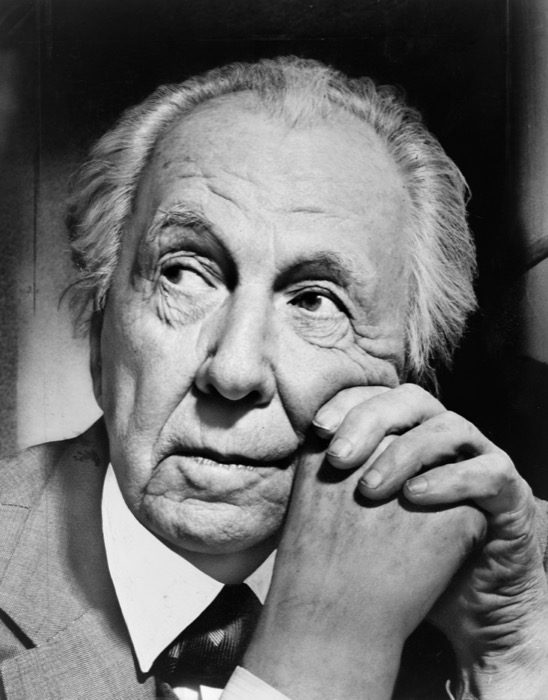
Portrait: public domain, via Wikimedia Commons
Movements
Signature works
- Fallingwater, Bear Run, Pennsylvania
- Robie House, Chicago
- Guggenheim Museum, New York
- Unity Temple, Oak Park
- Taliesin & Taliesin West
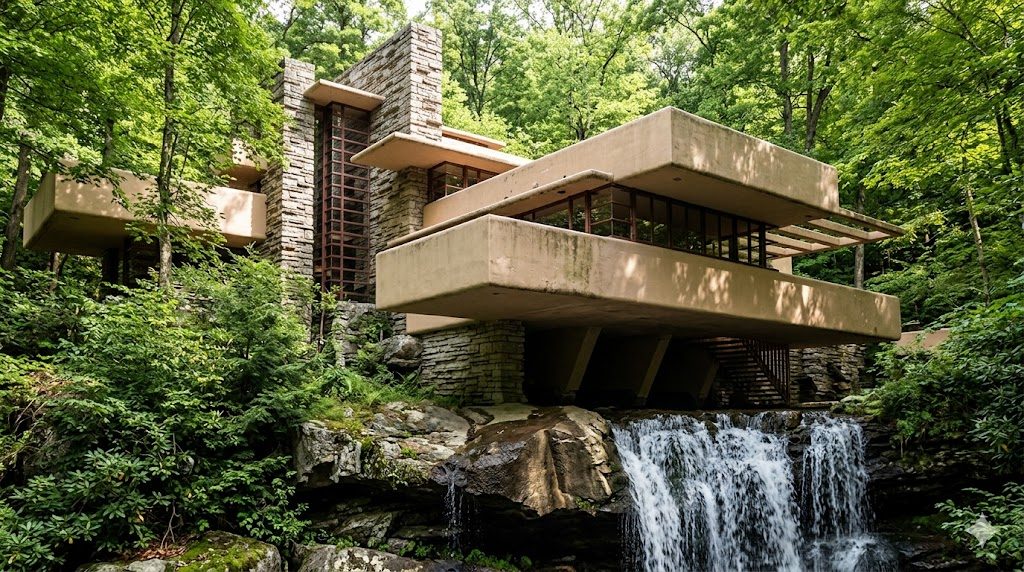
Step out of the dense green of Bear Run, Pennsylvania, and the first thing you hear is water. Then, through the rhododendron, you see it: pale concrete trays floating out over a waterfall, anchored into the living rock, as though the house had been quarried from the hillside and persuaded to bloom. This is Fallingwater, and it is the most famous private house in the world — not because it sits in a beautiful place, but because it refuses to sit on the place at all. It grows out of it.
The man who designed it, Frank Lloyd Wright, is the most celebrated architect in American history, and across seventy working years he built more than five hundred structures while teaching America what a building could be.
His single great idea was organic architecture: a building should grow from the inside out and from its site outward, in harmony with humanity and the natural world — never imposed upon the land, but born of it. Continuity of inside and outside, truth to materials, ornament integral to structure, a low horizontal line married to the ground, and human scale in every dimension — these were his lifelong instincts, and they reshaped how the modern world thinks about home.
The idea: a building of the land, not on it
Most architecture before Wright began with a facade — a front, a face, a mask applied to the street. Wright turned the whole process inside out. He started with how a family actually lives: the gathering at the fire, the flow from cooking to eating to rest, the way light falls across a winter afternoon. The plan grew from that life, the section grew from the plan, and the exterior was simply the honest outward expression of everything within.
He called this organic architecture, and he meant the word literally. A tree is not decorated; its form and its bark and its branching are one continuous truth. A great building, Wright argued, should be the same — its structure, its materials, its ornament and its site all expressions of a single idea. Stone should look and behave like stone; wood should be wood; concrete should not pretend to be marble. Ornament should not be glued on but should grow out of the structure itself, the way a leaf grows from a stem.
Two ideas anchor everything else. The first is the horizontal: long low rooflines, deep sheltering eaves, bands of windows that hug the earth and echo the line of the American prairie. The second is continuity — the dissolving of the hard box. Wright pushed walls apart, let space flow from room to room and out through glass into the garden, so that you could never quite say where inside ended and outside began. That continuity, more than any single building, is his gift to the century that followed.
Life and path
Frank Lloyd Wright was born in 1867 in Richland Center, Wisconsin, into a landscape of rolling farmland that he never stopped designing for. He absorbed an early lesson from a set of Froebel kindergarten blocks — simple geometric forms that he later credited with teaching him to see buildings as compositions of pure shape.
In 1888 he arrived in Chicago and joined the office of Louis Sullivan, the great pioneer of the tall building and the man who gave architecture the phrase "form follows function." It was a decisive apprenticeship. Sullivan was then reaching for an American architecture freed from the dead weight of European revival styles, and the young Wright drew in that ambition with the air. He revered Sullivan, called him his "lieber Meister" — beloved master — and carried Sullivan's conviction that ornament and structure must spring from the same living source for the rest of his life. Where Sullivan applied that conviction chiefly to the commercial high-rise, Wright would carry it home, to the ground, to the way ordinary people actually live.
He set up his own practice in the 1890s and, working from a studio attached to his house in suburban Oak Park, Illinois, began the run of houses that would change domestic architecture forever. Through the first decade of the new century he refined the Prairie type with a discipline that bordered on obsession — adjusting eaves, banding windows, sinking the fireplace deeper into the plan — until, in the Robie House, every element finally sang in one key.
His life was never quiet. It was, by any measure, turbulent and larger than life — marked by scandal, financial ruin, personal tragedy at his own home of Taliesin, and repeated, almost defiant reinventions. Yet through every upheaval the work deepened. In his sixties, when many assumed his career was finished, he produced Fallingwater and the Johnson Wax Headquarters and entered the most fertile decades of his life. He went on designing into his nineties, completing the spiral of the Guggenheim Museum in the year he died, 1959, at the age of ninety-one.
The signature works
Wright's catalogue is vast, but a handful of buildings carry the whole argument.
| Building | Place & year | Why it matters |
|---|---|---|
| Robie House | Chicago, 1910 | The masterpiece of the Prairie School — sweeping horizontal planes, deep cantilevered eaves, an open flowing plan with the hearth at its heart. |
| Unity Temple | Oak Park, 1908 | An early monument in poured concrete, proving the material could make sacred, top-lit, geometrically pure space. |
| Fallingwater | Bear Run, Pennsylvania, 1935 | His most famous house — concrete terraces cantilevered over a waterfall, the building fused with rock and stream. |
| Johnson Wax Headquarters | Racine, Wisconsin, 1930s | A workplace lit from above through slender "lily-pad" columns and glass tubing — an interior world unto itself. |
| Taliesin & Taliesin West | Wisconsin / Arizona | His own home, studio and school in two climates — living laboratories of organic building rooted in their very different landscapes. |
| Guggenheim Museum | New York, 1943–1959 | The great spiral — a continuous ramp coiling around a sunlit void, a building that is one unbroken gesture. |
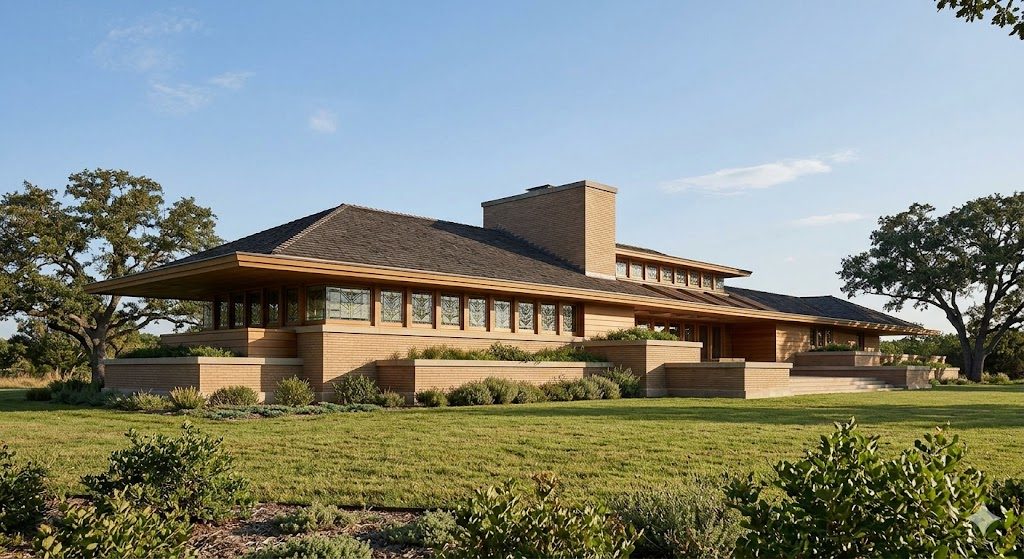
The Prairie School houses came first and defined the type: low, ground-hugging, horizontal, with the great central fireplace as the emotional anchor of an open plan. The Robie House remains its perfect statement — its roofline runs so far past the brickwork that visitors are sure it must fall, and its long ribbons of leaded art glass dissolve the wall into a screen of light. Inside, there is no front door to announce yourself at; you are drawn in around a corner, past the hearth, into a single flowing volume that has no real beginning or end. It is a house that teaches you how to move through it.
Decades later, Fallingwater took the same instincts and dramatised them at full operatic scale. Wright did not place the house with a view of the waterfall, as the clients expected; he placed it directly over the falls, so the family would live with the sound of the water rather than merely look at it. The cantilevered terraces reach out into the air without visible support, the native sandstone walls rise straight from the ledge they stand on, and a boulder of the original site is left protruding through the living-room floor to form the hearth. The boundary between house and forest is deliberately, gloriously blurred. It is the single most complete demonstration of organic architecture ever built.
Unity Temple and the Johnson Wax Headquarters show the same philosophy turned to public and working life. At Unity Temple, Wright took raw poured concrete — then a humble, almost industrial material — and made of it a serene, top-lit room for worship, proving that the new materials of the century could carry the old weight of the sacred. At Johnson Wax, he lit a great workroom from above through slender tapering "lily-pad" columns and bands of glass tubing, creating an interior world so complete that the windowless outer walls hardly matter — you are meant to look up and in, not out.
And crowning the whole career, the Guggenheim Museum distilled his lifelong faith in continuity into one unbroken gesture: a single ramp coiling upward around a sunlit central void, so that a visitor experiences the building as one continuous movement rather than a sequence of separate rooms. He worked on it from 1943 until his death in 1959, and it opened in the months after he was gone — a spiral signature on the New York skyline.
Alongside the famous commissions ran his democratic mission: the Usonian houses, modest single-storey homes designed in the 1930s and after to bring genuine organic architecture within reach of ordinary American families. They were compact, open-plan, naturally lit and radiantly heated through the floor, with carports instead of garages and kitchens opened into living space — every element pared to what a family of modest means truly needed, and nothing wasted. They are the direct ancestors of the affordable, climate-aware, open-plan modern home everywhere, and arguably his most far-reaching legacy of all, because they were meant not for millionaires but for everyone.
The philosophy
Wright did not merely practise organic architecture; he named it, argued it and taught it for half a century. In 1932 he founded the Taliesin Fellowship, an apprenticeship community where young architects learned by living and working alongside him — drawing in the morning, farming and building in the afternoon, absorbing the philosophy through the body as much as the mind. He set out his thinking in his writing too: "An Autobiography," one of the great architectural memoirs, and "The Natural House," his clearest manifesto for the organic home.
The principles are deceptively simple and endlessly demanding. A building should be of its site, not on it — generated by the slope, the rock, the trees, the light. It should be designed from the inside out, the plan and the life within shaping the form. It should be true to its materials. Its ornament should be integral, growing from structure. Its line should be horizontal, bound to the ground. It should keep the hearth at its heart, and it should hold to human scale in every dimension — ceilings that compress and release, spaces sized to the body. Read his organic philosophy in full in our guide to organic architecture explained.
The cantilever was his structural signature, the technical means to the organic end — floors and roofs reaching out into space without visible support, dissolving the box and letting the building seem to grow from a single point of anchorage. It was risky engineering, and at Fallingwater the long terraces have needed reinforcement in the decades since; but the audacity was the point. By removing the corner column and the bearing wall, Wright could let space flow uninterrupted from inside to out, which is what continuity demands. The structure was never decoration and never hidden — it was the organic idea made physical.
Underlying all seven principles is a single moral conviction that set Wright apart from the more clinical strands of European modernism. He did not believe a house was a "machine for living in." He believed it was an extension of the human being who lived there and of the earth it stood on — that architecture, done rightly, could make people more alive, more themselves, more at home in the world. That humane, almost spiritual reading of the organic is what keeps his work warm where so much modernism turned cold.
A great architect, Wright held, should make a building that grows naturally out of its place — so that where the human work begins and the land ends becomes impossible to tell.
India
Wright never built in India, yet his philosophy travelled there through one remarkable apprentice. Nari Gandhi, the maverick Indian organic architect, trained at Taliesin under Wright himself, then returned to Maharashtra and spent his life building extraordinary, hand-crafted, site-grown houses in stone, brick, wood and tile — each one shaped to its land, each a refusal of the standard box. Through Gandhi, Wright's organic conviction became a living Indian tradition; you can follow that thread in our biography of Nari Gandhi.
The deeper resonance is that organic architecture and Indian building have always rhymed. India's vernacular traditions — the courtyard that draws the sky inside, the deep verandah that mediates between in and out, the use of local stone and lime and timber, the home built around climate and the rhythms of a family — are organic architecture by another name, practised for centuries before Wright gave it a label. His continuity of inside and outside is the courtyard logic; his truth to materials is the lime-plaster-and-laterite logic; his human scale is the logic of the traditional home.
Nari Gandhi's houses make the connection vivid. Returning from Taliesin to Maharashtra, he refused the drawing board almost entirely, designing on site with the masons, bending each wall and roof to the rock and trees in front of him, letting Mangalore tile, stone, brick and timber speak in their own voices. There is no copying of Wright in them — there is the same instinct, transplanted to Indian soil and Indian craft. That is precisely what Wright would have wanted: not disciples imitating Fallingwater, but architects starting again from their own ground.
That is why his thinking speaks so directly to contemporary Indian practice. Architects working in a hot, varied, deeply site-specific country find in Wright a Western confirmation of an Eastern instinct: design for this land, this light, this life — not for a magazine cover. The same instinct connects him to other masters who built for place and climate, from Laurie Baker, who grew low-cost homes from local brick and earth and let the material make the ornament, to Tadao Ando, whose quiet concrete rooms frame light, water, nature and silence. Different hemispheres, different materials, one conviction: that a building belongs to its place.
Legacy and what we can learn
Wright's influence is almost too large to measure. The open plan, the great room flowing into the garden, the carport, the radiant-heated floor, the home oriented to sun and view rather than to the street — these now feel like common sense, and they are largely his. Generations of architects, in America and far beyond, learned from him to start with the site and the life within rather than the style.
For anyone building or commissioning a home today, his lesson is bracingly practical. Begin with the land: where does the sun rise, where does the breeze come from, what is the slope, what is the view worth keeping. Begin with the life: how this particular family gathers and moves and rests. Let those answers generate the plan, and let the plan generate the house. Use real materials honestly. Keep a heart to the home. Keep it to human scale. The result will not be a fashion that dates, but a building that belongs.
Wright's principles live on in how we design today — at DesignAI you can explore organic, site-responsive, naturally lit interiors for your own home, and gauge how well a space connects you to nature with our biophilic score tool.
References
- Frank Lloyd Wright, "An Autobiography" (1932; later editions).
- Frank Lloyd Wright, "The Natural House" (1954).
- Bruce Brooks Pfeiffer, "Frank Lloyd Wright: The Complete Works" (Taschen).
- Neil Levine, "The Architecture of Frank Lloyd Wright" (Princeton University Press, 1996).
- Ada Louise Huxtable, "Frank Lloyd Wright: A Life" (Penguin Lives, 2004).
- William J. R. Curtis, "Modern Architecture Since 1900" (Phaidon, 1996).
- Frank Lloyd Wright Foundation / Taliesin archives.
Continue with Nari Gandhi, Laurie Baker and Tadao Ando, and read the philosophy he fathered in organic architecture explained.
Philosophies they championed