
Infrared vs Colour Night Vision CCTV in India (2026): Which Sees Better in the Dark?
A homeowner's head-to-head between traditional infrared (IR) night vision, which lights the scene invisibly and shows a black-and-white image, and colour night vision, which keeps the picture in colour at night using a very sensitive sensor and a little white light — with an honest verdict on when each wins and why a hybrid camera is usually the smartest buy.
You are comparing two CCTV cameras for the dark hours, and the specifications are throwing two phrases at you: infrared (IR) night vision and colour night vision. One shows you a crisp black-and-white picture in total darkness; the other keeps the image in colour so you can actually see that the stranger at the gate wore a red shirt and arrived on a blue scooter. Both are genuinely useful, and neither is simply "better" — the honest answer is that it depends on where the camera looks, how much light that spot already has, and whether a small white light glowing at night is welcome or a nuisance.
This guide is a plain, even-handed head-to-head for a homeowner. We will explain exactly what each technology does, put them side by side across the things that matter — image usefulness, light needs, range, glare, power and cost — and then say clearly which suits which spot around an Indian home. And we will be honest up front about where this usually lands: for most homes the best answer is not one or the other but a hybrid camera that gives you colour when there is enough light and falls back to invisible infrared when there is not.
Scope and how to read this. This is a neutral comparison to help you choose, not a sales pitch for either side and not a price list — both technologies are legitimate and each wins in real situations. Indicative "cheaper or dearer" framing is included, but for actual budgets and models see the buying and cost guides linked below. Any camera recording people and a public street records personal data, so handle footage responsibly under the Digital Personal Data Protection Act, 2023 — point cameras at your own property, tell your household, and do not stream a neighbour's window. For choosing a camera overall, start with the how to choose a CCTV camera guide.
What each one actually is
Infrared (IR) night vision — the traditional way
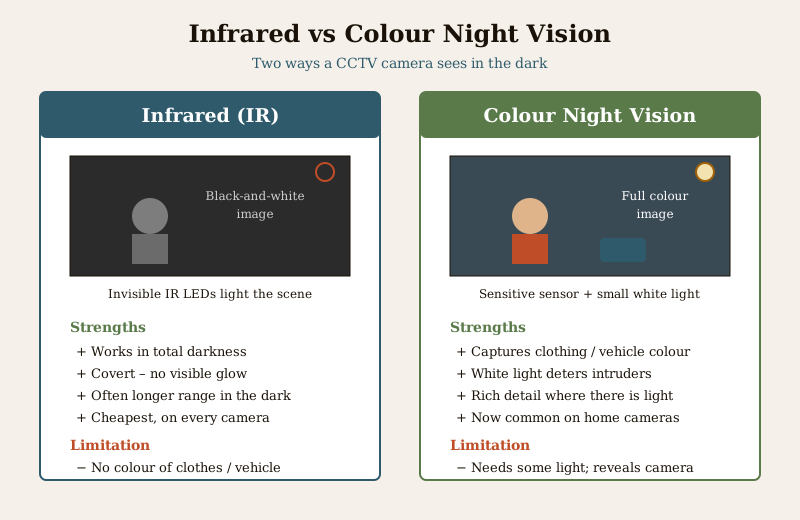
This is the night vision most people already know. Around the camera lens sits a ring of infrared LEDs. Infrared light is invisible to the human eye, so when the camera switches to night mode it silently floods the scene with a light you cannot see, and the sensor — with its IR-cut filter moved aside — reads that reflected infrared to build the picture. Because infrared carries no colour information the image comes out black-and-white (monochrome), often with that slightly ghostly, high-contrast look.
The big virtues are that it works in total darkness with no visible light at all, and it is covert — nothing about the camera glows, so an intruder gets no hint that a camera is watching or where it points. It is also mature, cheap and on almost every camera sold. Our deeper single-topic explainer is the night vision CCTV cameras guide.
Colour night vision — keeping the picture in colour
Colour night vision keeps the image in colour after dark. It does this two ways, usually together: a much more light-sensitive sensor (a larger sensor, a wider aperture and clever processing that gathers what little light exists — streetlight, a porch bulb, moonlight), and a small built-in warm white LED "spotlight" that switches on to add just enough visible light when the ambient light runs out.
The payoff is information. A colour image tells you the colour of a person's clothing, a vehicle's paint, a bag or a helmet — exactly the details that help identify a suspect or match a description later, and precisely what a monochrome IR image cannot give you. The trade is that colour night vision needs some light: either the spot already has a little ambient light, or the camera's own white light must come on. That white light is a genuine deterrent — a person up to no good dislikes being lit — but it also reveals the camera and can annoy a neighbour if it shines across a boundary. The dedicated explainer is the colour night vision CCTV cameras guide.
Why the colour matters — and why covert matters
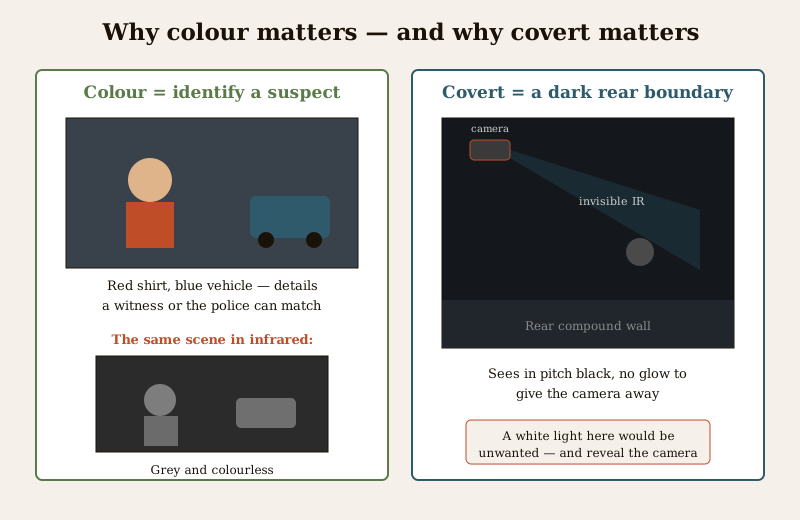
The single most important difference is what you can do with the recording the morning after. Suppose someone loiters at your gate at 2am and leaves. With infrared, you have a sharp monochrome clip: you can see build, height, movement and often the face — but a grey shirt and a grey scooter tell you nothing about colour. With colour night vision, that same clip shows a maroon shirt and a silver scooter — details that turn "a man on a two-wheeler" into something a neighbour, a guard or the police can actually match. For a driveway, a gate or a front door, that colour is often the whole point of having the camera.
But the covert, works-in-anything strength of infrared is just as real in the right place. Along a dark rear boundary, on a farmhouse perimeter or in a spot where you specifically do not want the camera advertised, IR's invisibility is the feature: it sees in pitch black without a telltale glow, and it does not need you to add a light that annoys the house behind you.
The head-to-head
Here is the honest comparison across the dimensions a homeowner actually cares about. Neither column is all-good or all-bad.
| Dimension | Infrared (IR) night vision | Colour night vision |
|---|---|---|
| Image in the dark | Black-and-white (monochrome) | Full colour |
| Captures clothing / vehicle colour | No — a key limitation for identifying a suspect | Yes — its headline advantage |
| Light needed | None — works in total darkness | Needs some ambient light, or turns on its own white light |
| Visible to an intruder | Covert — no visible glow | Reveals the camera when the white light is on |
| Deterrent effect | Low (nobody sees it) | Higher — a white light says "you are seen" |
| Range in pure darkness | Often reaches further with strong IR LEDs | Shorter unless the white light is bright |
| Neighbour nuisance | None | White light can spill across a boundary |
| Glare / reflection issues | IR can bounce off a dome cover, a wall or insects near the lens | Fewer IR-style reflections; light attracts some insects |
| Power and heat | IR LEDs draw power and warm the housing | White LED plus a hungrier sensor; broadly similar |
| Cost | Cheapest and universal | Slightly dearer, though now common |
A few of these deserve a word. Range: in genuinely pitch-black spots strong infrared often throws light further than a modest white spotlight, so for a long dark boundary IR can see more of it. Glare: infrared is prone to a specific, annoying failure — the invisible IR light reflecting off a dome camera's cover, a nearby wall, a spider web or insects drawn to the lens, washing the image into a white haze. If your night footage looks foggy or bloomed, that is usually IR reflection, and the CCTV night vision failure guide walks through fixing it. Colour night vision avoids that particular fault, though its white light does attract its own cloud of insects.
The honest caveat on colour night vision. It is only as good as the light it has. Marketing images are shot with a helpful streetlight nearby. In a truly dark corner with the white light switched off, a "colour" camera will give you a dim, noisy, disappointing picture — or it simply turns its light on, at which point you are no longer covert. Colour night vision earns its keep where there is already a little light, or where a white light is genuinely welcome.
Many cameras now do both
You do not always have to choose. A large share of modern cameras carry both infrared LEDs and a white light, and offer a hybrid or smart mode to get the best of each. Typically:
- Full-colour mode — stay in colour all night, using the sensor and, when needed, the white light. Best where there is reliable light and colour matters most.
- Infrared mode — behave like a classic IR camera: covert, monochrome, works in total darkness.
- Smart / hybrid mode — sit quietly in invisible infrared, and the moment motion is detected, snap on the white light and switch to colour to capture the important details in colour — then go dark again. This is often the sweet spot for a home: covert and non-annoying most of the night, but colour exactly when something happens.
That motion-triggered white light also doubles as an active deterrent — the light flicking on tells a prowler they have been noticed. For choosing among these features overall, the how to choose a CCTV camera guide covers what to prioritise.
Which suits whom — verdict by spot
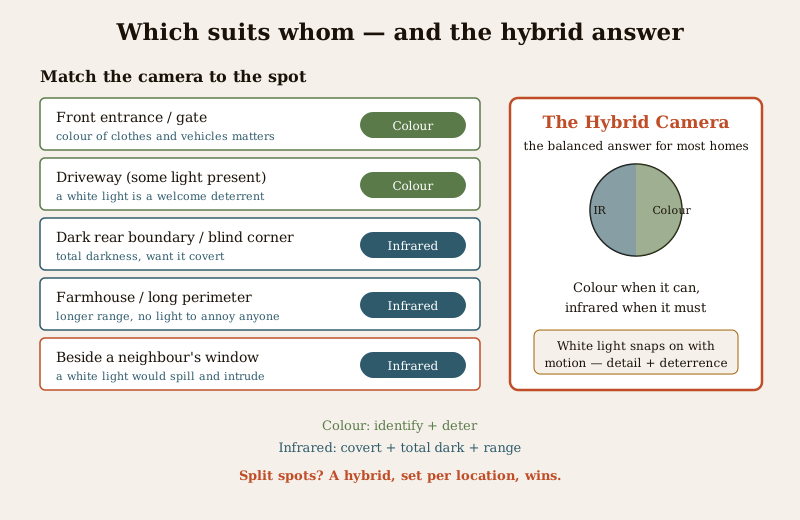
This is the useful part. Match the technology to where the camera looks.
- Front entrance, gate and driveway — colour (or hybrid in full-colour). These are exactly the places where the colour of clothing, a vehicle or a delivery matters most, and they usually have a porch light or streetlight already, so colour night vision performs well. A visible white light here is a bonus, not a problem — it says the entrance is watched.
- A spot where you want deterrence — colour with a white light, or hybrid on motion. If the goal is to make a would-be intruder think twice, the visible light is the feature. A motion-triggered light gives deterrence without burning all night.
- Dark rear boundary, side passage or blind corner — infrared. No ambient light, nobody to annoy, and you often want it covert. IR's total-darkness, no-glow strength wins, and its longer reach in pure dark helps cover the run.
- Farmhouse or large perimeter, long dark stretches — infrared. Covert, long-range and light-free is the right profile; a string of white lights along a boundary is neither practical nor neighbourly.
- Near a neighbour's window or across a shared boundary — infrared. Invisible IR does not spill light into someone's bedroom. A white light here invites a legitimate complaint.
- Most homes overall — a hybrid camera. If you are buying one type of camera for a mix of these spots, a hybrid that runs covert infrared by default and switches to colour on motion gives you colour when it can and infrared when it must, without you having to pick per camera.
Life-safety and privacy footnote. Night vision is about seeing, not about locking anyone out — never let a camera or its light interfere with your own movement, escape routes or a gate that must open in an emergency. And a white light that shines onto a public road or a neighbour's home is both a nuisance and a privacy question under the DPDP Act, 2023: aim it, shade it, or use infrared instead.
How to decide — a simple framework
Run the spot through four quick questions:
1. Does the colour of a person or vehicle matter here? Front door, gate, driveway — yes, lean colour. A dark boundary you only need to know someone crossed — colour matters less, infrared is fine.
2. Is there any light already, or is a white light welcome? Some ambient light or a welcome deterrent light — colour works. Pitch black and you want it covert — infrared.
3. How far must it see in the dark? A long dark run favours strong infrared reach; a short, near scene suits colour.
4. Would a glowing light annoy anyone or reveal the camera? If yes — near a neighbour, or where covert matters — choose infrared.
If your answers split across spots — as they usually do — buy a hybrid camera and set each one to suit its location: full-colour at the entrance, smart-motion on the drive, plain infrared on the dark boundary. That is why, for most Indian homes, the real recommendation is rarely "IR or colour" but "get a hybrid and point it well".
Key takeaways
- Infrared night vision is covert, works in total darkness, often reaches further in the dark, is cheapest — but its image is black-and-white, so it cannot tell you the colour of a suspect or a vehicle.
- Colour night vision keeps the picture in colour — its big advantage for identification and deterrence — but it needs some ambient light or its own white light, which reveals the camera and can annoy a neighbour.
- Neither is universally better; match the technology to the spot — colour at the entrance and driveway, infrared on dark, covert or long-range boundaries.
- Watch for IR glare — infrared bouncing off a dome, wall or insects can fog the image; see the night-vision failure guide.
- For most homes, a hybrid camera is the smartest buy — colour when it can, infrared when it must, with a white light that triggers on motion for both detail and deterrence.
Where to go next
- Night vision CCTV cameras and colour night vision CCTV cameras — the deeper single-topic explainers behind each side of this comparison.
- How to choose a CCTV camera — putting night vision alongside resolution, lens and placement.
- CCTV night vision failure — fixing IR glare, foggy night footage and dead night vision.
- The CCTV sub-hub, the security comparison guides and their comparison pillar, plus the main security hub.
References
- Digital Personal Data Protection Act, 2023 — a home camera that records identifiable people, and especially a white light or field of view reaching a public road or a neighbour's property, handles personal data; aim and shade cameras and lights to your own premises and be transparent with your household. Verify current status via the official Gazette.
- Bureau of Indian Standards catalogue — for the current status of any Indian Standard referenced by camera or lighting equipment: https://www.services.bis.gov.in/
This is an educational comparison for homeowners, not a buying guide, a price list or professional advice. Both infrared and colour night vision are legitimate technologies chosen to suit the spot and the light; for specific budgets, models and installation, consult a licensed installer, and verify any standard's current status via the BIS catalogue before relying on it.
Export this guide
Related Guides — Deep-dive reading
How to Choose a CCTV Camera (2026): The Homeowner's Decision Guide for India
Cut through the spec-sheet noise and choose the right CCTV camera for each spot around an Indian home. What actually matters — sensor and low-light performance, lens and field of view, form factor, IP and IK ratings, honest smart features — and the marketing claims to ignore.
SecurityColour Night-Vision CCTV Cameras in India: Full-Colour Footage After Dark, Explained
The two ways a camera keeps colour at night — a built-in warm spotlight, or an ultra-sensitive low-light sensor — why colour beats black-and-white for describing clothing and vehicles, and how to choose for an Indian home or shop.
SecurityCCTV Recording Failure in India (2026): Live View Works but Nothing Was Saved
You open the recorder to pull footage of an incident and there is nothing there, even though every camera shows a crisp live picture. A calm, ordered guide to why an Indian CCTV system records live but saves nothing, and how to fix it before the next incident.
SecurityRelated Tools — Try Free
CCTV Night-Vision Selector
Answer five questions and get the right night technology — infrared, low-light, colour night vision or thermal — with reasons.
Night-VisionCCTV Cloud vs Local Cost Calculator
Compare cloud CCTV subscription against a local NVR + HDD — upfront, 5-year total, monthly fee and break-even.
Cloud vs LocalCCTV Identification-Distance Calculator
How far a camera can still identify a face or number plate (DORI 250 px/m), from resolution, lens and sensor.
Identify Distance