
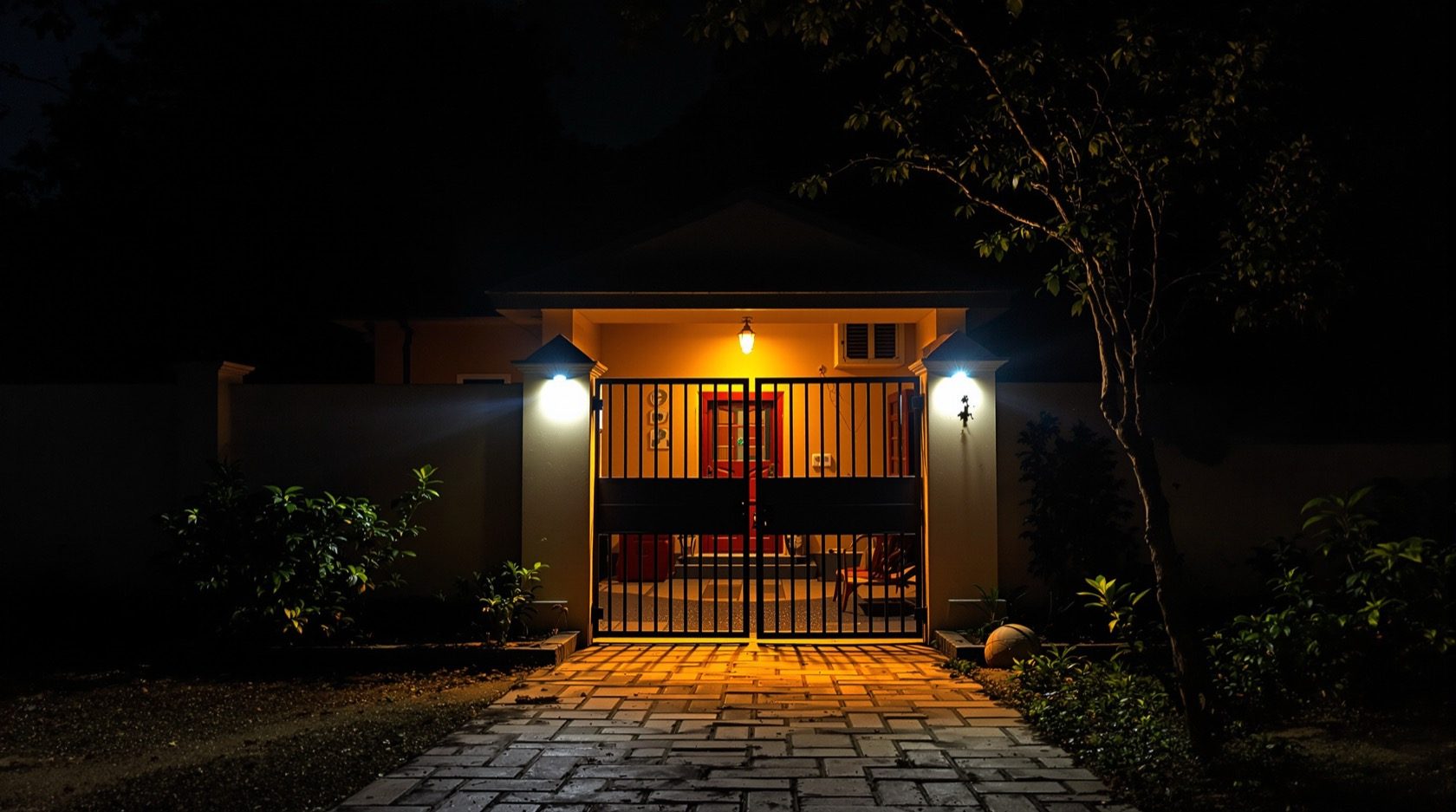
Colour Night-Vision CCTV Cameras in India: Full-Colour Footage After Dark, Explained
The two ways a camera keeps colour at night — a built-in warm spotlight, or an ultra-sensitive low-light sensor — why colour beats black-and-white for describing clothing and vehicles, and how to choose for an Indian home or shop.
A traditional night camera switches to black-and-white after dark. It sees, but it strips out the single most useful clue a witness ever gives: colour. "A man in a red shirt got into a white car" is a description the police can act on. "A man in a grey shirt got into a grey car" — which is all monochrome infrared can offer — is not. Colour night-vision CCTV cameras exist to keep that colour after sunset, and this guide explains the two very different ways they do it so you can choose the right one for your gate, shop or compound.
This is the focused explainer on keeping colour at night within Studio Matrx's CCTV hub. It sits beside the night-vision overview, the infrared (IR) camera guide that covers the classic black-and-white approach, the low-light camera guide on the sensor-only route, and the thermal camera guide. Read this one to decide how you want colour after dark.
Scope & safety. This guide helps you choose and plan. Mounting cameras at height, running cabling, and any mains-electrical work belong to licensed professionals — plan the positions here, but have them installed by a qualified installer. A camera or its spotlight must never blind a driver, block a window, door or fire-escape route, and cameras belong only on your own property and shared areas — never bathrooms, bedrooms or changing areas, and positioned to respect neighbours and the spirit of the DPDP Act, 2023.
Why colour at night is worth paying for
Night is exactly when most of what you want a camera to catch happens — the reversing car, the figure at the gate, the delivery gone wrong. Black-and-white infrared gives you a shape and a movement, which is often enough to know that something happened. Colour tells you who and what.
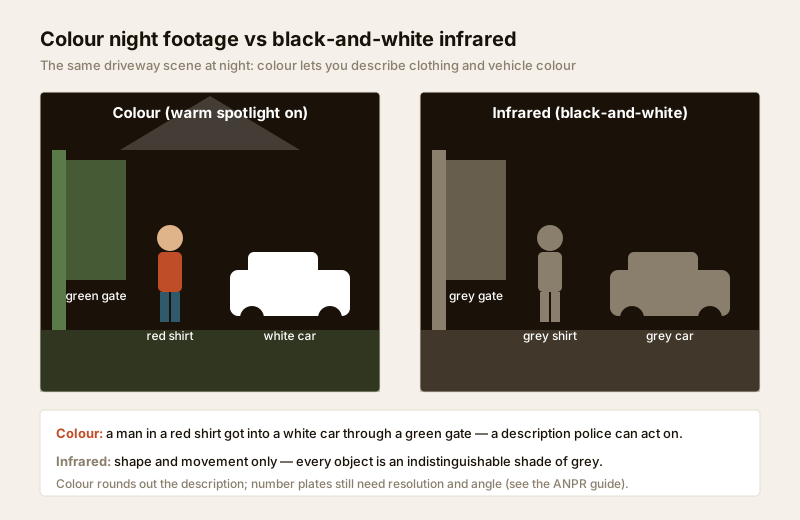
- Clothing colour. A red kurta, a blue helmet, yellow slippers — the details a neighbour or a constable can match to a person.
- Vehicle colour. "A silver hatchback" narrows a search far faster than "a light-coloured car." Number plates still need resolution and angle (that is the ANPR camera job), but colour rounds out the description.
- Faster review. Colour footage is quicker for a human — or the police — to scan and understand than a wash of greys.
Colour is not a luxury add-on; for the gate and the approach, it is often the single biggest jump in usefulness you can buy. What you are really choosing is how to get it.
The two ways to get colour at night
There are exactly two routes, and they feel completely different at your gate.
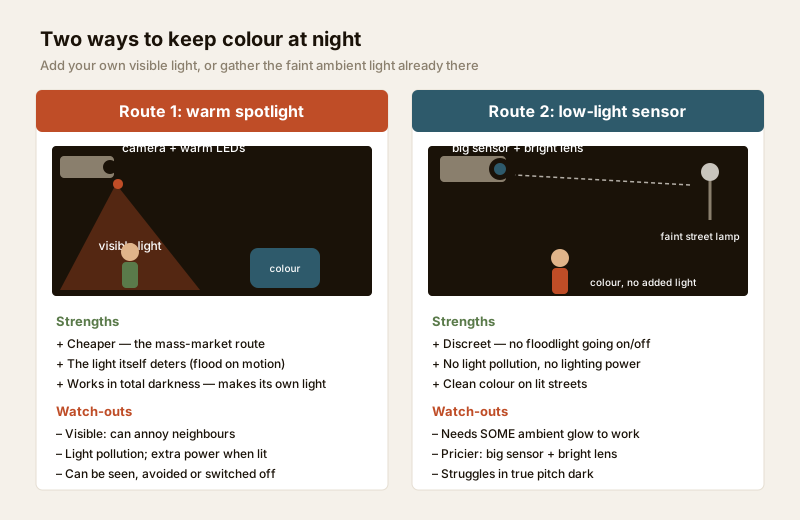
Route 1 — the warm white spotlight (add light)
The camera carries warm white LEDs — a built-in floodlight. When it needs to, it switches these on and floods the scene with ordinary visible light, so the ordinary colour sensor sees colour, just as it would in daytime. Many cameras keep the light off until motion is detected, then snap it on — which doubles as a startling deterrent: the moment someone steps toward your gate, a light hits them and a colour recording starts.
- Cheaper. This is the affordable, mass-market route — most budget "full-colour night" cameras work this way.
- The light itself deters. A sudden floodlight is a powerful "you have been noticed" signal, often more than the camera.
- Works in total darkness. Because it makes its own light, it needs no ambient glow at all — a pitch-black rear lane is fine.
- But the light is visible. It can shine into a neighbour's window, add to street light pollution, annoy people, and — crucially — it can be seen, avoided or its source switched off. A spotlight blazing all night is also a nuisance and wastes power.
Route 2 — the ultra-sensitive low-light sensor (add no light)
The other route adds no light at all. Instead the camera uses a large, ultra-sensitive image sensor and a bright lens to wring full colour out of the faint ambient light that is almost always present at night — a distant street lamp, a porch bulb, moonlight, the glow of the city sky. This is the approach marketed under names like "ColorVu" and "full-colour," and it is covered in depth in the dedicated low-light camera guide.
- Discreet. No floodlight going on and off; nothing for a neighbour to complain about; nothing to give the camera away or be avoided.
- No light pollution, no extra power for lighting.
- But it needs some ambient light. Give it a truly pitch-black scene — a windowless basement, a rural plot with no street lighting — and it has nothing to work with. Then it must fall back to its own spotlight or to infrared.
- Pricier. The big sensor and bright lens cost more than the LED approach.
Many good cameras now offer both — a low-light sensor for colour when there is a little ambient light, with a warm spotlight or infrared held in reserve for when it goes truly dark. That hybrid is often the most practical answer for an Indian plot where the street light works most nights but not every night.
Spotlight-colour vs sensor-colour vs infrared — the comparison
This is the decision in one table. The infrared guide covers the black-and-white column in full.
| Factor | Spotlight colour | Sensor (low-light) colour | Infrared (IR) black-and-white |
|---|---|---|---|
| Image at night | Full colour | Full colour | Grey-scale monochrome |
| How it lights the scene | Its own warm white floodlight | Faint ambient light only | Its own invisible IR beam |
| Needs ambient light? | No — makes its own | Yes — some glow required | No — makes its own (invisible) |
| Visible to people? | Yes — a bright light | No | No — IR is invisible |
| Deterrent effect | Strong — light + camera | Low — discreet | Low — invisible |
| Neighbour / light pollution | Can be a nuisance | None | None |
| Extra power for lighting | Yes (when lit) | No | Modest (IR LEDs) |
| Cost band | Lowest | Highest | Low |
| Best fit | Dark gate/lane where a deterrent light is welcome | Discreet watch where a little ambient light exists | Budget night watch where colour is not essential |
Colour-at-night pros, cons and best-fit
| Approach | Strengths | Watch-outs | Best fit in India |
|---|---|---|---|
| Warm spotlight colour | Cheapest colour; light deters; works in total darkness; motion-triggered | Light annoys neighbours; light pollution; can be avoided or switched off; extra power | Dark rear lane, isolated gate, shop shutter — where a deterrent flood is welcome |
| Low-light sensor colour | Discreet; no light nuisance; no lighting power; clean colour on lit streets | Needs some ambient glow; pricier; struggles in true pitch dark | Front gate on a lit street, porch, society common areas with some lamp glow |
| Hybrid (both) | Colour when ambient allows, spotlight/IR as backup | Costs more; set the switch-over thoughtfully | Most Indian plots — street light usually on, occasionally off in a cut |
| Infrared (compare) | Cheapest night vision; invisible; total-darkness capable | No colour — greys only | Budget watch where you only need to see that something moved |
Which colour-night approach for you
Match the route to the scene, not to the marketing on the box.
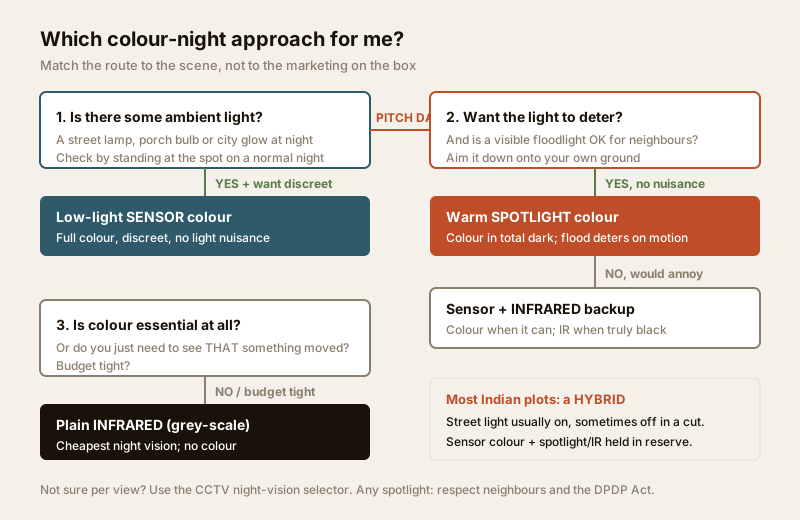
- A front gate on a lit street — a low-light sensor colour camera is usually the elegant answer: full colour, discreet, no light annoying the neighbour across the road.
- A dark rear lane or an isolated farm gate — a warm spotlight camera earns its keep. There is no ambient light for a sensor to use, and the flood-on-motion is a genuine deterrent where no one is around to be bothered by it.
- A shop shutter on a market street — either works; a spotlight adds a visible "watched" signal after closing, but check it does not glare into a neighbouring shop or the road.
- A society common area — usually a sensor camera, so residents are not strobed by lights all night; the gated-community security guide covers coordinating this with the RWA.
Not sure per position? The new CCTV night-vision selector walks you through ambient light, discretion and deterrent needs view by view, and the camera type selector handles the body shape.
India realities to plan for
- Assess the ambient light first. Before choosing sensor-only colour, stand at the spot on a normal night and look: is there a street lamp, a porch bulb, a neighbour's glow? A little goes a long way for a low-light sensor — but a genuinely black scene will defeat it. The lighting and visibility assessment is the right tool for judging this.
- Respect the neighbours with any spotlight. A warm floodlight that fires every time a cat crosses the lane will make you unpopular fast. Aim it down onto your own ground, tune the motion zones so it is not triggered by the road, and never let it shine into a bedroom window opposite. This is both courtesy and the spirit of the privacy assessment and the DPDP Act.
- Power cuts. Both routes need the camera powered; the spotlight route draws a little more when lit. Put the recorder and cameras on a UPS as part of the wider resilience plan in the building security systems guide.
- Dust, heat and monsoon. Choose an IP66-rated outdoor body; a spotlight lens and a low-light lens alike need an occasional wipe, or dust film will dull the colour.
India price bands (indicative)
Treat these as ballparks to sanity-check a quote, not fixed rates — brand, sensor size, resolution and season all move them.
| Item | Typical range (₹) | Notes |
|---|---|---|
| 2MP warm-spotlight colour bullet | ₹1,800 – ₹4,000 | Entry full-colour; the light does the work |
| 4MP spotlight + IR hybrid | ₹3,000 – ₹7,000 | Colour flood plus IR backup; the home workhorse |
| 4MP low-light (sensor) colour | ₹4,500 – ₹9,000 | Discreet colour where there is some ambient light |
| 5MP / 8MP premium low-light colour | ₹8,000 – ₹18,000 | Large sensor, bright lens, best clean colour |
| Weatherproof junction box | ₹300 – ₹900 | Keep the outdoor cable joint dry |
| Mounting + aiming labour (per camera) | ₹400 – ₹1,200 | Part of the installer's quote |
Size and cost a full scheme with the coverage calculator and the security system cost estimator.
Getting colour-at-night right
- Match the route to the ambient light. Sensor colour where there is a glow; spotlight where there is not. Do not buy a pure low-light camera for a pitch-black lane and expect miracles.
- Aim spotlights down and inward. Onto your own ground, angled away from the road and windows, motion-zoned to your plot.
- Set the switch-over on hybrids. Decide when the camera drops from colour to IR — too eager and you lose colour on a dim-but-usable night; too reluctant and you get noisy, smeary colour.
- Do not point into a light. A camera staring straight at a street lamp or a neighbour's security light will bloom and lose the very detail you wanted; aim across the scene.
When to bring in a professional. Decide the approach (spotlight vs sensor vs hybrid) and the positions yourself using this guide — then hand the mounting at height, cable pulling, weatherproof terminations, spotlight aiming and recorder commissioning to a licensed installer. Anything at the mains board is a licensed electrician's job; see the electrical hub. A well-aimed camera on the right route beats an expensive one pointed wrong.
Key takeaways
- Colour night-vision CCTV cameras keep footage in full colour after dark so you can describe clothing and vehicle colour — the clues black-and-white infrared throws away.
- There are two routes: a warm white spotlight that adds visible light (cheaper, a deterrent, works in total darkness — but the light can annoy neighbours, cause light pollution and be avoided or switched off), and an ultra-sensitive low-light sensor that adds no light (discreet, no nuisance — but pricier and needs some ambient glow).
- Match the route to the scene: sensor colour for a lit front gate; spotlight for a dark, isolated lane; a hybrid for most Indian plots where the street light is usually — but not always — on.
- Full darkness with no ambient light still needs either the spotlight or infrared — a sensor-only camera cannot make colour from nothing.
- Check each view with the night-vision selector, respect neighbours and the DPDP Act with any spotlight, and route mounting, cabling and mains work to a licensed professional.
References
- Digital Personal Data Protection Act, 2023 — position cameras and any spotlights to cover only your own property and shared areas with a legitimate purpose; avoid lighting or recording neighbours' private spaces.
- Ingress Protection (IP) ratings — verify a camera's weatherproofing (IP66 or higher for outdoors) on the manufacturer's specification sheet before ordering.
- National Building Code of India (SP 7), Bureau of Indian Standards, and local municipal bye-laws for any structural, electrical or life-safety aspect of an install; verify the current edition via the BIS catalogue: https://www.services.bis.gov.in/
This is an educational overview. Mounting at height, cabling and any electrical work are qualified professional tasks — engage licensed installers and verify any standard's current status via the BIS catalogue before relying on it.
Export this guide
Related Guides — Deep-dive reading
How to Choose a CCTV Camera (2026): The Homeowner's Decision Guide for India
Cut through the spec-sheet noise and choose the right CCTV camera for each spot around an Indian home. What actually matters — sensor and low-light performance, lens and field of view, form factor, IP and IK ratings, honest smart features — and the marketing claims to ignore.
SecurityInfrared vs Colour Night Vision CCTV in India (2026): Which Sees Better in the Dark?
A homeowner's head-to-head between traditional infrared (IR) night vision, which lights the scene invisibly and shows a black-and-white image, and colour night vision, which keeps the picture in colour at night using a very sensitive sensor and a little white light — with an honest verdict on when each wins and why a hybrid camera is usually the smartest buy.
SecurityLow-Light CCTV Cameras in India: Starlight-Class Night Colour, Explained
What a low-light (Starlight-class) camera is, how a large sensor and wide-aperture lens gather faint ambient light for full-colour night footage without IR glare, where it beats plain infrared, and where it still needs some glow to work.
SecurityRelated Tools — Try Free
CCTV Night-Vision Selector
Answer five questions and get the right night technology — infrared, low-light, colour night vision or thermal — with reasons.
Night-VisionCCTV Resolution Selector
The camera resolution (MP) a scene needs for identify, recognise or detect, using DORI pixel density.
ResolutionSecurity Backup Power Calculator
Size a UPS/inverter and battery to keep CCTV, NVR, router and alarm running through a power cut — load, Ah, VA and cost.
Backup Power