
Material Lifespan Comparison Guide
How long the materials in an Indian home really last, what shortens or extends their life, and how to choose for lowest lifetime cost — not lowest purchase price.
Your plumber says the tap is gone. Again. You replaced it four years ago. Before that, three years. The one before that lasted barely two. Meanwhile, the house next door has the same tap it was fitted with in 2002 — still smooth, still drip-free. The total money spent on taps in your bathroom over twenty years? Roughly four times the cost of the good one. Nobody told you that when you were handing money over at the hardware counter.
This is the material lifespan problem in miniature. Indian homeowners routinely optimise for purchase price, and contractors — often working to a budget or a commission — rarely push back. The result is a house that looks fine at handover, then quietly bleeds money through repeated repairs, early replacements, and the disruption that comes with them.
A material's service life is how long it keeps performing its job before needing major repair or replacement — and the lowest lifetime cost, not the lowest purchase price, is what a smart homeowner should optimise.
This guide is the cross-material reference you need before you build, renovate, or negotiate with a contractor. It covers structure, walls, finishes, waterproofing, services, and fittings — each with realistic Indian service-life ranges, the main failure modes, and what you can do to push life toward the top of the range. For the underlying science of why materials decay (carbonation, corrosion, moisture damage), read the companion guide science of durable buildings. This guide is the what lasts how long and what it costs reference.
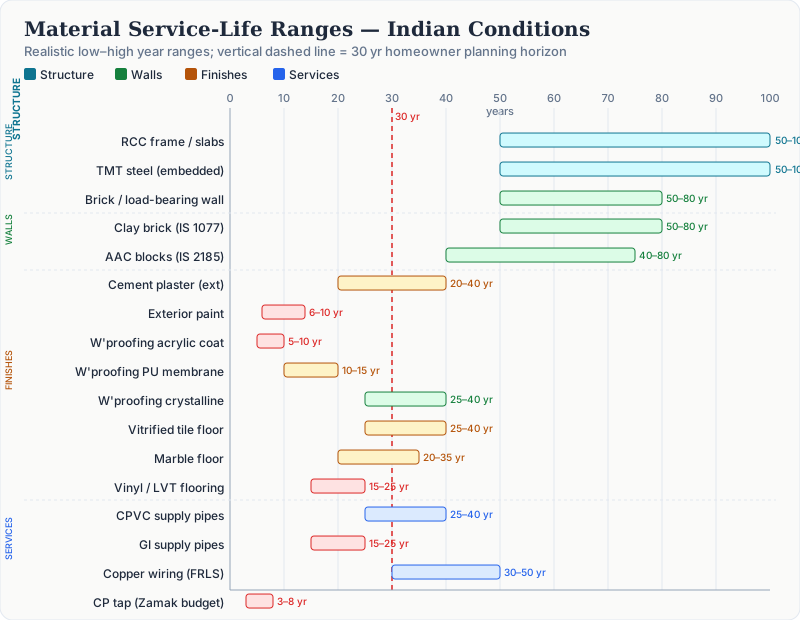
The service-life bar chart: at a glance, what you are betting on when you choose each material.
1. Understanding the Numbers: Service Life, Warranty, and Design Life
Three terms appear on data sheets and sales literature, and they mean different things.
Design life is the intended duration set by the structural engineer at the outset — IS 456:2000 clause 8.2 sets the nominal design life of reinforced concrete structures at 50 years, with durability provisions that can extend this significantly. The structure is designed to last that long assuming adequate cover, correct concrete grade, and adequate maintenance.
Service life is what actually happens on site. It depends on material quality, workmanship, maintenance, and exposure. A well-built M25 slab with 45 mm cover in Bengaluru's mild climate may reach 80 years. The same slab built with insufficient cover and poorly batched concrete in a coastal Mumbai flat may develop corrosion-related cracking within 20–25 years.
Warranty is the commercial guarantee the manufacturer or contractor offers — typically 1–10 years, and almost always shorter than realistic service life. A five-year warranty on waterproofing does not mean the membrane lasts only five years; it means the company will repair defects without charge for that period.
What narrows or widens the range? Four factors dominate:
| Factor | Effect on lifespan |
|---|---|
| Material quality (BIS grade, primary vs secondary) | Primary factor — low-grade material cuts life 30–50% |
| Installation workmanship | Equally important — good material, bad work = early failure |
| Climate and exposure (coastal, humid, hot-dry) | Can halve life in aggressive environments |
| Maintenance (regular vs neglected) | Regular maintenance can add 20–40% to effective life |
All figures in this guide are realistic ranges for Indian conditions. Treat the lower end as what happens with average materials, average workmanship, and no maintenance; the upper end as what a quality-conscious homeowner in a moderate climate can expect.
2. Structure: What Actually Lasts a Lifetime
Structure is the one category where you genuinely cannot afford to economise — it is hidden, hard to replace, and load-bearing.
RCC frame and slabs. IS 456:2000 sets minimum design life at 50 years; well-executed structures with appropriate exposure classification (moderate for most inland residential, severe for coastal) and correct concrete grade (M25 minimum for most structural elements) routinely achieve 75–100 years. The killers are inadequate cement cover (leading to reinforcement corrosion), poor concrete compaction, and water ingress. M30 or M35 concrete with 50 mm cover in coastal locations is not over-engineering — it is the correct baseline.
Steel reinforcement (TMT bars). Steel embedded in good concrete lasts as long as the concrete protects it — effectively the life of the structure. Exposed steel begins surface-rusting within weeks and can structurally weaken within a few years of sustained moisture contact. The critical parameter is cover: 40 mm minimum for moderate exposure, 50 mm for severe. Fe500D TMT bars (the D designation means higher ductility and a defined carbon-equivalent limit) are the current best-practice choice. See why reinforcement steel matters for detail on grades and checks.
Foundations. A well-designed foundation on stable soil has a design life matching the superstructure — 50–100 years. Differential settlement, expansive black-cotton soil movement, and tree root penetration are the practical failure mechanisms rather than the material itself. Waterproof isolation membranes below raft foundations and retaining walls are what actually fail first (typically 20–30 years for membrane; the concrete beneath remains intact).
"The life of a reinforced concrete structure is determined not by the strength of the concrete but by its durability — its resistance to the agents of deterioration." — A.M. Neville, Properties of Concrete, 5th ed., 2011
| Structural element | Typical service life (India) | Primary failure mode | Critical specification |
|---|---|---|---|
| RCC frame / columns | 50–100 yr | Reinforcement corrosion from carbonation or chloride attack | M25 min, correct cover, low w/c ratio |
| RCC slabs (roof/floor) | 50–100 yr | Corrosion, cracking from poor curing | M25 min, 40–50 mm cover, 7-day curing |
| TMT steel (embedded) | Life of structure | De-passivation by CO2 or Cl- penetration | Fe500D, BIS IS 1786 mark |
| Brick/load-bearing wall | 50–80 yr | Moisture-induced efflorescence, foundation settlement | IS 1077 Grade A, good plinth protection |
| RCC foundation (raft/strip) | 50–100 yr | Settlement, root penetration, waterproofing failure | Subgrade prep, DPC membrane |
Cross-reference: modern construction materials covers the full material selection landscape; understanding concrete strength explains grade selection.
3. Walling Materials: The Structural Envelope
Walls take the weather, support finishes, and mediate the indoor climate. Their service life is closely tied to the plaster and paint system that protects them.
Clay burnt brick (IS 1077) has the best track record — a well-built brick wall in a moderate climate will outlast the design life of the house. Failures are almost always in the mortar joints (which may need re-pointing after 30–40 years) or at the plaster interface, not in the bricks themselves. In high-rainfall or coastal areas, efflorescence and salt crystallisation can cause surface spalling within 10–15 years if plaster is neglected.
Fly-ash bricks (IS 12894) match clay brick in structural life (40–80 years) when manufactured to standard. The risk is quality variation — secondary-market fly-ash bricks often have low compressive strength and high water absorption. Check IS 12894 marking and ask for a water-absorption test (should not exceed 20% by weight). See fly-ash bricks vs clay bricks for a full comparison.
AAC blocks (IS 2185 Part 3) have a structural life comparable to brick — 40–80 years — but their greater porosity makes the plaster system critically important. Water reaching raw AAC leads to moisture wicking and internal damage. The AAC itself does not decay, but a building with failed plaster over AAC requires urgent attention. See AAC blocks vs red bricks.
Hollow concrete blocks (IS 2185 Parts 1 and 2) share a similar life range (40–80 years), are less porous than AAC, and perform well in humid climates when properly plastered.
| Walling material | Structural life | Plaster/finish dependency | Key risk |
|---|---|---|---|
| Clay brick (IS 1077 Grade A) | 50–80 yr | Moderate | Mortar joint erosion, efflorescence in coastal zones |
| Fly-ash brick (IS 12894) | 40–80 yr | Moderate | Variable quality, high water absorption in sub-standard units |
| AAC block (IS 2185 Pt 3) | 40–80 yr | High — raw AAC must not be exposed | Moisture wicking through unprotected surface |
| Hollow concrete block (IS 2185) | 40–80 yr | Moderate | Cracking at mortar joints in seismic zones |
4. Finishes and Coatings: The Maintenance Cycle
This is where most homeowners feel the most churn — and where the cheapest-first mistake is most obvious.
Cement plaster (internal and external) has a realistic life of 20–40 years before significant cracking, hollowing, or separation requires redoing. External cement plaster exposed to seasonal wetting and drying will begin to develop hairline cracks within 5–8 years in most Indian climates; these must be filled and repainted, not ignored. Gypsum plaster (internal walls only — gypsum is not weatherproof) has a life of 15–30 years in dry indoor conditions, but is unsuitable for kitchens, bathrooms, and external walls where moisture is present. Compare both in detail at gypsum plaster vs cement plaster.
Paints. Interior emulsion paint — with proper surface prep — lasts 5–8 years before needing repainting; a premium acrylic emulsion lasts 7–10 years. Exterior emulsion paint on a well-cured, crack-free surface lasts 6–10 years; a quality exterior texture paint or elastomeric coating can stretch to 10–15 years and bridge hairline cracks. The mistake is painting over damp walls or unfilled cracks: the paint peels within one to two monsoons regardless of brand.
Tiles. Vitrified tiles (full-body or double-charge, IS 15622) are the dominant Indian flooring choice. The tile itself lasts 25–40 years before significant wear or fading; the grout and adhesive may require attention at 10–15 years. Glazed ceramic tiles (IS 13753) are less wear-resistant — 15–25 years on floors, longer on walls.
Natural stone (marble, granite). Granite floors, properly sealed, can last 30–50 years with periodic resealing every 3–5 years. Marble is softer, more stain-prone, and wears faster (effective floor life 20–35 years in an occupied home). Neither "expires," but etching, staining, and grout failure eventually necessitate re-polishing or replacement.
Engineered wood and laminate flooring. Engineered wood (a real-wood veneer over a ply core) lasts 15–25 years and can be re-sanded once or twice; laminate flooring lasts 10–20 years. See engineered wood lifecycle costing for a full cost analysis.
Vinyl / LVT. Modern luxury vinyl tile has a wear-layer lifespan of 15–25 years for commercial-grade (0.5 mm+ wear layer); residential grade 10–20 years.
False ceilings. Grid-and-tile gypsum board false ceilings: 15–25 years in dry spaces; in bathrooms and kitchens, moisture-resistant (MR) boards last 10–20 years. POP (Plaster of Paris) moulded ceilings: 10–20 years before cracking or peeling.
| Finish / coating | Typical service life | Re-do trigger | Key tip |
|---|---|---|---|
| Cement plaster (external) | 20–40 yr | Cracking, hollowing, water ingress | Cure minimum 7 days; protect from rain for 21 days |
| Cement plaster (internal) | 25–40 yr | Cracking, dampness | Not for bathrooms without waterproof coat |
| Gypsum plaster (internal dry) | 15–30 yr | Moisture exposure, crack | Never use in bathrooms, kitchens, or externally |
| Interior emulsion paint | 5–8 yr | Peeling, fading, damp | Fix damp before painting; prime properly |
| Exterior emulsion paint | 6–10 yr | Chalking, flaking, cracks | Use alkali-resistant primer on new plaster |
| Exterior texture / elastomeric | 10–15 yr | Cracking, colour fade | Bridges hairline cracks |
| Vitrified tile floor (IS 15622) | 25–40 yr (tile); 10–15 yr (grout) | Surface wear, grout cracking | Use non-shrink epoxy grout in wet areas |
| Marble floor (polished) | 20–35 yr effective | Etching, staining, wear | Seal twice yearly; avoid acid cleaners |
| Granite floor | 30–50 yr | Grout failure, edge chips | Re-seal every 3–5 yr |
| Engineered wood flooring | 15–25 yr | Surface wear, swelling | Keep dry; AC recommended |
| Vinyl / LVT (0.5 mm wear) | 15–25 yr | Wear-layer loss | Avoid heavy point loads |
| Gypsum board false ceiling | 15–25 yr | Sagging, water damage | Use MR grade in wet areas |
5. Waterproofing: The Home's Most Under-Invested System
If there is one category where cutting costs consistently destroys value, it is waterproofing. A roof or terrace that leaks damages everything below — plaster, paint, false ceilings, wiring, furniture. Re-doing a failed waterproofing system after flooring and finishes are complete can cost 5–8× what the original system cost.
"Water is the universal solvent, and in construction, it is the universal destroyer." — field maxim among waterproofing engineers
Different systems have genuinely different service lives:
| Waterproofing system | Typical service life | Failure mode | ₹ cost (2026, per sq ft) |
|---|---|---|---|
| Integral admixture (IS 2645) in concrete | 30–50 yr (with concrete) | Cracking of concrete exposes bare areas | ₹8–20 psf (part of concrete cost) |
| Crystalline waterproofing (e.g. Kryton/Xypex type) | 25–40 yr | Re-activation if concrete cracks beyond self-sealing width | ₹25–60 psf |
| Acrylic-based coating (2-coat) | 5–10 yr | UV degradation, coating delamination | ₹20–40 psf |
| PU (polyurethane) membrane coating | 10–15 yr | UV and thermal cycling; needs UV-protective topcoat | ₹60–120 psf |
| APP/SBS bitumen membrane (torch-applied) | 15–25 yr | Joint failure, blister, mechanical damage | ₹80–150 psf |
| HDPE / EPDM sheet membrane | 20–40 yr | Joint failure, puncture | ₹100–200 psf |
The short life of acrylic coatings — still the most commonly specified system in Indian residential construction — is the main reason homeowners find themselves re-waterproofing a terrace every six to eight years. A PU membrane or properly installed bitumen membrane can reduce that cycle to once in a building's life. Full detail on each system is in waterproofing chemicals explained; the ways these systems fail in practice are documented in waterproofing failures explained.
IS 2645:2003 (Integral Cement Waterproofing Compounds — Specification) clause 4 is clear that admixtures reduce permeability but do not substitute for correct concrete design, adequate compaction, and proper curing — a lesson routinely ignored on site.
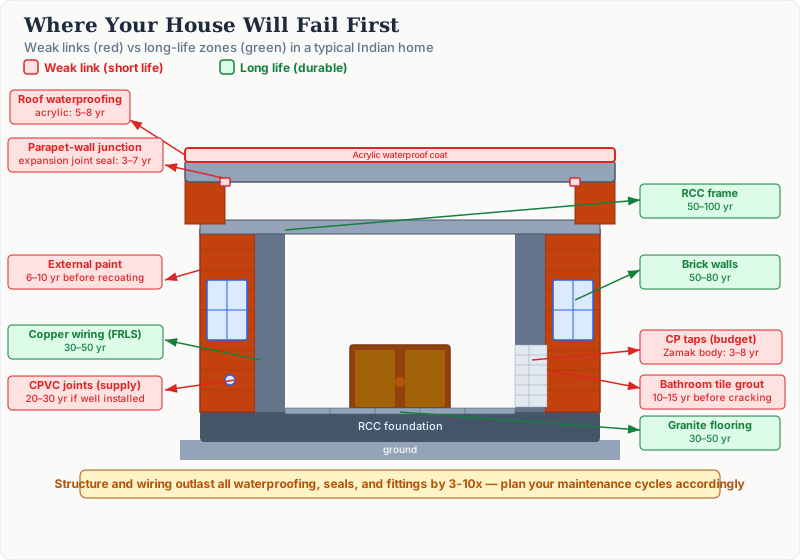
Where your house will fail first: the weak links are almost always waterproofing, seals, and CP fittings — not the structure.
6. Services and Fittings: The First Things to Fail
The mechanical and electrical services in an Indian home are the items that fail earliest — and the ones most homeowners have the least information about.
Plumbing pipes. GI (galvanised iron) pipes, once standard, have a realistic life of 15–25 years before internal corrosion reduces flow and external rust causes leaks; in hard-water areas (much of peninsular India), 12–18 years is realistic. CPVC (chlorinated PVC) is the current best-practice choice for hot and cold supply lines — realistic life of 25–40 years, with proper fittings (solvent-weld joints, not mechanical). UPVC (for cold water and drainage) lasts 30–50 years. Copper piping, where afforded, lasts 40–60 years and has the most established track record globally; it is uncommon in Indian residential projects due to cost.
Electrical wiring. Copper wiring (IS 694) with FRLS (flame-retardant low-smoke) insulation has a life of 30–50 years if circuit loading is not exceeded and if the conduit system is intact. Aluminium wiring — used in older Indian homes — has a life of 20–30 years and presents fire risk from loose connections as it ages; any home with aluminium wiring over 25 years old deserves a full rewire assessment. The fuse box and MCB panel — typically 15–25 years — will need replacement before the wiring does.
Sanitaryware. Vitreous china toilets, washbasins, and bath panels (IS 2556) are among the most durable items in a home — realistically 30–50 years if not physically damaged. Flushing mechanisms within the cistern (float valves, flush valves) need replacement every 8–15 years.
CP fittings (taps, showers, mixers). The most-replaced item in an Indian bathroom. Cheap chrome-plated zinc-alloy (Zamak) taps have a realistic life of 3–8 years before the chrome pits, the bodies crack, or the cartridges fail. Brass-body taps with ceramic disc cartridges last 10–20 years. Premium European-spec taps (solid brass, quality ceramic cartridges) last 20–30 years. This is the tap example from the opening — and it is entirely real.
Doors and windows. Solid teak wood doors, properly maintained, last 40–60 years; other hardwood (sal, pine) 25–40 years; flush hollow-core doors 10–20 years. uPVC windows (IS 14735) have a design life of 25–35 years with no painting required; UV-stabilised profiles resist chalking for 15–20 years before surface degradation. Aluminium powder-coated frames last 20–30 years; anodised aluminium is more durable (25–40 years).
| Service / fitting | Typical service life | Failure mode | Replacement cost indicator |
|---|---|---|---|
| GI supply pipes | 15–25 yr | Internal corrosion, rust leaks | ₹100–200 per running ft (replumbing) |
| CPVC supply pipes (IS 15778) | 25–40 yr | UV degradation if exposed; joint failure | ₹60–120 per running ft |
| UPVC drainage pipes | 30–50 yr | Joint seal failure | ₹40–80 per running ft |
| Copper supply pipes | 40–60 yr | Pinhole corrosion in acidic water | ₹180–350 per running ft |
| Copper electrical wiring (FRLS) | 30–50 yr | Insulation degradation, overloading | Full rewire: ₹40–80k per 1,000 sq ft |
| MCB panel / fusebox | 15–25 yr | Trip failure, overheating | ₹15–40k replacement |
| Vitreous china sanitaryware | 30–50 yr | Physical damage only | ₹3–20k per piece |
| Flushing mechanism (cistern) | 8–15 yr | Float valve failure, seal wear | ₹500–2,000 per WC |
| Zamak CP tap (budget) | 3–8 yr | Chrome pitting, body crack | ₹500–2,000 per tap |
| Brass CP tap (ceramic disc) | 10–20 yr | Cartridge wear | ₹1,500–6,000 per tap |
| Flush hollow-core door | 10–20 yr | Warping, delamination, frame rot | ₹3–8k per door |
| Solid teak wood door | 40–60 yr | Neglected finish, hardware failure | ₹18–45k per door |
| uPVC window (IS 14735) | 25–35 yr | Seal failure, hardware wear | ₹350–700 per sq ft (full replacement) |
| Aluminium window (powder-coated) | 20–30 yr | Seal failure, coating chalk | ₹250–500 per sq ft |
7. What Extends or Shortens a Material's Life
Four forces determine where within the range a material lands.
Water is the universal enemy. Water carries dissolved salts into concrete and initiates reinforcement corrosion. It saturates plaster and causes it to hollow. It degrades waterproof coatings, swells wood, and corrodes metal. Almost every premature material failure in an Indian home traces back to uncontrolled water. See why buildings leak for the mechanism of how water finds its way in.
Quality of the material. The gap between IS-compliant primary material and non-IS secondary or spurious material is significant. Sub-standard fly-ash bricks can have twice the water absorption of IS 12894-compliant ones. Non-BIS-marked TMT bars may have insufficient ductility, affecting both structural performance and durability. Always insist on BIS marked material and ask for manufacturer test certificates or batch mill certificates for steel.
Installation workmanship. A PU waterproofing membrane applied over dusty, unbonded concrete is a ten-year warranty waiting to fail in two. A vitrified tile laid without adequate adhesive coverage (minimum 80% for floors, IS 15477) will hollow within five years. Concrete without adequate curing will achieve only 50–70% of its design strength. No material performs well if installed badly.
Climate and exposure. Coastal homes within 500 m of the sea face chloride-laden salt spray that accelerates reinforcement corrosion and degrades paint and metal fittings 2–3× faster than an inland moderate-climate home. High-humidity zones (Kerala, coastal Karnataka, eastern states) demand breathable exterior paints, robust waterproofing, and moisture-resistant materials throughout. Hot-dry climates (Rajasthan, Gujarat summers) stress exterior coatings through severe thermal cycling.
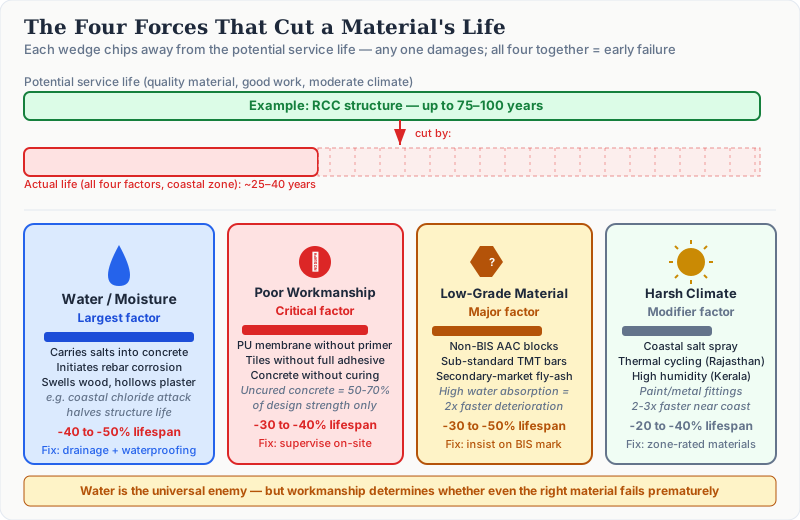
The four forces that cut a material's life: any one alone does damage; all four together produce structural failure within years.
8. Lifecycle Cost Thinking: The 30-Year View
A lifecycle cost calculation adds up the purchase price, all planned maintenance, all replacement events, and the disruption cost of replacement — across a defined period.
A simplified comparison for waterproofing a 500 sq ft flat roof illustrates the principle:
| Acrylic coating (cheap) | PU membrane (quality) | |
|---|---|---|
| Initial cost (₹, 2026 indicative) | ₹20,000 | ₹65,000 |
| Service life | 6–8 years | 12–15 years |
| Replacements in 30 years | 4–5× | 2× |
| Re-application cost per time | ₹22,000 (labour + material) | ₹70,000 |
| Total direct cost over 30 yr | ~₹1,10,000 | ~₹2,05,000 — before disruption |
| Disruption (moving furniture, vacating room) | ₹20,000 × 4 = ₹80,000 | ₹25,000 × 2 = ₹50,000 |
| Damage from leaks in years before detection | ₹30,000–₹60,000 (plaster, paint, false ceiling) | Minimal |
| Total realistic 30-yr cost | ~₹2,00,000–₹2,50,000 | ~₹2,55,000–₹2,75,000 |
At this scale, the numbers are closer than expected — but that assumes the acrylic reapplication is done promptly each time. In practice, homeowners defer the job by one to three years after visible leaking starts, during which internal damage accumulates. The quality option also protects finishes beneath it, which the cheap option does not.
A flooring comparison makes the case more starkly:
| Laminate flooring | Vitrified tile (double-charge, IS 15622) | |
|---|---|---|
| Initial cost per sq ft (laid, 2026) | ₹55–80 | ₹90–140 |
| Service life | 10–15 yr | 30–40 yr |
| Replacements in 40 yr | 3× | 1× |
| Labour per replacement (1,000 sq ft) | ₹25,000 | ₹35,000 |
| Total 40-yr cost (material + labour) | ~₹3,30,000–₹4,20,000 | ~₹1,25,000–₹1,75,000 |
For flooring — a high-disruption, high-labour replacement — the durable option wins easily. The same logic applies to pipes (CPVC vs GI), taps (brass vs Zamak), and windows (uPVC vs cheap aluminium).
"The bitterness of poor quality is remembered long after the sweetness of low price is forgotten." — attributed to Benjamin Franklin, widely used in construction procurement contexts
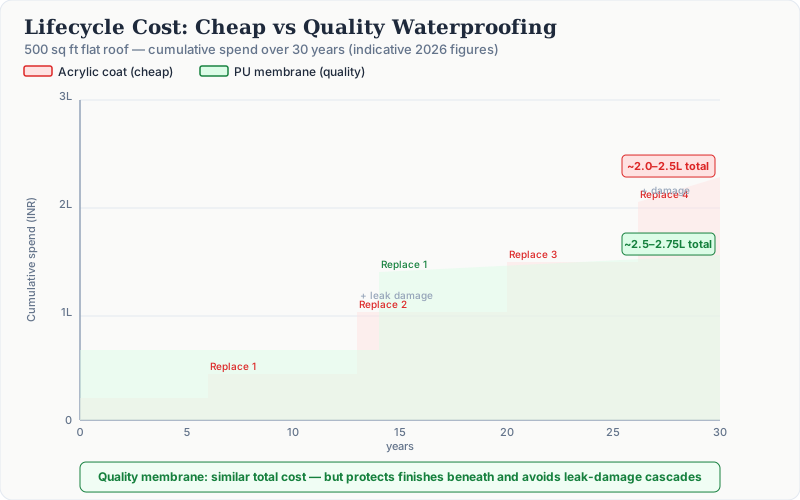
Lifecycle cost visualised: cheap buys an initial saving, quality buys a lower total.'
9. The Spend-Up vs Save-Here Matrix
Not every material decision requires the premium option. The logic is: spend more where the material is hidden, structural, or hard to replace; save where the material is visible, non-structural, and easy to swap.
| Category | Material | Recommendation | Why |
|---|---|---|---|
| SPEND UP | Waterproofing (roof, terrace, basement) | Quality PU or bitumen membrane | Failure damages everything below; re-doing after finishes is 5–8× costlier |
| SPEND UP | Plumbing pipes (within walls) | CPVC or copper | Opening walls to replumb costs 5–10× the pipe cost |
| SPEND UP | Electrical wiring | Copper FRLS, correct sizing | Rewiring in a finished home is extremely disruptive; undersized wiring is a fire risk |
| SPEND UP | Reinforcement steel | Fe500D, BIS-marked from reputable mill | Structural; invisible; impossible to correct after pour |
| SPEND UP | Concrete grade and cover | M25 minimum; correct cover blocks | Same — hidden, structural, permanent |
| SPEND UP | Waterproof sealants (expansion joints, parapets, roof edges) | Polyurethane or polysulphide sealant | These are where leaks start; cheap acrylic sealant lasts 2–4 years |
| SPEND UP | Windows and external doors | uPVC or anodised aluminium | 30-year maintenance-free operation vs repainting every 3–5 years |
| SAVE HERE | Interior paint (repainting is cheap and easy) | Standard acrylic emulsion; repaint every 6–8 yr | Visible; easy; renovation is low-disruption |
| SAVE HERE | Decorative false ceiling tiles (grid system) | Mid-grade gypsum tiles | Individual tiles are replaceable; not structural |
| SAVE HERE | Soft furnishings and curtains | Budget by preference | Short-life by design; 5–10 yr cycle normal |
| SAVE HERE | Kitchen cabinet shutters (not carcass) | Mid-grade laminate shutters | Shutters are easily replaced; carcass is harder |
| SAVE HERE | Internal door hardware (handles, hinges) | Standard stainless; replace when needed | Low-cost, high-replaceable |
"Spend on the invisible. Save on the decorative." — a widely-shared rule among experienced Indian site engineers
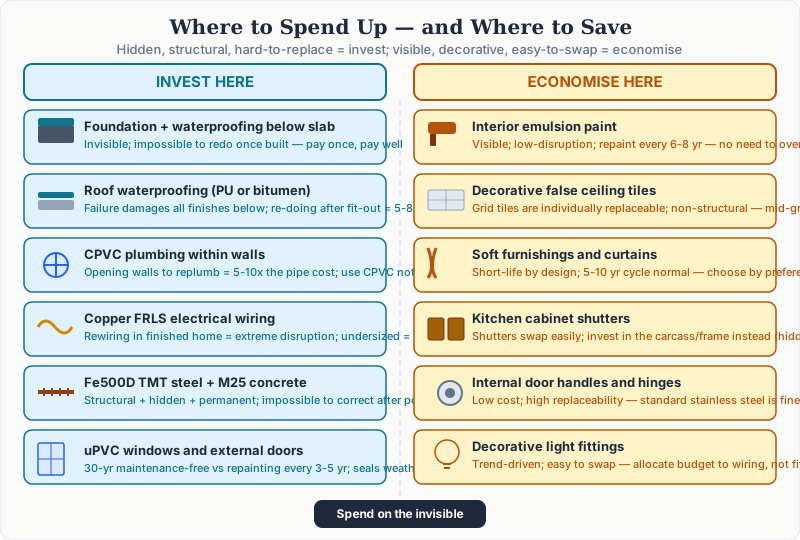
Where to allocate your material budget: the hidden and hard-to-replace elements earn every extra rupee.
10. Indian Climate and Exposure: How Location Changes the Numbers
Indian geography spans five distinct exposure zones for building materials, and the service-life ranges above shift significantly by location.
Coastal zones (within 500 m of the sea, or areas subject to salt-laden air — Goa, coastal Maharashtra, Kerala, Tamil Nadu coastline, Andhra, Odisha): IS 456:2000 classifies these as "severe" to "very severe" exposure. Chloride-initiated reinforcement corrosion shortens the structure window to 25–50 years unless M30+ concrete, 50 mm cover, and low water-cement ratio are used. Metal fittings, CP items, and powder-coated aluminium all degrade 2–3× faster. Exterior paints need specialist marine-grade or anti-fungal formulations and may need reapplication every 3–5 years rather than 6–8.
High-humidity zones (Kerala, Assam, coastal West Bengal, Meghalaya): Wood swells and warps; laminate flooring and engineered wood are high risk without climate control. Gypsum plaster should not be used. Waterproofing is load-bearing — every surface that can hold water will eventually be tested. Fungal growth on walls is a maintenance cycle driver.
Arid and semi-arid zones (Rajasthan, Gujarat, parts of Maharashtra): Thermal cycling is the dominant stress — large temperature swings between night and day (sometimes 20–30°C) crack exterior plaster and degrade sealants rapidly. Water is scarce, which perversely can cause inadequate curing of concrete in summer. Dust infiltration at window seals accelerates hardware wear.
Seismic zones (IS 1893 Zone III–V — much of northern India, North-East, Gujarat post-Bhuj): Masonry in unreinforced walls remains a mortality risk in Zone IV–V areas; confining columns and beams (band reinforcement) extend both structural safety and durability. Rigid brittle finishes (full-body tiles without flexible grout, rigid plaster coats) crack at connections; flexible sealants and isolating mortar beds matter.
The science of durable buildings covers the chemistry of how each of these environments accelerates material decay; this reference gives you the lifespan consequences.
11. The Homeowner's Buy-for-Life Checklist
Before signing off on materials with your contractor, run through this list. It encodes the lifecycle-cost logic from the sections above.
Structure and substructure
- Concrete grade specified M25 or higher; ask for mix design certificate
- TMT steel is Fe500D, BIS IS 1786 marked, from a named mill — reject unlabelled bundles
- Concrete cover maintained with cover blocks — inspect before each pour
- Waterproofing below raft/plinth confirmed in BOQ
Waterproofing (before finishes go over)
- Roof and terrace: PU coating, bitumen membrane, or crystalline system — not acrylic alone
- Bathrooms: minimum two-coat polymer-modified waterproofing membrane before tiling, tested with a 24-hour water ponding test
- Expansion joints and parapet junctions: polyurethane or polysulphide sealant, not white cement or cheap acrylic
- External wall-window junction: flexible sealant, not cement
Plumbing (before closing walls)
- CPVC for hot and cold supply lines; UPVC for drainage — GI is a 20-year compromise
- Joints are solvent-welded by a trained plumber; no thread-to-compression mixed joints
- All supply lines pressure-tested before plastering closes the chases
Electrical (before closing walls)
- Copper FRLS wiring, IS 694 marked
- Wire sizing correct for circuit load; no undersizing
- All in rigid conduit (RPVC), not direct in plaster
- ELCB/RCCB at main panel, MCBs at each circuit
Finishes
- Exterior: alkali-resistant primer on cured plaster; quality exterior emulsion or texture coat
- Flooring: vitrified IS 15622 grade for high-traffic areas; natural stone sealed at install
- Bathrooms: epoxy grout in wet areas; flexible silicone at all tile-to-fitting junctions
- False ceiling in bathrooms: moisture-resistant (MR) board only
Fittings
- Taps and CP fittings: brass body, ceramic disc cartridge — check manufacturer spec sheet
- Sanitaryware: IS 2556 marked, reputable brand
- Windows: uPVC (IS 14735) or anodised aluminium; avoid cheap powder-coat-only with thin profiles
For a deeper look at how to apply these principles while managing construction quality on site, see construction quality control for homeowners.
Author's Note
My father built our home in 1987. Thirty-five years later, the structure is solid — the RCC columns, the brick walls, the granite floors in the main hall are essentially untouched. What he spent the most money on, against advice, were the waterproofing and the pipes. He was teased by neighbours for "wasting money on things you can't see."
He never replumbed that house. He never had a major leak. His neighbours, three of them, have replumbed once or twice each, and at least two have dealt with significant terrace-leak damage that cascaded into false ceilings, paintwork, and electrical fittings.
This guide exists because that lesson — spend on what is hidden, structural, and hard to replace — is not obvious when you are standing at a contractor's table being asked to choose between two waterproofing specifications, the cheaper of which sounds perfectly reasonable.
Amogh N P built this platform to make that kind of knowledge available to every homeowner in India, not just the ones lucky enough to have an experienced builder in the family.
Disclaimer
This guide is for educational purposes and provides indicative service-life ranges based on published standards, industry norms, and field experience. Actual material performance varies with specific products, manufacturers, installation quality, maintenance practices, and local climate. Price figures are 2026 indicative ranges and will change. Always verify current BIS marks, request manufacturer technical data sheets, and engage a licensed structural engineer or registered architect for structural and waterproofing decisions on your project.
References
1. Bureau of Indian Standards. IS 456:2000 — Plain and Reinforced Concrete — Code of Practice (4th revision). BIS, New Delhi.
2. Bureau of Indian Standards. IS 2645:2003 — Integral Cement Waterproofing Compounds — Specification. BIS, New Delhi.
3. Bureau of Indian Standards. IS 1786:2008 — High Strength Deformed Steel Bars and Wires for Concrete Reinforcement — Specification. BIS, New Delhi.
4. Bureau of Indian Standards. IS 1077:1992 — Common Burnt Clay Building Bricks — Specification (5th revision). BIS, New Delhi.
5. Bureau of Indian Standards. IS 12894:2002 — Pulverised Fuel Ash-Lime Bricks — Specification. BIS, New Delhi.
6. Bureau of Indian Standards. IS 2185 Part 3:1984 — Concrete Masonry Units: Autoclaved Cellular (Aerated) Concrete Blocks. BIS, New Delhi.
7. Bureau of Indian Standards. IS 15622:2006 — Specifications for Pressed Ceramic Tiles (which covers vitrified and ceramic grades). BIS, New Delhi.
8. Bureau of Indian Standards. IS 15778:2007 — CPVC Pipes and Fittings for Hot and Cold Water Supplies. BIS, New Delhi.
9. Bureau of Indian Standards. IS 694:2010 — PVC Insulated Cables for Working Voltages up to and including 1100V. BIS, New Delhi.
10. Neville, A.M. Properties of Concrete, 5th ed. Pearson, Harlow, 2011. Chapters 11–12 (Durability).
11. Mehta, P.K. and Monteiro, P.J.M. Concrete: Microstructure, Properties, and Materials, 4th ed. McGraw-Hill, New York, 2014.
12. Shetty, M.S. Concrete Technology: Theory and Practice, 7th ed. S. Chand, New Delhi, 2019.
13. Central Public Works Department (CPWD). Plinth Area Rates and Schedule of Rates (annual editions) — service-life assumptions for maintenance planning.
14. Building Materials and Technology Promotion Council (BMTPC). Guidelines for Selection and Use of Building Materials in Different Climatic Zones of India. Ministry of Housing and Urban Affairs, New Delhi, 2019.
15. National Building Code of India (NBC) 2016, Part 5 (Building Materials) and Part 6 Section 2 (Plumbing). Bureau of Indian Standards.
16. Gambhir, M.L. Concrete Technology, 5th ed. McGraw-Hill Education India, 2013. Chapter on durability and service life.
17. Duggal, S.K. Building Materials, 4th ed. New Age International, New Delhi, 2017.
Word count: approximately 3,550 words.
Export this guide
Related Guides — Deep-dive reading
Plaster, Render and Texture-Paint Facades in India: The Honest Guide to the Country's Default Wall Finish
A building-physics guide to cement and lime render, exterior emulsion and weatherproof paints, and textured coatings — how these everyday facades are built, why they crack, streak and grow algae, and what actually keeps them looking good in the Indian monsoon.
Building FacadesBathroom Waterproofing Failure in India: Causes, Diagnosis & Fixes (2026)
Why bathroom waterproofing fails in Indian homes — poor surface prep, thin coats, missed junctions, no membrane turn-up, damage during tiling — how to read the symptoms, and whether a surface fix or a full redo is the right remedy.
BathroomsEpoxy Grout vs Cement Grout for Tiles in India: Which to Specify (2026)
A plain-English guide to tile grouts for Indian homes: what grout does, how cementitious grout compares with epoxy grout on cost, stain and water resistance, hygiene and durability, and exactly where each one belongs - kitchens, bathrooms, pools, dry rooms and more.
Building MaterialsRelated Tools — Try Free
Monsoon-Readiness Checklist
Pre-rain home audit across 9 categories — terrace, drains, waterproofing, electrical, HVAC, pest, vehicles, documents.
Seasonal AuditCross-Ventilation Analyzer
Estimate airflow and air changes per hour (ACH) from room size, window areas, layout, and local wind — with NBC 2016 Part 8 compliance check.
Ventilation CalculatorFalse Ceiling Cost Estimator
Live ₹/sqft across 8 ceiling types — POP, gypsum, designer, metal, PVC, wooden — with cove and spot lighting for 20 Indian cities.
Cost Calculator