
Plaster, Render and Texture-Paint Facades in India: The Honest Guide to the Country's Default Wall Finish
A building-physics guide to cement and lime render, exterior emulsion and weatherproof paints, and textured coatings — how these everyday facades are built, why they crack, streak and grow algae, and what actually keeps them looking good in the Indian monsoon.
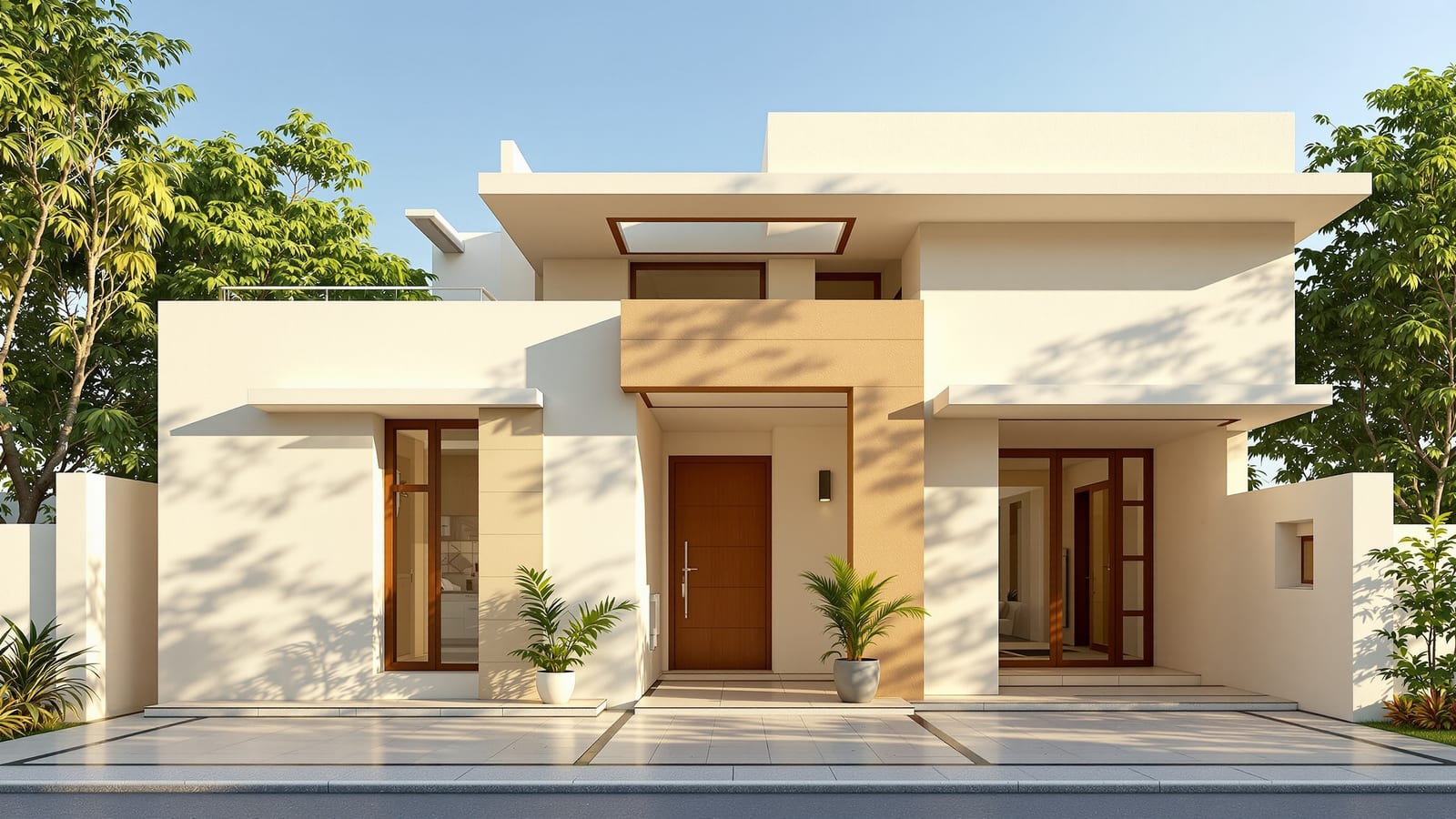
Look down almost any Indian street — a tier-2 town, a metro suburb, a village main road — and the walls are doing the same thing. Grey cement plaster, a coat of putty, an exterior emulsion in cream or ochre or that particular Indian peach. It is so ordinary that we have stopped seeing it. Nobody photographs a plastered-and-painted wall. Nobody writes a magazine feature about it. And yet this quiet, cheap, infinitely repeated surface is the single most common building facade in the country — the skin on tens of millions of homes.
Here is the thing we forget: that wall is a facade system. It has layers, it has detailing, it has failure modes, and it weathers in entirely predictable ways. The green stain creeping down a north wall, the dark tear-streaks below a window sill after the first heavy monsoon, the hairline cracks that map themselves across a sun-baked parapet, the chalky white salt blooming through fresh paint — none of these are bad luck. They are building physics, and they are avoidable. A rendered facade that is detailed and cured well, with the right finish for its orientation, can look crisp for a decade. One that is rushed looks tired in two monsoons no matter how expensive the paint tin was.
This is part of our Building Facades series, where we treat the outer skin of a building as a system in its own right — see the main types of building facades in India for where render sits among brick, stone, glass and cladding, and facade maintenance and durability for how all of these age. One important distinction up front: we already have a buyer's guide that treats plaster as a construction material — sand grades, mix ratios, what to ask the supplier. This guide is different. Here we treat plaster, render and texture paint as a facade finish system — the exterior build-up, the coatings on top, the textures, the crack control, and how the whole assembly behaves as a weathering building skin.
1. Render versus plaster: getting the words straight
People use the words interchangeably, and for a homeowner that is fine, but the distinction is useful. Plaster is the cementitious coat applied to a wall to give it a flat, smooth, workable surface; traditionally "plaster" implies the interior, finer finish. Render is the same idea applied externally — a thicker, coarser, weather-facing coat designed to take rain, sun and movement. In Indian site language both are usually just "plaster," and the external version is "outside plaster." Whatever you call it, the external coat is the one that matters for a facade, because it is the layer standing between weather and your masonry.
The dominant render in India is sand-cement plaster — ordinary Portland cement, river or manufactured sand, and water, typically in a 1:4 to 1:6 cement-to-sand ratio, applied in one or two coats over brick or block masonry. It is cheap, locally available, and every mason in the country knows it. Its weaknesses are equally well known: cement is rigid and shrinks as it cures, so it is prone to cracking, and it is relatively impermeable, which means moisture trapped behind it has trouble escaping.
The older alternative is lime render (or cement-lime plaster) — lime putty or hydrated lime, sometimes blended with a little cement and sand. Lime is softer, more flexible, and crucially it breathes: it lets water vapour pass through, so damp walls can dry outward instead of blistering the paint. This is why heritage conservators insist on lime for old buildings and why it suits genuinely damp walls. The catch is that good lime work is slow, needs skilled hands that are now rare, and cannot be rushed to a contractor's monsoon deadline. The Indian standards that govern this work — IS 1661 (the code of practice for cement and cement-lime plaster finishes) and IS 2402 (the code of practice for external rendered finishes) — are decades old but still set out the basics every render should follow: clean substrate, correct mix, even thickness, and proper curing.
2. The facade build-up: what is actually on the wall
A rendered facade is not one thing; it is a stack. Understanding the stack is the whole game, because most failures are a failure of one specific layer.
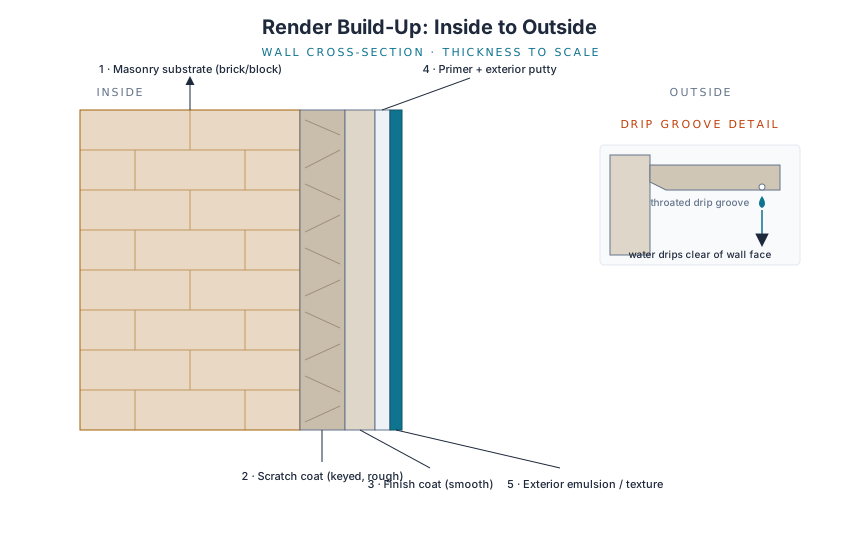
From the masonry outward, a well-built rendered facade reads roughly like this. First the substrate — brick, concrete block or RCC — which is dampened and keyed so the render grips. Then the render itself, ideally in two passes: a scratch coat (the first, deliberately roughened layer that bonds to the wall) and a finish coat that is floated smooth or left with the chosen texture. On top of the render comes the primer — a thin sealing coat that binds chalky surfaces and gives the paint something uniform to hold onto — and often exterior wall putty, a fine acrylic-cement filler that smooths out minor undulations so the top coat looks flat and even. Finally the visible layer: exterior emulsion (a water-based acrylic paint), a weatherproof paint, or a texture coating.
The two details that protect this stack are not paint at all. Drip grooves (throating) — a small channel cut under projecting sills, copings and chajjas — force rainwater to drip clear of the wall instead of curling back and running down the face. Overhangs — chajjas, eaves, deep reveals — keep direct rain off the render in the first place. A facade with good overhangs and properly throated sills will stay clean far longer than one without, regardless of which tin of paint went on top. Hold that thought, because it is the most important honesty anchor in this entire guide.
3. The finishes, compared honestly
The visible coat is where homeowners spend their money and their anxiety. Here are the realistic options as they actually perform on Indian walls.
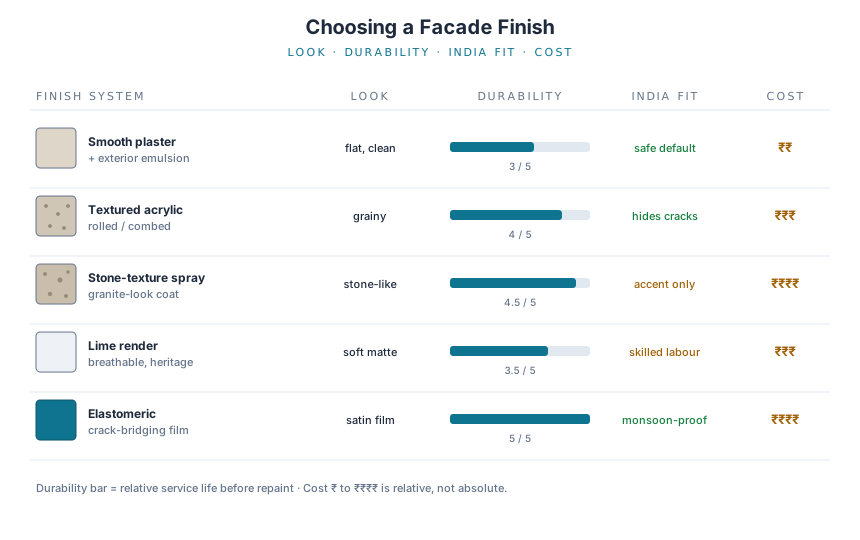
| Finish system | What it is | Look | Durability (years before repaint/refresh) | Honest India fit | Rough cost (₹/sq ft, material + labour) |
|---|---|---|---|---|---|
| Smooth cement plaster + exterior emulsion | Floated render, primer/putty, acrylic exterior paint | Clean, flat, modern; any colour | 5-7 yrs typical | The sensible default; light colours and good detailing make it last | ₹30-80 incl. paint over existing plaster |
| Premium weatherproof emulsion (e.g. Apex Ultima Protek, Berger WeatherCoat Long Life, Dulux Weathershield) | Same build-up, higher-grade acrylic with anti-algal, dust-resist, crack-bridging additives | Same as above, richer sheen | 7-10 yrs; top variants warranty 12-15 yrs | Worth it on exposed/coastal/high-rain walls; warranty needs approved applicator | ₹50-110 incl. paint |
| Textured acrylic / "spray plaster" coating | Thick acrylic-aggregate coat sprayed or trowelled over render | Sand, ripple or pebbled texture; premium, hides hairline cracks | 7-10 yrs as a coat; very hard to repaint cleanly | Looks great, hides cracks — but traps dust and grime, and you are stuck with it | ₹80-200+ |
| Stone-texture / mineral spray finish | Coloured stone chips in resin, sprayed on | Speckled granite-like stone look | 8-12 yrs | Durable, low-fade, popular on compound walls and feature panels; cleaning is harder | ₹120-250+ |
| Lime render (breathable) | Lime-sand render, limewash or mineral paint | Soft, matte, heritage; slightly uneven by nature | Render long-lived; limewash refreshed every few years | Best for old/damp/heritage walls; needs skilled labour, slow | ₹60-150+ depending on labour |
| Elastomeric weatherproof coating | Thick, rubbery high-build acrylic that stretches | Flat or low-texture; flexible film | 7-10 yrs | Bridges moving hairline cracks; good on cracked or sun-exposed walls, but not a damp cure | ₹70-150 |
A few terms in that table earn definitions. Texture coating is a thick, pigmented acrylic loaded with aggregate, applied much heavier than paint to create a tactile surface; its great trick is that it hides the hairline cracks underneath, which is exactly why it reads as "premium." Elastomeric paint is a high-build acrylic that cures into a flexible, rubbery film — it can stretch over a moving hairline crack (typically bridging up to about 2 mm) without splitting, which is why graphene-reinforced premium ranges advertise "crack bridging." None of these, it must be said, can fix a structural crack or stop water entering from a genuinely failing wall.
4. The weatherproof paint question
Walk into any paint shop and you will be pushed toward the premium exterior range, and the warranty numbers are genuinely large. Asian Paints Apex Ultima Protek carries a 12-year performance and 10-year waterproofing warranty, and the Duralife variant pushes that to a 15-year performance, waterproofing and anti-algal warranty. Berger WeatherCoat Long Life 10 offers a 10-year performance warranty; its Anti-Dustt variant carries 7 years. Dulux Weathershield ranges sit around 5 years on the value tiers and higher on the premium ones. Nerolac Excel competes in the same UV-resistant, weather-barrier space.
These are real, useful products. A premium weatherproof emulsion genuinely resists rain ingress better, fades less, sheds dust better and discourages algae longer than a cheap exterior paint. The additives — anti-algal biocides, UV stabilisers, dust-shedding chemistry, fibre-reinforced crack bridging — do something measurable.
But read the warranty fine print and you will find the catch that nobody at the counter emphasises: the long warranties typically require application by a manufacturer-approved contractor, following the full specified system (surface prep, primer, basecoat, two top coats) exactly. Skip the primer, paint over damp or chalky render, or use the wrong putty, and the warranty — and the performance — evaporate. The paint is only as good as the system beneath it.
5. Real-world performance, not the brochure
Here is how these facades actually weather in India, which is not how the brochure photographs them.
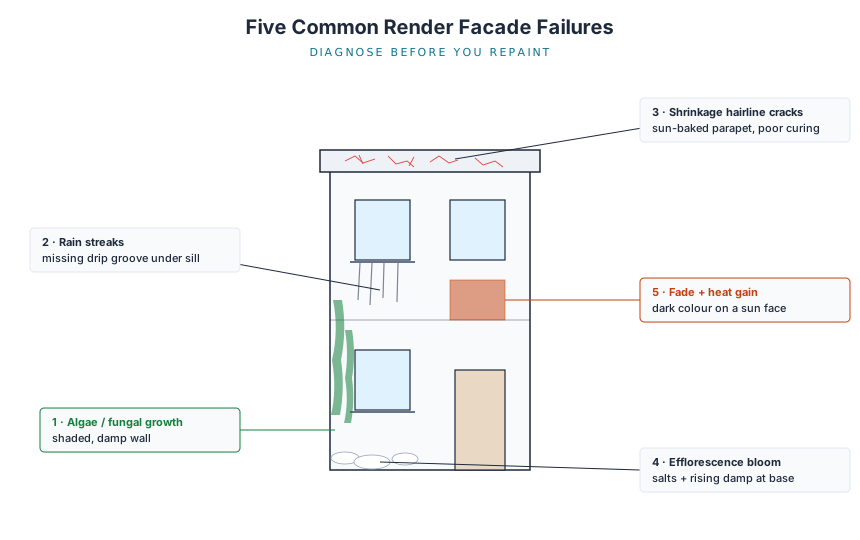
North and shaded walls go green. In humid India — coastal belts, the monsoon-soaked Western Ghats, the Northeast, even Bengaluru's wet months — any wall that stays damp and out of direct sun will grow algae and fungal staining. The wall stays moist, sunlight cannot bake it dry, and biological growth takes hold. Anti-algal paint slows this, but no paint stops it permanently on a chronically shaded, chronically damp wall. This is orientation and microclimate, not paint failure.
Rain streaks run below sills and projections. When a window sill, coping or chajja has no drip groove, monsoon water sheets across the projection, curls under the edge and runs down the wall face — carrying dirt with it. The result is the dark vertical tear-stains you see under every unthroated sill in the country. A ₹5 throating detail prevents what no premium paint can hide.
Hairline shrinkage cracks map across the render. Cement shrinks as it cures, and if the render was applied too thick, too fast, in too much sun and wind, or — most commonly — was not cured properly (not kept damp for the early days), it cracks. These map cracks are usually cosmetic, but they let water in and they spread. Inadequate curing is, by a wide margin, the most common cause of cement render failure in India.
Efflorescence blooms white through the paint. Efflorescence is the crystalline white salt deposit that forms when water dissolves soluble salts inside the masonry and render, migrates to the surface, evaporates, and leaves the salt behind. India's hard groundwater and salty sands make this common, especially near the wall base where rising damp draws moisture up. It pushes through fresh paint and looks like the wall is sweating powder.
Dark and saturated colours fade — and heat up. Deep maroons, navies, bottle greens and bright reds look striking on day one and tired within a couple of years; the pigments are simply harder to keep colour-fast under India's intense UV. Worse, a dark wall has a much lower solar reflectance — it absorbs heat and runs hotter, raising the wall's surface temperature and, on a west wall, pushing heat into the room behind it. Light, warm tones fade less and stay cooler.
Realistically: a standard exterior emulsion on a well-detailed wall looks good for about 5-7 years before it wants a repaint; a premium weatherproof system stretches that to 7-10 years, longer still on protected elevations. On exposed, north-facing, poorly-detailed walls, halve those numbers.
6. The honest case: cost, cracking and repaint cycles
The economic appeal of rendered facades is overwhelming and real. At roughly ₹30-80 per square foot to repaint over existing plaster — and ₹30-45 per square foot for the render itself — this is far and away the cheapest way to give a building a finished, weather-facing skin. Stone cladding, ACP, terracotta or glass cost many times more. For most Indian budgets, render is not a choice among equals; it is the affordable facade, and everything else is an upgrade.
But the cheapness has an honest cost, and it is the repaint cycle. Unlike stone or fair-faced brick — which you finish once and forget for decades — a painted render facade is a recurring expense. Budget for a full exterior repaint every 5-7 years on standard paint, 7-10 on premium. Over a 30-year building life, that is several repaints, and the cumulative cost quietly closes the gap with a one-time premium cladding.
The cracking is the other honest cost. Cement render will develop hairline cracks — the question is only how many and how soon, and that is decided at construction, not at the paint shop. Good sand, a controlled mix, the right thickness, and above all proper curing (keeping the fresh render damp for days, not hours) are what separate a wall that cracks lightly from one that crazes badly. Texture coatings and elastomeric paints can hide and bridge hairline cracks, which is a genuine benefit — but hiding a crack is not the same as preventing the movement that caused it, and neither will save a wall with structural cracking or active damp.
7. What this means for you
For homeowners, the single most valuable idea in this guide is this: good detailing beats expensive paint, every time. Before you agonise over Apex versus Berger, make sure every sill, coping, parapet and chajja has a proper drip groove, that you have generous overhangs over exposed walls, and — most of all — that your render is cured properly. A ₹40-per-sq-ft system on a well-detailed, well-cured wall will outlast a ₹110 system on a rushed one.
Then, choosing the finish:
- Go light. Light, warm tones fade less, run cooler, and hide dust and minor streaking better than dark saturated colours. Save deep colours for small, protected accent panels.
- Match the finish to the orientation. Spend the premium weatherproof, anti-algal money on the exposed and shaded walls (north, and the rain-driven side). A protected, sunlit wall does fine on standard exterior emulsion.
- Get the primer and putty system right. The right primer over clean, dry, fully-cured render — never over fresh or damp plaster — is what makes the top coat actually last and the warranty actually hold.
- Understand texture before you commit. Textured and stone-spray coatings look premium and hide hairline cracks beautifully, but they trap dust and grime in their relief, they are very hard to repaint cleanly, and you are essentially married to that surface. Use them deliberately, on feature walls, not everywhere.
- For old or damp walls, think lime. If you are working on a heritage or chronically damp wall, a breathable lime render that lets the wall dry outward will outperform a cement render that traps moisture and blisters — provided you can find the skilled labour.
For practitioners: specify curing in the contract and inspect it, detail the throating on every projection, and resist letting an excited client paint the whole house a fashionable dark colour. And be honest with owners that "waterproof" paint reduces but does not cure structural damp — penetrating or rising damp is solved at the wall, with damp-proofing and detailing, not with a paint tin.
The rendered-and-painted wall will never be glamorous. But understood as a system — built up in the right layers, detailed with drip grooves and overhangs, cured with patience, finished in a sensible colour with the right paint for its orientation — it is a genuinely good facade: affordable, repairable, and capable of looking crisp for years. The failures we walk past every day are not the material's fault. They are the shortcuts.
Sources
- Bureau of Indian Standards, IS 1661 — Code of Practice for Application of Cement and Cement-Lime Plaster Finishes.
- Bureau of Indian Standards, IS 2402 — Code of Practice for External Rendered Finishes.
- Asian Paints — technical literature and warranty terms for Apex Ultima Protek (12-year performance / 10-year waterproofing) and Ultima Protek Duralife (15-year performance, waterproofing and anti-algal); product pages, asianpaints.com.
- Berger Paints — WeatherCoat Long Life 10 (10-year warranty) and WeatherCoat Anti-Dustt (7-year) product and technical pages, bergerpaints.com.
- Dulux (AkzoNobel) — Weathershield exterior range product literature and warranty terms.
- Kansai Nerolac — Nerolac Excel exterior emulsion product information.
- General building-science references on render shrinkage cracking, the role of curing, efflorescence mechanism, and biological (algal/fungal) growth on shaded exterior walls — industry technical notes and rendering/stucco specialist guidance.
- Indian construction cost references for exterior plastering, painting and texture-coating rates per square foot (2025-2026 market figures).
Export this guide
Related Guides — Deep-dive reading
Exterior Wall Paint: The Complete Guide for Indian Homes
The coat that fights the sun and the monsoon — the weatherproofing system beneath the colour, why your climate zone decides the paint, the five exterior types, how these paints fail, and the order of work that makes a warranty mean something.
Wall FinishesCompound Wall Finishes in India: Plaster, Texture, Cladding and Paint (2026)
A plain, India-grounded guide to choosing the exterior finish for a compound wall — plaster and exterior paint, textured coatings, stone, tile, laminate and HPL cladding, exposed brick, concrete and rubble stone, and decorative faces — compared on look, weather durability, maintenance and cost band, with the front wall treated as your street facade.
Compound WallsCompound Wall Waterproofing in India: Coping, DPC and Damp Protection (2026)
A plain, India-grounded guide to keeping water out of your boundary wall — the three ways rain and ground damp get in, and the three defences that stop them: a proper overhanging coping with a drip on top, a damp-proof course and plinth-protection band at the base, and a breathable rain-resistant render and paint on the face. Plus efflorescence, drainage and coastal care.
Compound WallsRelated Tools — Try Free
Painting Prep & Quality Checklist
Painting audit — 10 categories, 65+ checkpoints across surface prep, putty, primer, emulsion coats, enamel, external, ceilings, defects, final QC.
Painting QCCross-Ventilation Analyzer
Estimate airflow and air changes per hour (ACH) from room size, window areas, layout, and local wind — with NBC 2016 Part 8 compliance check.
Ventilation CalculatorBrise-Soleil Visualizer
Interactive horizontal-louvre cut-off angle calculator — sun altitude, louvre depth, and spacing inputs with a live shadow preview. Computes θ = arctan(spacing/depth) for façade shading, ECBC envelope compliance, hospital daylight design, and tropical sun-control detailing.
Sun Shading Tool