
Waterproofing Chemicals Explained
Integral, crystalline, acrylic, PU, membranes — what each waterproofing product actually is, how it works, and which to use where, so you can read a quotation and choose well.
Your contractor just sent a waterproofing quotation. It lists five line items: "integral admixture," "crystalline coating," "acrylic elastomeric," "PU coating," and "APP membrane." Five products. Five prices. And you have absolutely no idea what any of them are — or why you apparently need all five for one house. Is the contractor over-specifying to inflate the bill? Are any of them the same thing with different names? Which one actually matters?
This guide exists to answer those questions. It is the chemistry and product companion to the zone-by-zone how-to covered in the waterproofing guide and the failure-analysis explained in waterproofing failures. Read those alongside this one — but this is where you learn what is inside the bucket.
Waterproofing chemicals work in three fundamentally different ways: they either block the pores inside concrete (integral and crystalline systems), form a continuous flexible or rigid skin on the surface (coatings and membranes), or repel water at a molecular level without forming a film (silane/siloxane repellents) — and the correct chemistry depends on the surface, the water pressure, and whether the substrate will move.
1. Why the chemistry matters before the zone
Most waterproofing failures are not application failures alone — they are chemistry mismatches. A rigid cementitious coating applied over a moving terrace slab will crack. A breathable silane water-repellent applied to an underground basement will do nothing against hydrostatic pressure. Crystalline chemistry needs a concrete or cement substrate to react with; it will not work on a brick wall.
Before any application decision, four questions define the correct product family:
1. Positive side or negative side? Positive side means water is trying to push through from the outside — you waterproof the surface the water hits first (preferred). Negative side means the structure is already built and you can only reach the dry/interior face — the chemical must resist reverse hydrostatic pressure.
2. Flexible or rigid substrate? Concrete slabs, sunken slabs, and large terraces move with thermal expansion and structural load. A chemical system must either be as elastic as the movement (elastomeric) or be protected by a decoupling layer.
3. Exposed or protected? An exposed terrace endures UV radiation, thermal cycling, and foot traffic. A basement wall is buried and load-protected. UV stability and abrasion resistance matter only in exposed locations.
4. Hydrostatic pressure or just moisture ingress? Basements, underground walls, and buried water tanks experience water trying to push through under pressure. Most coatings cannot resist sustained hydrostatic head — crystalline systems and robust membranes can.
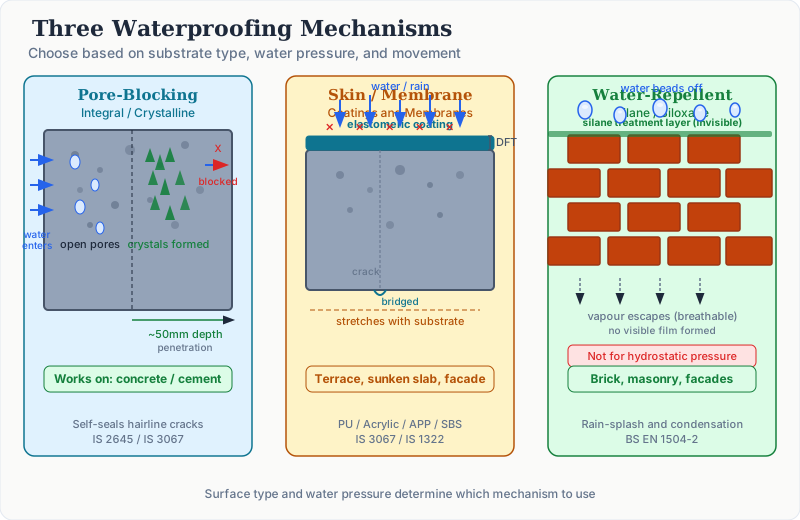
The three strategies: pore-blocking (integral/crystalline), skin-forming (coatings/membranes), and water-repelling (silane/siloxane) — your surface and water-pressure conditions decide which family to reach for.
2. Product family 1 — Integral and admixture waterproofing
What it is: A powder or liquid additive that goes directly into the concrete or mortar mix at the batching stage. IS 2645:2003 (Integral Cement Waterproofing Compounds — Specification) governs this category in India. The active ingredients are typically crystalline densifiers, calcium stearate (a pore-blocker/hydrophobic agent), or colloidal silica.
How it works: The admixture reacts with the calcium hydroxide and hydrating cement to produce additional C-S-H gel and finer pore structures, reducing capillary porosity throughout the concrete mass — not just on the surface. It does not form a surface film; it modifies the concrete itself. Some formulations combine a hydrophobic component (water repellent in the mass) with a chemical densifier.
Where to use: As a first line of defence in all reinforced concrete elements — roof slabs, basement raft, retaining walls, sunken slabs, water tanks. It is added to the mix, so it cannot be forgotten later. It is a foundation, not a complete waterproofing system on its own.
Pros: Permanent (it is part of the concrete), zero labour overhead if batching is on-site, no separate surface treatment, does not crack or peel. Cons: Cannot bridge cracks that form post-pour. Adds modest cost (₹1.50–₹3/litre of concrete mix, indicative 2026). Does not replace a surface system for high-risk zones like terraces and basements.
"No integral admixture replaces good concrete design — adequate cover, correct water-cement ratio, and vibration. It is a supplement to quality, not a substitute for it." — M. S. Shetty, Concrete Technology: Theory and Practice, S. Chand, 9th ed.
3. Product family 2 — Crystalline waterproofing
What it is: A crystalline waterproofing compound — typically a cement-based powder containing proprietary active chemicals (sodium silicate, aluminium silicates, or specific reactive catalysts) — that reacts with concrete to permanently seal capillary pores. The best-known reference standard is ASTM C1202 (permeability), though Indian practice follows IS 2645 for admixture use and IS 3067 (Code of Practice for General Design Details and Preparatory Work for Damp-proofing and Waterproofing of Buildings) for surface application.
How it works: When the slurry contacts concrete, the active chemicals migrate into capillaries and react with water and cement hydration products (calcium hydroxide) to form insoluble calcium silicate hydrate crystals that physically fill and block pores. The reaction is not limited to the surface — crystals can penetrate several centimetres into the slab. More importantly, if a hairline crack later forms and water re-enters, the reaction re-initiates around the crack — a property called self-sealing.
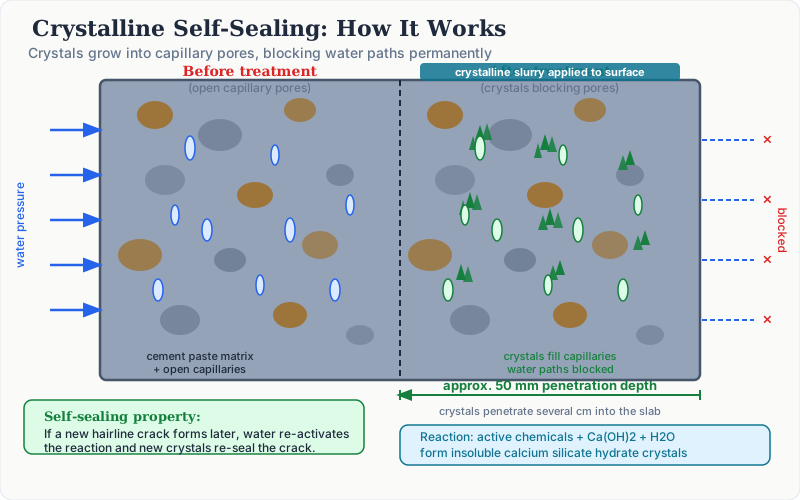
Crystalline chemistry: the compound migrates into capillaries and grows insoluble crystals that block water paths — and re-activates if fresh water reaches a new crack.
Where to use: Water tanks (including potable water tanks — most brands have food-safe certifications), basements and retaining walls (especially negative-side application where you cannot reach the exterior), tunnels, foundations. Excellent for positive and negative side alike.
Pros: Self-sealing in hairline cracks, permanent if the concrete is intact, food-safe options available, applicable to negative side, no VOC. Cons: Works only on concrete/cement substrates, cannot bridge live structural cracks (>0.3–0.5 mm), higher material cost than cementitious coatings, requires thorough surface preparation.
4. Product family 3 — Cementitious and polymer-modified coatings
What it is: A two-component brush-applied slurry: cement + polymer (typically styrene-acrylic or SBR — styrene-butadiene rubber). Often sold as a two-pack: a powder component and a liquid polymer. When mixed and applied, it cures to a rigid-to-semi-flexible coating firmly bonded to the substrate.
How it works: The cement component provides bond and compressive strength; the polymer component improves tensile strength, adhesion, and reduces brittleness. The result is a coating that is more flexible than plain cement slurry but less flexible than pure acrylic or PU. IS 9395 (Code of Practice for Application of Waterproof Treatments for External Surfaces of Walls) and IS 3067 are the relevant reference standards.
Where to use: Internal bathroom walls and floors, sunken slab refill-zone surfaces, potable water tanks, planter walls — anywhere substrate movement is low, chemical exposure is modest, and a brush-applied system is convenient. Often used as an intermediate or primer layer under acrylic/PU systems.
Pros: Easy to apply, available everywhere in India, bonds well to masonry and concrete, modest cost. Cons: Limited crack-bridging (typically cracks if the substrate moves more than 0.1–0.2 mm), not suitable for exposed UV applications alone, cannot resist sustained hydrostatic head greater than a few metres.
5. Product family 4 — Acrylic liquid-applied coatings (elastomeric)
What it is: A water-based acrylic polymer emulsion, often called "elastomeric waterproofing" or "acrylic waterproofing membrane." Typically applied in two to three coats by brush or roller, forming a continuous flexible film when dry.
How it works: The acrylic polymer chains cross-link on drying, forming an elastic film that stretches and recovers as the substrate moves. Good UV resistance makes it suited to exposed terraces. Crack-bridging ability — typically 0.5–1.5 mm depending on DFT (dry film thickness) — is the key advantage over cementitious coatings. Elongation at break typically 200–400%.
Where to use: Terraces (as a base waterproofing layer under tiles or screed), exposed external walls, parapet copings, mild-movement substrates. Also used over rigid cementitious coats to give the system some flexibility.
Pros: UV-stable, reasonable elasticity, water-based and lower VOC than solvent systems, widely available, relatively easy repair. Cons: Less elastic than PU; cannot bridge large live cracks; performance degrades significantly if applied too thin (below minimum DFT of 500–600 microns dry); not suitable for sustained submerged applications.
6. Product family 5 — Polyurethane (PU) coatings
What it is: A two-component (2K) or single-component (1K moisture-cure) liquid-applied membrane based on polyurethane chemistry. The two-component version mixes a polyol with an isocyanate hardener; the single-component version cures with atmospheric moisture.
How it works: PU chemistry produces one of the most elastic waterproofing films available — elongation at break typically 300–800%, depending on formulation. This means PU can bridge live cracks of 1–3 mm without tearing. The film is seamless, impermeable, and adheres strongly to primed concrete. Aliphatic formulations are UV-stable for exposed terraces; aromatic formulations are cheaper but chalk under UV and must be overcoated.
Where to use: Exposed terraces (the premium system), sunken slab waterproofing (under refill concrete), podium decks, balconies, car park decks. The best choice where substrate movement is expected or where consequences of failure are high.
Pros: Highest elasticity of any liquid-applied system, seamless, excellent adhesion, long service life (15–25 years well-applied), can overcoat and repair. Cons: Highest cost of liquid-applied systems, two-component systems require careful mixing ratios, moisture-sensitive during application (rising damp degrades adhesion), 2K product has a pot life of 30–90 minutes. Indicative material cost: ₹80–₹160/sq ft (2026), depending on grade and DFT.
"The elastic modulus of a waterproofing membrane must be matched to the thermal and structural movement of the substrate — a stiff coating on a moving slab is merely a crack waiting for a reason." — A. W. Beeby and R. S. Narayanan, Designers' Guide to EN 1992-1-1, Thomas Telford, 2005.
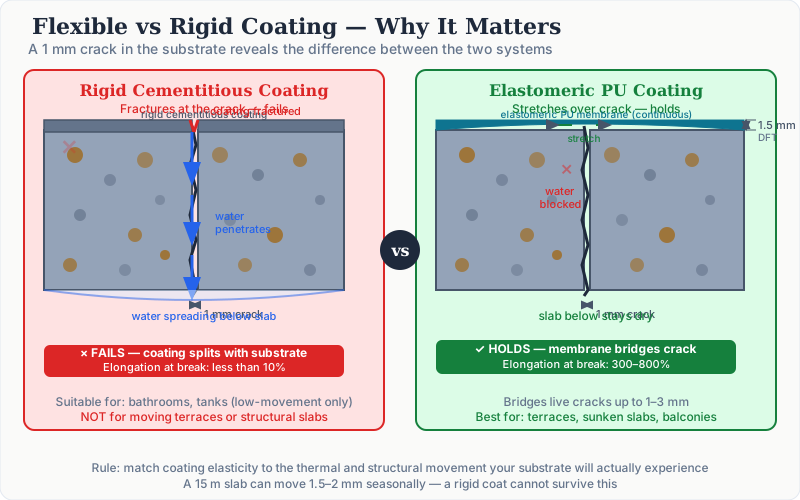
Why flexibility matters: a rigid coating splits when the substrate cracks; an elastomeric PU membrane stretches and maintains the watertight seal. See also waterproofing failures and what makes buildings crack.
7. Product family 6 — Bituminous membranes: APP and SBS
What it is: Pre-manufactured rolls of bitumen-modified polymer sheet — either APP (Atactic Polypropylene modified bitumen, which is stiffer and heat-resistant) or SBS (Styrene-Butadiene-Styrene, which is more flexible at low temperatures). Governed in India by IS 1322 (Bitumen Felts for Waterproofing and Damp-proofing — Specification) and IS 3384 (Bitumen Primer for Use in Waterproofing and Damp-proofing). Also referred to as "torch-on membranes" for APP.
How it works: APP sheets are torch-applied — a gas burner heats the underside as the roll is unfurled, melting the bitumen to bond it to the primed concrete substrate. The overlapping seams are torch-welded. The result is a thick (3–5 mm) continuous membrane. Self-adhesive bituminous membranes (cold-applied, polyethylene or aluminium-faced) are used where open flame is not possible.
Where to use: Large flat terraces and commercial roofs, underground retaining walls (blindside waterproofing), podium slabs, construction joints (as a slip layer), bridges. Not suited to exposed UV applications without a UV-protective topcoat or tile overburden because bitumen degrades with UV.
Pros: Thick and robust, good puncture resistance, large areas applied quickly, proven long track record in India, moderate cost. Cons: Requires skilled torch operators, vulnerable to UV if left exposed, not suitable for complex shapes and penetrations (requires careful detailing), repair is more labour-intensive than liquid-applied systems.
8. Product family 7 — Epoxy coatings and grouting
What it is: Two-component epoxy resin systems — epoxy resin plus amine or polyamide hardener — forming a hard, chemically resistant film or mortar.
How it works: Epoxy cures by chemical cross-linking into a rigid, non-porous, chemically inert film. It is impermeable to water and to a wide range of chemicals. Not elastic — epoxy cracks if the substrate flexes.
Where to use: Internal surfaces of chemical storage tanks, industrial floor sumps, sewage treatment structures, potable water tanks (food-grade epoxy), areas with aggressive chemical exposure. Also used as an injection grout (low-viscosity epoxy or PU injection) for crack repair — pumped under pressure into active cracks to seal them. Why buildings leak covers several failure scenarios where injection grouting is the correct remedy.
Pros: Chemically resistant, hard-wearing, food-safe grades available, bonds strongly to concrete. Cons: Rigid — not for any moving substrate; expensive; requires strict mixing ratios and application temperature control; not UV-stable (chalks outdoors).
9. Product family 8 — Silane and siloxane water-repellents
What it is: Small-molecule organosilicon compounds — silane monomers (isobutyltriethoxysilane) or siloxane oligomers — typically in a solvent or water carrier, penetrating into masonry, brick, or concrete surfaces.
How it works: Silane/siloxane molecules penetrate the substrate (brick mortar joints, concrete surface, stone) and chemically bond to the silica on pore walls, converting hydrophilic surfaces to hydrophobic ones. Water beads off; the surface "breathes" because vapour molecules are much smaller than liquid water molecules. No visible film is formed. This is why silane/siloxane is not called a membrane — it is a water-repellent treatment, not a waterproofing membrane. It cannot resist sustained hydrostatic pressure.
Where to use: External facades (brick, sandstone, concrete), plastered external walls, stone cladding, heritage masonry — anywhere moisture ingress from rain-splash, condensation, or capillary rise degrades the surface but you cannot tolerate a surface coating changing the appearance. Often combined with gypsum plaster vs cement plaster decisions on exterior finishes.
Pros: Invisible, breathable, preserves the substrate, no peel/crack risk, long service life (8–15 years). Cons: No resistance to hydrostatic pressure, cannot bridge cracks, requires dry substrate for penetration, solvent-based versions have VOC concerns, not suitable for areas with standing or positive-pressure water.
10. Product family 9 — Sheet membranes: PVC and TPO
What it is: Pre-manufactured thermoplastic sheet membranes — PVC (Polyvinyl Chloride) or TPO (Thermoplastic Polyolefin) — seam-welded by hot-air gun.
How it works: Rolls of thermoplastic sheet (1.2–2 mm thick) are laid over the substrate, typically over insulation or a geotextile separation layer, and adjacent sheets are hot-air welded at overlapping seams to form a continuous membrane. Seam integrity is the critical quality control point.
Where to use: Large flat commercial and institutional roofs, green roofs (root-resistant PVC/TPO variants), extensive waterproofed podium slabs. Less common on residential terraces in India but growing in premium construction.
Pros: Excellent long-term UV performance (TPO especially), factory-manufactured quality, fast installation on large areas, fully recyclable (TPO), long service life (20–30 years). Cons: High material and welding equipment cost, requires skilled seam-welding, detailing around penetrations demands care, puncture during construction phase is a risk.
11. Joints, waterstops, and injection grouts
Two specialised product families complete the picture:
Waterstops are PVC or hydrophilic rubber strips cast into construction joints in concrete — the joint between a raft slab and a basement wall, for instance. A PVC waterstop is a flat profile embedded across the joint; a hydrophilic waterstop swells when wetted, sealing the joint. IS 3413 (Specification for Polyvinyl Chloride Waterstop) and IS 13144 cover this category. Waterstops prevent water tracking through construction joints where membranes alone cannot protect.
Joint sealants (PU and polysulphide) are gun-applied flexible sealants for expansion joints, pipe-wall interfaces, and movement joints. PU sealants are more elastic; polysulphide (IS 12118) is better for chemical resistance and submerged joints. Correct joint design — chamfer, backer rod, correct sealant depth-to-width ratio — determines whether the sealant outlasts the building or fails in two monsoons.
PU injection grouting is the right tool when an active (wet, leaking) crack must be sealed from inside. Low-viscosity PU foam or hydrophilic PU gel is injected under pressure; it reacts with the moisture in the crack to expand and seal. This is a repair tool, not a primary waterproofing system.
12. Matching chemical to zone — the reference matrix
The table below maps each zone of an Indian house to the recommended primary and secondary chemical systems. For application steps and layer sequences, refer to the waterproofing guide.
| Zone | Primary system | Secondary / backup | Notes |
|---|---|---|---|
| Exposed terrace (tiled) | PU or acrylic elastomeric coating | Integral admixture in slab | Tile + screed over coating; aliphatic PU if left exposed briefly |
| Exposed terrace (no tile) | APP/SBS membrane or PU | — | UV-stable topcoat or gravel ballast over bitumen |
| Bathroom floor + walls | Polymer-modified cementitious + acrylic | Integral admixture in slab | Two-coat cementitious under tile; PU at drain junction |
| Sunken slab (service area) | PU coating | Polymer-modified cementitious | Apply before plumbing backfill; protect with screed |
| Basement/retaining wall (exterior) | APP/SBS membrane + drainage mat | Crystalline slurry on concrete face | Positive-side preferred; membrane + geocomposite drainage |
| Basement (interior/negative side) | Crystalline waterproofing | Injection grout for cracks | If exterior not accessible; crystalline + negative-side slurry |
| Underground water tank | Crystalline slurry (food-safe) or epoxy | Integral admixture in slab/walls | Confirm food-safe certification; no APP in potable tanks |
| Overhead water tank | Crystalline or polymer-cementitious | — | Access possible; two-coat system + check annually |
| External plaster/facade | Silane-siloxane penetrating repellent | — | Not for hydrostatic zones; breathable, invisible |
| Roof garden/green roof | Root-resistant PVC/TPO sheet membrane | Drainage geocomposite | Root-puncture resistance essential |
| Construction joints in concrete | PVC/hydrophilic waterstop | PU sealant over joint | Cast-in waterstop; never skip for basements |
| Active crack (live leak) | PU injection grout | Follow with crystalline or coating | Stop the active leak first; then surface system |
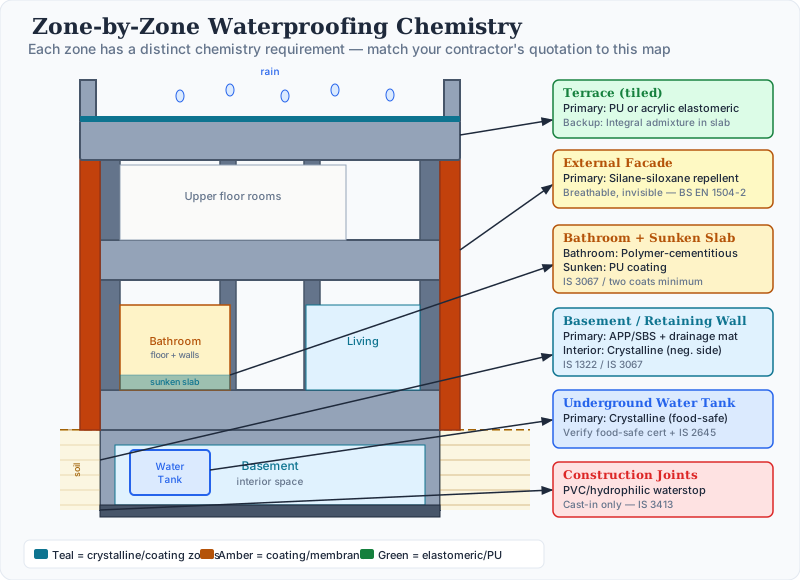
Read this map against your contractor's quotation — each zone has a distinct chemistry requirement. A single-system "waterproofing package" applied everywhere is almost always a mismatch somewhere.
13. Flexible vs rigid — the crack-movement rule
This is the single most important selection criterion after zone. If the substrate will move — thermally, structurally, or because of settlement — a rigid coating will crack and fail. The elasticity hierarchy from most to least flexible is:
| System | Elongation at break | Maximum bridgeable crack (typical) | Substrate suitability |
|---|---|---|---|
| PU coating (2K) | 300–800% | 1–3 mm (live) | Moving slabs, sunken, terrace |
| SBS bituminous membrane | 150–300% | 0.5–2 mm (static) | Large terraces, basements |
| Acrylic elastomeric | 200–400% | 0.5–1.5 mm (static) | Terraces, mild movement |
| APP bituminous membrane | 50–150% | 0.3–0.8 mm (static) | Moderate movement |
| Polymer-cementitious (modified) | 20–80% | 0.1–0.3 mm | Low-movement: bathroom, tank |
| Cementitious/crystalline | Less than 10% | Hairline only (self-sealing) | Rigid concrete, no movement |
| Epoxy | Less than 5% | None (must stop cracks before coating) | Rigid industrial floors only |
| Silane/siloxane | N/A (no film) | N/A | Breathable facade, no cracks |
The science behind durable buildings explains why concrete slabs expand and contract with temperature — a 15 m long slab can move 1.5–2 mm seasonally. That is why a rigid coating almost always fails on an unprotected Indian terrace within three to five years. For crack causes, see what makes buildings crack.
14. Reading a waterproofing quotation
A typical Indian waterproofing contractor quotation uses brand-specific and informal names. Here is a decoder for common terminology:
| Quotation term | Product family | What to verify |
|---|---|---|
| "SBR coat," "polymer cementitious," "two-pack cementitious" | Polymer-modified cementitious coating | Ask for two-coat application; ask for IS 2645 or IS 3067 reference |
| "Acrylic waterproofing," "elastomeric coating," "rubberised coating" | Acrylic liquid-applied membrane | Confirm minimum 500 microns DFT; ask for elongation specification |
| "PU membrane," "polyurethane coating," "seamless membrane" | PU liquid-applied coating | Ask: 1K or 2K? Aliphatic or aromatic? Minimum DFT? Pot-life handled correctly? |
| "Torch-on," "APP membrane," "bituminous sheet" | APP bituminous roll membrane | Check: IS 1322 grade? Thickness (min 3 mm for terrace)? Seam overlap width? |
| "Self-adhesive membrane," "peel-and-stick" | Self-adhesive bituminous membrane | Check: primer specified? Temperature range? |
| "Crystalline waterproofing," "reactive chemical slurry" | Crystalline waterproofing | Ask: food-safe if used on tanks? Applied wet-on-wet or dry-on-wet? Two coats? |
| "Integral," "mix admixture," "waterproofing compound for concrete" | Integral admixture (IS 2645) | Dosage in mL/kg of cement? BIS-marked product? |
| "Injection grouting" | PU/epoxy crack injection | Type: PU foam or hydrophilic gel? Pressure injection or gravity? |
| "Waterstop" | PVC or hydrophilic waterstop | Profile width? Cast-in or retrofitted? IS 3413? |
| "Silicone treatment," "water-repellent coat" | Silane/siloxane penetrating repellent | Carrier: solvent or water-based? Active % content? |
Warranty red flags: A blanket "10-year waterproofing guarantee" on a cementitious coating over a moving slab is meaningless. Realistic warranty periods: PU coatings 5–10 years (with maintenance); APP membranes 8–12 years (protected); acrylic 3–5 years; crystalline — effectively permanent on the concrete, not warranted against structural cracks.
15. Application quality — why the chemistry is only 50% of the result
The best waterproofing product fails if applied incorrectly. The three most important quality factors are:
Surface preparation: All systems require a sound, clean, dust-free, laitance-free substrate. Crystalline and cementitious coatings require a saturated-surface-dry (SSD) condition. PU coatings require a dry surface (below 5–7% moisture content) — rising damp causes adhesion failure. APP membranes require a primed surface with bituminous primer (IS 3384).
Number of coats and DFT: Thin applications are the single biggest cause of coating failure in India. Polymer-cementitious: two coats, minimum 1–1.5 mm total. Acrylic: two to three coats, minimum 500–600 microns DFT. PU: two coats, minimum 1.5–2 mm DFT (or per manufacturer's spec). Ask for a DFT gauge reading on site — not theoretical coverage, actual measured dry film thickness.
Fillets, coves, and upstands: Every wall-floor junction in a bathroom or terrace is a stress concentration. The coating must be built up at these corners into a cove fillet (typically 50–75 mm radius in cement slurry) before the main coating — otherwise the coating bridges a sharp corner at reduced thickness and cracks first. Upstands must extend at least 150–300 mm up the wall above the screed/tile level.
For a detailed catalogue of exactly how application failures happen, read waterproofing failures explained. For overall quality-control practice on site, construction quality control for homeowners covers checklists and inspection points you can use without any technical background.
16. Cost bands by system — the value ladder
The following are indicative 2026 costs for material only (installed/total project cost is 1.5–3× material cost depending on labour, surface prep, and detailing complexity). Systems are shown in ascending cost order.
| System | Indicative material cost (₹/sq ft, 2026) | Typical service life (well applied) | Best fit |
|---|---|---|---|
| Integral admixture (added to concrete) | 1.50–3 (per litre of mix) | Life of structure | All concrete elements, as standard |
| Cementitious / polymer-modified (two-coat) | 8–18 | 5–8 years | Bathrooms, low-movement tanks |
| Acrylic elastomeric (two-coat) | 15–30 | 6–10 years | Terraces, exposed mild-movement |
| APP/SBS bituminous membrane (3 mm) | 25–45 | 10–15 years | Large terraces, basements |
| Crystalline (two-coat slurry) | 35–65 | Life of concrete | Basements, tanks, negative side |
| PU coating (two-coat, 1.5 mm DFT) | 80–160 | 12–20 years | Premium terraces, sunken slabs |
| Epoxy (two-coat) | 90–180 | 15–25 years (rigid surface) | Chemical tanks, industrial floors |
| PVC/TPO sheet membrane | 120–220 | 20–30 years | Large commercial roofs, green roofs |
"A waterproofing system that costs ₹20/sq ft and fails in three years costs more than a ₹120/sq ft system that lasts twenty — once you account for the remediation, the redone tiles, and the damaged plaster." — Site engineer maxim widely used across Indian construction sites.
The cheap-now-expensive-later trap is most visible on terraces: a single-coat cementitious application saves ₹10/sq ft upfront and fails in 3–4 monsoons. Ripping out tiles, re-waterproofing, and re-tiling costs ₹150–₹250/sq ft in retrofit — four to eight times the upgrade cost.
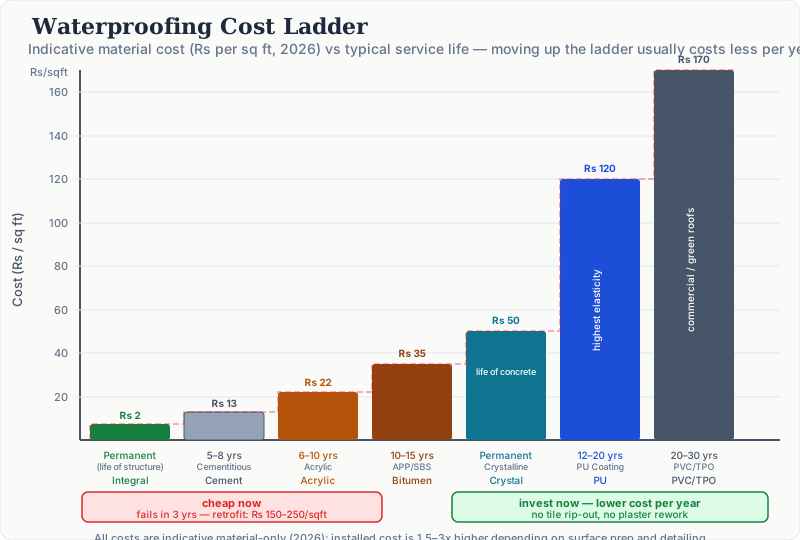
The cost-per-year calculation almost always favours moving up the ladder — especially on terraces and basements where remediation is disruptive and expensive.
17. Positive vs negative side — a critical decision
| Criterion | Positive side | Negative side |
|---|---|---|
| Definition | Waterproof the face that water strikes first | Waterproof the dry/interior face |
| Preferred? | Always preferred | Only when exterior is inaccessible |
| Suitable systems | Any (membrane, coating, crystalline) | Crystalline, polymer-cementitious, injection grout only |
| Hydrostatic performance | All systems can work | Only systems bonding mechanically to the substrate resist reverse pressure |
| Common context | New construction terrace, exterior basement wall | Existing basement interior, tank interior already lined |
| Key risk | UV, physical damage during construction | Reverse-pressure delamination if wrong product used |
18. Environmental and health considerations
VOC and indoor air quality: Solvent-based PU and epoxy systems have significant VOC content and require adequate ventilation during and after application. Water-based PU and acrylic systems have much lower VOC. For enclosed spaces — basement rooms, bathrooms — specify low-VOC or water-based systems wherever possible.
Food-safe certifications: For potable water tanks, verify that the product has food-grade or NSF/ANSI 61-equivalent certification, or that the manufacturer's technical datasheet explicitly confirms potable water suitability. Most crystalline systems qualify; most bituminous and solvent-based epoxy systems do not.
Breathability on facades: A silane/siloxane treatment on an external wall keeps moisture out while allowing vapour out from inside — critical in a climate where walls often trap residual construction moisture. A film-forming coating that is not breathable can trap moisture and accelerate plaster deterioration.
For guidance on how these waterproofing chemical choices interact with overall material durability and building lifespan, see material lifespan comparison and the broader framework in modern construction materials for Indian homes.
"If you are applying a product that is not breathable to a wall that has moisture inside, you are not waterproofing the wall — you are imprisoning the moisture. The wall will do the rest." — M. T. Kubal, Construction Waterproofing Handbook, McGraw-Hill, 2nd ed., 2008.
Application quality minimum standards — on-site checklist
| Check | What to verify | Minimum standard |
|---|---|---|
| Surface preparation | Laitance removed, substrate sound | Wire-brush or sand-blast; no loose material, no oil |
| Moisture content (PU) | Substrate dryness before PU application | Below 5% moisture content (CM meter check) |
| Substrate condition (crystalline) | Surface saturated-surface-dry | Damp but not puddled; no standing water |
| Primer | Applied as specified | Correct primer type for the coating system; uniform coverage |
| First coat DFT | Measured with wet-film gauge | As per manufacturer; minimum 600–800 microns wet for acrylic |
| Second coat DFT | Total DFT reached | Acrylic: 500+ microns dry; PU: 1.5 mm+ dry |
| Corner fillets | Wall-floor junction and pipe upstands | 50–75 mm radius cove in cement slurry before main coating |
| Upstand height | Coating continuation up vertical face | Minimum 150 mm above screed/tile level |
| Curing / protection | Coat protected from rain/UV/traffic | Minimum 24–48 hours before next coat; screed within 7 days for PU |
| Flood test | Standing water test post-application | 25–50 mm head for 24 hours before screed is poured |
19. Summary table — product families at a glance
| Family | Mechanism | IS/standard | Key use | Crack bridging | Positive side | Negative side |
|---|---|---|---|---|---|---|
| Integral admixture | Pore densification | IS 2645 | All concrete at mix stage | None (prevents, not bridges) | Yes (in mix) | Yes (in mix) |
| Crystalline | Reactive crystal growth | IS 2645, IS 3067 | Basements, tanks | Hairline (self-sealing) | Yes | Yes (best choice) |
| Polymer-cementitious | Rigid film | IS 3067 | Bathrooms, tanks | Minimal | Yes | Yes (limited head) |
| Acrylic elastomeric | Elastic film | IS 3067, BS 6920 | Terraces, facades | Up to 1.5 mm | Yes | No |
| PU coating | Highly elastic film | IS 3067, ASTM C836 | Terraces, sunken slabs | Up to 3 mm | Yes | No |
| APP/SBS membrane | Thick elastic sheet | IS 1322 | Terraces, basements | Up to 2 mm (SBS) | Yes | No |
| Epoxy | Rigid chemical-resistant film | IS 13182 | Tanks, industrial floors | None | Yes | No |
| Silane/siloxane | Hydrophobic pore-lining | BS EN 1504-2 | Facades, masonry | None | Breathable surface only | No |
| PVC/TPO sheet | Welded thermoplastic film | ASTM D4434 (TPO) | Large flat roofs | Accommodated at seam | Yes | No |
| Waterstop | Physical barrier | IS 3413 | Construction joints | N/A (joint system) | Cast-in | Cast-in |
| PU injection grout | Expanding foam/gel | — | Active crack repair | Live/wet cracks | Crack injection | Crack injection |
Author's Note
Waterproofing is the part of a house that should be invisible — and the part that costs you the most when it fails. My father's house had a terrace that leaked every monsoon for a decade. Each year, a contractor came, applied a fresh coat of whatever was cheapest, and left. Each year it leaked again. When we finally did it properly — PU system, fillets, correct DFT, properly applied — it held. The difference was not magic. It was choosing the right chemistry for the movement the slab actually had, and applying it to the thickness it needed.
The product families in this guide exist for good reasons. Crystalline chemistry does things PU cannot do. PU does things crystalline cannot do. The waterproofing industry in India is full of salespeople presenting every product as the answer to every question. Your protection as a homeowner is understanding what each product actually does — then holding a contractor accountable when they specify a rigid coat over a moving slab, or a single-coat application where two are needed.
Build it right the first time. The one place you should never try to save money is the one you cannot see until it is too late.
Disclaimer
This guide is educational. All cost figures are indicative 2026 ranges and will vary by city, grade, brand, and project scope. IS code references are to the latest editions available at time of writing — always verify current BIS mark requirements with the Bureau of Indian Standards or a qualified structural/civil engineer. Waterproofing system design for basements, water-retaining structures, and high-hydrostatic-pressure applications must be carried out by a qualified engineer following IS 3067, IS 456, and relevant project-specific standards. Studio Matrx does not endorse any specific brand or contractor.
References
1. Bureau of Indian Standards. IS 2645:2003 — Integral Cement Waterproofing Compounds — Specification. BIS, New Delhi.
2. Bureau of Indian Standards. IS 3067:1988 — Code of Practice for General Design Details and Preparatory Work for Damp-proofing and Waterproofing of Buildings. BIS, New Delhi.
3. Bureau of Indian Standards. IS 13182:1991 — Epoxy Resin Based Bonding Agents for Use with Cement Concrete — Specification. BIS, New Delhi.
4. Bureau of Indian Standards. IS 1322:1993 — Bitumen Felts for Waterproofing and Damp-proofing — Specification. BIS, New Delhi.
5. Bureau of Indian Standards. IS 3384:1986 — Bitumen Primer for Use in Waterproofing and Damp-proofing. BIS, New Delhi.
6. Bureau of Indian Standards. IS 3413:1980 — Specification for Polyvinyl Chloride Waterstop. BIS, New Delhi.
7. Bureau of Indian Standards. IS 9395:1980 — Code of Practice for Application of Waterproof Treatments for External Surfaces of Walls. BIS, New Delhi.
8. Neville, A. M. Properties of Concrete. 5th ed. Pearson Education, 2012. Chapter 5: Permeability and Durability.
9. Mehta, P. K. and Monteiro, P. J. M. Concrete: Microstructure, Properties and Materials. 4th ed. McGraw-Hill, 2014. Chapter 4: Durability of Concrete.
10. Shetty, M. S. Concrete Technology: Theory and Practice. S. Chand, 9th ed., 2021. Chapter 16: Waterproofing of Concrete.
11. CIRIA. C766 — Control of Ground Movement at Utility Assets. Construction Industry Research and Information Association, London, 2017. (Relevant sections on waterproofing approaches for buried structures.)
12. British Standards Institution. BS EN 1504-2:2004 — Products and Systems for the Protection and Repair of Concrete Structures: Surface Protection Systems for Concrete. BSI, London.
13. ASTM International. ASTM C836/C836M — Standard Specification for High Solids Content, Cold Liquid-Applied Elastomeric Waterproofing Membrane for Use With Separate Wearing Course. ASTM, West Conshohocken.
14. Kubal, Michael T. Construction Waterproofing Handbook. 2nd ed. McGraw-Hill, 2008. Chapter 3: Liquid-Applied Membranes; Chapter 5: Sheet Membranes.
15. Crystalline Technology Education Centre (CTEC). Crystalline Waterproofing Technology Manual. 3rd ed. Kryton International, 2019. (Technical reference — manufacturer-neutral sections on reaction mechanism.)
16. National Building Code of India 2016. Part 5: Building Materials. Bureau of Indian Standards, New Delhi. Section 6.3: Waterproofing materials and admixtures.
Export this guide
Related Guides — Deep-dive reading
Cementitious Waterproofing India: Coatings, Coats & Cost (2026)
How cement-based waterproofing coatings work in Indian bathrooms — one- vs two-component, polymer-modified slurries, surface prep, number of coats, curing, where they suit sunken slabs and wet areas, and where their low flexibility lets you down, with rupee costs.
BathroomsConstruction Chemicals Guide (India): Admixtures, Adhesives, Sealants, Grouts & More (2026)
The anchor guide to construction chemicals for Indian homes - what these small-dose products do, the main families from concrete admixtures to adhesives, sealants, grouts, waterproofing and curing compounds, and how to buy and use them safely.
Building MaterialsEpoxy Grout vs Cement Grout for Tiles in India: Which to Specify (2026)
A plain-English guide to tile grouts for Indian homes: what grout does, how cementitious grout compares with epoxy grout on cost, stain and water resistance, hygiene and durability, and exactly where each one belongs - kitchens, bathrooms, pools, dry rooms and more.
Building MaterialsRelated Tools — Try Free
Monsoon-Readiness Checklist
Pre-rain home audit across 9 categories — terrace, drains, waterproofing, electrical, HVAC, pest, vehicles, documents.
Seasonal AuditPlumbing Pressure-Test & Leak Checklist
Pre-closure pressure and leak test — 9 categories, 60+ checkpoints across water supply, drainage, fixtures, waterproofing, hot water, tanks.
Pre-Closure TestBathroom Waterproofing Calculator
Work out waterproofing material (kg/L) and cost for a bathroom by area, wall band, system type and coats — cementitious, acrylic, PU or SBR.
Bathroom Calculator