

Construction Quality Control for Homeowners
How to make sure your house is actually built well, stage by stage, without an engineering degree — concrete, steel, cover and curing, the cardinal site sins to refuse, and the simple checks anyone can do.
The day the plaster crew arrives is one of the happiest on a construction site. The walls stop looking raw. The house starts looking like a home. And that is precisely the day you should worry — because within a week, every shortcut taken in the previous six months disappears under 12 mm of cement plaster, forever.
That crack in a beam from inadequate stirrups. The rebar that sat touching the formwork instead of sitting on cover blocks. The column concrete that got three extra litres of water poured in because the mix was "too stiff." The slab that was cured for four days instead of fourteen. All of it invisible. All of it locked inside your structure for the next fifty years.
Construction quality control is not something that happens after a problem appears. It happens in the gap between one layer and the next — in the messy months of mud and rebar and shuttering, when nothing looks finished but everything still matters. This guide is about those months.
Construction quality control means verifying that materials and workmanship meet the design intent at each stage, before the next stage covers it up — because once concrete is cast or plaster is applied, the inspection window closes permanently.
1. Why It Falls on the Homeowner
In a large commercial project, there is a dedicated quality control engineer, a site agent representing the client, a structural consultant who visits regularly, and a local body inspector who checks at key stages. Build a house, and most of that scaffolding disappears.
Your contractor has built a hundred houses. You have built one. The information gap is enormous. And while most contractors are not malicious, they are under constant cost and time pressure. The bucket of water that goes into stiff concrete does not feel like a crime — it just solves an immediate problem. The cover block that falls over and is not replaced feels minor on a busy day. The slab cured for five days instead of fourteen is invisible.
Structural safety for your home ultimately depends on a chain of small decisions made correctly on a noisy, chaotic, rushed site. Since you are the only party on that site with a long-term financial and personal stake in the outcome, you are also the most motivated quality inspector — even if you have no engineering degree.
This guide gives you the specific things to check, stage by stage, along with the simple observations that need no expertise at all.
"Quality is never an accident; it is always the result of intelligent effort."
— John Ruskin, The Stones of Venice (often cited in civil engineering education)
2. The 80/20 of Structural Quality — the Few Things That Matter Most
Not everything on a construction site carries equal structural weight. Understanding the hierarchy helps you focus your attention and choose your battles with contractors.
The structural failures that kill people or render buildings unusable — collapse, severe settlement, spalling concrete, corrosion eating through beams — can almost always be traced to a handful of root causes. IS 456:2000 (the Indian standard governing plain and reinforced concrete) and the National Building Code 2016 together identify these as the design and construction controls that govern durability.
| Factor | Why it dominates structural quality | The single biggest risk |
|---|---|---|
| Concrete grade and mix | Sets the strength floor for all RCC elements | Wrong water-cement ratio negates the design grade |
| Water-cement ratio | Most critical single parameter in concrete quality | Adding water at site drops strength by 15–40% |
| Reinforcement grade and placement | Steel carries tensile forces; errors are invisible after casting | Wrong grade, missing bars, or short laps |
| Concrete cover | Protects rebar from corrosion for the design life | Too little cover — rebar corrodes, concrete spalls |
| Compaction / vibration | Eliminates air voids that create weakness | Honeycombing — visible after deshuttering |
| Curing | Develops the full strength of cement | Stopping too early cuts 28-day strength by 30–50% |
| Formwork quality | Controls shape, alignment and safety | Poor shuttering causes bulging, misalignment, failures |
These seven factors are the spine of this guide. Every QC check you do maps back to one of them.
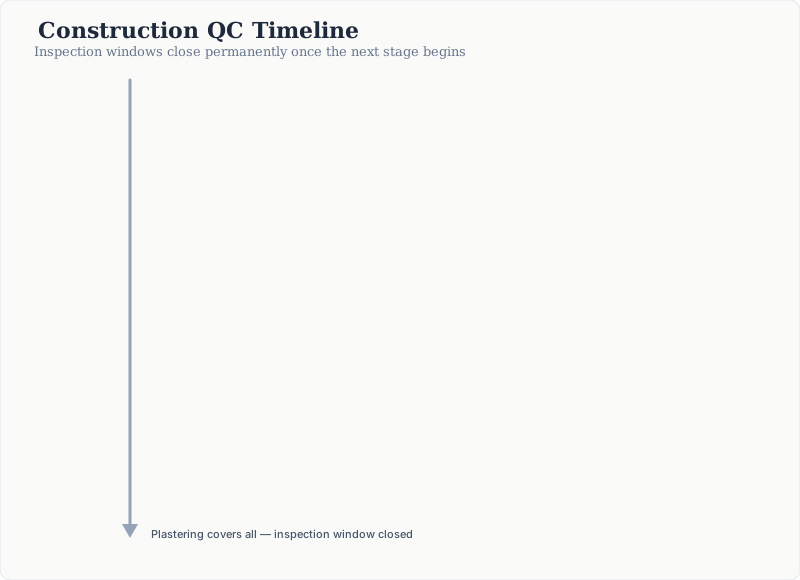
The QC timeline: your inspection window closes permanently at each stage. Once concrete is cast over reinforcement or plaster covers masonry, that stage is no longer accessible without destructive testing.
3. Stage-by-Stage QC — What to Check and When
Stage A: Soil and Foundation
Foundation failures are the most expensive to fix and the most preventable. The foundation problems homeowners face in India almost always originate here — in decisions made before a single column is poured.
| What to check | Good sign | Red flag | IS reference |
|---|---|---|---|
| Soil investigation report (SBC) | SBC report from a geotechnical agency, depth and bearing capacity noted | "We always build here, the soil is fine" | IS 1904:1986 |
| Foundation depth | Reaches the depth specified in the structural drawing | Stopped early because "hard strata felt" | IS 1904, structural drawing |
| Anti-termite treatment | Chemical injection in soil before PCC layer | Skipped, "will do later" | NBC 2016 Part 4 |
| PCC (Plain Cement Concrete) layer | 75–100 mm blinding PCC under footings | Missing or just compacted soil | IS 456 Cl. 26.4.2 |
| Footing reinforcement | Bars, dia and spacing match structural drawing | Bars missing, spacing too wide | IS 456 |
| Cover at footing bottom | Minimum 75 mm cover from steel to soil face | No cover blocks or blocks made from ordinary soil | IS 456 Table 16 |
| Black cotton soil or expansive soil | Lime-stabilised or engineered fill | Ordinary filling without treatment | IS 1498:1970 |
The homeowner check: Visit the site before concrete is poured into any footing. Count the rebar bars in the footing trench — match them to the structural drawing. Check that concrete cover blocks (small precast cubes, typically 75 mm) are tied to the bottom steel. Confirm the PCC layer is in place. Take a photograph.
Stage B: Reinforcement (Columns, Beams, Slabs)
Reinforcement is the skeleton of your structure. Errors here are completely invisible after casting and can have catastrophic consequences in an earthquake. The earthquake zone design guide explains why stirrup spacing at column-beam joints is especially critical.
| What to check | Good sign | Red flag | IS reference |
|---|---|---|---|
| Rebar grade marking | Fe500 (or Fe500D) marked on bar with "D" or confirmed from mill certificate | Fe415 specified but unlabelled bars used | IS 1786:2008 |
| Bar diameter | Diameter matches drawing — measure with a vernier or ruler | "Roughly 12 mm" without confirming | IS 1786, structural drawing |
| Number of bars in each element | Count matches structural drawing | "One or two bars less doesn't matter" | Structural drawing |
| Bar spacing in slabs | As specified — typically 100–200 mm c/c | Wider spacing to save steel | IS 456 Cl. 26.3 |
| Cover blocks (side and bottom) | Precast cement cover blocks, tied to rebar, correct thickness | No blocks, or tiles/stones used as spacers | IS 456 Cl. 26.4 |
| Minimum cover to main steel | Column main bars: 40 mm; Beam: 25–40 mm; Slab: 20–25 mm; Foundation: 75 mm | Less than specified — rebar too close to formwork | IS 456 Table 16 |
| Lap length | Minimum 40d (40 × bar diameter) for column laps | Short laps — bars barely overlap | IS 456 Cl. 26.2.5 |
| Stirrup / link spacing at joints | Closely spaced (100 mm) near column-beam junctions per IS 13920 | Wide stirrup spacing throughout — "same as mid-span" | IS 13920:2016 |
| Anchorage of beam bars into column | Bars bent and anchored as per drawing | Bar simply stops at column face | IS 456 Cl. 26.2.3 |
| Rust on bars | Light surface rust — acceptable; wipe-off test passes | Heavy flaking rust, section reduced | IS 1786 |
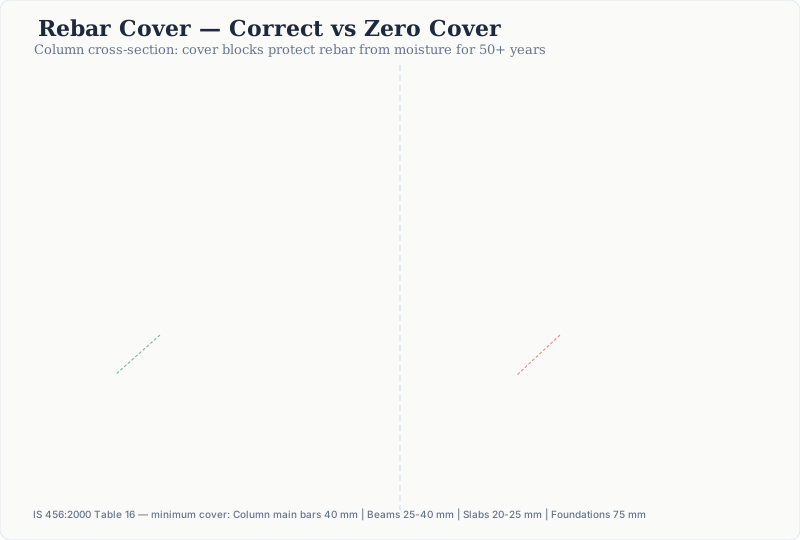
Rebar cover — the difference between a 50-year column and a 15-year one. Cover blocks cost almost nothing; the corrosion they prevent costs everything.
"The cover to reinforcement is the concrete's first and only line of defence against the environment. Compromising it is not a minor oversight — it is a time-delayed structural defect."
— Field principle, IS 456:2000 Clause 26.4 commentary
The homeowner check: Before any concrete is poured, look at the formwork assembly. Can you see concrete cover blocks tied to the bars? Are bars floating free close to the timber shuttering? Push a finger toward the side of the column cage — the nearest bar should be well beyond arm's reach from the form face. Photograph from multiple angles. Ask for and keep a copy of the mill test certificate for the reinforcement.
Stage C: Concrete — Mix, Pour, and Vibration
This is where most quality failures happen and where the homeowner's presence makes the most difference.
| What to check | Good sign | Red flag | IS reference |
|---|---|---|---|
| Specified concrete grade | M20 minimum for residential RCC; M25 for heavier spans or ground floors | M15 or "1:2:4 site mix" for RCC columns | IS 456 Table 5 |
| Ready-mix vs site mix | RMC (Ready Mix Concrete) with mix design, delivery challan, slump data | Ingredients measured in head-load buckets | IS 456 Cl. 9 |
| Slump test at pour | 50–100 mm for columns/beams; challan records it | No slump test, "we know by look" | IS 1199:1959 |
| Water added at site | No water added after the truck arrives | Drum truck accepting water poured in at site | IS 456 Cl. 10.3 |
| Cube samples taken | 3 cubes per batch, site-cured and sent for 28-day test | No cube samples, "we trust the supplier" | IS 516:1959 |
| Vibration (needle vibrator) | Vibrator working in every pour zone, withdrawn slowly | No vibrator, "compacted by tamping rod only" | IS 456 Cl. 13.3 |
| Over-vibration | Vibrator moved regularly — not left in one place | Vibrator stationary for long periods (segregation) | IS 456 Cl. 13.3 |
| Pour continuity | Column/beam/slab poured in one continuous session | Stopped mid-pour and resumed next day without cold joint treatment | IS 456 Cl. 13.2 |
| Honeycombing after deshuttering | Smooth, even surface; no voids visible | Pockets of aggregate with no paste around them | IS 456 Cl. 13.5 |
| Deshuttering time | Sides of columns: 24–48 hrs; soffits of slabs: 14–21 days (varies by span) | "We pull the shutters off after 3 days because we need them elsewhere" | IS 456 Table 11 |
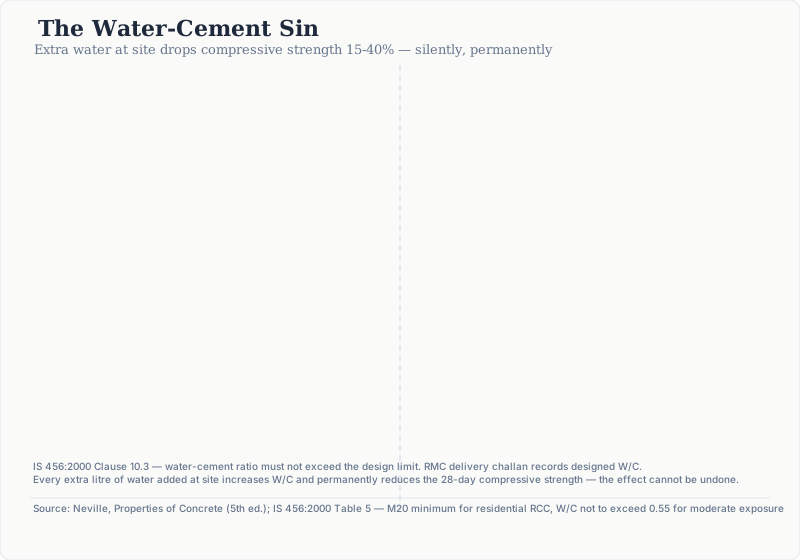
Adding water to concrete is the single most common quality sin on Indian sites. It makes the mix easier to work with. It also cuts structural strength by 15 to 40 percent — silently, invisibly, permanently.
"Water is concrete's worst enemy after it has done its hydrating job. Every extra litre that goes in is a vote for a weaker structure."
— Common site maxim, rooted in IS 456:2000 Clause 10.3 (water-cement ratio limits)
The homeowner check: Be present for concrete pours. Watch the RMC truck arrival — note the time and do not allow water to be added. If site mixing is used, watch the proportioning — it should be by weight or at minimum by calibrated volume, not by "the way we always do it." After deshuttering (form removal), inspect every column and beam surface carefully for honeycombing. Small voids can sometimes be repaired; large or deep honeycombing is a structural defect requiring an engineer's assessment.
Stage D: Curing — the Most Skipped Free Quality Step
Cement gains strength through a chemical reaction called hydration. This reaction needs water and time. Stop the water too early and you permanently lose strength that can never be recovered — the chemistry simply stops.
IS 456 requires a minimum curing period of 7 days for ordinary Portland cement and 14 days for blended cements (PPC, PSC) or for all structural elements exposed to aggressive environments. In practice, research cited by the Gambhir Concrete Technology textbook shows that concrete cured for 28 days achieves roughly double the durability of concrete cured for only 3 days.
| Curing method | How it works | Minimum duration | Practical note |
|---|---|---|---|
| Wet hessian / gunny bags | Kept continuously wet on column/beam surfaces | 14 days | Commonest, most practical — needs daily wetting |
| Ponding (slabs) | Water retained on slab surface by temporary earthen bunds | 14 days | Most effective for slabs; ensures entire surface is wet |
| Curing compound | Sprayed membrane that retards evaporation | Manufacturer-specified | Good for large pours; verify it is a genuine curing compound, not white paint |
| Water spray | Periodic misting | Minimum 14 days; spray multiple times/day | Insufficient unless almost continuous in hot/windy weather |
The homeowner check: Walk the site every 2–3 days during the curing period. If beams are dry and pale-coloured three days after deshuttering, curing has already been stopped — confront this immediately. Hessian should feel damp to the touch at mid-afternoon. Ponded slabs should have visible standing water. This costs nothing extra — it just requires that someone remembers to wet the concrete every morning.
Stage E: Masonry (Brick and Block Work)
Masonry is not structural in an RCC frame building, but poor masonry still creates problems: heavy cracking at interfaces, water penetration, sound transmission, and occasionally local wall failures.
| What to check | Good sign | Red flag |
|---|---|---|
| Block / brick quality | ISI-marked blocks; sounding test gives clear ring | Hollow sound, visible cracks in blocks |
| Wetting before use | Clay bricks soaked 12 hours; AAC blocks lightly dampened | Dry bricks placed directly — they suck water from mortar |
| Mortar mix | 1 cement : 6 sand for internal; 1:4 for external/wet | "Whatever proportion the mason likes" |
| Joint thickness | 10–12 mm horizontal, 10 mm vertical | Over-thick joints (>15 mm) or thin joints (<8 mm) |
| Lintel at openings | RCC lintel over every door and window opening | Brick arching or no lintel at all |
| Plinth protection (apron) | 450–600 mm concrete apron sloping away from plinth | No apron — rain and plant growth against plinth |
| Seismic bands | Horizontal RCC bands (plinth, sill, lintel, roof) as per IS 4326 in load-bearing walls | Missing bands in unreinforced masonry construction |
Stage F: Waterproofing
Waterproofing failures are the most common homeowner complaint in India after construction. The waterproofing failures explained guide covers the full diagnosis — here, the QC check during construction is the focus.
| Location | QC check | Test to insist on |
|---|---|---|
| Terrace / roof slab | Waterproofing applied before brick bat coba or screed; slope minimum 1:100 toward drain | Flood test: pond 25 mm water for 24 hours, check ceiling below |
| Toilet / wet area floors | Screed with waterproofing compound; upturn 150 mm at walls | Flood test 24 hours before tiling |
| Basement / below-grade | External membrane or tanking; drainage layer if required | Visual inspection before backfilling |
| Expansion and construction joints | Sealant applied; no gap left open | Visual check before finishing |
| Parapet-terrace junction | Fillet cove at junction; membrane running up parapet | No sharp 90-degree angle where water accumulates |
The homeowner check: Insist that flood tests are done and that you witness them. No plaster or tiling should proceed over any waterproofed surface until the flood test is cleared. Record the result with a photograph showing the timer and the ceiling below.
Stage G: Plumbing and Electrical Before Concealment
Once conduits are buried in walls and pipes are plastered over, every fault requires destructive chasing to find and fix. The correct time to verify:
- Pressure test on plumbing: water pressure maintained at 1.5× working pressure for 30 minutes before walls are plastered.
- Electrical conduits: ensure conduits are correctly run, supported, and junction boxes are in place before plastering. Check that conduit sizes match the number of cables intended.
- Drainage falls: all drainage pipes must slope toward the outfall — check with a spirit level.
- Rodding points: cleanout access provided at every bend and at floor trap positions.
4. The Cardinal Sins of Indian Site Quality
These are the most common quality shortcuts on Indian construction sites. Each seems minor in the moment. Each has a predictable, documented consequence.
| The sin | What it looks like on site | The consequence | How long before it shows |
|---|---|---|---|
| Extra water in concrete | "The mix is too stiff — add a bucket" | Strength drops 20–40%; durability halved | 5–20 years: cracks, spalling |
| Short or zero curing | Hessian removed after 3–4 days | 28-day strength never achieved | 10–30 years: early deterioration |
| Insufficient cover to rebar | Bars touching or close to formwork | Corrosion, concrete spalling, visible rust staining | 8–15 years in coastal/humid areas |
| Honeycombing ignored | Voids patched with mortar and painted | Internal weakness, water ingress path, corrosion | 5–15 years |
| Cube tests skipped or faked | No samples taken; results copied from another batch | No verification that specified grade was achieved | Failure mode unknown until stress event |
| Wrong or lighter rebar | Fe415 used where Fe500D specified; smaller diameter | Reduced load capacity; seismic ductility compromised | Earthquake event; early cracking |
| Short lap lengths | Bars barely overlapping | Load transfer fails; longitudinal cracking | Overload or seismic event |
| Skipping the structural engineer | "Small house, we know what to do" | Unsafe design, no drawings to build from | Unpredictable; often discovered only at failure |
| No soil testing | "This land is solid" | Foundation inadequate for actual SBC; settlement | 2–10 years: differential settlement, cracks |
| No slope in wet areas | "Will fix in tiling" | Chronic water ponding; waterproofing failure | First monsoon |
5. The Homeowner's 7 Site Checks — No Expertise Needed
These are the things you can observe on any site visit, with no engineering degree, that will catch the most significant quality problems.

Seven checks any homeowner can do, no degree required. Together they catch the vast majority of the most consequential construction quality failures.
| # | What to do | When | What you are checking |
|---|---|---|---|
| 1 | Count bars in columns and beams against structural drawing | Before every pour | Correct reinforcement quantity |
| 2 | Confirm cover blocks are in place and tied | Before every pour | Adequate cover to rebar |
| 3 | Watch the concrete pour — no water addition | At each pour | Water-cement ratio integrity |
| 4 | Touch hessian/check ponding at mid-afternoon | Every 2–3 days for 14 days after pour | Curing is actually happening |
| 5 | Inspect all surfaces after deshuttering | Immediately on form removal | Honeycombing, cold joints |
| 6 | Ask for cube test reports — keep copies | 28 days after each pour | Concrete achieved specified grade |
| 7 | Inspect rebar before use — reject heavy rust | Before steel fixing | Rebar section not compromised |
"A homeowner who walks the site twice a week and asks one good question each time will prevent more quality failures than a quality inspector who visits once a month and says nothing."
— Field wisdom from Indian construction practice
6. Tests Worth Insisting On — and What They Cost
Many homeowners assume that testing is expensive, inconvenient, or something only for large projects. The costs are very modest relative to the value at stake.
| Test | What it verifies | IS reference | Approximate ₹ cost (2026) | When to insist |
|---|---|---|---|---|
| Concrete cube compressive test (28-day) | Concrete achieved the specified grade | IS 516:1959 | ₹300–₹600 per set of 3 cubes | Every major pour — columns, beams, slab |
| Slump test | Workability/water-cement ratio is in range at time of pour | IS 1199:1959 | ₹200–₹400 (or done on site at no charge with RMC) | Every RMC delivery |
| Rebar mill test certificate | Steel grade, yield strength, elongation | IS 1786:2008 | Typically free from supplier; ask before purchase | Before reinforcement steel is ordered |
| Soil test / bore log (SBC) | Bearing capacity, type and depth of competent strata | IS 1904, IS 2131 | ₹5,000–₹15,000 for a residential plot | Before foundation design |
| Silt content test (sand) | Sand is within acceptable silt limits for concrete | IS 2386 Part 2 | ₹500–₹1,000 | Before concrete sand is purchased |
| Rebound hammer test (NDT) | Surface hardness of in-situ concrete; indicative of grade | IS 13311 Part 2:1992 | ₹3,000–₹8,000 per visit | Post-construction verification; buying an existing house |
| Ultrasonic pulse velocity (UPV) | Internal concrete quality, detect voids and cracks | IS 13311 Part 1:1992 | ₹5,000–₹15,000 per visit | Suspected honeycombing or existing structure assessment |
| Water pressure test (plumbing) | Pipe joints hold at 1.5× working pressure | NBC 2016 Part 9 | Cost of plumber's time — no separate fee | Before plastering over any plumbing |
| Flood test (waterproofing) | Waterproofing membrane is continuous, no leaks | NBC 2016 Part 9 | Cost of time and water — no separate fee | Before tiling over any waterproofed surface |
These tests together — for a typical 1,500 sq ft G+1 house — cost in the range of ₹25,000–₹50,000. That is less than one percent of the construction cost, and it is the most leveraged spend available to a homeowner.
7. Materials QC — the BIS Marks and Quick Checks
Materials quality is the foundation of workmanship quality. Even the best-trained mason cannot produce durable concrete from bad sand.
| Material | BIS / IS mark to look for | Simple site check | Red flag |
|---|---|---|---|
| Cement | ISI Mark, BIS licence number on bag; date of manufacture | Bag feels fresh, no lumps — squeeze test | Bags older than 3 months from manufacture; grey powder clumping |
| Reinforcement steel | ISI Mark, Fe500/Fe500D stamped or rolled into bar | Mill test certificate matches delivery | No markings; certificate unavailable or photocopy only |
| Coarse aggregate (stone chips) | Conform to IS 383 — check from an approved quarry | Clean, angular, no clay coating; sieve analysis | Dusty, flat/elongated flaky pieces, clay-coated |
| Fine aggregate (sand) | IS 383; silt content less than 8% for concrete | Rub in hand — should not leave mud; glass jar silt test | High silt, sea-sand smell (chlorides), dark colour |
| AAC blocks | IS 2185 Part 3; ISI mark | Sharp edges, consistent size, low weight | Crumbles at corner, uneven sizes, no markings |
| Clay bricks | IS 1077; ISI mark or field test | Water absorption test, compressive strength spot check | Hollow ring sound, high absorption, visible cracks |
| Water for mixing | Potable or test per IS 456 Cl. 5.4 | No colour, no odour; sea water strictly prohibited | Salty taste, turbid, stagnant source |
| Waterproofing membrane | Product data sheet; manufacturer's application guide | Applied in specified coats; coverage rate checked | Thin single coat, wrong product, diluted material |
For the science behind why material quality translates directly to durability, the science behind durable buildings guide goes deeper into the chemistry and microstructure.
8. Documentation — Your Paper Trail of Quality
Quality on a site without documentation is just a memory. Six months later, when a crack appears, no one will remember what grade of concrete went into that column or whether it was cured for seven days or fourteen.
The drawings to build from: Your structural engineer should provide a set of drawing-for-construction (as opposed to drawing-for-approval). These are the construction drawings that carry rebar schedules, concrete grades, footing depths and all the information that your QC checks reference. Never allow construction to proceed from sketch drawings or "verbal specifications."
The quality log every homeowner should keep:
A simple notebook or smartphone folder with photographs and notes, tagged by date and stage, is enormously valuable. Record: date of pour, concrete grade specified, RMC supplier's challan number, whether cubes were taken, whether water was added, deshuttering date, curing observation dates, and cube test results when received. Photograph every rebar assembly before concrete is poured. Photograph every surface after deshuttering.
Structural stability certificate: In most states under RERA, the developer or owner-builder is required to provide a structural stability certificate from a licensed structural engineer at completion. Demand this. Keep it.
Engineer site visits: At minimum, insist on your structural engineer being present — or sending a site supervisor — at: foundation rebar check, footing pour, column/beam rebar check, slab pour. These are the four most critical inspection windows and they cannot be recovered once missed.
"An engineer who inspects at the right moment prevents the problem. An engineer called to investigate after the problem is usually delivering bad news."
— Site principle often attributed to Laurie Baker in his writings on construction quality for ordinary buildings
9. Building Through a Contractor and Buying Completed Homes
If You Are Building Through a Contractor
Write quality into the contract. Specify:
- Concrete grade (M20 minimum, M25 for specified elements) and mandatory cube testing with results submission.
- Reinforcement grade (Fe500/Fe500D) with mill certificates.
- Mandatory structural engineer site visits at defined milestones (foundation, rebar, slab).
- Retention clause: 5–10% of contract value retained for 12 months after completion as defect liability.
- No water to be added to RMC concrete on site — clause in writing.
- Flood test clearance required before tiling over waterproofing.
| Milestone | What to inspect and document before releasing payment |
|---|---|
| Foundation complete | Depth, PCC layer, footing rebar, cover blocks, anti-termite |
| Superstructure rebar fixed | All columns and beams: rebar count, grade, cover blocks, stirrup spacing |
| Concrete poured (all levels) | Cube test reports (28-day) submitted; honeycombing inspection post-deshuttering |
| Curing period closed | 14-day curing observation records |
| Masonry complete | Lintel at openings, plinth protection, mortar quality |
| Waterproofing complete | Flood test results; slopes verified |
| Services concealed | Pressure test; conduit runs verified |
| Possession | Structural stability certificate; completion certificate; as-built drawings |
If You Are Buying a Completed Home
The inspection window for in-progress construction QC is closed. What you can still do:
- Ask for the structural stability certificate from a licensed structural engineer.
- Ask for completion certificate from the local authority.
- Commission an independent third-party snagging inspection — a qualified engineer spends 3–4 hours on site, checks for surface distress, structural concerns, service defects.
- If buying an older property, consider a rebound hammer or UPV test on critical columns and beams — non-destructive and relatively inexpensive.
- Check for signs of the cardinal sins: map cracks at column-beam junctions, rust staining on concrete surfaces, ceiling stains indicating waterproofing failure.
The what makes buildings crack guide explains how to interpret the crack patterns you might find in a completed building, and whether they are cosmetic or structural.
10. How Stage QC Prevents the Failures Described in Companion Guides
Every guide in this structural safety series describes a failure mode. Stage QC during construction is the intervention that prevents them.
| Failure mode | Root cause in construction | QC stage that prevents it |
|---|---|---|
| Foundation settlement and cracking | Inadequate soil test; wrong footing depth or size | Stage A — soil test, footing inspection |
| Beam/column cracks at joints | Short stirrup spacing; inadequate rebar anchorage | Stage B — reinforcement inspection |
| Concrete spalling and rust staining | Insufficient cover to rebar | Stage B — cover block verification |
| Structural weakness under load | Water added to concrete; wrong grade | Stage C — concrete pour monitoring |
| Early concrete deterioration | Curing stopped too soon | Stage D — curing observation |
| Roof and bathroom leaks | Waterproofing not flood-tested; no slope | Stage F — waterproofing inspection |
| Seismic vulnerability | Wrong rebar grade; missing confinement | Stage B — stirrup and grade check |
Quality control during construction is not a separate discipline from structural safety — it IS structural safety, applied at the moment it is still possible to act. The science behind durable buildings shows what happens at the material level when these stages are executed correctly.
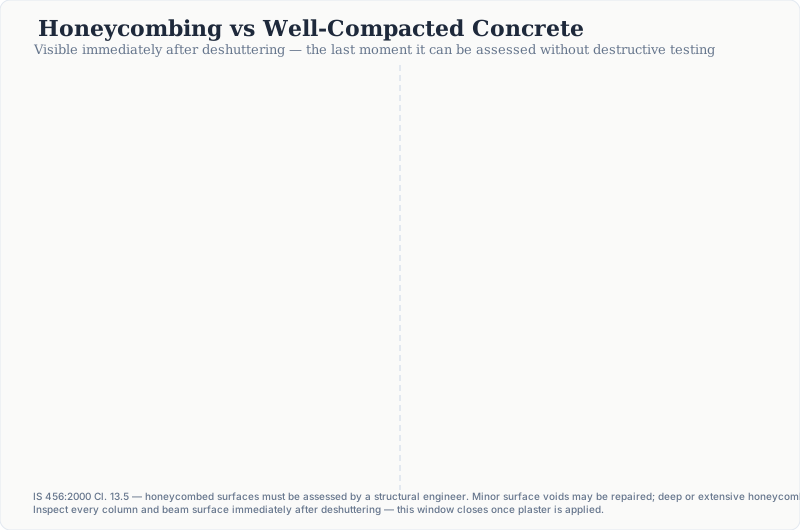
Honeycombing — visible immediately after deshuttering, and the last moment it can be addressed without major remediation. Cause: insufficient vibration, or concrete too stiff and then diluted with water rather than properly vibrated.
11. The Payoff — Why This Is Worth Your Time
A homeowner who spends 20–30 site-hours on quality observation across the construction period — that is roughly one to two hours per week across the active construction months — is doing more to protect their investment than almost any other action they could take.
The Indian construction market has no shortage of skilled and conscientious contractors. But every site, on every day, has dozens of small decisions that go slightly right or slightly wrong, and the site is watched most carefully when someone who cares about the outcome is present. Your presence, your photographs, your questions, and your willingness to hold payment against milestone inspections changes contractor behaviour more reliably than any contract clause.
Quality in construction is not a luxury. In a country where Bhuj (2001) and subsequent seismic surveys have shown that the vast majority of residential casualties in earthquakes occur in poorly constructed buildings, quality control during construction is a safety issue for you and for your family. It is also a financial issue: the cost of remediation for defects found after completion is typically 3–8× the cost of preventing them.
Start with the seven checks in Section 5. Take photographs. Ask for the cube test reports. Insist on flood tests. Question the curing. These are not technical interventions — they are the questions that any alert homeowner can raise, and they make an enormous difference.
"What is done cannot be undone; what is not done while it can be done is the real loss. In construction, the real loss always happens in those three to six months when everything is still accessible."
— Principle attributed to field practice in post-earthquake damage assessments, including those following Bhuj 2001 (IS 16700, NBC 2016 revision commentary)
When planning the structural approach for your home — how loads flow, what kind of structure you are building, and what your engineer is designing against — Studio Matrx DesignAI can help you frame the right questions before you reach the site.
Author's Note
My father talked me through construction sites when I was a child, pointing out rebar before pours, watching curing, questioning contractors. I did not understand the engineering then. What I understood was that someone who cared was paying attention — and that this mattered. Most of the catastrophic failures I have studied — the columns that folded in earthquakes, the slabs that punched through, the facades that came down — were not the result of wrong design. They were the result of correct design that was not built correctly, and no one noticed in time.
This guide is an attempt to give homeowners the specific, actionable attention that turns a design intention into a built reality. You do not need a degree to count rebar bars or feel wet hessian. You just need to show up and know what to look for.
Disclaimer
This guide is educational material intended to help homeowners understand construction quality principles. It does not constitute a site inspection, structural engineering assessment, or professional advice. Every building project has specific site conditions, structural design requirements, and material characteristics that must be evaluated by a qualified and licensed structural engineer. Engage a licensed structural engineer for all structural design, specification, and site inspection for your project.
References
1. Bureau of Indian Standards. IS 456:2000 — Plain and Reinforced Concrete — Code of Practice (Fourth Revision). New Delhi: BIS, 2000.
2. Bureau of Indian Standards. IS 516:1959 — Method of Tests for Strength of Concrete. New Delhi: BIS, 1959 (reaffirmed 2018).
3. Bureau of Indian Standards. IS 1199:1959 — Methods of Sampling and Analysis of Concrete. New Delhi: BIS, 1959.
4. Bureau of Indian Standards. IS 1786:2008 — High Strength Deformed Steel Bars and Wires for Concrete Reinforcement — Specification (Fourth Revision). New Delhi: BIS, 2008.
5. Bureau of Indian Standards. IS 13920:2016 — Ductile Design and Detailing of Reinforced Concrete Structures Subjected to Seismic Forces — Code of Practice. New Delhi: BIS, 2016.
6. Bureau of Indian Standards. IS 2386 (Parts 1–8):1963 — Methods of Test for Aggregates for Concrete. New Delhi: BIS, 1963.
7. Bureau of Indian Standards. IS 1904:1986 — Design and Construction of Foundations in Soils: General Requirements (Third Revision). New Delhi: BIS, 1986.
8. Bureau of Indian Standards. IS 383:2016 — Coarse and Fine Aggregate for Concrete — Specification (Third Revision). New Delhi: BIS, 2016.
9. Bureau of Indian Standards. IS 13311 (Parts 1 and 2):1992 — Non-Destructive Testing of Concrete — Ultrasonic Pulse Velocity and Rebound Hammer Methods. New Delhi: BIS, 1992.
10. Bureau of Indian Standards. IS 4326:2013 — Earthquake Resistant Design and Construction of Buildings — Code of Practice. New Delhi: BIS, 2013.
11. Ministry of Housing and Urban Affairs. National Building Code of India 2016, Volume 1 and 2. New Delhi: BIS, 2016.
12. Gambhir, M.L. Concrete Technology: Theory and Practice (5th edition). New Delhi: Tata McGraw-Hill, 2013.
13. Pillai, S. Unnikrishna and Devdas Menon. Reinforced Concrete Design (3rd edition). New Delhi: Tata McGraw-Hill, 2009.
14. Neville, A.M. Properties of Concrete (5th edition). London: Pearson, 2011. (Authoritative reference on water-cement ratio and strength relationships.)
15. Levy, Matthys and Mario Salvadori. Why Buildings Fall Down: How Structures Fail. New York: W.W. Norton, 1992.
16. Salvadori, Mario. Why Buildings Stand Up: The Strength of Architecture. New York: W.W. Norton, 1980.
17. Indian Building Congress / Indian Concrete Institute. Guidelines on Quality Assurance During Construction of Buildings. Reference documents issued post-Bhuj 2001 reconstruction programme.
Export this guide
Related Guides — Deep-dive reading
Bathroom Waterproofing Failure in India: Causes, Diagnosis & Fixes (2026)
Why bathroom waterproofing fails in Indian homes — poor surface prep, thin coats, missed junctions, no membrane turn-up, damage during tiling — how to read the symptoms, and whether a surface fix or a full redo is the right remedy.
BathroomsWaterproofing Failures Explained: Why Systems Fail and How to Spot It
Why waterproofing so often leaks again within a year or two — the weak links in the system, the junctions that really fail, the flood test everyone skips, and how to tell a real repair from a cosmetic patch.
Structural SafetyCompound Wall Piers and Columns in India: Spacing, Reinforcement and Stability (2026)
Why a long, free-standing boundary wall needs intermediate piers or RCC columns to stay up — the physics of overturning in plain terms, thickened masonry piers vs reinforced-concrete columns on footings, indicative spacing that an engineer sets to your height and wind zone, the coping or tie beam that braces the top, and where to break a long run with movement joints.
Compound WallsRelated Tools — Try Free
Plumbing Pressure-Test & Leak Checklist
Pre-closure pressure and leak test — 9 categories, 60+ checkpoints across water supply, drainage, fixtures, waterproofing, hot water, tanks.
Pre-Closure TestMonsoon-Readiness Checklist
Pre-rain home audit across 9 categories — terrace, drains, waterproofing, electrical, HVAC, pest, vehicles, documents.
Seasonal AuditMaterial Schedule Generator
Generate a room-wise finish schedule — walls, floors, ceilings, trim, and joinery by location.
Material Schedule