
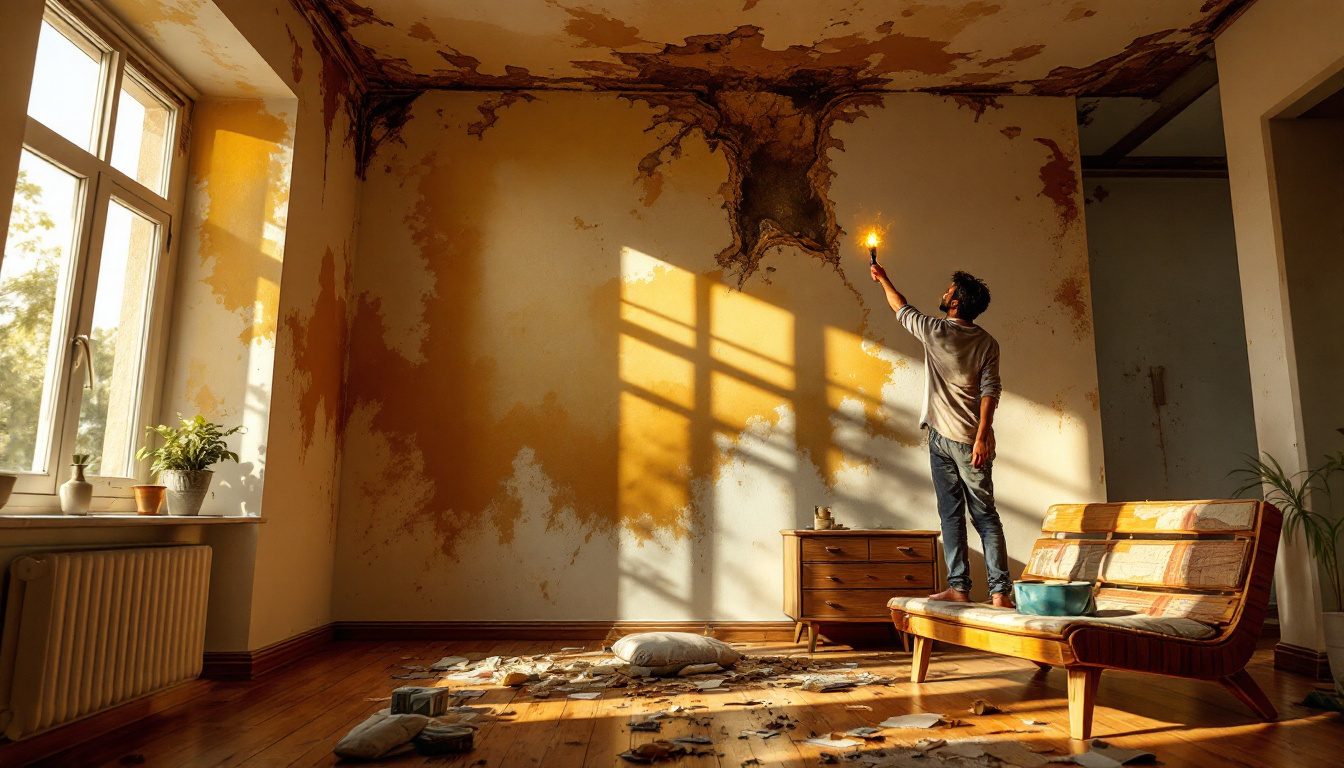
Why Buildings Leak: Tracing the Paths Water Takes Into Your Home
The four sources of water in a building — rain, plumbing, ground and condensation — why the stain is never where the leak is, and the homeowner's method for tracing a leak to its true source before spending a rupee.
The monsoon had been over for three weeks, but the brown stain on Meenakshi's bedroom ceiling kept growing. Her builder had already sent a waterproofing contractor up to the terrace twice. New membrane, fresh screed, the works. The leak continued. Her plumber found nothing. A painter suggested "just seal it with Dr. Fixit and paint over it." Six months and ₹40,000 later, the stain was bigger than ever. When a friend finally called in a structural consultant, the answer was humbling in its simplicity: water was entering through a failed sealant joint around her air conditioner sleeve — two floors above and three rooms away. The terrace was perfectly fine.
This story plays out in thousands of Indian homes every year. We blame the terrace because that is where the water pours in during the monsoon. We blame the wall because that is where the stain appears. And we spend money fixing the wrong thing, over and over, because we never traced the water back to where it actually entered.
Water enters a building through any unsealed, unsloped, cracked or pressure-driven path in the envelope or system — and it then travels along slabs, beams, conduits and rebar for metres before showing itself as a stain, a blister or a puddle far from the true entry point.
This guide is about the detective work. For a deep technical treatment of why waterproofing systems themselves fail, see the companion waterproofing failures explained. For step-by-step repair methods, see the Waterproofing Guide. What this guide gives you is the framework for finding the real source — before any money is spent.
1. The Master Frame: Four Sources of Water in a Building
Before you can trace a leak, you need to understand that buildings face water from four completely different origins. Each has its own logic, its own timing and its own fix. Confusing them is the root cause of most failed repairs.

Fig. 1 — The four water sources acting on a typical Indian home simultaneously. The entry point and the symptom are often in different rooms.
Source 1 — Rain (the Envelope): Wind-driven rain, monsoon ponding on flat terraces, and water running down external walls. This is the most visible and most commonly assumed source.
Source 2 — Plumbing: Supply lines under pressure, gravity drainage, bathroom sunken slabs, overhead tanks overflowing, geyser discharge, AC condensate lines.
Source 3 — Ground and Rising Damp: Capillary rise through masonry where there is no damp-proof course (DPC), hydrostatic pressure against basements and plinths, garden planters built against walls.
Source 4 — Condensation: Humid air depositing moisture on cool surfaces — the inside face of north walls, rooms with heavy AC use, poorly ventilated bathrooms. This is often completely misdiagnosed as a structural leak.
2. Rain and the Building Envelope
Rain is the most powerful driver of water entry in India, but it uses many more pathways than just a failed terrace membrane.
Terraces and Roofs
Indian residential buildings overwhelmingly have flat RCC terraces. When the waterproofing system on a terrace fails — whether the membrane, the screed slope, the parapet junction or the drain detailing — rainwater ponds and eventually finds a path. But terrace failure is only one of several rain entry routes.
Parapet and Terrace Junctions
The junction where a parapet wall meets the terrace slab is among the most leak-prone details in Indian construction. The two elements undergo different thermal movement, and a hairline crack opens at the junction over a few monsoon cycles. Water sits in this crack during rain and wicks into the slab.
External Walls: Porous Plaster and Cracks
A solid-looking plastered wall is not waterproof. Standard cement-sand plaster has a porosity that allows wind-driven rain to soak in. During heavy monsoon spells with sustained wind, the outer surface of a west- or south-facing wall can become fully saturated. The damp then appears on the inside face 12–24 hours later — often interpreted as a "water pipe" leak. Cracks in plaster, even hairline cracks 0.1–0.2 mm wide, dramatically accelerate this ingress; IS 456 : 2000 limits surface crack widths for durability reasons, and the same reasoning applies to water entry.
Windows and Sills: The Most Underestimated Entry Point
In practice, windows and their sill detailing account for a very large share of "wall leak" complaints. Two failure modes dominate:
- Flat or inward-sloping sills: Many Indian window sills are cast nearly flat or even slope slightly inward. Rainwater ponds on the sill and is pushed by wind into the gap between the frame and the masonry opening. IS 3414 : 1968 (Design of Window Sills) requires a minimum slope of 1:20 outward and a drip groove on the underside. These are routinely omitted on site.
- Sealant failure at the frame: Silicone or cement mortar used to seal the gap between a window or door frame and the surrounding masonry degrades in 3–7 years outdoors. A 2 mm gap here is an efficient collector of wind-driven rain.
Chajja and Sunshade Junctions
Where a chajja (sunshade slab) is cast monolithic with the external wall, its top surface must slope outward. If it is flat, rainwater ponds at the wall junction and seeps into the junction crack that thermal cycling opens over time.
Expansion Joints and Movement Gaps
Buildings over approximately 45 m in length (per NBC 2016 Part 6) must have expansion joints. These joints must be sealed with a compressible backer and a flexible sealant. On site, these are often poorly executed or simply left open, becoming direct channels for rainwater.
3. Plumbing: The Hidden Source Most Often Missed
When a stain appears on a ceiling directly below a bathroom, most people assume rain. But if the stain appears on a dry day, or gets worse after a shower is used, the source is almost certainly plumbing.
Concealed Supply Pipes Under Pressure
Modern Indian homes increasingly use concealed CPVC or copper supply lines chased into walls or slabs. A pinhole leak in a joint, or a slow failure at a threading junction, can release water under supply pressure (typically 1–3 bar). Because the pipe is concealed, this water follows the cavity, reaches a cold joint in the slab and emerges as a ceiling stain in the room below — which may be in a completely different part of the plan.
Sunken-Slab Bathroom Floors
Indian bathrooms are typically built with a 150–200 mm sunken RCC slab filled with loose material over which the drainage pipes are laid. Over time, water from imperfect drain seals, grout failure in floor tiles or a cracked sunken slab accumulates in this fill material and slowly seeps through the slab below. The resulting stain in the ceiling of the room below is indistinguishable by eye from a rain entry — until you check the timing.
Overhead Tanks and Pipe Overflows
Most Indian homes have gravity-feed overhead RCC or plastic tanks on the terrace. A stuck float valve, a crack in an RCC tank or an overflowing inlet pipe saturates the terrace near the tank. The stain this creates inside the building looks exactly like a terrace membrane failure.
AC Condensate and Geyser Discharge
A split-AC unit produces 0.5–2.0 litres of condensate per hour in humid Indian conditions. The condensate drain line, if improperly sloped or blocked, can back up and drip inside the wall chase or drip onto the slab. This produces a localised damp patch that appears and disappears with AC use — a useful diagnostic clue.
4. Ground and Rising Damp: The Slow, Persistent Enemy
Water from below is different from water from above in one important way: it is relentless and continuous. It does not wait for rain.
Capillary Rise and the Missing DPC
Masonry has microscopic pores. By capillary action, ground moisture is drawn upward through brick or block walls continuously. In most Indian construction, IS 3067 : 1988 (Code of Practice for Damp-Proof Course) requires a horizontal DPC — typically two courses of DPC bricks or a membrane layer — at or just above plinth level. Where this is absent, poorly executed or subsequently bridged by soil built up against the wall, rising damp climbs steadily.
Rising damp produces a very characteristic pattern: a tide-mark at a fairly uniform height (typically 0.5–1.5 m above the floor), with a crisp upper boundary that fluctuates seasonally. Salts from the soil crystallise at this tide-mark and produce a white efflorescence. The wall below is often permanently damp to the touch.
Hydrostatic Pressure in Basements and Plinths
When a basement or a sunken portion of a building sits below the local water table, water pressure acts directly on the external face of the foundation walls and slab. Without a tanking system (a continuous external waterproof barrier), water forces its way through cracks, cold joints and porous concrete — entering at the floor-wall junction and through the slab itself. This is a foundation problems issue as much as a waterproofing one, and the two disciplines must be addressed together.
Garden Planters Against External Walls
A very common Indian cause of "mysterious" first-floor and ground-floor wall damp: a raised garden planter or a flower bed built directly against the external face of a wall. The soil in the planter sits above the DPC level and continuously feeds moisture into the wall. The waterproofing on the outside surface of that wall is now irrelevant — the water is bypassing it.
5. Why Water Travels: The Central Diagnostic Insight
This is the piece of understanding that makes everything else click. Once you grasp this, you stop blaming the stain.

Fig. 2 — Water entering at a parapet junction crack can travel along the slab for several metres before finding a weak point — a conduit hole, a cold joint, a rebar corroding through cover — and emerging as a stain at an entirely different location.
Water inside a building structure follows the path of least resistance. Once it enters, it:
- Follows gravity along sloped surfaces: A flat Indian terrace slab typically has a finished slope of 1:80 to 1:100. Water entering at a parapet crack runs toward the lowest point — which may be the drain opening or a low corner of the slab — and percolates through any defect it finds along the way.
- Travels along steel reinforcement: Water finds the gap between a corroding rebar and its concrete cover. Once rust forms, the cover spalls and a path opens. The rebar may run for metres; the stain emerges where the cover is thinnest.
- Follows conduit and pipe chases: Electrical conduits, GI pipes and CPVC sleeves create ready-made channels through slabs and walls. Water that enters a wall crack above a conduit route travels the full length of that conduit before emerging.
- Pools at cold joints: In RCC construction, a cold joint is the interface between two concrete pours. If not properly treated, this plane is less dense than the surrounding concrete and becomes a migration path.
"The stain is the messenger, not the culprit. Always follow the water uphill." — Field maxim repeated by site engineers across Indian construction practice.
The practical implication: your investigation must always go upstream and uphill from the stain. If the stain is on the ceiling, look at what is directly above it at every level, and then follow all possible paths the water could have taken from a higher entry point.
6. The Homeowner's Leak-Tracing Method
This is the structured process for finding the true source before committing to a repair.
Step 1: Map the stain precisely. Photograph and sketch the exact location on a floor plan. Mark the distance from external walls, the room above, the bathroom above, the pipe runs you know about.
Step 2: Note the timing. This is the single most powerful diagnostic clue. Keep a log for two to four weeks:
- Does it appear only during or just after rain? → Rain/envelope source.
- Does it appear or worsen after someone showers or flushes a toilet? → Plumbing source.
- Is it permanent, independent of weather or building use? → Ground/rising damp, or a slow constant plumbing drip.
- Does it appear in humid, still weather but not during rain? → Condensation.
- Does it appear seasonally in winter? → Condensation (dew point shifts with temperature).
Step 3: The foil tape condensation test. Tape a 300 × 300 mm square of aluminium foil firmly to the damp patch, sealing all four edges. Leave for 24–48 hours. If the moisture collects on the room-facing (outer) surface of the foil, the source is condensation in the room air. If the moisture is on the wall-facing (inner) surface, the source is water migrating through the wall.
Step 4: The dry-then-watch test. Surface-dry the affected area completely. Mark its boundary with pencil. Return daily. Where does the boundary grow first? Growing at the top suggests water trickling down from above. Growing from the floor level suggests rising damp. Growing uniformly suggests penetrating damp from outside.
Step 5: The hose flood test. With one person inside watching the stain and another outside, systematically apply water from a garden hose to suspect external areas — the parapet junction, the window sill, the wall directly above. Work from low to high, one zone at a time, waiting 15–20 minutes at each zone. When the inside watcher reports new dampness appearing, the outside person has found the zone. This is the gold-standard test for identifying envelope entry points.
Step 6: Isolate the plumbing. Turn off the mains supply at the meter. Note the water meter reading. Wait two hours without opening any tap. Re-check the meter. Movement means there is a supply leak in the system. To narrow down which line: close isolation valves one branch at a time and repeat.
Step 7: Dye test for tank leaks. Add a food-safe dye (e.g., red food colour) to the overhead tank or sump. Check if the dye appears in the stained area over the next 24 hours. This confirms tank/pipe leakage as the source.
7. Source-vs-Symptom Diagnostic Table
| Observation | Most Likely Source | Secondary Possibility |
|---|---|---|
| Stain appears only during rain or within 6 hours after | Rain/envelope | Plumbing (rain raises pressure) |
| Stain appears after using bathroom above | Plumbing — sunken slab or drainage | Supply pipe under pressure |
| Constant damp at skirting/floor level, tide-mark on wall | Rising damp (no/failed DPC) | Planter or soil above DPC |
| Damp patch that grows in humid still weather, no rain | Condensation | Poorly ventilated internal space |
| Damp only in winter mornings, disappears by afternoon | Condensation (surface dew point) | North/east wall orientation |
| Stain at window corner, appears during rain | Window sill or frame sealant failure | Wind-driven wall penetration |
| Ceiling stain that worsens after overhead tank overflows | Plumbing — tank/inlet | Terrace drain blocked |
| Basement floor or wall wet, worse after monsoon | Hydrostatic/ground water | Rising damp through slab |
| Stain follows a straight line (conduit or pipe route) | Concealed plumbing leak | Rebar corrosion path |
| Blistering or paint peeling on external wall face only | Penetrating damp from outside | Porous plaster saturation |
8. Rising Damp vs Penetrating Damp vs Condensation: Telling the Three Apart
These three are the classic triad of confusion. The treatment for each is completely different, so misdiagnosis wastes both money and structural health.

Fig. 3 — Rising damp, penetrating damp and condensation produce visually similar symptoms on the wall surface, but each has a characteristic pattern, boundary and timing that distinguishes it.
| Feature | Rising Damp | Penetrating Damp | Condensation |
|---|---|---|---|
| Height pattern | Tide-mark, fairly uniform, usually below 1.5 m | Concentrated at external face, can be at any height | Often high — at ceiling, corners, cold bridges |
| Timing | Constant; worsens in monsoon but never fully dries | Appears during and shortly after rain | Worst in humid weather or winter mornings |
| Location | Ground-floor walls, plinth-level externally | External face of wall, window surrounds | Inside face — north walls, AC rooms, bathrooms |
| Efflorescence (white salts) | Common — salts carried up from soil | Sometimes — road dust and salts in rain | Absent |
| Foil test result | Moisture on wall-facing side of foil | Moisture on wall-facing side of foil | Moisture on room-facing side of foil |
| Fix direction | DPC injection or physical DPC insertion at plinth | Waterproof external render, sill/joint repair | Ventilation, insulation, dehumidification |
| Common misdiagnosis | "The waterproofing failed" | "The pipes are leaking" | "There must be a leak in the roof" |
"Condensation is a climate problem, not a construction defect — and you cannot waterproof your way out of a ventilation problem." — Adapted from BRE Digest 297, Surface Condensation and Mould Growth in Traditionally-Built Dwellings, Building Research Establishment, UK.
9. Location-by-Location: The Usual Suspects
| Location | First Suspect | Test It By | Second Suspect |
|---|---|---|---|
| Top-floor bedroom ceiling, central | Terrace membrane failure or drain blockage | Hose flood terrace, check drain | Parapet junction crack |
| Top-floor ceiling, near external wall | Parapet junction or chajja | Hose from parapet down | Expansion joint |
| Ceiling below a bathroom | Sunken-slab seepage or drain joint | Note timing vs shower/flush use | Supply pipe pinhole |
| Window corner on internal wall | Window sill or frame sealant | Hose at sill and frame | Wind-driven wall penetration |
| Skirting and floor junction on ground floor | Rising damp (no DPC) | Foil test + tide-mark inspection | Planter or soil bridging DPC |
| External wall blistering (all floors) | Porous plaster or hairline cracks | Inspect after sustained rain | Lack of external waterproofing coat |
| Balcony door threshold | Flat balcony / missing drip edge | Check slope with spirit level | Expansion joint at wall-balcony junction |
| Stain following a straight line down wall | Concealed pipe joint failure | Plumbing isolation test + dye | Electrical conduit acting as channel |
| Basement floor wet patches | Hydrostatic pressure | Mark boundary, watch for 48 h | Rising damp through slab |
10. Windows and Junctions: The Underappreciated Leaks
Windowsill and frame leaks probably account for more "mystery wall dampness" complaints than any other single source in Indian construction, yet they are rarely the first place a waterproofing contractor looks.

Fig. 4 — A flat or inward-sloping sill (left) forces rainwater to the frame gap. A correctly sloped sill with a drip groove (right) directs water clear of the wall face. The drip groove is specified by IS 3414 : 1968 and is routinely omitted on Indian sites.
Window and Junction Leak Checklist
| Detail to Check | Pass Condition | Common Failure |
|---|---|---|
| Sill slope | Minimum 1:20 outward | Flat or reverse slope |
| Drip groove on sill underside | Continuous groove 20 mm from face | Absent or filled with paint |
| Frame-to-masonry sealant | Intact, uncracked silicone bead | Cracked, missing or cement only |
| Sealant age | Less than 7 years outdoors | UV-degraded brittle sealant |
| Lintel projection | Min 25 mm beyond frame face | Flush or recessed |
| Chajja/sunshade slope | 1:20 outward minimum | Flat — ponds at wall junction |
| AC sleeve sealant | Watertight, drained outward | No seal, sleeve drains inward |
| Expansion joint sealant | Flexible sealant over backer rod | Open joint or rigid filler |
| Parapet coping slope | Inward slope with down-pipe | Flat coping, no outlet |
Why Wind-Driven Rain Changes Everything
During a severe monsoon storm, wind pressure can force water upward through openings that would never leak under still conditions. A sill sloped at 1:20 outward is designed for gravity drainage. Wind at 60 km/h (common in coastal India during cyclone season) can push water upward against a 1:20 slope. This is why IS 875 Part 3 provisions for wind loads matter not just for structural design but for the watertightness of the envelope — and why a window that leaks only in storms is not necessarily a defective window but may be an under-designed junction for that wind zone.
11. The Leak-Tracing Test Toolkit
| Test | What It Diagnoses | Time Required | Cost (approx.) |
|---|---|---|---|
| Timing observation log | Source category (rain/plumbing/ground/condensation) | 2–4 weeks | Nil |
| Foil tape condensation test | Condensation vs. liquid water | 24–48 hours | Nil |
| Dry-and-watch boundary mapping | Direction water is travelling | 3–7 days | Nil |
| Spirit level on sills and balconies | Slope failures | 30 minutes | ₹200–500 for a level |
| Hose flood zone test | Specific envelope entry zone | 2–4 hours | Nil |
| Water meter isolation test | Active supply leak in system | 2 hours | Nil |
| Dye in tank | Tank/overhead pipe as source | 24 hours | ₹50 (food colour) |
| Plumbing branch isolation | Which branch is leaking | 1–2 hours | Nil |
| Moisture meter reading | Quantify and compare moisture | 30 minutes | ₹1,500–3,000 (loan/hire) |
| Thermal imaging (IR camera) | Locate concealed wet areas | 1 hour | ₹2,000–5,000 (professional) |
12. What You Can Fix vs What Needs a Professional

Fig. 5 — The four-question decision flow for classifying a leak source and deciding whether professional investigation is needed.
Homeowner-manageable fixes:
- Re-sealing a window frame with fresh silicone sealant (clean, prime, apply in dry weather).
- Applying a surface waterproofing coat to an external wall (Dr. Fixit Raincoat, Fosroc Renderoc, or equivalent) after surface preparation.
- Clearing blocked terrace drains and ensuring the drain is the lowest point of the terrace.
- Removing a planter from contact with an external wall.
- Improving bathroom ventilation to address condensation.
- Replacing a cracked flexible sealant at an expansion joint.
Always involve a qualified professional:
- Any repair where the structural integrity of the slab or foundation is involved — connect this to the structural safety framework.
- Basement tanking under hydrostatic pressure.
- Injection DPC for rising damp (specialist equipment, chemical selection, injection spacing).
- Terrace waterproofing system replacement (not just a patch) — this needs a system warranty and proper detailing at junctions.
- Concealed plumbing leaks requiring breaking open walls or slabs.
- Any situation where the water path cannot be conclusively identified by the methods above.
"Do not seal the symptom before you have identified the source. Every coat of waterproof paint over an active leak reduces the time available before a far more expensive failure." — Field guidance from Indian waterproofing practice, cited in NBC 2016 Part 5, Section 4.
The companion guide waterproofing failures explained details precisely why membrane systems fail — the wrong membrane choice, inadequate slope, missed junctions — and when a complete system replacement is warranted rather than a patch. Cracks that are letting in water (rather than just allowing moisture wicking) are addressed in depth in what makes buildings crack. And for cases where poor site drainage and soil conditions are driving the problem from below, foundation problems is the essential read.
The broader context of how Indian buildings age and degrade is in the science of durable buildings — which explains why concrete cover, mix quality and curing create durable structures that resist both water and crack formation from the outset.
13. Why "Just Re-Waterproof the Terrace" Fails
The terrace gets the blame because it is the most accessible suspect and because contractors are available to quote for it. But consider the cases where terrace re-waterproofing does nothing:
- The window sill is flat and the sealant around the frame failed five years ago.
- The bathroom sunken slab above is slowly seeping through its drain collar.
- A concealed CPVC joint is weeping at 1 bar pressure inside a wall chase.
- The planter built against the north wall has been wicking moisture for three monsoons.
- The AC drain line is blocked and dripping inside the ceiling void.
In each of these cases, the terrace waterproofing is irrelevant. More subtly, applying a coat of surface waterproofing over an active rising damp situation actually worsens it — the crystallisation pressure of rising salts will blow the coating off within one season, and you have spent money on a repair that the water simply routes around.
"Waterproofing a wet wall from the inside is like putting a bandage over a pipe that is still spraying — it holds for a moment and then fails with more force." — As site engineers across Indian practice put it.
The sequence that works: identify the source → trace the path → eliminate the entry → then apply a durable surface protection system that is compatible with the repaired substrate. Not the reverse.
Author's Note
Amogh spent many hours in buildings that puzzled their owners — buildings where the rain had been over for a month but the ceiling was still dripping, or where a "plumbing leak" turned out to be a chajja joint that had been weeping silently for three years. The frustrating thing was never the technical complexity. It was the money already spent on the wrong diagnosis.
The gap between what a good forensic investigation costs — often just time, a torch, a hose and two weeks of careful watching — and what a misdiagnosed repair costs is enormous. A ₹2,000 moisture meter reading and a ₹0 foil test often gives you more information than a ₹15,000 contractor visit from someone who is motivated to sell a terrace membrane job.
Water is patient. It will keep entering through whatever path you have left open, for as long as that path exists. Your job as a homeowner is simply to find that path before someone else finds a way to charge you for fixing the wrong one.
Disclaimer
This guide is educational and intended to build diagnostic awareness in homeowners and students of construction. It does not constitute a professional structural or waterproofing assessment. Every building and every leak is unique. Where water ingress is causing or suspected to be causing structural damage — including to RCC slabs, beams, columns or foundations — engage a licensed structural engineer or qualified waterproofing consultant for a site inspection. Do not commence any demolition, breaking of slabs or injection treatment without professional guidance.
References
1. Bureau of Indian Standards. IS 456 : 2000 — Plain and Reinforced Concrete — Code of Practice (4th revision). BIS, New Delhi.
2. Bureau of Indian Standards. IS 3067 : 1988 — Code of Practice for General Design Details and Preparatory Work for Damp-Proofing and Waterproofing of Buildings. BIS, New Delhi.
3. Bureau of Indian Standards. IS 3414 : 1968 — Code of Practice for Design of Window Sills. BIS, New Delhi.
4. Bureau of Indian Standards. IS 2212 : 1991 — Code of Practice for Brickwork. BIS, New Delhi (includes DPC requirements in masonry).
5. Ministry of Housing and Urban Affairs. National Building Code of India 2016, Part 5: Building Materials and Part 6: Structural Design, Section 4: Masonry. Bureau of Indian Standards, New Delhi.
6. Ministry of Housing and Urban Affairs. National Building Code of India 2016, Part 9: Plumbing Services, Section 1: Water Supply, Drainage and Sanitation. Bureau of Indian Standards, New Delhi.
7. Bureau of Indian Standards. IS 875 (Part 3) : 2015 — Design Loads for Buildings and Structures: Wind Loads. BIS, New Delhi.
8. Building Research Establishment. BRE Digest 297: Surface Condensation and Mould Growth in Traditionally-Built Dwellings. BRE Press, Garston, UK.
9. Building Research Establishment. BRE Digest 245: Rising Damp in Walls — Diagnosis and Treatment. BRE Press, Garston, UK.
10. Gambhir, M.L. Concrete Technology: Theory and Practice (5th ed.). McGraw-Hill Education India, New Delhi, 2013. (Chapter on permeability and durability of concrete.)
11. Neville, A.M. Properties of Concrete (5th ed.). Pearson Education, Harlow, UK, 2011. (Chapters on permeability, moisture movement and durability.)
12. Forde, M.C. (ed.). ICE Manual of Construction Materials, Volume I. ICE Publishing, London, 2009. (Sections on moisture in masonry and concrete.)
13. Levy, Matthys and Salvadori, Mario. Why Buildings Fall Down: How Structures Fail. W.W. Norton, New York, 1992. (Chapter 1 on diagnostic thinking; context for structural failure modes.)
14. Nair, P.S. Waterproofing of Structures: A Practical Manual for Indian Conditions. Tata McGraw-Hill, New Delhi (referenced in post-graduate civil engineering curriculum; guidance on terrace and basement detailing for Indian climate conditions).
15. Rao, P.S.N. Estimating and Costing in Civil Engineering (28th ed.). Standard Book House, New Delhi, 2020. (Unit cost references for Indian waterproofing and repair work, current ₹ bands.)
Word count: approximately 3,350 words.
Export this guide
Related Guides — Deep-dive reading
Bathroom Waterproofing Failure in India: Causes, Diagnosis & Fixes (2026)
Why bathroom waterproofing fails in Indian homes — poor surface prep, thin coats, missed junctions, no membrane turn-up, damage during tiling — how to read the symptoms, and whether a surface fix or a full redo is the right remedy.
BathroomsBathroom Leak Prevention India: Detailing the Junctions That Stop Water Reaching the Flat Below
Bathroom leaks almost never come from a broken pipe — they come from a badly detailed junction. Here is how to get the wall-floor corner, pipe penetrations, floor trap, nahani trap and door threshold right, plus the flood test that catches a leak before you tile.
BathroomsRoof Leak Diagnosis & Repair
The homeowner's most common roofing crisis, calmly explained — how to read the signs (stains, damp, efflorescence, peeling paint, drips, a musty smell), why the leak is almost never right above the stain, where roofs actually leak, how leaks are traced, and the honest line between what you can safely check yourself and what needs a professional. India-grounded, monsoon-tested.
RoofingRelated Tools — Try Free
Cross-Ventilation Analyzer
Estimate airflow and air changes per hour (ACH) from room size, window areas, layout, and local wind — with NBC 2016 Part 8 compliance check.
Ventilation CalculatorMonsoon-Readiness Checklist
Pre-rain home audit across 9 categories — terrace, drains, waterproofing, electrical, HVAC, pest, vehicles, documents.
Seasonal AuditPlumbing Pressure-Test & Leak Checklist
Pre-closure pressure and leak test — 9 categories, 60+ checkpoints across water supply, drainage, fixtures, waterproofing, hot water, tanks.
Pre-Closure Test