

Low-Carbon Construction Materials in India: Cutting Embodied Carbon (2026)
What embodied carbon is in plain terms, why cement and steel dominate it, and the practical levers to cut it in Indian building - blended cement and SCMs, material efficiency, lower-carbon walling, local sourcing, durability, timber and bamboo, and recycled content. A specify-and-select guide.
Every material in a building carries a hidden carbon cost that was paid before a single light was switched on. Digging the raw material out of the ground, firing a kiln to 1,450 deg C, hauling it across the country, and lifting it into place all burn fuel and release carbon dioxide. That upfront cost is called embodied carbon, and for a modern Indian home it is now a large and growing share of the building's whole-life climate impact. This guide explains embodied carbon in plain terms and, more usefully, shows you the practical levers to cut it when you specify materials - without asking you to redesign your structure or run a carbon model yourself.
This is a choose-and-specify guide. It helps you recognise which materials carry the heaviest carbon load and which lower-carbon substitutes do the same job, so you can make better calls with your architect and contractor. It does not replace a proper carbon assessment or structural design.
Scope and safety: This is a selection guide. Carbon figures, cost ranges and percentages here are indicative only - they move with source, brand, mix, region and transport, so treat them as direction, not exact numbers, and get an Environmental Product Declaration (EPD) or supplier data for a real project. Carbon accounting, life-cycle assessment, structural design and any decision about how much cement, steel or concrete a building actually needs are engineering tasks - hand them to a qualified architect, structural engineer or sustainability consultant. Nothing here replaces the IS codes, a tested data sheet or a licensed professional.
Embodied carbon vs operational carbon - the plain-English version
A building emits carbon in two very different ways, and keeping them apart is the whole point.
Operational carbon is the carbon from running the building once you live in it - the electricity for air conditioning, fans, lights, pumps and appliances, and any gas you burn. It is spread out over decades and you can keep cutting it with better insulation, a cool roof, efficient equipment and, eventually, cleaner grid power.
Embodied carbon is the carbon locked into the materials themselves - everything released to extract, process, manufacture, transport and assemble them, plus later repair, replacement and eventual demolition. Most of it - the "upfront" embodied carbon - is emitted before you ever move in. You cannot claw it back later with an efficient air conditioner. Once the concrete is poured, that carbon is spent.
For decades, operational carbon dwarfed embodied carbon, so nobody worried about materials. Two things changed that. Buildings got far more energy-efficient, shrinking the operational share. And as the electricity grid slowly gets cleaner, operational carbon keeps falling - while embodied carbon, paid upfront in today's dirty-energy materials, does not. The result: for an efficient new building, embodied carbon can be a third to a half of the whole-life total, and it is the part you lock in on day one.
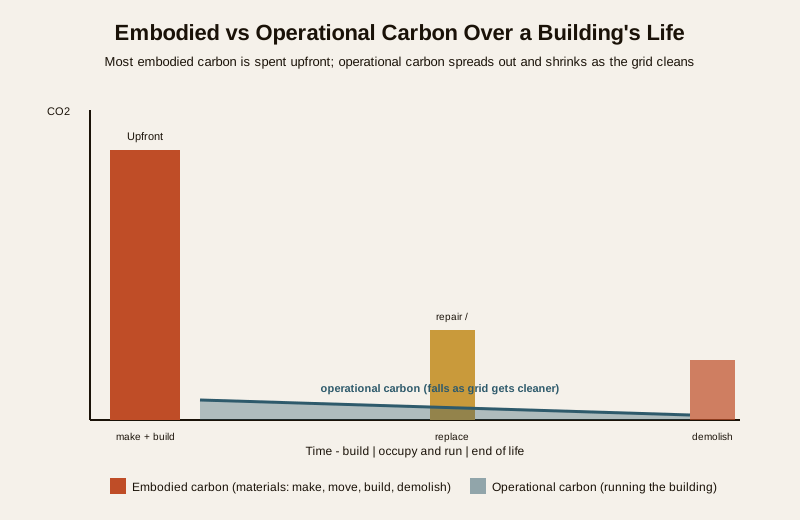
The practical takeaway for a homeowner or specifier: you get exactly one chance to influence embodied carbon, and it is now, at material-selection time. That is where this guide focuses.
Where the carbon hides - cement and steel dominate
If you only remember one fact, make it this: in a typical Indian reinforced-concrete building, two materials - cement and steel - account for the large majority of embodied carbon. Concrete is mostly sand, aggregate and water, which are relatively low-carbon; the carbon lives in the cement that binds it. Cement manufacture is doubly carbon-heavy: burning fuel to heat the kiln, plus a chemical reaction that releases carbon dioxide from limestone itself. Steel is energy-intensive to smelt and shape. Together they are the giants.
Everything else - bricks, blocks, tiles, glass, plaster, finishes, insulation - matters too, but in a concrete-frame home the biggest carbon savings almost always come from doing something smarter with cement and steel. That single insight reorders the whole low-carbon strategy.
| Carbon hotspot | Why it is heavy | How to cut it |
|---|---|---|
| Cement | Kiln fuel plus limestone chemistry release carbon | Use blended cement (PPC, PSC) and SCMs - GGBS, fly ash - to replace clinker |
| Reinforcement steel | Energy-intensive smelting and rolling | Right-size the structure; specify steel with recycled content; avoid over-design |
| Concrete volume | Cement content scales with how much you pour | Efficient structural design; do not oversize members; lower-carbon mixes |
| Fired clay brick | Kiln-fired at high temperature, often coal | Switch to AAC, fly-ash brick, or CSEB for suitable walls |
| Long-distance transport | Diesel freight of heavy materials | Source locally; use regional stone, sand, blocks |
| Short-lived finishes | Frequent replacement repeats the carbon | Choose durable materials with long service life |
The levers - how to actually cut embodied carbon in India
Cutting embodied carbon is not one heroic move; it is a stack of sensible choices. Here are the levers in rough order of impact for an Indian project.
1. Replace cement clinker - the single biggest win
The carbon in concrete is almost all in the clinker (the fired ingredient of cement). Replace part of that clinker with supplementary cementitious materials (SCMs) - industrial by-products that behave like cement - and the carbon falls sharply for the same strength. The two workhorses in India are GGBS (ground granulated blast-furnace slag), a by-product of iron-making, and fly ash, a by-product of coal power. Blended cements do this for you off the shelf: PPC (Portland Pozzolana Cement) already contains fly ash, and PSC (Portland Slag Cement) already contains slag - both are lower-carbon than plain OPC and widely available. For structural mixes, an engineer can specify still-higher SCM replacement. This is the lever with the biggest, cheapest, most reliable payoff - read the detail in GGBS and SCMs in concrete and the family of cements in types of cement in India. At the frontier, geopolymer concrete skips clinker almost entirely.
2. Use less material - efficiency beats substitution
The lowest-carbon tonne of concrete is the tonne you never pour. Material efficiency - a well-designed structure that carries its loads with less concrete and steel - can cut embodied carbon before you even change a single material. Right-sized foundations, sensibly spanned slabs, columns and beams that are not oversized "to be safe", and a rational grid all mean less cement and less steel. This is squarely a structural-engineering decision, not a homeowner one, but it is worth asking your engineer the question: is this design carbon-efficient, or are we over-building? A leaner structure saves carbon and money at once.
3. Choose lower-carbon walling
Walls are a big volume, and here you have real, easy choices. Fired clay brick is carbon-heavy because every brick is baked in a kiln, often with coal. Several alternatives do the same walling job for less carbon: AAC (autoclaved aerated concrete) blocks are light and often use fly ash; fly-ash bricks reuse a waste stream instead of firing fresh clay; CSEB (compressed stabilised earth blocks) are pressed, not fired, from local soil with a little cement; and hempcrete is a bio-based infill that actually stores carbon. Compare the front-runners in AAC blocks vs red bricks and fly-ash bricks vs clay bricks, and see the earth-and-bio options in compressed stabilised earth blocks, hempcrete and rammed earth construction.
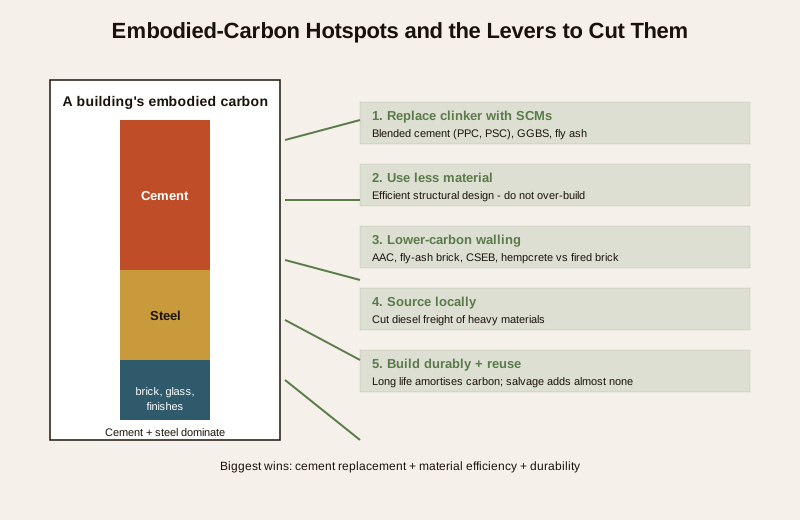
4. Source locally - cut the transport carbon
Heavy materials moved long distances by diesel truck carry a freight-carbon tax. Choosing regionally sourced sand, aggregate, stone, blocks and timber cuts those transport emissions and usually supports local economies too. A locally quarried stone or a block plant down the road beats an identical material railed across the country. It also tends to be cheaper. Local sourcing is a quiet lever, but on a heavy material it adds up.
5. Build to last - durability amortises carbon
A material's carbon is a one-time cost spread over its service life. A cladding that lasts sixty years spreads its carbon over sixty years; a finish you rip out and replace every eight years pays that carbon again and again. Durability is therefore a carbon strategy: choosing robust, weather-appropriate, well-detailed materials that do not need frequent replacement quietly lowers lifetime embodied carbon. So does reusing materials - salvaged brick, stone or timber carries almost no new carbon. Weigh service lives in material lifespan comparison and the durability fundamentals in the science behind durable buildings.
6. Favour materials that store carbon - timber and bamboo
Some materials are carbon negative in the making. Trees and bamboo absorb carbon dioxide as they grow and lock it into their fibres; using them in a building keeps that carbon out of the air (sequestration) for the life of the material. Responsibly sourced timber and fast-growing bamboo are the classic examples, and bio-based options like hempcrete work the same way. They are not right for every element, and they demand good detailing against moisture, fire and pests, but where they fit they are among the lowest-carbon choices available.
7. Choose recycled content - and the cool, efficient envelope
Materials made from recycled content - recycled steel, recycled-aggregate concrete, recycled-content boards and insulation - avoid much of the carbon of virgin production. See what reuses well and what does not in recycled building materials. Finally, embodied and operational carbon are linked: a cool roof, good insulation and an efficient envelope cut operational carbon for decades and are worth the modest embodied carbon they add - a genuinely low-carbon building optimises both together, which is the whole message of the green building materials guide.
Quick wins - the shortlist
Not every lever needs an engineer or a redesign. These are the moves a specifying homeowner can push for on almost any Indian project, roughly ranked by bang-for-buck.
| Quick win | What to do | Effort | Carbon impact |
|---|---|---|---|
| Specify blended cement | Use PPC or PSC instead of plain OPC where suitable | Very low | High |
| Ask for SCM-rich mixes | Have the engineer specify fly-ash / GGBS replacement in concrete | Low | High |
| Question the structure | Ask if members are right-sized or over-built | Low (ask engineer) | High |
| Lower-carbon walls | Choose AAC, fly-ash brick or CSEB over fired brick where suitable | Low | Medium |
| Buy local | Source sand, aggregate, stone and blocks regionally | Low | Medium |
| Choose durable finishes | Pick materials with long service life; avoid frequent replacement | Low | Medium (long-term) |
| Add recycled content | Prefer recycled-content steel, boards and insulation | Low | Medium |
| Reuse where you can | Salvage brick, stone or timber where feasible | Medium | High per item |
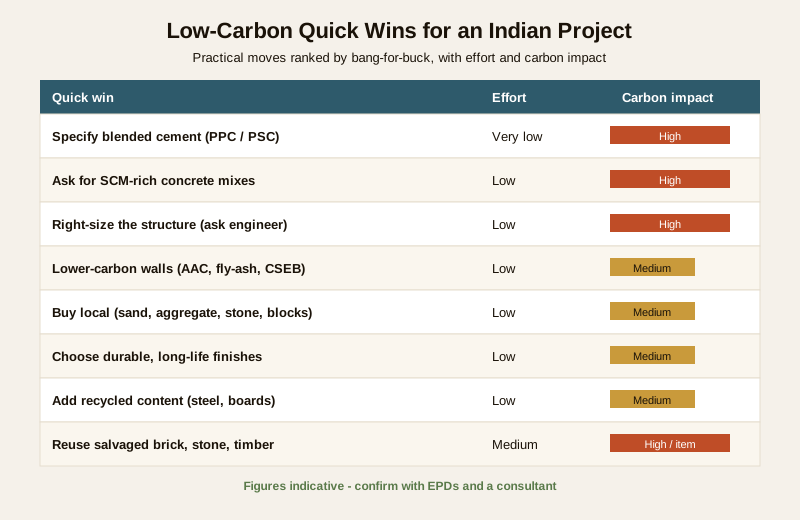
The pattern is clear: the biggest wins are cement replacement, material efficiency and durability. Get those three right and you have addressed most of a building's embodied carbon before you even reach the finishes.
Estimating and comparing - use the tools
You do not need to guess. The embodied-carbon calculator lets you put indicative numbers to your material choices and see how much swapping OPC for a blended cement, or fired brick for AAC, moves the total - a quick way to test the levers above before you commit. To weigh a material's broader green credentials, not just carbon, run it through the green-material scorecard. Treat both as decision aids; a real project still needs supplier EPDs and a consultant's assessment.
Standards, ratings and how carbon is measured
Embodied carbon is measured through life-cycle assessment (LCA), and a material's result is published as an Environmental Product Declaration (EPD) - a standardised, third-party-verified carbon and environmental data sheet for a specific product. When a supplier offers an EPD, it is the most trustworthy figure you will get; when they do not, you are relying on generic averages. Ask for EPDs on the big-ticket materials - cement, steel, concrete, blocks.
Green-building rating systems reward low embodied carbon and its levers. GRIHA (India's national rating), IGBC and LEED all credit blended cements and SCMs, recycled content, local sourcing, durability and material efficiency - so pursuing a rating and cutting carbon pull in the same direction. Material quality and marking still sit under Bureau of Indian Standards (BIS) specifications - named generally here: IS standards govern cements, aggregates, blocks and steel; the material standards and certifications guide sets out how to read them, and fire and life-safety provisions sit within the National Building Code of India (SP 7:2026). Verify against current EPDs, rating-system criteria and code editions rather than relying on memory.
For the full green picture and where these ideas sit in the wider materials world, keep the green building materials guide and the complete building materials guide close.
Key takeaways
- Embodied carbon is the carbon to make, move and build with a material, most of it spent upfront before you move in - unlike operational carbon, which you can keep cutting over the building's life.
- In a concrete-frame Indian home, cement and steel dominate embodied carbon, so the biggest savings come from doing something smarter with them.
- The highest-impact levers are replacing cement clinker with SCMs / blended cement (PPC, PSC, GGBS, fly ash), using less material through efficient structural design, and building durably so carbon is spread over a long life.
- Supporting levers: lower-carbon walling (AAC, fly-ash brick, CSEB, hempcrete), local sourcing to cut transport, timber and bamboo that store carbon, and recycled content.
- Use the embodied-carbon calculator and green-material scorecard to test choices; ask for EPDs and follow GRIHA / IGBC / LEED credits. Leave carbon accounting and structural design to a professional.
References
- Environmental Product Declarations (EPDs) and life-cycle assessment (LCA) reports - the authoritative, product-specific source for a material's embodied carbon; request them from cement, steel, concrete and block suppliers.
- GRIHA, IGBC and LEED rating systems - credits and criteria covering blended cements, supplementary cementitious materials, recycled content, local sourcing, material efficiency and durability; consult the current versions.
- Bureau of Indian Standards - product-specific IS specifications for cements, aggregates, blocks and reinforcement steel; consult the current editions for grade, composition and marking.
- National Building Code of India (SP 7:2026) - fire, life-safety and building provisions relevant to material selection and assemblies.
- Studio Matrx guides: green building materials guide, GGBS and SCMs in concrete, geopolymer concrete, recycled building materials, types of cement in India, material standards and certifications and the complete building materials guide.
Export this guide
Related Guides — Deep-dive reading
Embodied Carbon in Construction: Cutting the Carbon Locked Into Your Indian Home
The CO2 baked into your cement, steel and bricks is paid up front and can never be undone. Here is where it hides in an Indian home, and the low-cost choices that cut it by roughly a quarter.
SustainabilityGreen Building Materials Guide (India): Low-Carbon, Healthy & Sustainable Choices (2026)
What actually makes a building material green - low embodied carbon and energy, recycled and renewable content, local sourcing, durability, recyclability, low VOC and water efficiency - mapped honestly across the whole Indian building, with the lifecycle nuance no label can give you.
Building MaterialsGGBS, Fly Ash and SCMs in Concrete India: The Low-Carbon Mix (2026)
A plain-language guide to GGBS, fly ash, silica fume and other supplementary cementitious materials (SCMs) - the industrial by-products that replace part of the cement in concrete, cut its carbon, and boost durability - and why the replacement percentage and mix design belong to a qualified engineer or the RMC plant.
Building MaterialsRelated Tools — Try Free
Material Decision Framework (M-Score)
Score 30+ Indian construction materials across cost, durability, climate fit, maintenance, and sustainability.
MaterialsRenovation vs New Build Calculator
Compare renovating vs building new interiors city-wise across 13 work scopes with GST and per-sqft rates.
Cost ComparisonGreen Building Water Score Calculator
Score a building's water efficiency 0–100 from treated-water reuse, rainwater harvesting, low-flow fixtures and metering, with an IGBC/GRIHA-style rating and your biggest improvement lever.
Sustainability