
Building Material Standards and Certifications in India: BIS, ISI, NBC and Green Labels Explained (2026)
How to know a building material is genuine and fit for purpose. A plain-language guide to the BIS / IS ecosystem and the ISI mark, the international standards you will see on datasheets, the NBC (SP 7:2026) umbrella code, and the sustainability certifications - GRIHA, IGBC, LEED, GreenPro - that tell you a product is genuinely green.
A building is only as good as the materials inside it - and in India the market is full of look-alikes: cement that is under-strength, TMT bars that fail the bend test, plywood that is not really "marine", tiles that chip and eco-labels that mean nothing. The difference between a genuine, fit-for-purpose material and an expensive mistake usually comes down to one thing: the standards and certifications it carries, and whether you know how to read them. This guide teaches you to read them.
There are really two questions a certification answers. The first is "is this material safe and up to spec?" - answered by the quality and safety standards ecosystem built around the Bureau of Indian Standards (BIS), the IS codes and the familiar ISI mark. The second is "is this material genuinely sustainable?" - answered by a separate world of green certifications like GRIHA, IGBC, LEED and product eco-labels. We cover both, and finish with exactly what to ask a supplier so you leave the shop with proof, not promises.
Scope and safety: This is a specify-and-select guide - it helps you recognise and ask for the right marks and certificates. It does not make you a testing authority. Whether a specific batch actually passes - laboratory testing, structural adequacy, code compliance and site acceptance - is the job of a qualified structural engineer, an accredited testing lab and your contractor. Standard numbers and mark schemes are named generally and are revised periodically; always verify against the current BIS and certifier editions rather than relying on memory. Nothing here replaces the IS codes, the National Building Code or a licensed professional.
Part 1: quality and safety standards - the BIS / IS ecosystem
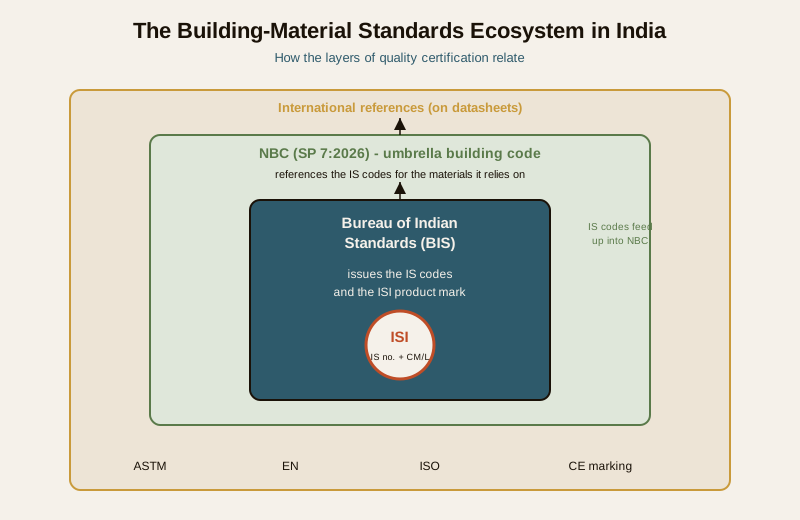
At the centre of material quality in India sits the Bureau of Indian Standards (BIS), the national standards body. BIS does two things that matter to you. First, it publishes the Indian Standards (IS) - the technical specifications that define what a material must be: its composition, strength, dimensions, tolerances and the test methods used to check them. When someone says a cement is "IS 269 grade" or a bar is "IS 1786 Fe 500D", they are naming the IS standard that governs it. Second, BIS runs a product certification scheme that lets a manufacturer put a mark on a product to certify it conforms to the relevant IS - the mark most people recognise as the ISI mark.
What the ISI mark actually means
The ISI mark is a licence, not a logo. A manufacturer whose factory and quality system have been assessed by BIS is granted a licence to stamp the ISI mark on a specific product, alongside the IS number it conforms to and a licence number (a CM/L number). So a genuine ISI mark always travels with two pieces of information: which standard the product meets, and the licence that authorises the mark. A mark with no IS number, no licence number, or a licence you cannot verify is a red flag.
For a defined list of products, BIS certification is mandatory - the government has placed them under compulsory certification because their failure is a safety risk. Cement and structural steel are the classic examples: it is illegal to sell non-certified cement or reinforcement bars. Many other products - some plywood, some electrical and safety items - are mandatory too, while a great many are voluntary (the manufacturer chooses to certify to signal quality). Either way, the presence of a genuine ISI mark tied to the correct IS number is your first, cheapest quality filter.
Hallmark, the newer numbering, and how to spot fakes
You will also meet the BIS hallmark, best known on gold and precious metals - a separate BIS scheme with its own six-digit alphanumeric HUID, not something you will see on cement. Do not confuse the metals hallmark with the ISI product mark; they certify different things. To verify any BIS mark, the practical checks are: read the IS number and confirm it is the right standard for that material; read the CM/L licence number and, where possible, check it against the BIS verification channels (the BIS Care route lets you look up and report); and be suspicious of blurry, misprinted or missing marks, packaging with spelling errors, and prices far below the market. Counterfeit ISI marks exist - the mark alone is necessary but not sufficient, which is why you also ask for a test certificate (Part 3).
The international standards you will see
On imported or premium products - facade systems, sealants, glass, insulation, tiles - datasheets often quote foreign standards instead of, or alongside, IS numbers. The common families are ASTM (American Society for Testing and Materials, US test methods), EN (European Norms) and ISO (International Organization for Standardization). You may also see the CE marking, a manufacturer's declaration that a product meets the applicable European health, safety and environmental requirements - useful context, but not an Indian conformity mark. These references are legitimate and often signal a well-characterised product, but for anything structural or safety-critical in India, the IS/BIS route is what governs acceptance on site. Treat foreign marks as supporting evidence, and ask how the product maps to the relevant Indian standard.
NBC (SP 7:2026) - the umbrella code
Sitting above the individual material standards is the National Building Code of India (SP 7:2026), published by BIS. The NBC is not a product spec - it is the umbrella building code that ties everything together: how buildings must be designed and constructed for structural safety, fire and life safety, services and more, referencing the individual IS codes for the materials it relies on. When your engineer specifies concrete grade, cover, or fire ratings, the NBC is the framework those decisions live inside. As a specifier you do not apply the NBC yourself - your architect and structural engineer do - but knowing it is the top-level code helps you understand why a material must meet its IS standard in the first place. For how these codes shape interior specification, see understanding IS codes for interior design.
A table of common materials and the IS standards that govern them
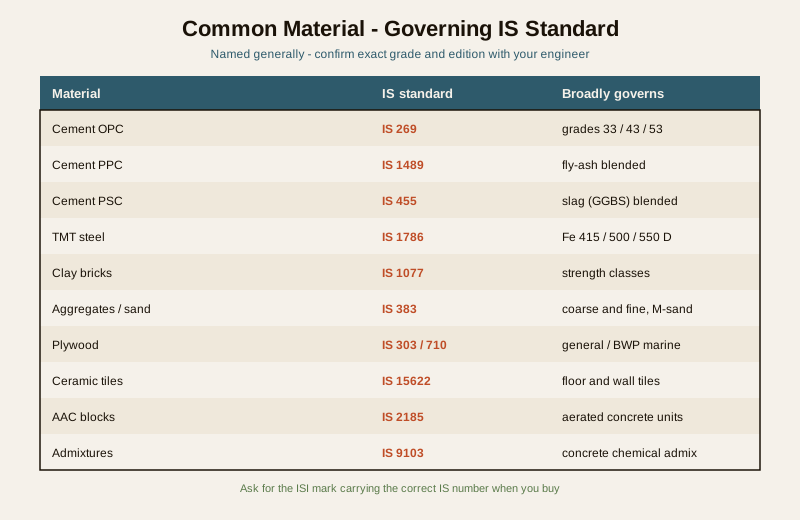
The single most useful thing you can carry into a material market is a rough map of which IS family governs what, so you can ask for the right mark by name. The table below names standards generally - always confirm the exact current number, grade and edition with your engineer or the BIS catalogue, because grades and editions change.
| Material | IS standard family (named generally) | What it broadly governs |
|---|---|---|
| Cement (OPC) | IS 269 | Ordinary Portland Cement grades (33 / 43 / 53) |
| Cement (PPC) | IS 1489 | Portland Pozzolana Cement (fly-ash blended) |
| Cement (PSC) | IS 455 | Portland Slag Cement (GGBS blended) |
| TMT reinforcement steel | IS 1786 | High-strength deformed bars (Fe 415 / 500 / 550, D grades) |
| Burnt clay bricks | IS 1077 | Common building bricks, classes by strength |
| Aggregates and sand | IS 383 | Coarse and fine aggregate for concrete, incl. manufactured sand |
| Plywood | IS 303 / IS 710 | General plywood (303) and boiling-water-proof "marine/BWP" grade (710) |
| Ceramic and vitrified tiles | IS 15622 | Pressed ceramic floor and wall tiles |
| AAC blocks | IS 2185 | Autoclaved aerated concrete masonry units |
| Concrete admixtures | IS 9103 | Chemical admixtures for concrete |
Use this alongside the material-specific guides: types of cement in India unpacks the IS 269 / 1489 / 455 families, and the TMT steel complete guide covers IS 1786 grades and the bend/rebend tests that separate genuine bars from fakes. For dimension stone, natural stone standards in India covers how granite, marble and other stones are specified and tested.
Part 2: sustainability certifications - the green ecosystem
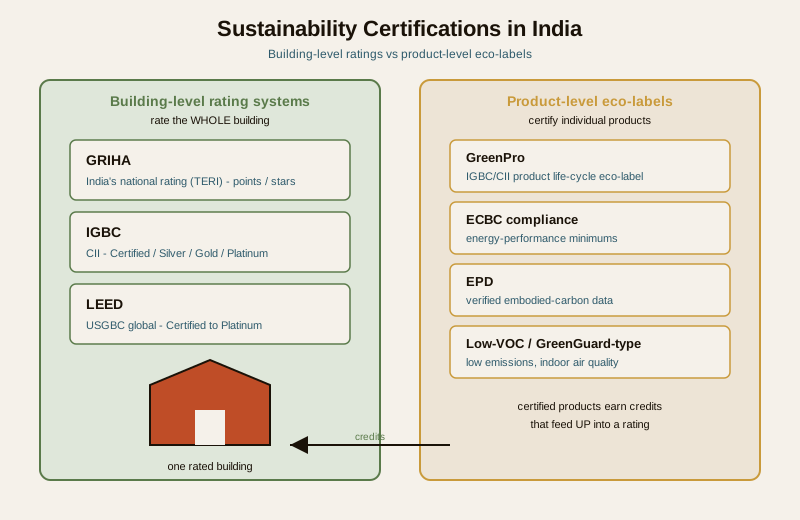
The second family of certifications answers a different question: not "is it safe and up to spec?" but "is it genuinely sustainable?" These split cleanly into building-level rating systems and product-level eco-labels.
Building-level rating systems
Three names dominate green buildings in India:
- GRIHA (Green Rating for Integrated Habitat Assessment) - India's own national rating system, developed by TERI and endorsed by the government, awarding a building a rating (on a star / points basis) for its energy, water, materials, site and comfort performance. It is well suited to Indian conditions and is often required on public projects.
- IGBC (Indian Green Building Council, part of CII) - a family of India-specific rating systems (IGBC Green Homes, Green New Buildings and others) awarding Certified / Silver / Gold / Platinum levels. Widely used by private developers and popular for homes.
- LEED (Leadership in Energy and Environmental Design) - the US Green Building Council's globally recognised system, also awarding Certified to Platinum. Common on corporate and international projects in India.
All three rate the whole building, not a single product - but they award credits for using certified sustainable materials, low-embodied-carbon products, regional materials and low-emitting finishes, which is why product eco-labels feed directly into a building's score.
Product-level eco-labels and declarations
At the product level, several labels help you specify greener materials:
- GreenPro - the IGBC / CII eco-label for products (paints, boards, cement, insulation, fittings and more), certifying that a product meets defined environmental criteria across its life cycle. A GreenPro-certified product usually earns credits under IGBC ratings.
- ECBC compliance - the Energy Conservation Building Code sets minimum energy-performance requirements; materials and systems (glazing, insulation, HVAC) are often specified to help a building meet ECBC, and product data will state ECBC-relevant performance.
- EPD (Environmental Product Declaration) - a standardised, third-party-verified report of a product's environmental impact (including embodied carbon) across its life cycle. An EPD does not say a product is "good" - it discloses its numbers so you can compare like with like. Increasingly important for low-carbon specification.
- Low-VOC and indoor-air labels - certifications of the GreenGuard type (and equivalent low-VOC declarations) certify that paints, adhesives, boards and finishes emit low levels of volatile organic compounds, protecting indoor air quality. These matter most for interiors and healthy homes.
How a homeowner or pro uses green certifications
You use them as a shortlist and a comparison tool, not as gospel. If you are chasing a GRIHA or IGBC rating, choose GreenPro-certified and locally made materials to bank credits. If indoor air quality matters, specify low-VOC / GreenGuard-type paints and boards. If you care about climate impact, ask for an EPD and compare embodied-carbon numbers rather than trusting the word "eco". And always check what a label actually certifies - a "green" claim with no recognised certifier behind it is marketing. For the material choices themselves, see the green building materials guide and low-carbon construction materials, and to quantify impact use the embodied carbon calculator and the green material scorecard.
Part 3: how to use standards when you actually buy
Knowing the marks only pays off at the point of purchase. Here is the practical routine that turns a certification from a sticker into proof:
- Ask for the IS mark on the product and packaging. Confirm the correct IS number and a readable ISI mark with a CM/L licence number. For mandatory-certified items like cement and steel, no genuine mark means walk away.
- Ask for the test certificate / mill certificate. For steel, request the mill test certificate (MTC) showing the heat number, chemistry and mechanical test results for that batch. For a batch of cement, aggregate or concrete, ask for recent test results.
- Ask for the TDS (Technical Data Sheet) and, where relevant, the MSDS. The TDS states the product's specified properties and the standard it is tested to; the MSDS covers safe handling. For admixtures, adhesives, sealants and paints these are essential.
- Match the batch to the paperwork. A certificate is only meaningful if the batch, grade and date on the product match the document. Photograph markings and keep the certificates - they are your acceptance record.
- For green claims, ask who certified it. Get the eco-label certificate (GreenPro, EPD, low-VOC) from the named certifier, not a self-declared logo.
The table below maps each certification to what it certifies and where it helps you, so you can see at a glance which piece of paper answers which question.
| Certification / document | What it certifies | Where it helps you |
|---|---|---|
| ISI mark (BIS product cert) | Product conforms to its IS standard | First quality filter; mandatory for cement and steel |
| IS standard number | The spec, grades and test methods for a material | Naming the right grade when you buy |
| NBC (SP 7:2026) | The umbrella building/design code | Framework your engineer designs within |
| Mill test certificate (MTC) | Batch chemistry and mechanical test results | Verifying a specific steel batch |
| Technical Data Sheet (TDS) | Declared properties and test standard | Comparing products; specifying admixtures, adhesives |
| GRIHA / IGBC / LEED | Whole-building sustainability rating | Certifying and marketing a green building |
| GreenPro eco-label | Product meets life-cycle environmental criteria | Banking green-rating credits; shortlisting materials |
| EPD | Third-party-verified environmental impact data | Comparing embodied carbon like-for-like |
| Low-VOC / GreenGuard-type | Low emissions of volatile organic compounds | Protecting indoor air quality in interiors |
For the wider buying workflow - vendor checks, quantities and negotiation - read the building materials buying guide, and for the full material map start at the building materials hub.
Key takeaways
- Two questions, two certification worlds. Quality and safety are answered by the BIS / IS system and the ISI mark; sustainability is answered by GRIHA / IGBC / LEED and product eco-labels. Do not confuse the two.
- The ISI mark is a licence, not a logo. A genuine mark always carries the IS number and a CM/L licence number - verify both. Certification is mandatory for cement and structural steel.
- Name the right standard when you buy - cement IS 269 / 1489 / 455, TMT steel IS 1786, bricks IS 1077, aggregates and sand IS 383, plywood IS 303 / 710, tiles IS 15622, AAC IS 2185, admixtures IS 9103 - confirming the exact current grade and edition with your engineer.
- NBC (SP 7:2026) is the umbrella code the individual IS standards feed into; your architect and structural engineer apply it, not you.
- Green labels are a shortlist tool. Use GreenPro, EPDs and low-VOC certificates to compare and specify, and always check who certified the claim.
- At purchase, get proof, not promises: ask for the IS mark, the test / mill certificate, the TDS, and match the batch to the paperwork. Leave laboratory testing and code compliance to accredited labs and qualified professionals.
References
- Bureau of Indian Standards (BIS) - the IS catalogue, the product certification (ISI mark) scheme, the CM/L licence system and BIS Care verification / complaint channels; consult the current editions and product coverage lists.
- National Building Code of India (SP 7:2026), published by BIS - the umbrella building code referencing the individual material IS standards.
- Individual Indian Standards named generally in this guide (cement, steel, bricks, aggregates, plywood, tiles, AAC, admixtures) - verify exact numbers, grades and current editions with BIS or a qualified engineer.
- GRIHA (TERI), IGBC (CII), LEED (USGBC) rating systems; GreenPro eco-label; the Energy Conservation Building Code (ECBC); Environmental Product Declarations (EPD); and low-VOC / GreenGuard-type indoor-air certifications - consult each certifier for current criteria.
- International reference standards - ASTM, EN, ISO and the CE marking - as cited on product datasheets; treat as supporting evidence, with IS/BIS governing Indian acceptance.
- Studio Matrx guides: building materials buying guide, green building materials guide, low-carbon construction materials, types of cement in India, TMT steel complete guide, understanding IS codes for interior design and natural stone standards in India.
Export this guide
Related Guides — Deep-dive reading
Green Building Materials Guide (India): Low-Carbon, Healthy & Sustainable Choices (2026)
What actually makes a building material green - low embodied carbon and energy, recycled and renewable content, local sourcing, durability, recyclability, low VOC and water efficiency - mapped honestly across the whole Indian building, with the lifecycle nuance no label can give you.
Building MaterialsFire Safety Audit in India (2026): The Independent Check That Proves You Are Actually Safe
A periodic, independent audit tests a building's whole fire provision against NBC Part 4 and the Fire NOC - and separates compliant-on-paper from safe-in-reality. This guide sets out what it covers, who does it, and why findings must be fixed, not filed.
SecuritySecurity Product Certification Guide (2026): Reading the Marks That Prove a Device Is Safe and Genuine
How a homeowner tells a genuinely certified, fit-for-purpose security product from an uncertified one, and why it matters most for life-safety and anything electrical or outdoor. A plain-language buyer's guide to the marks and standards you will actually meet in India, and how to verify one is real.
SecurityRelated Tools — Try Free
Healing View Impact Calculator
Evidence-Based Design dashboard quantifying the recovery impact of nature view + daylight factor on analgesic use, length of stay, and HCAHPS patient-experience uplift. Calibrated against Ulrich 1984 (Science), Park & Mattson 2008, and the CHD EBD evidence base.
EBD CalculatorMaterial Compare — Side by Side
Compare materials side-by-side: granite vs quartz vs marble, laminate vs acrylic vs PU, and more.
ComparisonCross-Ventilation Analyzer
Estimate airflow and air changes per hour (ACH) from room size, window areas, layout, and local wind — with NBC 2016 Part 8 compliance check.
Ventilation Calculator