
Hempcrete in India: The Carbon-Negative Bio-Composite Wall, Decoded (2026)
What hempcrete really is - hemp shiv plus a lime binder plus water - and how to specify it honestly for Indian eco and passive homes: its breathable, carbon-negative, non-combustible strengths, its non-load-bearing reality, and the licensing, supply and cost hurdles that keep it niche.
Hempcrete is one of the most talked-about "green" materials of the decade, and one of the most misunderstood. It is not a concrete, it is not load-bearing, and it will not replace your structural frame. What it is: a bio-composite made by mixing the woody core of the hemp plant - called shiv or hurd - with a lime binder and water, then casting or packing it around a structural frame as a breathable, insulating infill. This guide helps you choose and specify hempcrete honestly for an Indian home: what it genuinely does well, where it does not belong, and the licensing, supply and cost realities that keep it a promising but still-niche option here.
The aim is a clear head, not hype. Hempcrete has real, unusual virtues - it can be carbon-negative, it buffers humidity, it resists fire and pests - but it is emerging in India, hemp cultivation is regulated, suppliers are few, it costs more, and it needs a trained crew and a separate structural system. You should know all of that before you fall for the photographs.
Scope and safety: This is a selection guide. Properties, mix behaviour and prices here are indicative only and move with supplier, density, climate and region - always get current data sheets and local quotes. The lime-and-shiv mix design, the structural frame it wraps, the casting or spraying, curing and moisture detailing are execution decisions - hand them to a qualified contractor, a structural engineer and a trained hempcrete crew. Hemp cultivation and sourcing in India are subject to state licensing under narcotics law - confirm the legal position for your state. Nothing here replaces IS codes, the NBC (SP 7:2026), a green-building consultant or a licensed professional.
What hempcrete actually is
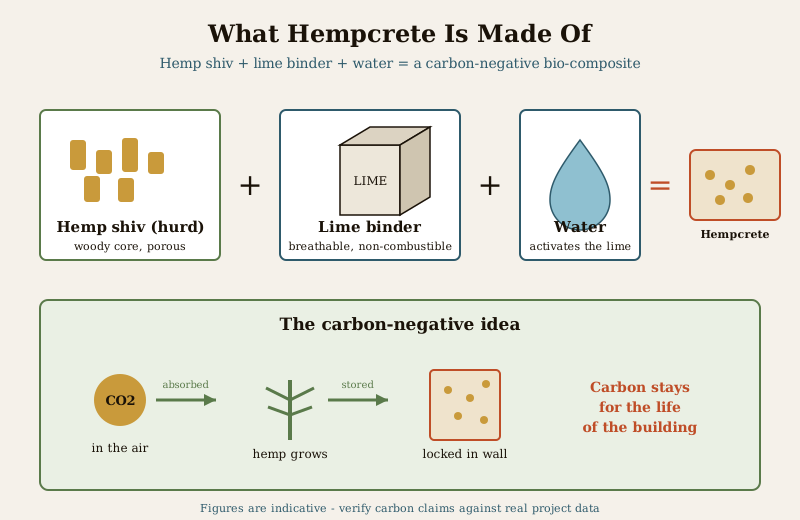
Strip away the marketing and hempcrete is three humble ingredients:
- Hemp shiv (hurd). The chopped woody core left over after hemp stalk is processed for fibre. It is light, porous and full of tiny air pockets - the source of the insulation.
- A lime binder. Usually a hydraulic or formulated building lime (sometimes blended with a little natural pozzolan). Lime coats the shiv, sets over time, and gives the wall its fire resistance, its alkalinity (which discourages mould and pests) and its breathability. Ordinary Portland cement is generally avoided because it is too dense and stops the wall breathing.
- Water, to activate the lime and let the mix be placed.
Mixed together, these form a low-density, monolithic material that is cast around a frame, cured, and finished with a breathable lime plaster. The result is closer to a "solid insulation" than to a wall material in the concrete sense - it is light, it is not strong in compression, and its whole point is thermal and moisture performance, not load.
Why people get excited: the properties
Hempcrete's appeal is a rare cluster of properties that mainstream wall materials do not combine.
Carbon-negative potential. This is the headline. The hemp plant absorbs carbon dioxide as it grows, and a large share of that carbon stays locked in the shiv inside the wall. The lime binder also slowly reabsorbs some carbon dioxide as it cures. Add these up and a hempcrete wall can, over its life, store more carbon than was emitted making it - a genuinely carbon-negative or at least very low embodied-carbon envelope, which is why it earns attention on green-rated projects. (Treat any specific "kg per sq m" figure with caution - it depends heavily on crop, transport and binder, so verify against real project data.)
Breathability and humidity buffering. Hempcrete is vapour-open: it lets moisture move through and, crucially, absorbs and releases humidity without rotting or losing performance. In a warm, humid Indian climate this "moisture buffering" helps steady indoor humidity and reduces the conditions that feed mould - provided the wall is detailed to stay free-draining and is never sealed with a non-breathable paint or cement plaster.
Thermal insulation plus some thermal mass. Hempcrete is a good insulator - not as high in raw R-value per inch as foam, but respectable - and it also carries modest thermal mass, so it dampens temperature swings across the day. That combination suits passive, climate-responsive design where you want the envelope to smooth out heat rather than just resist it. To weigh thickness against a target R-value, run the numbers with our insulation R-value calculator, and see how it sits among other bio-based options in our natural insulation materials guide.
Non-combustible and pest/mould resistant. The lime binder makes hempcrete resist fire well - it does not readily burn - and the high alkalinity discourages insects, rodents and fungal growth without the chemical treatments that most plant-fibre insulants demand. That is a real advantage over untreated natural insulants.
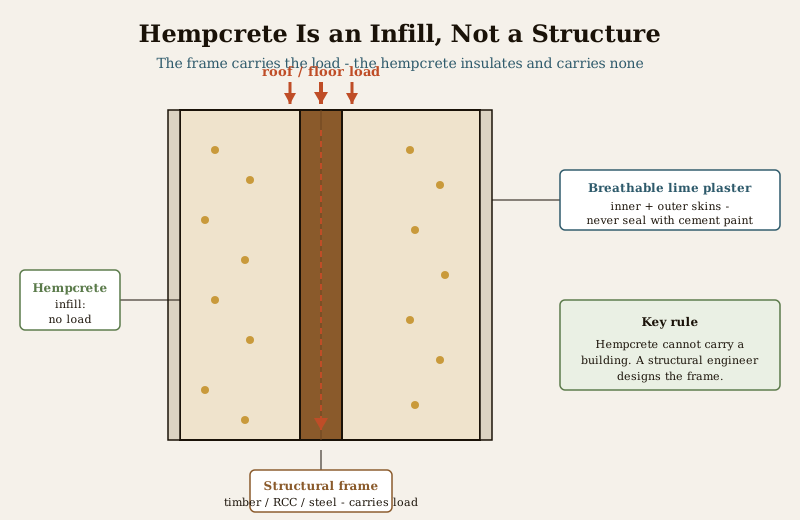
Not load-bearing - and this is the key caveat. Hempcrete has very low compressive strength. It cannot carry the weight of a building. It is always an infill: you build a structural frame first - timber is traditional, but a reinforced-concrete or steel or masonry-pier frame works too - and hempcrete is cast or packed around and between those members. The frame carries the loads; the hempcrete insulates, regulates moisture and stores carbon. Any structural decision here belongs to a structural engineer - never treat a hempcrete wall as a wall you can build a roof on.
The forms it comes in
Hempcrete reaches site in three main ways, and the choice affects cost, speed and who can install it.
- Cast in-situ. The classic method: shuttering is set up around the structural frame and wet hempcrete is placed and tamped by hand, then the shuttering is struck once it holds shape. Flexible and monolithic, but labour-intensive and slow to dry.
- Blocks (precast). Hempcrete cast into blocks in a factory, cured, then laid like masonry with a lime mortar. Faster and more predictable on site, and easier where skilled cast-in-situ crews are scarce - which describes most of India.
- Spray-applied. Machine-sprayed onto a backing around the frame; fast on large areas but needs specialist equipment and trained operators, so it is rare here.
Properties at a glance
The table below summarises how hempcrete behaves. Treat every figure as indicative and directional - hempcrete's performance shifts a lot with density, mix and finish, so confirm against a supplier's data sheet before you specify.
| Property | Hempcrete behaviour | What it means for you |
|---|---|---|
| Structural role | Non-load-bearing infill only | Always needs a separate structural frame |
| Density | Low (light) | Easy to handle; low compressive strength |
| Thermal insulation | Good, plus modest thermal mass | Smooths temperature swings; suits passive design |
| Embodied carbon | Very low to carbon-negative | Stores carbon for the building's life |
| Breathability | High (vapour-open) | Buffers humidity; must stay unsealed / lime-finished |
| Fire behaviour | Resists fire (lime binder) | No added fire treatment needed |
| Pest / mould | Naturally resistant (alkaline) | Avoids the chemical treatments other bio-insulants need |
| Moisture | Handles vapour well; must not be trapped wet | Needs breathable finishes and good detailing |
| Relative cost | Higher than mainstream walls | A premium, values-led choice today |
For contrast, here is how hempcrete stacks up against the wall systems most Indian homes actually use:
| Aspect | Hempcrete infill | AAC blocks | Burnt clay brick |
|---|---|---|---|
| Load-bearing | No (needs frame) | Can be, in low rise | Yes, traditionally |
| Embodied carbon | Very low / negative | Moderate | High (kiln-fired) |
| Insulation | Good + mass | Good | Modest |
| Breathability | High | Moderate | Moderate |
| Fire / pest | Strong (lime) | Non-combustible | Non-combustible |
| Availability in India | Niche / emerging | Everywhere | Everywhere |
| Relative cost | High | Moderate | Low to moderate |
| Skilled crew needed | Yes (trained) | Standard masons | Standard masons |
To see where either mainstream option sits, compare our AAC blocks vs red bricks guide. And to put a number on the carbon claim for your own design, our embodied carbon calculator is the honest way to test whether hempcrete actually earns its premium on your project.
The honest India reality
This is where enthusiasm meets the ground. Hempcrete is real and it works, but in India it is niche and emerging, and pretending otherwise does no one a favour.
- Hemp cultivation is regulated. Hemp is botanically the same species as cannabis, so its cultivation is controlled under narcotics law. Industrial hemp - low in the psychoactive compound - is permitted for cultivation and industrial use in some Indian states under a state licence, and the policy landscape is evolving. The practical effect is that hemp shiv supply is limited and geographically patchy. Confirm the legal and licensing position for your state before you build a supply plan around it.
- Few suppliers, thin supply chain. Because cultivation is restricted and the market is young, there are few established sources of building-grade hemp shiv and formulated lime binder in India. Lead times and consistency are the usual pain points.
- Higher cost. Between imported or scarce inputs, a niche market and slower construction, hempcrete typically costs more than a conventional wall - it is a values-led, sustainability-first choice today, not a cost-saving one.
- Needs skilled, trained crews. Getting the mix, placement, density and curing right is a craft. India has few crews trained in hempcrete, which is a real constraint on quality and speed - and a strong argument for block forms over cast-in-situ where trained labour is scarce.
- Always needs a structural frame. As covered above, hempcrete carries no load, so it only makes sense as part of a designed frame-plus-infill system - it does not slot into a routine load-bearing masonry build.
Is hempcrete right for you?
Use this to decide honestly whether hempcrete belongs on your project.
| If your priority is... | Hempcrete verdict |
|---|---|
| Lowest possible embodied carbon / a carbon story | Strong fit - a headline reason to choose it |
| A green rating (GRIHA / IGBC / LEED) | Good fit - earns low-carbon and healthy-material credits |
| Passive, climate-responsive comfort | Good fit - breathable, insulating, some mass |
| A load-bearing wall without a frame | Wrong material - hempcrete cannot carry load |
| Lowest cost / tight budget | Poor fit - it costs more than mainstream walls |
| Fast build with standard local masons | Poor fit - needs trained crews and cure time |
| Guaranteed availability anywhere in India | Poor fit today - supply is niche and regional |
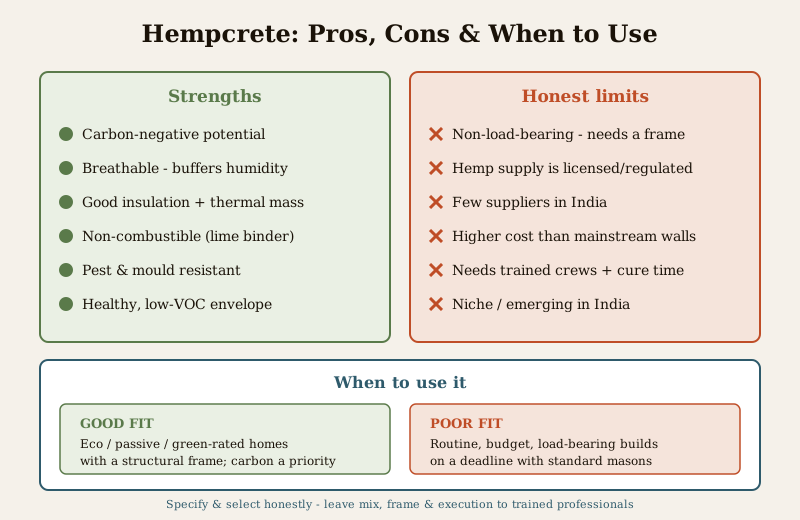
The pattern is clear: hempcrete shines on eco-led, passive, green-rated homes where a structural frame is already in the design and carbon is a genuine priority - and it struggles on routine, budget-driven, load-bearing builds on a deadline. For the wider case for choosing low-carbon materials at all, start from our green building materials guide and the sustainability and green buildings hub. If earth-based, low-carbon walling is your real goal, also weigh the more India-ready alternatives - rammed earth construction and compressed stabilised earth blocks (CSEB) - which have deeper local supply chains and craft traditions than hempcrete does today.
Key takeaways
- Hempcrete is a bio-composite of hemp shiv, lime binder and water - a breathable, insulating infill, not a concrete and not load-bearing.
- Its standout virtues are carbon-negative potential, humidity buffering and breathability, good insulation with some thermal mass, and natural fire and pest resistance from the lime.
- It always needs a structural frame - timber or otherwise - to carry loads; leave that design to a structural engineer.
- It comes as cast in-situ, precast blocks or spray; blocks suit India best where trained crews are scarce.
- The Indian reality is niche and emerging: hemp cultivation is licensed/regulated, suppliers are few, cost is higher, and skilled crews are limited - best for eco and passive homes, not routine budget builds.
- Test the carbon claim with our embodied carbon calculator, size insulation with the insulation R-value calculator, and leave mix, frame and execution to qualified professionals.
References
- Bureau of Indian Standards - lime, building-material and thermal-performance standards; consult current editions and verify each product's designation on its data sheet. Hempcrete itself is not yet a mainstream IS-coded system, so specify against manufacturer test data.
- National Building Code of India (SP 7:2026) - thermal performance, fire and materials provisions for the wall assembly and its structural frame.
- State industrial-hemp licensing frameworks - hemp cultivation and sourcing are regulated under narcotics law; confirm the legal and licensing position for your state before sourcing shiv.
- GRIHA, IGBC and LEED rating frameworks - credits for low embodied carbon, renewable content and healthy indoor materials.
- Studio Matrx guides: green building materials, natural insulation materials, rammed earth construction, compressed stabilised earth blocks, AAC blocks vs red bricks and the sustainability and green buildings hub.
Export this guide
Related Guides — Deep-dive reading
Compressed Stabilised Earth Blocks (CSEB): A Specify-and-Select Guide for India (2026)
What CSEB is - local soil plus a small percentage of cement or lime, compressed in a press and cured, never kiln-fired - its low-carbon and thermal-mass strengths, its real limits around soil, quality control and water, and how it compares with fired clay brick and fly-ash brick. A specify-and-select guide.
Building MaterialsGreen Building Materials Guide (India): Low-Carbon, Healthy & Sustainable Choices (2026)
What actually makes a building material green - low embodied carbon and energy, recycled and renewable content, local sourcing, durability, recyclability, low VOC and water efficiency - mapped honestly across the whole Indian building, with the lifecycle nuance no label can give you.
Building MaterialsHow to Choose Building Materials in India: A Step-by-Step Decision Guide (2026)
A practical, climate-first and budget-first process for selecting the right wall, floor, and roof materials for an Indian home - and knowing capital cost from whole-life cost.
Building MaterialsRelated Tools — Try Free
Cross-Ventilation Analyzer
Estimate airflow and air changes per hour (ACH) from room size, window areas, layout, and local wind — with NBC 2016 Part 8 compliance check.
Ventilation CalculatorMaterial Decision Framework (M-Score)
Score 30+ Indian construction materials across cost, durability, climate fit, maintenance, and sustainability.
MaterialsBefore vs After — Cost Reality Check
Compare what you expected to pay vs what you actually paid, category by category.
Reality Check