
Types of Cement in India: OPC, PPC, PSC & Specials Explained (2026)
A buyer's guide to the cements actually sold in India - OPC 33/43/53 grade, PPC, PSC and the specials (white, rapid-hardening, sulphate-resisting, low-heat) - with a side-by-side comparison and clear guidance on when to use each.
Cement is the one material almost every part of a building leans on - it binds the concrete in your columns, the mortar in your walls, the plaster on your ceiling and the screed under your floor. Yet most people buy it as a single anonymous grey bag, unaware that the market offers several distinct cements, each tuned for a different job. Pick the wrong one and you can pay for strength you cannot use, or miss the durability a coastal site badly needs.
This guide decodes the cements actually sold in India: the three mainstream families - OPC (Ordinary Portland Cement, in 33, 43 and 53 grades), PPC (Portland Pozzolana Cement) and PSC (Portland Slag Cement) - plus the specials you will occasionally need. The goal is to help you choose and specify the right bag, not to design the concrete inside it.
Scope and safety: This is a selection guide. The numbers here - strengths, prices, mix hints - are indicative only; cement rates move with region, brand and freight, so always get local quotes. The concrete grade, mix design, water-cement ratio and structural detailing are engineering decisions - hand them to a qualified structural engineer or your RMC supplier. Nothing here replaces the IS codes or a licensed professional.
The cement family at a glance
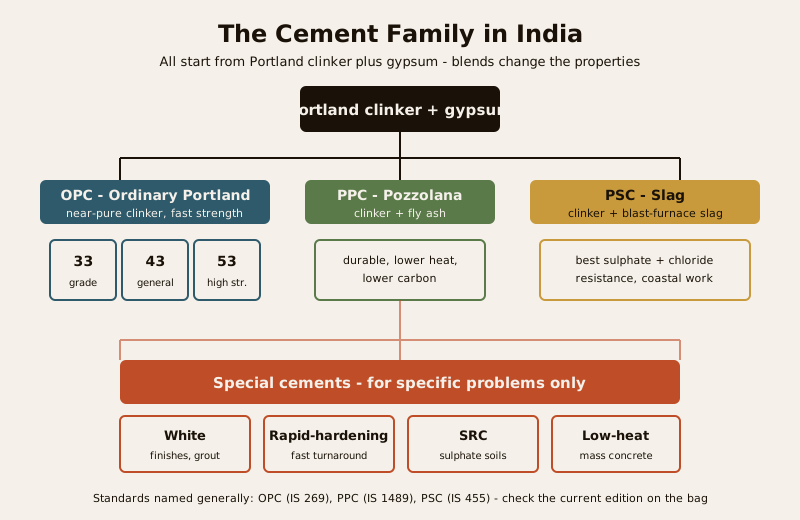
All the cements you will meet share the same skeleton: Portland clinker (limestone plus clay, burnt and ground) mixed with gypsum. What separates them is what else is blended in. OPC is almost pure clinker. PPC replaces a slice of clinker with a pozzolana - usually fly ash from thermal power plants. PSC replaces a larger slice with ground granulated blast-furnace slag (GGBS), a by-product of steel-making. Those blends are not cost-cutting tricks: the fly ash and slag react with the by-products of cement hydration to make the hardened concrete denser, less permeable and more durable over time.
To understand what "grade" means and why any of this matters for a structure, it helps to read alongside our explainers on how cement works and understanding concrete strength.
OPC - Ordinary Portland Cement (33, 43, 53 grade)
OPC is the classic grey cement: mostly clinker, so it hydrates fast and gains strength quickly. The number after it - 33, 43 or 53 - is the minimum compressive strength in MPa that a standard cement-sand mortar cube reaches at 28 days. Higher grade means faster and higher early strength.
- OPC 33 grade is now largely obsolete for structural work and rarely stocked; you will occasionally see it for plaster and non-structural masonry.
- OPC 43 grade is the workhorse - a balanced, general-purpose cement for most residential RCC, plastering and blockwork where a fast finish is not critical.
- OPC 53 grade is the high-strength option: rapid early strength, ideal where forms must be stripped quickly, for precast elements, prestressed work, high-rise columns and higher concrete grades (M25 and above). Its speed comes with more heat and a need for disciplined curing, or it can crack.
OPC's strength is also its weakness. It hydrates hard and hot, and it leaves behind free lime that makes concrete slightly more permeable and more vulnerable to sulphates and chlorides. That is exactly the gap that blended cements fill. For choosing the concrete grade OPC will go into, see choosing the right concrete grade.
PPC - Portland Pozzolana Cement
PPC blends OPC clinker with a pozzolana, most commonly fly ash, at roughly 15 to 35 percent by mass. The fly ash reacts with the lime released during hydration to form additional binding gel. The practical effects:
- Slower early strength, equal-or-higher ultimate strength. PPC lags OPC in the first week but catches up and often overtakes it by 90 days.
- Lower heat of hydration, so less thermal cracking - useful in thicker pours and hot weather.
- Denser, less permeable concrete, which resists water, chlorides and sulphates better - a real durability edge for foundations, coastal and marine-adjacent sites.
- Better workability and finish, because the spherical fly-ash particles roll like ball bearings.
PPC is the sensible default for most general house construction, plastering, masonry and mass concrete in India, and its lower clinker content gives it a smaller carbon footprint. Its one caution is curing: because early strength builds slowly, PPC needs longer, more diligent water curing to develop fully.
PSC - Portland Slag Cement
PSC blends clinker with GGBS at a higher replacement level than PPC - often 25 to 65 percent. It behaves like PPC's more durable cousin:
- Even lower heat of hydration and excellent resistance to sulphates, chlorides and aggressive groundwater.
- Very low permeability once fully cured, making it a strong choice for foundations, retaining structures, water tanks, marine and coastal work.
- The slowest early strength of the mainstream cements, so curing discipline matters most here.
For most durability-driven decisions, PPC and PSC are interchangeable good choices; PSC edges ahead where sulphate and chloride attack is the dominant threat.
Special cements - know they exist
Beyond the big three, a handful of specials solve narrow problems:
- White cement - low iron content gives a bright white base for decorative finishes, tile grout, textured coats and coloured concrete. It is far costlier than grey and is used for finishes, not structure.
- Rapid-hardening cement - similar to OPC 53 in family but ground finer for very fast early strength; used where formwork must turn around quickly or in cold conditions.
- Sulphate-resisting cement (SRC) - low in the compound that sulphates attack; specified for foundations in sulphate-rich soils and sewage or industrial environments. Blended PSC often achieves similar protection.
- Low-heat cement - releases heat slowly to control cracking in mass concrete such as large rafts and dams.
Specify these only on a professional's advice - they are answers to specific site problems, not general upgrades.
OPC vs PPC vs PSC - the comparison
The table below is the heart of the decision. Treat the cost column as relative and indicative; confirm current rates locally.
| Property | OPC 43 | OPC 53 | PPC | PSC |
|---|---|---|---|---|
| Early strength (1-7 days) | Fast | Fastest | Slow | Slowest |
| Ultimate strength (90 days) | High | Highest | High, often exceeds OPC | High |
| Heat of hydration | High | Highest | Lower | Lowest |
| Permeability / density | Moderate | Moderate | Low permeability | Very low permeability |
| Sulphate / chloride / coastal resistance | Fair | Fair | Good | Best |
| Workability and finish | Good | Good | Better | Better |
| Curing demand | Moderate | High | High (needs long curing) | Highest |
| Relative cost | Baseline | Slightly higher | Similar or slightly lower | Similar |
| Sustainability (embodied carbon) | Higher | Higher | Lower (fly ash) | Lowest (slag) |
| Typical governing standard | IS 269 | IS 269 | IS 1489 | IS 455 |
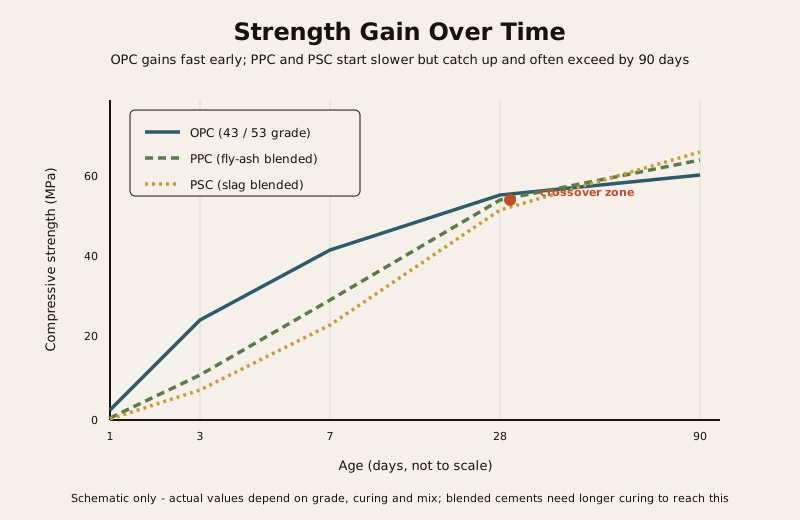
The single most important idea in that chart: early speed and long-term durability are a trade-off. OPC wins the first week; PPC and PSC win the long game on durability and often on ultimate strength. Choose based on what your job actually values.
Which cement for which job
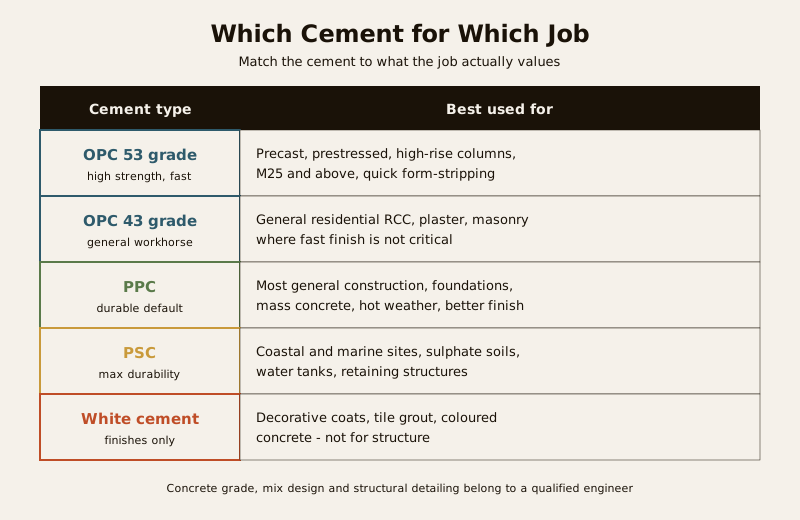
- High-strength or fast-turnaround work - precast, prestressed, high-rise columns, M25 and above: OPC 53.
- General residential RCC, plaster and masonry: OPC 43 or PPC - PPC if durability and finish matter more than early speed.
- Foundations, retaining walls, water tanks, mass concrete and hot-weather pours: PPC or PSC for lower heat and low permeability.
- Coastal, marine-adjacent or sulphate-rich sites: PSC (or SRC on engineering advice) for the best chemical resistance.
- Decorative finishes, grout, coloured concrete: white cement.
When you have chosen a cement and want to estimate quantities, our cement bag calculator and concrete volume calculator do the arithmetic; if you are buying concrete rather than mixing on site, see ready-mix concrete (RMC), where the supplier selects and controls the cement for you. Cement never works alone - pair it with the right sand and aggregates to make sound concrete.
Standards and the IS mark
Every legitimate bag carries an IS (BIS) certification mark tied to the standard for its type - broadly IS 269 for OPC, IS 1489 for PPC and IS 455 for PSC (named generally here; check the current edition on the bag). The mark, the licence number and the grade are printed on the bag. If any of these is missing, faded or inconsistent, treat the cement as suspect. Standards, editions and BIS licences are revised periodically, so verify the exact designation against the printed bag rather than relying on memory.
How to buy cement well
Cement is perishable. It reacts with moisture in the air, so a bag that has sat in a damp godown for months is weaker than its grade promises - regardless of brand. Buy on these checks:
| What to check | What good looks like | Red flag |
|---|---|---|
| IS mark and licence | Clear IS mark, licence number, grade and type printed | Missing, blurred or peeling mark |
| Manufacture date | As fresh as possible; ideally used within about 3 months | Old date, or no date at all |
| Lumps | Powder flows freely, breaks to fine dust in the hand | Hard lumps that will not crush = moisture damage |
| Colour and feel | Uniform grey (or true white for white cement), cool and smooth | Patchy colour, warm bag, gritty feel |
| Bag condition | Intact, dry, sealed | Torn, damp, water-stained bags |
| Storage on site | Off the floor on planks, away from walls, covered, stacked no more than about 10 bags high, oldest used first | Bags on bare floor against a damp wall |
Buy only what you will use soon, keep it dry and off the ground, and rotate stock. Fresh cement of the right type, well stored, is worth more to a structure than a higher grade bought stale.
Key takeaways
- OPC, PPC and PSC are the three cements you will actually choose between; grades 33/43/53 apply only to OPC and refer to 28-day strength.
- OPC 53 for high strength and speed; OPC 43 for general work; PPC and PSC for durability, lower heat and coastal or mass concrete.
- Blended cements (PPC, PSC) trade slower early strength for denser, more durable, lower-carbon concrete - but demand longer curing.
- White, rapid-hardening, SRC and low-heat are specials for specific problems, used on professional advice.
- Buy fresh, IS-marked, lump-free cement and store it dry; leave the concrete mix design and structure to a qualified engineer.
References
- Bureau of Indian Standards - IS 269 (Ordinary Portland Cement), IS 1489 (Portland Pozzolana Cement) and IS 455 (Portland Slag Cement); consult the current editions for grades, marking and requirements.
- National Building Code of India (SP 7:2026) - materials and construction practice provisions.
- Studio Matrx guides: how cement works, understanding concrete strength, choosing the right concrete grade and the complete building materials guide.
Export this guide
Related Guides — Deep-dive reading
GGBS, Fly Ash and SCMs in Concrete India: The Low-Carbon Mix (2026)
A plain-language guide to GGBS, fly ash, silica fume and other supplementary cementitious materials (SCMs) - the industrial by-products that replace part of the cement in concrete, cut its carbon, and boost durability - and why the replacement percentage and mix design belong to a qualified engineer or the RMC plant.
Building MaterialsThe Complete Building Materials Buying Guide (India) (2026)
The capstone of the Building Materials hub - a stage-by-stage buying process (estimate, specify, shortlist, compare, verify, store) plus how to buy well in every material category, the mistakes that cost the most, and a smart-buyer checklist that routes to every deep guide and calculator.
Building MaterialsCompressed Stabilised Earth Blocks (CSEB): A Specify-and-Select Guide for India (2026)
What CSEB is - local soil plus a small percentage of cement or lime, compressed in a press and cured, never kiln-fired - its low-carbon and thermal-mass strengths, its real limits around soil, quality control and water, and how it compares with fired clay brick and fly-ash brick. A specify-and-select guide.
Building MaterialsRelated Tools — Try Free
Material Decision Framework (M-Score)
Score 30+ Indian construction materials across cost, durability, climate fit, maintenance, and sustainability.
MaterialsMaterial Schedule Generator
Generate a room-wise finish schedule — walls, floors, ceilings, trim, and joinery by location.
Material ScheduleMaterial Comparison Sheet
India's interior material cheatsheet — plywood, finishes, hardware, countertops, paints, waterproofing.
Reference Guide