
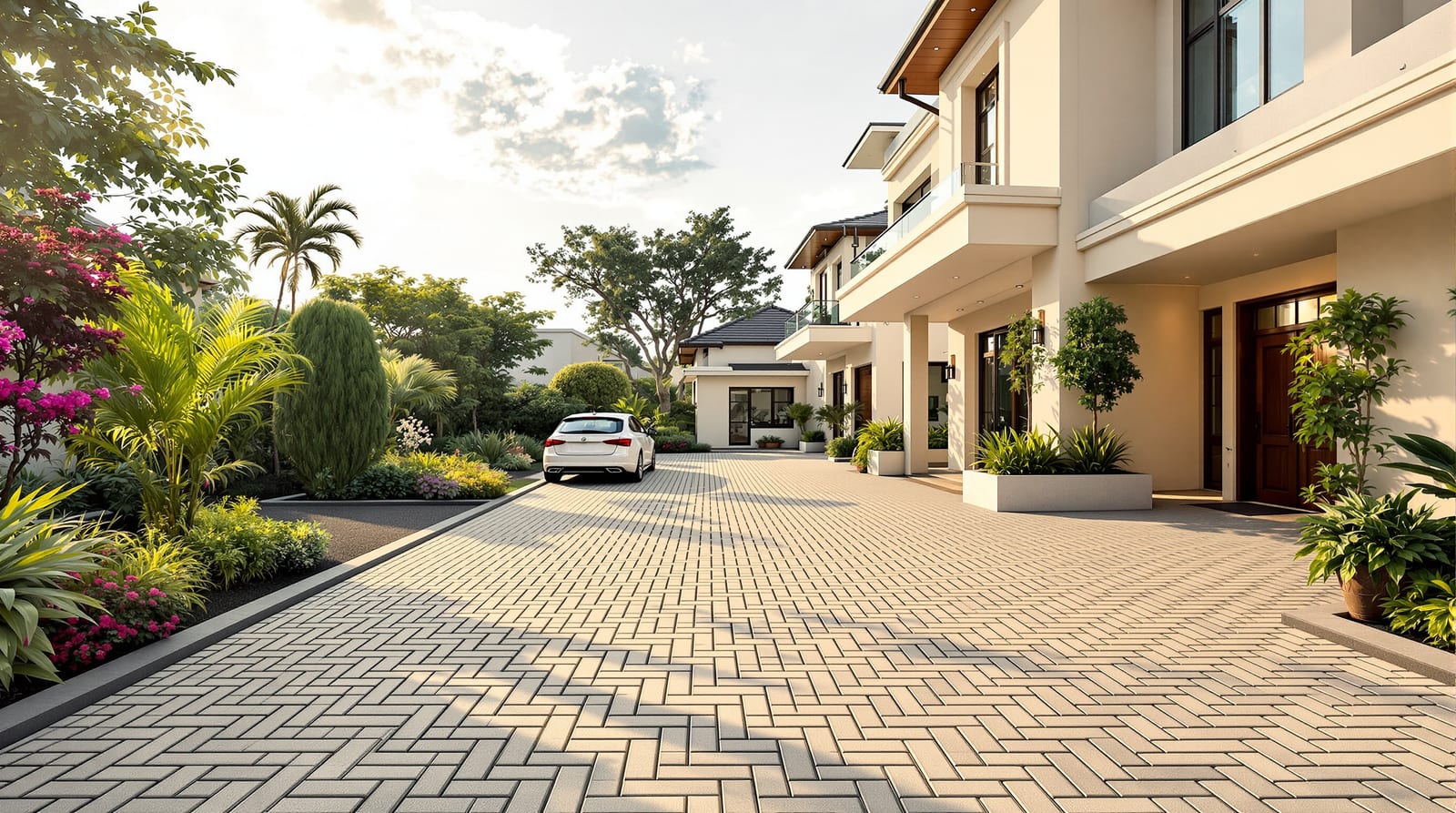
Driveway Flooring in India: Best Surfaces for Load, Wet Grip & Drainage
How to choose a driveway floor that carries vehicle weight, grips in the monsoon, sheds water and still adds kerb appeal to your home.
A driveway is the first thing a visitor sees and the hardest-worked outdoor surface on your plot. It carries a car or SUV on four small tyre patches, takes oil and coolant drips, bakes in summer sun and then has to grip wet slippers and shed a Mumbai or Bengaluru cloudburst without becoming a slide. Get it wrong and you face cracked tiles, ponding water and a slippery slope by the first monsoon. This guide ranks the surfaces that actually work for an Indian driveway, weighs them on load, wet grip, drainage, oil resistance, repairability and looks, and gives you real ₹/sq ft numbers.
What a driveway floor really has to handle
A driveway is not a patio you happen to park on. Before you pick a material, be honest about six demands it must meet at once.
- Vehicle load, carried as point load. A car weighs 1,200-2,000 kg and an SUV more, all delivered through four contact patches the size of your palm. The surface and, more importantly, the base beneath it must resist punching, sinking and cracking. Thin, pretty tiles over a weak base will pop within a season.
- Wet grip. Rain, washed-in grit and worn slippers make a driveway a real falls risk. Aim for a textured, anti-skid finish in the DIN 51130 R11 band or better for any sloped or rain-exposed run, never a polished mirror surface. Our anti-slip flooring standards guide explains R-ratings, and anti-slip flooring for wet areas covers the principle.
- Drainage and permeability. Standing water is the number-one killer of Indian driveways. You need a fall of roughly 1 in 60 to 1 in 80 toward a kerb, channel or soak-away, plus either open joints or a permeable surface so rain soaks in rather than ponding. See monsoon-ready flooring.
- Oil and stain resistance. Engine oil, brake fluid, coolant and hot black tyre rubber all stain. You want a surface that is either non-absorbent and wipeable, dark and textured enough to hide drips, or cheaply repairable in patches.
- Kerb appeal. The driveway frames your elevation. Pattern, colour and the way it meets the porch and garden all matter, so a good-looking, durable surface earns its keep.
- Repairability and cost. Outdoor surfaces take knocks. A floor you can lift and re-lay block by block ages far better than a poured slab that has to be broken out. And it all has to fit a sensible ₹/sq ft.
A covered porch and an open, sloping driveway are different problems. The porch stays drier, so a handsome stone such as kota or granite works; the open run gets sun, rain and slope, so drainage, UV stability, grip and repairability win.
The top picks, ranked
1. Paver blocks (60-80 mm interlocking) — the popular default
Interlocking concrete paver blocks are the most common Indian driveway surface, and deservedly so. Use 60 mm thickness for cars, 80 mm where a heavier vehicle or occasional truck is expected. They are laid dry over a compacted sub-base and sand bed with no rigid screed to crack, so the surface flexes with the ground, drains through its joints and stays naturally anti-skid. Best of all, an oil-stained or sunken block is simply lifted and swapped, and you can lay herringbone, basketweave or two-tone patterns for kerb appeal. Look for IS 15658 compliant pavers of at least M30-M35 grade. Full detail in our paver blocks guide, and size the job with the driveway flooring cost calculator.
2. Exposed-aggregate concrete — durable, grippy, hides drips
Exposed-aggregate concrete (the cement skin is washed back to reveal the stone chips) gives a hard-wearing, naturally anti-skid, monolithic surface with no joints to weed. The pebbly texture grips wet tyres and disguises oil and tyre marks beautifully, so it ages gracefully and looks contemporary. Being a poured slab it needs proper control joints and a sound base, and patch repairs show more than swapping a paver. See the exposed-aggregate flooring guide.
3. Stamped / coloured concrete — the decorative slab
Stamped concrete presses a textured mat into a fresh, colour-hardened slab so it mimics cobblestone, brick, slate or timber at a poured-slab price. It is strong, gives a continuous joint-free look and offers huge design freedom for kerb appeal. The catches: the surface sealer can become slippery when wet unless an anti-skid additive is mixed in, hairline cracks can appear with the slab, and it needs re-sealing every few years to keep colour. Best on gentler slopes with a textured, R11-grade finish.
4. Natural stone / cobblestone — the premium look
Granite setts, sandstone slabs and natural cobblestone give a driveway real character and outlast almost everything. Cobblestone, laid in sand like pavers, drains through its joints, is endlessly repairable and reads as heritage luxury; flamed or leathered granite is near-indestructible and grips when wet. The trade-offs are cost, a slightly bumpier ride on rough cobbles, and the need to keep mirror-polished stone out of sloping, rain-exposed runs. See cobblestone flooring and natural stone pavers.
5. Grass pavers — green and permeable
Grass pavers (concrete or HDPE grid cells planted with grass) let you park on what still reads as lawn. They are fully permeable, recharge groundwater, stay cooler than solid paving and tick green-building boxes, which is why society and villa projects increasingly use them for occasional or overflow parking. They suit light, intermittent use rather than a daily-turned, oil-dripping spot, and the grass needs watering and mowing. See grass pavers and permeable flooring.
6. Kota / granite — for the covered porch transition
Where the driveway runs under a covered car porch and meets the house, natural stone ties the two together. Kota stone is tough, cheap, cool underfoot and fine for a porch in a leather or honed (not mirror) finish; granite is harder, near-stain-proof and premium. Keep polished stone out of the open, sloping, rain-exposed stretch. See kota stone flooring and our home parking flooring guide for the porch-and-garage side of the same plot.
Comparison: surface vs load, grip, drainage and cost
The table ranks the realistic driveway choices. Cost is indicative installed 2026 ₹/sq ft and varies with city, base prep, pattern and finish.
| Surface | Best for | Vehicle load | Wet grip | Oil-stain resistance | Drainage | Repairability | Cost (₹/sq ft) |
|---|---|---|---|---|---|---|---|
| Paver block 60-80 mm | Open driveway, daily use | Excellent (spreads load) | High (textured + joints) | Medium — swap stained block | Excellent (permeable joints) | Excellent (block by block) | 60-150 |
| Exposed aggregate | Open driveway, modern look | Excellent | High | High (hides drips) | Good (sloped slab) | Fair (patch shows) | 120-220 |
| Stamped / coloured concrete | Decorative driveway | Excellent | Medium-High (with R11 additive) | Medium | Needs slope + channel | Poor (break out slab) | 130-300 |
| Cobblestone / granite setts | Premium, heritage | Excellent | High | Medium-High | Excellent (joints) | Good (re-lay setts) | 150-450 |
| Grass paver | Light / overflow, green | Good (light vehicles) | High | Low (grass + soil) | Excellent (permeable) | Good | 60-160 |
| Kota / granite (porch) | Covered porch transition | Good-Excellent | Medium-High (honed/flamed) | Medium-High | Needs slope | Fair | 60-350 |
For the parking-bay and garage side of the same project, our home parking flooring guide compares VDF concrete, epoxy and anti-skid tiles; for the wider outdoor picture see the outdoor flooring guide.
How a driveway is built: base, slope and drainage
Most driveway failures are base failures, not surface failures. A car cracks a thin slab or sinks a paver only when the layers beneath cannot spread the load or shed the water. The section below shows the build-up that lets a thin surface carry a heavy vehicle, and the fall that keeps it dry.
The rules that keep a driveway alive: compact the subgrade and lay a proper granular sub-base; never lay any surface dead level, give it a steady fall to a kerb channel or soak-away; use joints or a permeable surface so water has somewhere to go; and isolate the slab from rigid kerbs so it can move without cracking.
Design tips for kerb appeal
- Tie it to your elevation. Pick paver or stone colours that echo the compound wall, gate and façade rather than fighting them; a charcoal-and-grey two-tone reads smart and hides drips.
- Use a border. A contrasting paver or stone band along the edges frames the driveway and tidies the meeting with grass or kerb.
- Mix hardscape with green. A central runner strip of grass paver or pebble between two wheel tracks softens a large driveway and helps drainage.
- Plan the porch transition. Step the material from a textured open-driveway surface up to a honed stone porch so the look flows but the grip stays where it is needed.
- Light the edges. Recessed or bollard lighting along the driveway edge adds night-time kerb appeal and safety on the slope.
Do and don't
- Do insist on a properly compacted sub-base, the right paver thickness and a clear fall to drainage before you think about pattern.
- Do choose a textured, R11-grade anti-skid finish for any sloped, rain-exposed run.
- Don't lay glossy vitrified or polished stone on an open driveway, it will craze under point load and turn lethal when wet.
- Don't lay the surface dead level or let it pond, trapped monsoon water is the commonest cause of failure.
- Do keep a few spare pavers or setts from the original lot so stained or cracked units can be swapped invisibly later.
Care and maintenance
Sweep grit off regularly so it does not grind the surface. Hose down oil drips quickly, and on pavers or cobbles swap a badly stained unit rather than scrubbing the whole floor. Top up joint sand on paver and cobblestone driveways once a year. Re-seal stamped or coloured concrete every two to four years to hold colour and grip. Keep weeds out of permeable joints, and before each monsoon clear the kerb channel and soak-away so water still drains. For the full routine see our floor cleaning guide.
Frequently asked questions
Which driveway flooring is best for Indian conditions?
For most homes, IS 15658 interlocking paver blocks (60 mm for cars, 80 mm for heavier vehicles) are the best all-round driveway flooring in India: they spread vehicle load, drain through their joints, grip when wet, are repairable block by block and offer plenty of patterns. Exposed aggregate and cobblestone are strong premium alternatives, and grass pavers suit light or overflow parking where you want permeability and greenery.
What thickness of paver block should a driveway use?
Use 60 mm thick paver blocks for cars and light vehicles, and 80 mm where an SUV, occasional truck or heavier load is expected. Equally important is the base: a compacted subgrade, a 150-200 mm granular sub-base and a 30-50 mm sand bed let the blocks spread the point load without sinking or cracking.
How much does driveway flooring cost per square foot in India?
As an indicative installed 2026 figure, expect roughly ₹60-150 per sq ft for paver blocks, ₹120-220 for exposed aggregate, ₹130-300 for stamped concrete, ₹150-450 for cobblestone or granite setts and ₹60-160 for grass pavers. Base preparation, drainage works, pattern complexity and city rates move these numbers, so use the driveway flooring cost calculator for your plot.
How do I stop my driveway being slippery in the monsoon?
Choose a textured, anti-skid surface in the DIN 51130 R11 band or better, such as paver blocks, exposed aggregate or flamed stone, never polished tile or glossy stone. Give the driveway a steady fall of about 1 in 60 to 1 in 80 to a kerb channel or soak-away so water never ponds, and keep the joints and drains clear so rain soaks away.
Are grass pavers strong enough for a car?
Yes for light and intermittent use. Concrete or HDPE grid grass pavers carry cars and light vehicles while staying permeable and green, which makes them popular for villa overflow and society parking. They are less suited to a daily-turned, oil-dripping main driveway, and the grass needs watering and occasional mowing to stay healthy.
Export this guide
Related Guides — Deep-dive reading
Home Parking Flooring in India: Best Surfaces for Car Porch, Driveway & Garage
How to choose a parking floor that takes vehicle load, resists tyre marks and oil drips, drains the monsoon and still looks good.
Flooring & SurfacesGarden Path Flooring in India: Natural, Anti-Slip & Permeable Walkway Materials (2026)
How to choose path and walkway flooring that blends with greenery, grips when wet, drains the monsoon and stays low-maintenance.
Flooring & SurfacesCourtyard Flooring in India: Cool, Anti-Slip Stone & Aangan Materials (2026)
How to floor an open-to-sky aangan or central courtyard so it stays cool underfoot, grips in the rain, drains to a central point and ages beautifully.
Flooring & SurfacesRelated Tools — Try Free
Driveway Flooring Cost Calculator
Estimate driveway surfacing cost — paver blocks, exposed aggregate, stamped concrete, cobblestone or grass paver.
Flooring CalculatorFlooring Cost Calculator
Estimate the all-in cost of a floor — material, laying, wastage, skirting and GST — by area and material.
Flooring CalculatorParking Flooring Calculator
Estimate commercial or society parking floor cost — paver blocks, VDF concrete, epoxy or grass paver.
Flooring Calculator