
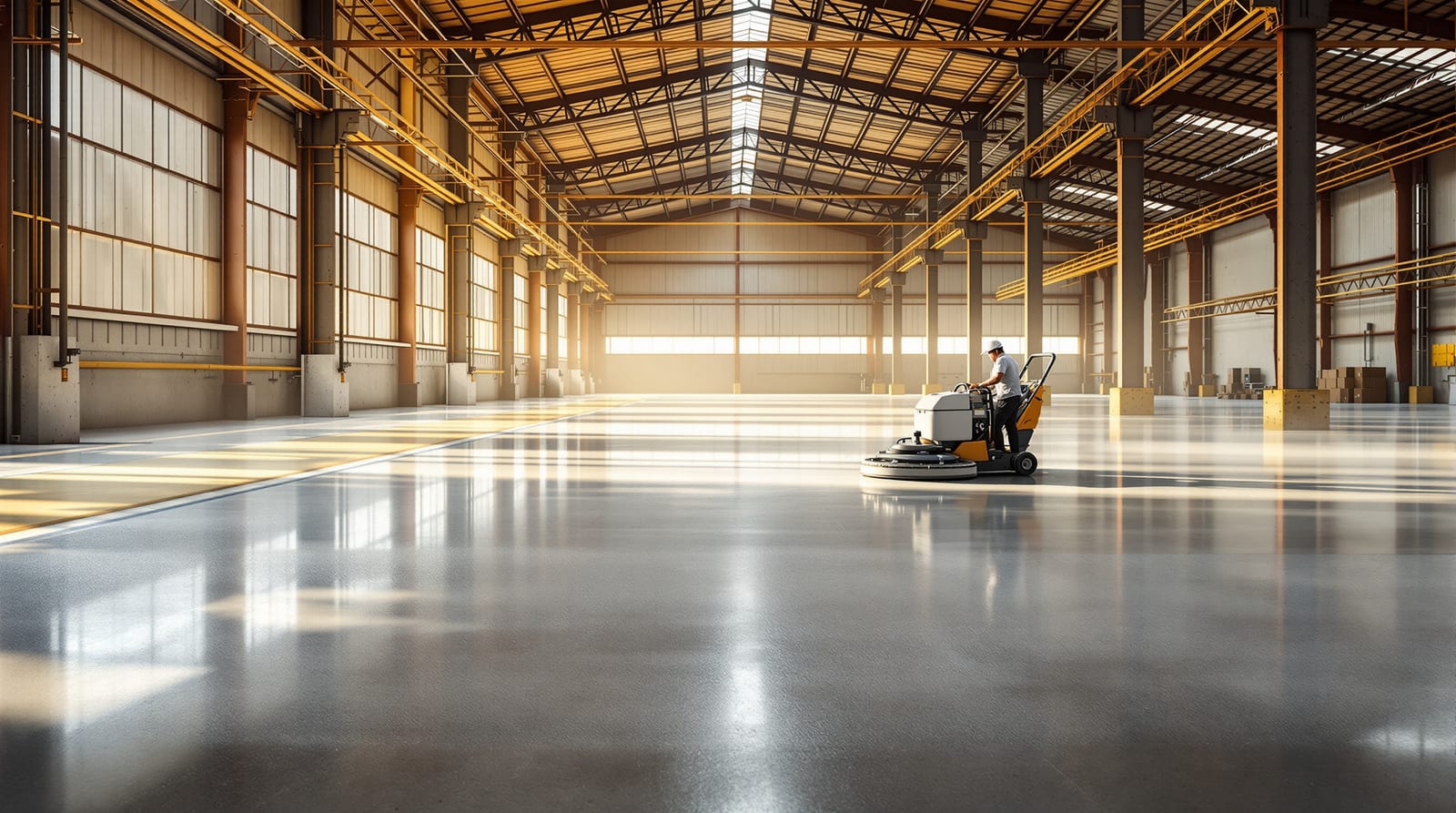
Vacuum Dewatered Concrete (VDF / Tremix) Flooring in India: Process, Strength, Cost & Where It Suits
Vacuum dewatered concrete — the VDF or "Tremix" floor — sucks the excess mixing water out of a freshly laid slab through vacuum mats to leave a denser, stronger, flatter, dust-free surface. It is the workhorse floor for warehouses, factories, parking, godowns, footpaths and industrial yards at ₹60–200 per sq ft. Here is how it is laid, why it is tougher than ordinary concrete, its joints, curing, hardener options, costs and trade-offs.
Vacuum dewatered concrete — known on Indian sites as VDF flooring or by the old brand name "Tremix" — is the quiet engineering trick behind most good warehouse, factory and parking floors in the country. The idea is simple and clever: after the concrete is laid and levelled, special vacuum mats are placed on the wet surface and a pump literally sucks the surplus mixing water back out, pulling the cement particles tighter together. The result is a denser, stronger, flatter, harder-wearing and dust-free floor than ordinary concrete, at a very modest ₹60–200 per sq ft.
This guide explains what VDF actually does, why removing water makes concrete stronger, the full laying sequence from pour to cure, the joints and thickness that matter, the surface hardener option, where it suits, its trade-offs, and how it compares with ordinary concrete and with a granolithic topping.
What vacuum dewatered concrete flooring is
Concrete needs only a small amount of water to react chemically with cement and set. But to make it workable enough to mix, transport, place and level, masons add far more water than the reaction needs. That extra water is the enemy of strength: as the slab dries it leaves behind tiny voids and capillaries where the water used to be, so the hardened concrete is more porous, weaker at the surface, and prone to dusting, abrasion and shrinkage cracks.
Vacuum dewatering attacks the problem at exactly the right moment. Immediately after the fresh concrete is screeded flat, a filter mat and a top cover sheet are laid over it and connected to a vacuum pump. The suction draws the surplus water — typically around 15 to 25 per cent of the mixing water — up out of the slab through the mat in a few minutes, while the cement and aggregate stay behind. With less water in it, the concrete instantly stiffens, settles tighter, and effectively achieves a much lower water-cement ratio at the surface than it was poured at. A floor poured wet and workable ends up behaving like a much stiffer, stronger mix.
The "Tremix" name many Indian contractors still use comes from one of the original equipment systems, in the same way "Xerox" came to mean photocopy. The proper generic term is VDF — vacuum dewatered flooring. Studio Matrx groups it with the seamless, in-situ industrial floors, alongside granolithic toppings and floor hardeners covered in the industrial-flooring-india and specialty-flooring-guide-india overviews.
Why removing water makes the floor stronger
The whole benefit chain flows from one principle: lower water-cement ratio means stronger, denser concrete. Pulling the surplus water out delivers several gains at once.
- Higher strength. Compressive strength typically rises markedly — site experience and the original system literature claim gains of the order of 20 to 30 per cent over the same concrete left undewatered, because the densified matrix has fewer voids.
- Much harder, abrasion-resistant surface. The top few millimetres — the layer that takes forklift wheels, dragged crates and grit — become far denser and harder, often cited at roughly double the surface abrasion resistance of ordinary concrete. This is the property that matters most for industrial floors.
- Less shrinkage and fewer cracks. Less water to evaporate later means less drying shrinkage, so a well-detailed VDF floor with proper joints cracks far less than a wet, undewatered slab.
- Dust-free, dense top. The closed surface does not generate the fine cement dust that plagues bare concrete floors — important in stores, food units and clean-handling areas.
- Fast turnaround. The slab stiffens immediately after dewatering, so workers can start power-floating within an hour or two, and the floor takes light traffic far sooner than a conventional slab.
- Flat and level. Screeded and then power-floated to a tight tolerance, a VDF floor finishes flatter than a hand-trowelled concrete floor — useful for high-rack warehouses and forklift movement.
The diagram below shows what happens during the dewatering step: the vacuum mat and pump pulling surplus water up out of the freshly screeded slab.
How VDF flooring is laid — the process step by step
VDF is laid by specialist flooring contractors with the right equipment train: a double-beam vibrating screed, the vacuum pump and mats, a power float ("helicopter") and a power trowel. The sequence runs fast and continuously, which is why it needs an experienced crew.
1. Prepare the base. A compacted, well-graded sub-base is laid to falls, blinded, and covered with a polythene damp-proof membrane. Edge forms and any reinforcement mesh or dowels are set to line and level.
2. Pour and spread. A controlled-workability concrete — commonly M20 to M30, often with 10–20 mm aggregate — is placed between the forms to the required thickness. Ready-mix from UltraTech, ACC, Ambuja or a site batching plant is typical on larger jobs.
3. Screed and vibrate. A double-beam vibratory screed is drawn across the surface, compacting the concrete and striking it off dead level. Good compaction here is essential before dewatering.
4. Vacuum dewater. The filter mats and cover sheets are laid over the screeded surface and the vacuum pump is run. Suction time is roughly 1.5 to 3 minutes per centimetre of slab thickness — so a 100–150 mm floor is dewatered in a handful of minutes per mat position. The surplus water is drawn out and discharged.
5. Power float (skip float). As soon as the dewatered slab is firm enough to walk on with minimal indentation, it is power-floated with a disc to consolidate and flatten the surface and bring up a smooth, tight matrix.
6. Power trowel. Finally the floor is steel power-trowelled — sometimes in two or three passes as it stiffens — to close the surface into a hard, dense, smooth finish. A broom or anti-skid texture can be applied instead where slip resistance outdoors matters more than smoothness.
7. Cut and cure. Joints are saw-cut early (see below), and the floor is moist-cured continuously for at least 7 days — ponding, wet hessian or a curing compound — to develop strength and avoid surface crazing. India's heat and dry winds make curing the step where VDF quality is won or lost.
Thickness, joints and curing
These three details separate a VDF floor that lasts decades from one that cracks and curls in a year.
Thickness is driven by load, not finish. A typical light warehouse or showroom floor runs 100–150 mm over a good sub-base; heavy-loaded factory and parking floors with point loads from racking, trucks or machinery go to 150–200 mm or more, with the slab thickness and reinforcement designed by the structural engineer to the imposed loads. VDF densifies the surface — it does not replace structural design.
Joints control the cracking that all concrete wants to do as it shrinks. A VDF floor needs a disciplined joint layout: construction joints at the edges of each day's pour, and sawn contraction joints (typically cut within hours, while the concrete is green, to about a quarter to a third of the slab depth) dividing the floor into reasonably square panels — commonly in the order of 3 to 4.5 m each way, depending on thickness and design. Joints are later filled with a flexible polysulphide or polyurea sealant in trafficked floors so wheels do not spall the arrises. Skimping on joints is the commonest cause of random cracking in otherwise good VDF floors.
Curing is non-negotiable. Because the surface is now dense and low in water, it is also vulnerable to plastic and drying shrinkage cracks if it is allowed to dry too fast in the sun. Continuous moist curing for a minimum of 7 days — or a quality curing compound where ponding is impractical — is essential. For the resealing and ongoing care of any cementitious floor, the floor-resealing-guide-india and floor-cleaning-guide-india companions apply.
Surface hardener — the optional upgrade
For genuinely heavy-duty floors, a dry-shake floor hardener is broadcast onto the VDF surface during the floating stage and trowelled in. These are cement-based shakes loaded with hard mineral aggregate (non-metallic, such as quartz or emery) or metallic aggregate (iron filings) that fuse into the top few millimetres to create an extremely abrasion- and impact-resistant wearing skin.
VDF plus a non-metallic hardener is the standard "good warehouse floor" specification in India — it combines the dense dewatered body with a super-hard surface, at a modest premium over plain VDF. Metallic hardeners go onto the most punishing floors (heavy steel-wheeled traffic, foundries) but can rust-stain in wet areas, so they are used selectively. This hardener layer is the same family of products discussed in the industrial-flooring-india overview, and for chemical or wet-process areas a VDF base is often later overlaid with an epoxy-flooring-india or PU resin topping.
Costs in India
VDF is one of the most cost-effective ways to get a high-quality industrial floor, because the materials are commodity concrete and the value is added by process, not expensive product. The table below sets indicative 2026 applied rates; all are indicative and vary by city, slab thickness, concrete grade and contractor. Add 18 per cent GST, and remember the structural slab below is usually a separate RCC cost.
| Specification | Indicative ₹/sq ft (applied) | Notes / best use |
|---|---|---|
| Plain VDF floor (100–150 mm) | ₹60–110 | Warehouses, godowns, showroom backs, footpaths |
| VDF + non-metallic floor hardener | ₹90–150 | Standard heavy warehouse / factory / parking floor |
| VDF + metallic hardener | ₹130–200 | Foundries, very heavy steel-wheeled traffic |
| VDF as base under epoxy / PU topping | ₹60–110 (VDF) + topping | Food, pharma, chemical, wet-process floors |
| Heavy thick VDF (150–200 mm, designed) | ₹120–200+ | Truck parking, high racking, point loads |
Rates above are for the floor finish system; the structural sub-base and RCC slab, joint sealants, and any reinforcement are additional. For a full project estimate use the Studio Matrx flooring cost calculator, and the broader benchmarks in flooring-cost-per-square-foot-india and flooring-cost-india-2026.
Where VDF flooring suits — and where it does not
VDF is the default workhorse wherever a large area needs a tough, flat, dust-free, low-maintenance concrete floor on a sensible budget.
- Warehouses, godowns and logistics — large flat floors taking forklifts and racking.
- Factories and workshops — abrasion-resistant, dust-free production floors.
- Parking, basements and ramps — durable, washable, with a brushed anti-skid finish on slopes.
- Footpaths, industrial yards and external paving — a broom-finished VDF resists weather and traffic.
- Showrooms and large retail backs — sometimes left as a sealed or polished VDF for an industrial-chic look (see polished-concrete-flooring-india).
It is less suited to homes and finished interiors where a softer or more decorative floor is wanted — though a sealed or ground VDF can be the base for a polished-concrete or microcement finish. It is overkill for small areas where the equipment mobilisation cost is not justified, and it is not a wet-chemical-resistant floor on its own — for that it becomes the base for an epoxy or PU topping.
VDF vs ordinary concrete vs granolithic
The three are easy to confuse because all are grey cementitious floors. The table below sets the differences.
| Property | Ordinary concrete floor | Vacuum dewatered (VDF) | Granolithic topping |
|---|---|---|---|
| What it is | Plain placed-and-trowelled slab | Same concrete with surplus water vacuumed out | Rich cement + hard granite-chip wearing topping over a base |
| Surface strength / abrasion | Soft, dusts and wears | High — dense, hard, dust-free top | Very high — artificial-stone wearing skin |
| Flatness | Hand-trowel tolerance | Screeded + power-floated, flatter | Trowelled, depends on mason |
| Shrinkage cracking | More (high water content) | Less (lower water content) | Low if bonded and cured |
| Best area size | Any | Large floors (equipment-driven) | Any, incl. stairs and small bays |
| Indicative ₹/sq ft | ₹40–90 | ₹60–200 | ₹50–150 (topping over a base) |
| Best use | General, light-duty | Warehouses, factories, parking, paving | Heavy industrial floors, stairs, garages |
In practice VDF and granolithic are complementary, not rivals: VDF densifies a whole slab quickly over large areas, while a granolithic topping adds a separately laid hard wearing skin and suits stairs and smaller heavy-duty bays. Many industrial specs use VDF for the main warehouse and a granolithic or hardener finish at the most punished spots. For the full picture of heavy-duty options, see industrial-flooring-india, granolithic-flooring-india and polished-concrete-flooring-india; for the map of all alternative floors, the specialty-flooring-guide-india pillar.
Frequently asked questions
Is VDF flooring the same as Tremix?
Effectively yes. "Tremix" is an old equipment brand name that became the common Indian term for the vacuum dewatering process, much like "Xerox" for photocopying. The correct generic name is VDF — vacuum dewatered flooring. Any competent contractor with a vibrating screed, vacuum pump and mats, power float and trowel can deliver a VDF floor; you are buying the process, not a proprietary product.
How much stronger is VDF than ordinary concrete?
The same concrete mix, when dewatered, typically gains in the order of 20 to 30 per cent in compressive strength and around double the surface abrasion resistance, because pulling the surplus water out lowers the effective water-cement ratio and densifies the matrix. The biggest practical gain is the hard, dust-free, abrasion-resistant top surface — exactly what industrial floors need.
Does VDF flooring crack?
All concrete shrinks and wants to crack; VDF cracks far less than a wet undewatered slab because it has less water to lose. But it still needs a proper joint layout — sawn contraction joints cutting the floor into reasonably square panels, cut early while green — plus good curing. Most random cracking in VDF floors comes from skimped joints or fast drying in the sun, not from the dewatering itself.
Can VDF be used in homes?
It is unusual but possible. VDF gives a flat, hard, dust-free slab that makes an excellent base for a polished-concrete or microcement finish, or can be sealed for an industrial-chic look. For most homes a softer or more decorative floor is chosen, and the equipment mobilisation makes small areas uneconomic, so VDF stays mainly in warehouses, factories, parking and large commercial floors.
How long before a VDF floor can take traffic?
Foot traffic and power-floating can start within an hour or two of dewatering because the slab stiffens immediately. Light traffic follows in a few days, but the floor must still be moist-cured for at least 7 days to reach strength, and heavy loads such as full racking or trucks should wait until the concrete has gained adequate strength — usually around 28 days — as confirmed by the structural engineer.
Export this guide
Related Guides — Deep-dive reading
Industrial Flooring in India: Floor Hardeners, VDF, Epoxy & PU Systems for Factories, Warehouses & Parking — Method, Flatness & Cost
Industrial flooring is the family of heavy-duty floor systems built for factories, warehouses, godowns, workshops, parking and logistics — dry-shake floor hardeners, vacuum-dewatered concrete, granolithic, epoxy and PU toppings, and polished concrete, all rated for forklift traffic, point loads, abrasion, chemicals and dust control at roughly ₹80–400 per sq ft. Here is how to choose the right system by use, with the joints, curing, flatness and cost detail.
Flooring & SurfacesGranolithic Flooring in India: Cement-and-Granite Wearing Topping for Industrial Floors, Method, Cost & IS 5491
Granolithic is the heavy-duty cement-and-crushed-granite wearing topping trowelled over a concrete base for factories, warehouses, garages, godowns, staircases and high-traffic floors — abrasion-resistant, dust-free and cheap at ₹50–150 per sq ft. Here is what it is, how it is laid to IS 5491, its finishes, where it suits and its trade-offs.
Flooring & SurfacesWarehouse Flooring in India: VDF Concrete, Hardeners & FM2 Flatness
How vacuum-dewatered concrete with a dry-shake hardener became the workhorse warehouse floor — and how load, flatness and joint design decide whether it survives forklifts and high-bay racking.
Flooring & SurfacesRelated Tools — Try Free
Flooring Cost Calculator
Estimate the all-in cost of a floor — material, laying, wastage, skirting and GST — by area and material.
Flooring CalculatorHome Building & Interior Cost Calculator — 20 Cities
Construction + interior costs for 20 Indian cities across kitchen, wardrobes, flooring, painting, ceiling.
Cost CalculatorInterior Budget Planner
Live room-wise and component-wise cost breakdown in ₹ with contingency, GST, and PDF summary.
Budget Calculator