
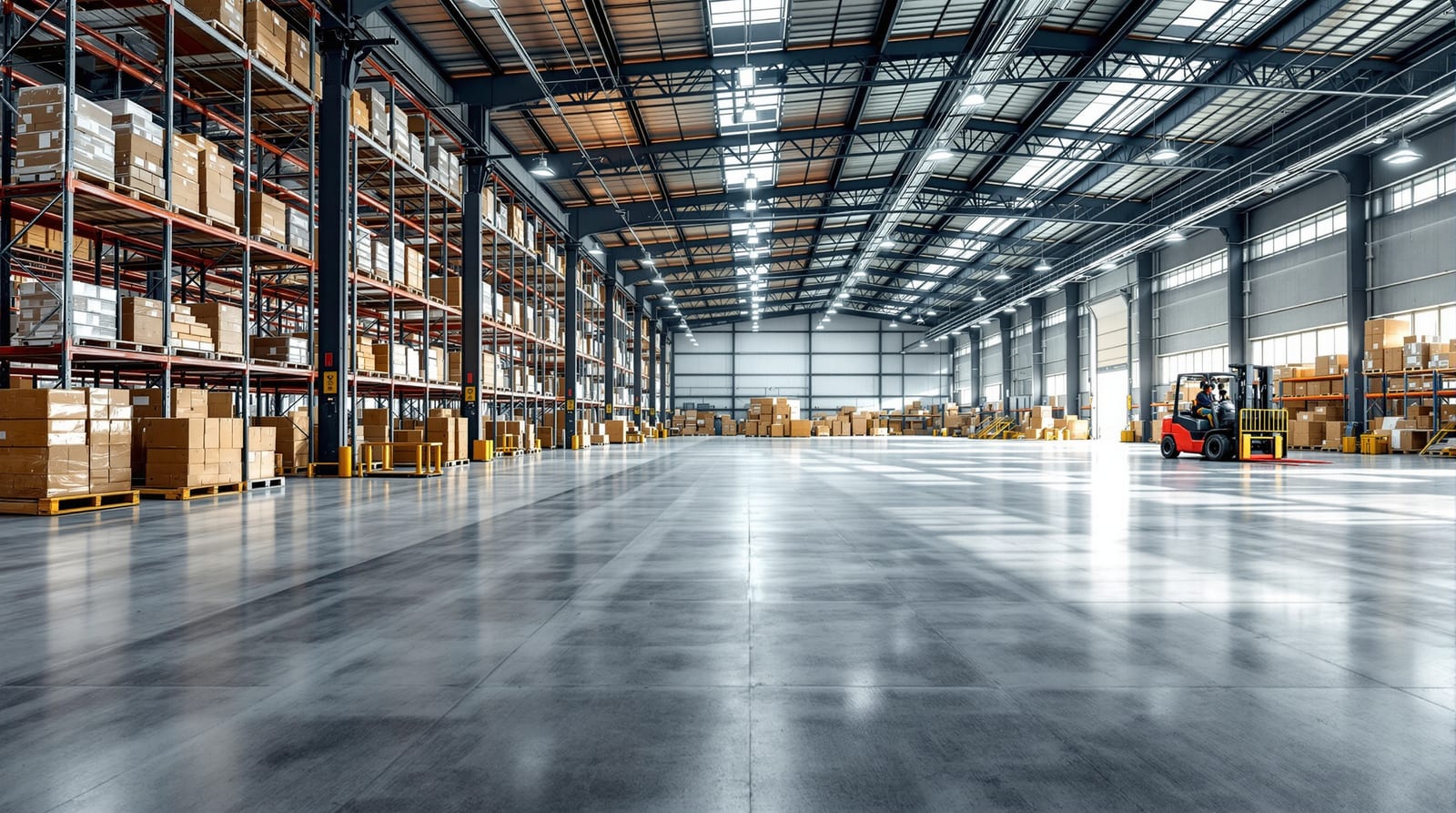
Industrial Flooring in India: Floor Hardeners, VDF, Epoxy & PU Systems for Factories, Warehouses & Parking — Method, Flatness & Cost
Industrial flooring is the family of heavy-duty floor systems built for factories, warehouses, godowns, workshops, parking and logistics — dry-shake floor hardeners, vacuum-dewatered concrete, granolithic, epoxy and PU toppings, and polished concrete, all rated for forklift traffic, point loads, abrasion, chemicals and dust control at roughly ₹80–400 per sq ft. Here is how to choose the right system by use, with the joints, curing, flatness and cost detail.
Industrial flooring is not one material but a family of heavy-duty floor systems engineered for places that punish a floor — factories, warehouses, godowns, workshops, parking decks and logistics hubs. The job is brutally practical: carry forklift wheels and racking point loads, resist abrasion from dragged crates and grit, shrug off oils and chemicals, stay flat enough for tall racking and fast trucks, and above all not generate dust. At roughly ₹80–400 per sq ft applied, the right system pays for itself in years of low maintenance; the wrong one dusts, cracks and fails inside a season.
This guide maps the menu of industrial floors used in India — dry-shake floor hardeners, vacuum-dewatered concrete, granolithic toppings, epoxy and PU coatings, and polished concrete — and shows how to choose by what the floor actually has to do, with the joints, curing, flatness and cost detail that decide whether a heavy floor lasts.
What "industrial flooring" actually means
In an Indian factory or warehouse, the floor is structural, not decorative. It usually starts with a thick reinforced concrete slab on a compacted, well-drained sub-base. What turns that slab into an industrial floor is the wearing surface and how it is finished:
- A monolithic surface treatment worked into the fresh concrete — a dry-shake floor hardener, vacuum dewatering, or a power-trowelled granolithic topping — that hardens and densifies the top few millimetres.
- Or a bonded coating system laid over a cured slab — an epoxy or polyurethane (PU) resin floor — that adds chemical resistance, hygiene and colour.
- Or the slab is mechanically ground and polished to expose and refine the concrete itself.
The slab carries the load; the surface system carries the wear, the dust control, the chemical and the hygiene duty. Studio Matrx groups these as the heavy-duty, seamless, in-situ industrial floors, distinct from the tiled, stone, resilient or paving floors covered elsewhere in the cluster.
The menu of industrial floor systems
Each system suits a different duty. The table below is the quick map; the sections that follow add the detail.
| System | What it is | Typical ₹/sq ft (applied) | Best at |
|---|---|---|---|
| Dry-shake floor hardener (non-metallic) | Quartz/mineral aggregate broadcast into fresh slab, trowelled in | ₹80–200 | General factories, warehouses, dust control |
| Dry-shake floor hardener (metallic) | Iron-aggregate hardener for the most punishing floors | ₹150–300 | Steel-wheeled, impact and very heavy loads |
| Vacuum-dewatered concrete (VDF / "Tremix") | Vacuum-dewatered dense, flat slab | ₹60–200 | Large flat warehouse and parking slabs |
| Granolithic topping | Cement + hard granite chips trowelled topping | ₹50–150 | Budget abrasion resistance, stairs, small bays |
| Industrial epoxy (coating to screed) | Bonded resin coating or self-levelling screed | ₹100–400+ | Chemicals, hygiene, dust-free, coloured |
| PU / PU-cement resin | Seamless polyurethane, more flexible than epoxy | ₹150–500 | Food, pharma, cold storage, thermal shock |
| Polished concrete | Mechanically ground and polished slab | ₹100–400 | Industrial-chic, low maintenance, retail-grade |
| Anti-static / ESD floor | Conductive vinyl or epoxy that drains charge | ₹150–600 | Electronics, server rooms, ESD-sensitive lines |
Dry-shake floor hardeners — the workhorse surface
A dry-shake hardener is a pre-blended powder of hard aggregate, cement and admixtures that is broadcast (shaken) onto the surface of a freshly placed concrete slab while it is still plastic, then floated and power-trowelled in. It fuses with the slab to form a dense, monolithic, abrasion-resistant and dust-proof wearing skin in a single pour — no separate topping, no bonding interface to fail.
There are two families. Non-metallic hardeners use graded quartz, silica or natural hard mineral aggregate; they are non-rusting, suit general industrial and warehouse floors, and come in grey plus colours. Metallic hardeners use specially processed iron aggregate; they are harder and tougher still, made for floors under steel-wheeled trolleys, impact and the heaviest point loads, but they can rust where chronically wet, so they are kept to dry heavy-duty areas. Indian suppliers such as Fosroc, Sika, BASF/MBCC, Ironite-type products and Dr. Fixit cover both. A typical dose is around 3–5 kg per sq m for non-metallic and higher for metallic.
Vacuum-dewatered concrete (VDF / Tremix)
VDF, known on Indian sites by the "Tremix" process name, is a method rather than a coating. Fresh concrete is screeded, then a vacuum mat and pump suck out surplus mix water through the top, pulling the aggregate together. The result is a denser, stronger, lower-water-cement-ratio slab with a flat, hard, low-dust surface, finished by power floating and trowelling — often with a dry-shake hardener broadcast in for an even tougher skin. It shines on large open bays: warehouses, parking and factory floors where flatness and dust-free toughness over thousands of square metres matter. Studio Matrx covers the method in depth in the vacuum dewatered concrete flooring guide.
Granolithic toppings
Granolithic is a rich cement-and-crushed-granite mortar trowelled as a 20–40 mm wearing topping over a concrete base, laid to IS 5491. It is the value choice for abrasion resistance and dust control on small-to-medium bays, stairs and budget jobs where you do not need chemical resistance or huge flatness. It bonds best monolithically to a green base. The full method, mixes and trade-offs are in the granolithic flooring guide.
Epoxy and PU resin toppings
Where the floor must resist chemicals, stay hygienic, or carry a colour and gloss, a resin system is bonded over the cured concrete. Epoxy floors range from thin roller coats through self-levelling screeds to heavy-duty mortar systems; they are seamless, chemical- and stain-resistant, easy to clean, and the default for clean rooms, pharma, electronics, showrooms and washdown areas. PU (polyurethane) and PU-cement floors are more flexible, more thermal-shock and chemical resistant, and tolerate hot-and-cold wet processes better — the choice for food and beverage factories, dairies, breweries and cold storage. Both are laid over a sound, dry, mechanically prepared slab. See the epoxy flooring guide and the PU resin flooring guide for the system types, build-ups and where each wins.
Polished concrete and anti-static floors
Polished concrete mechanically grinds and refines the slab itself to a hard, low-maintenance, dust-free surface that can pass as an industrial-chic finish in retail, showrooms and warehouses — covered in the polished concrete flooring guide. Anti-static / ESD floors (conductive vinyl or epoxy) drain static charge to earth for electronics manufacturing, server rooms, labs and operation theatres; they are a specialist sub-type detailed in the anti-static ESD flooring guide.
The build-up: base, topping and hardener
Whatever the surface, an industrial floor is a layered system, and most failures trace to the layer below the one you can see. The diagram shows a typical heavy-duty build-up.
The non-negotiables that protect the whole build-up are a well-compacted, drained sub-base (settlement here cracks everything above), a damp-proof membrane under the slab (moisture rising through the slab blisters epoxy and PU coatings), a slab designed for the real loads, and disciplined curing of the concrete. In India's heat and dry winds, skipped curing is the single most common cause of dusting, crazing and a weak surface.
How to choose by use
Pick the system from what the floor must survive, not from price alone. The table below is the decision map.
| Requirement | Recommended system | Indicative ₹/sq ft |
|---|---|---|
| General factory / workshop, forklift traffic, dust control | Concrete slab + non-metallic dry-shake hardener | ₹80–200 |
| Very heavy point loads, steel wheels, impact (dry) | Slab + metallic dry-shake hardener | ₹150–300 |
| Large flat warehouse / parking / logistics bays | VDF (Tremix) slab, with hardener broadcast in | ₹60–200 |
| Budget abrasion resistance, stairs, small bays | Granolithic topping | ₹50–150 |
| Chemicals, acids, oils, stain resistance | Epoxy coating or screed | ₹100–400+ |
| Hygiene-critical, washdown, food contact | Epoxy or PU self-levelling, coved skirting | ₹150–450 |
| Food / pharma / cold storage, thermal shock, wet process | PU / PU-cement | ₹150–500 |
| Electronics, server rooms, ESD-sensitive | Anti-static / ESD vinyl or epoxy | ₹150–600 |
| Industrial-chic interior, showroom, low maintenance | Polished concrete | ₹100–400 |
| Parking decks, driveways, external yards | Paver blocks or VDF, anti-skid texture | ₹80–250 |
A few rules of thumb. For most ordinary factories and warehouses, a hardened concrete slab — VDF and/or a dry-shake hardener — is the most cost-effective answer and needs no separate coating. Reach for epoxy only when chemicals, hygiene or colour demand it; reach for PU when there is heat, thermal cycling or food processing. Use anti-static only where electronics or static genuinely matter, because it costs a premium. And remember that many real floors are hybrids: a VDF or granolithic base in the bulk areas, with epoxy or PU coved zones in the wet, clean or chemical rooms.
Performance requirements: load, abrasion, dust and flatness
Specifying an industrial floor means writing down four things and choosing the system to meet them.
Load. Define the uniformly distributed load (kN per sq m), the racking leg point loads, and the wheel loads of the heaviest forklift or truck. These size the slab thickness and reinforcement; the surface system does not carry structural load. Get the structural engineer to design the slab to IS 456 against these.
Abrasion. Grit, dragged loads and wheels grind a floor. Abrasion resistance is the headline duty of hardeners and granolithic; it is graded (for example AR1 to AR6 in some specs, or by depth of wear test). The harder the aggregate and the better the trowelling and curing, the slower the wear.
Dust-proofing. Bare power-trowelled concrete still dusts over time. Dust-proofing comes from a dry-shake hardener, a granolithic topping, a silicate/lithium densifier, or a resin coating — essential in stores, food units and electronics where dust contaminates product.
Flatness. Tall narrow-aisle racking and fast trucks need flat, level floors, specified to a flatness standard — FM2 (and the tighter FM1/super-flat for very narrow aisles) in the TR34 system, expressed as FF (flatness) and FL (levelness) numbers. VDF and laser-screed placing achieve flatness; defined-movement vs free-movement areas get different tolerances. Loosely-trafficked general floors can accept FM3.
Joints, curing and finishing
The detail that makes or breaks an industrial floor is joints and curing.
Joints. Concrete shrinks as it cures and moves with temperature, so floors are divided by joints. Construction joints end a day's pour; contraction (saw-cut) joints are cut early to force shrinkage cracks into straight lines; isolation joints separate the floor from columns, walls and machine bases. Joints are the weak points under wheels — they spall and chip — so heavy-duty floors use armoured (steel-edged) joints and joint sealants/fillers, and good design minimises joint length with larger pours and dowels for load transfer. Poorly cut or unfilled joints are the commonest forklift-floor complaint.
Curing. Continuous moist curing (ponding, wet hessian, or a curing compound) for at least 7 days is non-negotiable. A floor allowed to dry early dusts, crazes and ends up weak at exactly the surface that takes the wear.
Finishing. Power floating and steel power-trowelling (helicopter machines) close and densify the surface on large bays; the timing of each trowel pass against the concrete's set is a craft. For resin floors, the cured slab must be shot-blasted or diamond-ground to a sound, clean, dry profile before priming — coatings laid over laitance or damp concrete peel.
Cost of industrial flooring in India
Costs below are indicative for 2026 and vary with city, area, slab thickness, hardener type, flatness class and labour; they are the applied surface system, with the structural slab usually costed separately.
| System | Indicative ₹/sq ft (applied) | Notes |
|---|---|---|
| Non-metallic dry-shake hardener on slab | ₹80–200 | Most common factory/warehouse spec |
| Metallic dry-shake hardener | ₹150–300 | Heaviest, steel-wheeled, impact floors |
| VDF (Tremix) finishing | ₹60–200 | Method cost over the slab; add hardener |
| Granolithic topping | ₹50–150 | Over a base; cheapest durable topping |
| Industrial epoxy (coat to SL screed) | ₹100–400+ | Rises with thickness and chemical grade |
| PU / PU-cement | ₹150–500 | Premium; food, pharma, thermal shock |
| Polished concrete | ₹100–400 | Grind and polish of the slab |
| Anti-static / ESD floor | ₹150–600 | With copper grid and earthing |
For a project-wide estimate use the Studio Matrx flooring cost calculator, and for the wider picture see the flooring cost per square foot in India guide. Where the goal is a working industrial floor rather than a finish, the slab, curing and joints are as much of the budget as the surface system — under-spending there is a false economy.
Pros and cons of industrial flooring systems
| Pros | Cons |
|---|---|
| Engineered for heavy load, abrasion and traffic | Needs a properly designed slab and sub-base under it |
| Dust-free, easy to clean and maintain | Curing and joint discipline are unforgiving in India's heat |
| Seamless, monolithic options have no joints to harbour dirt | Resin coatings demand a dry, well-prepared, moisture-controlled slab |
| Wide menu — match cost to duty exactly | Wrong system for the duty fails fast (rust, peel, dust) |
| Hardeners and VDF finish the slab in one pass | Premium hygiene/ESD/PU systems are expensive |
| Resin systems add chemical resistance and hygiene | Joints under forklifts spall if not armoured and sealed |
| Long service life when specified and laid correctly | Repairs to worn or peeled areas can be visible and disruptive |
Where industrial flooring fits in the cluster
Industrial flooring is the decision layer that sits above the individual heavy-duty systems. For the method detail of each, follow the dedicated guides: vacuum dewatered concrete flooring for large flat slabs, granolithic flooring for cement-and-granite toppings, epoxy flooring and PU resin flooring for resin systems, and polished concrete flooring for ground-and-polished slabs. For where industrial floors sit among all the alternative and specialty floors — seamless, resilient, paving and technical — see the specialty flooring guide.
Frequently asked questions
Which industrial floor is best for a warehouse with forklift traffic?
For most warehouses, a properly designed reinforced slab finished with a non-metallic dry-shake floor hardener — and laid by the VDF (Tremix) method on large bays for density and flatness — is the most cost-effective answer. It is abrasion-resistant, dust-free and needs no separate coating. Reserve metallic hardeners for the heaviest steel-wheeled and impact loads, and specify armoured, sealed joints because joints are where forklift floors fail first.
What flatness standard should an industrial floor meet?
Flatness is specified with FF (flatness) and FL (levelness) numbers, commonly to FM2 in the TR34 system for general warehouse floors, with the tighter FM1 or super-flat tolerances reserved for very narrow-aisle, high-racking operations where small deviations throw tall trucks off. Loosely trafficked floors can accept FM3. VDF and laser-screed placing are how these flatness classes are achieved on large slabs.
When should I choose epoxy or PU over a hardened concrete floor?
Choose a resin coating only when the slab alone cannot do the job. Use epoxy for chemical resistance, hygiene, stain resistance, colour or a clean-room finish; use PU or PU-cement where there is heat, thermal cycling, wet processing or food and pharma production. For ordinary dry factories and warehouses, a hardened or VDF concrete slab is cheaper and entirely adequate, and resin systems also demand a dry, well-prepared, moisture-controlled slab to bond to.
Why do industrial floors crack and dust, and how is it prevented?
Cracking usually traces to a poorly compacted sub-base, an under-designed slab, or missing and badly placed joints; dusting traces to too much water in the mix and skipped curing. Prevent both with a sound drained sub-base, a slab designed for the real loads, saw-cut contraction joints placed early and correctly spaced, a dry-shake hardener or densifier at the surface, and continuous moist curing for at least 7 days. In India's heat, early curing failures are the leading cause of weak, dusting floors.
What does an anti-static (ESD) industrial floor need?
An ESD floor uses conductive or static-dissipative vinyl or epoxy with a copper earthing grid laid into the system and bonded to the building earth, so static charge drains away safely. It is specified by its electrical resistance range and is essential in electronics manufacturing, server rooms, labs and operation theatres. It costs a premium, so use it only where static genuinely matters; ordinary industrial floors do not need it.
Export this guide
Related Guides — Deep-dive reading
Vacuum Dewatered Concrete (VDF / Tremix) Flooring in India: Process, Strength, Cost & Where It Suits
Vacuum dewatered concrete — the VDF or "Tremix" floor — sucks the excess mixing water out of a freshly laid slab through vacuum mats to leave a denser, stronger, flatter, dust-free surface. It is the workhorse floor for warehouses, factories, parking, godowns, footpaths and industrial yards at ₹60–200 per sq ft. Here is how it is laid, why it is tougher than ordinary concrete, its joints, curing, hardener options, costs and trade-offs.
Flooring & SurfacesGranolithic Flooring in India: Cement-and-Granite Wearing Topping for Industrial Floors, Method, Cost & IS 5491
Granolithic is the heavy-duty cement-and-crushed-granite wearing topping trowelled over a concrete base for factories, warehouses, garages, godowns, staircases and high-traffic floors — abrasion-resistant, dust-free and cheap at ₹50–150 per sq ft. Here is what it is, how it is laid to IS 5491, its finishes, where it suits and its trade-offs.
Flooring & SurfacesWarehouse Flooring in India: VDF Concrete, Hardeners & FM2 Flatness
How vacuum-dewatered concrete with a dry-shake hardener became the workhorse warehouse floor — and how load, flatness and joint design decide whether it survives forklifts and high-bay racking.
Flooring & SurfacesRelated Tools — Try Free
Flooring Cost Calculator
Estimate the all-in cost of a floor — material, laying, wastage, skirting and GST — by area and material.
Flooring CalculatorHome Building & Interior Cost Calculator — 20 Cities
Construction + interior costs for 20 Indian cities across kitchen, wardrobes, flooring, painting, ceiling.
Cost CalculatorParking Flooring Calculator
Estimate commercial or society parking floor cost — paver blocks, VDF concrete, epoxy or grass paver.
Flooring Calculator