

Fire Safety and Home Lifts (India): Why You Use the Stairs
In a fire, a home lift is not an escape route. Here is what your lift does on a fire alarm, why smoke detectors come first, and how to build a household fire plan that assumes the lift is unavailable.
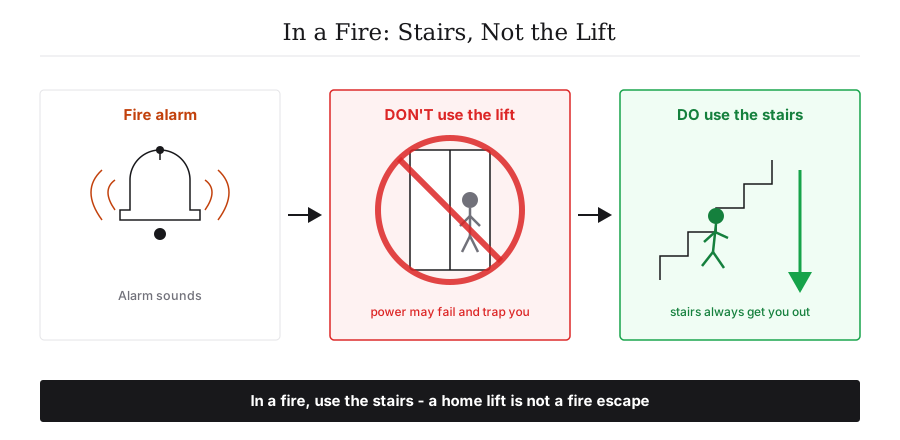
A home lift is one of the safest machines in your house. It has door interlocks, a governor and safety gear, an emergency alarm and, in India, almost always an Automatic Rescue Device that brings the car to the nearest floor on a power cut. But there is one situation where even a perfectly maintained, modern home lift is the wrong choice, and the rule is simple enough for a child to remember:
In a fire, do not use the lift. Use the stairs.
This guide is the safe-USE, household-fire-plan companion to our lift fire-safety planning guide, which covers the design side — fire-rated landing doors, shaft compartmentation, fire-recall wiring and the fireman's-lift trigger for taller buildings. Here we stay in the home: why a passenger lift is not a fire escape, what your lift actually does when the smoke detector sounds, how to build a fire plan that assumes the lift is unavailable, and the special care a wheelchair user needs. Calm, clear, and India-specific.
The cardinal rule: a home lift is not a fire escape
A normal home or passenger lift is built to move people between floors comfortably — it is not designed, and is not certified, as a means of escape from fire. There are three plain reasons every fire service in the world says "use the stairs."
- A fire can cut the power. If the supply fails while you are between floors, you may be stranded. An ARD will move the car to the nearest floor on a normal power cut, but a fire is not a normal power cut — wiring can be damaged and the situation is unpredictable.
- The shaft can act like a chimney. Smoke and hot gases rise. A lift shaft is a vertical channel; without the fire-rated doors and compartmentation that the design guide describes, it can draw smoke upward and carry it to other floors. You do not want to be inside that channel.
- The lift can stop and open at the wrong floor. Lift controls sense heat and smoke imperfectly. A car could be called to, or open onto, the very floor that is burning.
Stairs have none of these problems. They do not need power, they do not behave like a chimney when fire doors are kept closed, and you control exactly where you go. This is why the rule is universal and absolute.
What your lift does when the fire alarm sounds
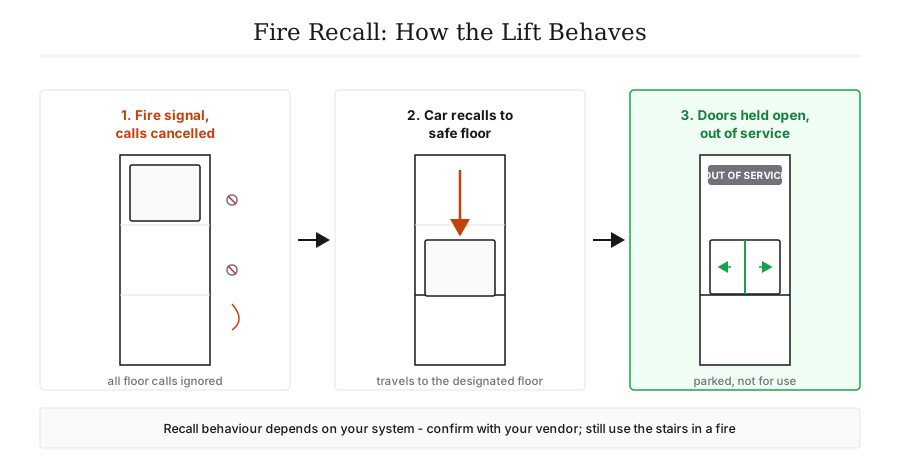
A well-specified home or building lift does not simply ignore a fire. On a fire signal it is designed to take itself out of the way so that nobody is tempted to use it and so it cannot deliver people into danger. This behaviour is called fire recall (the design and wiring are covered in the fire-safety planning guide). In a home, the sequence looks like this:
1. A smoke or heat detector — or the building fire-alarm panel — sends a fire signal.
2. The lift cancels all the floor calls people have pressed.
3. The car travels to a designated safe floor (usually the ground or main exit level, away from the likely fire).
4. The doors open and stay open, and the lift goes out of service. It will not answer calls.
The lift parking doors-open at a safe floor is deliberate: it stops anyone using it, and it leaves no one trapped inside a sealed car. Treat a lift that has gone out of service in a fire as a signal, not a fault — it is doing its job. Do not try to override it, prop the doors, or "send it up" to fetch someone. Walk to the stairs.
Note that not every basic home lift is wired to a fire-alarm panel — many standalone home lifts simply continue to run normally until the power is interrupted. That is exactly why the household rule must not depend on the lift behaving cleverly: you decide to use the stairs the moment you suspect fire, whether or not the lift recalls itself.
Working smoke detectors come first
A fire plan only works if you get early warning. Smoke detectors are inexpensive — a basic battery smoke alarm costs a few hundred rupees, and interlinked detectors for a larger home a little more — and they are the single highest-value safety item in any house. They matter more for your lift plan than any feature inside the car, because they give you the minutes you need to reach the stairs while the air is still breathable.
- Fit detectors on every level, near sleeping areas and the kitchen (use a heat detector, not a smoke type, directly in the kitchen to avoid cooking false alarms).
- Test them monthly and change batteries on a fixed date each year.
- If your lift is wired for fire recall, the detector network is what triggers it — so a dead battery weakens both your warning and your lift's safe behaviour.
The fire do-and-dont table
Keep this simple. The whole household — children, seniors, domestic staff, guests — should know it without thinking.
| Situation | DO | DON'T |
|---|---|---|
| Fire alarm sounds anywhere in the house | Leave by the stairs immediately, calmly | Use the lift, for any reason |
| You were already inside the lift when the alarm sounds | Let it recall to the safe floor, then step out and take the stairs | Press random buttons hoping to redirect it, or force the doors between floors |
| A family member is on an upper floor | Account for them at the meeting point; tell the fire service if anyone is missing | Send the lift up to "rescue" them |
| Smoke is in the stairwell | Stay low, feel doors for heat, use an alternate route if one exists | Re-enter to use the lift instead |
| A wheelchair user needs to evacuate | Follow the pre-agreed, fire-service-approved plan | Improvise by putting them in the lift |
| The lift has gone out of service in a drill or alarm | Leave it parked, report it to your technician afterwards | Try to reset or "fix" it during the emergency |
| Fire is out and building is declared safe | Have the lift inspected before you use it again | Assume it is fine because it looks fine |
Build a household fire plan that assumes the lift is gone
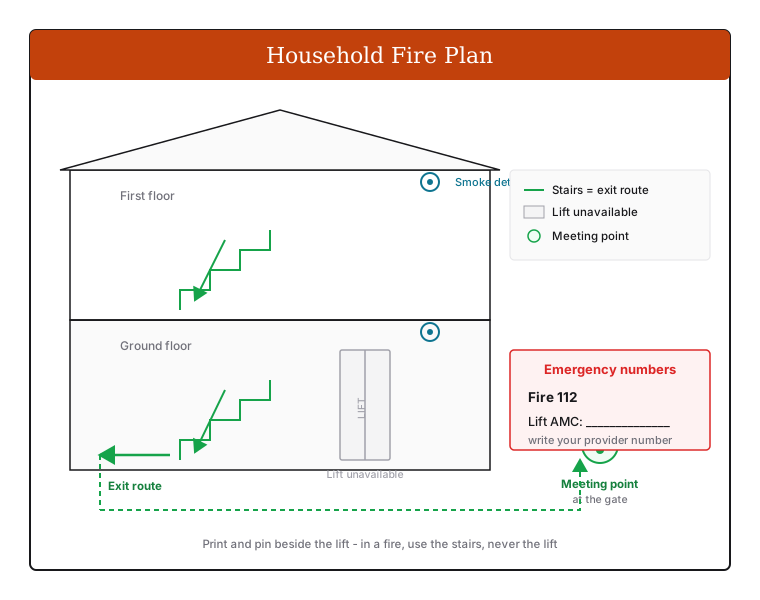
The strongest fire plan treats the lift as if it does not exist. If your plan works without the lift, it works in any fire. Build it once, write it on a card, and rehearse it.
Household fire-plan checklist
- [ ] Know two ways out of every floor wherever possible — and confirm the staircase is always the primary route, never the lift.
- [ ] Working smoke detectors on every level, tested monthly, batteries changed yearly.
- [ ] Keep stairs and landings clear — no shoe racks, cycles, stored boxes or cylinders blocking the escape path.
- [ ] Agree one outside meeting point (the gate, a neighbour's compound) where everyone gathers to be counted.
- [ ] Assign who helps whom — name the adult responsible for each child, senior or person with reduced mobility.
- [ ] Pre-plan any wheelchair or mobility evacuation with your fire service or building manager (see below) — do not leave it to improvise.
- [ ] Save the fire-service number (112 / local fire) and your lift AMC emergency number in every adult's phone and on a card by the lift.
- [ ] Teach the rule plainly: alarm means out by the stairs, gather at the meeting point, do not go back for belongings.
- [ ] Practise twice a year, including at night, so the route is automatic in the dark and in smoke.
- [ ] After any fire or alarm-driven recall, book a lift inspection before returning the lift to use.
A wheelchair user must not simply be "put in the lift"
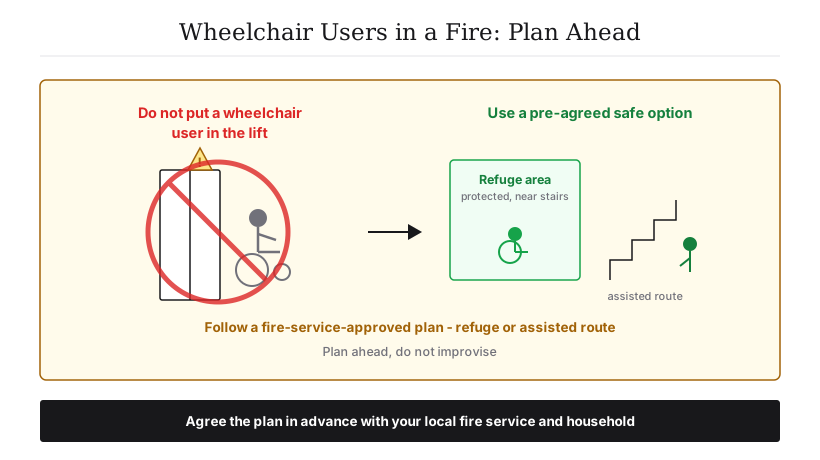
This needs its own section because the well-meaning instinct — "the lift is right here, it is faster" — can be dangerous in a fire. A person who uses a wheelchair, or anyone who cannot manage stairs, must not be placed in an ordinary home lift to escape a fire unless you are following an evacuation plan that the fire service or a qualified fire-safety professional has approved for your specific building.
The reason is the same chimney-and-power risk that applies to everyone, made worse because the person cannot quickly self-rescue if the lift stops. The safe approach is to plan ahead, in calm conditions:
- Agree a refuge or assembly strategy in advance. In larger buildings this may mean a protected refuge area near the stairs where the person waits in relative safety for the fire service. In a private home, it may mean a ground-floor sleeping arrangement, an evacuation chair on the stairs, or designated helpers — decided with professional advice.
- Talk to your local fire service or building manager about what is appropriate for your home. They can tell you whether any lift-based evacuation is acceptable and under what conditions.
- Never improvise during the fire. The middle of an emergency is not the time to decide whether the lift is safe. Decide once, write it into the fire plan, and rehearse it.
A fireman's lift is a different thing entirely (see below) — it is a certified system for firefighters in taller buildings, not the home lift you ride every day, and it does not change the household rule.
What a fireman's lift is — and why it is not your home lift
You may have heard the term "fireman's lift" and wondered if it is an exception to the use-the-stairs rule. It is not, for ordinary occupants. A fireman's lift is a separately certified lift, generally required in taller buildings — under NBC 2016 the trigger is commonly buildings above 15 m (some residential rules set 30 m). It has a protected power supply, fire-rated construction, a dedicated switch, and a car large enough (around 1100 by 1400 mm, roughly an 8-person / 544 kg car) to carry a stretcher. It exists so that trained firefighters can move equipment and casualties under controlled conditions — not so that residents evacuate themselves.
Most independent home lifts and the small lifts in low-rise residences are below the height where a fireman's lift is required, so the household never has one at all. Either way, the rule for you and your family does not change: a fireman's lift is operated by the fire service; you use the stairs. The design, wiring and trigger heights for fireman's lifts are covered in the fire-safety planning guide.
If you are ever caught between floors
This belongs to the everyday-emergency playbook rather than the fire plan, and our lift emergency-procedures guide covers it in full, with the rescue-device detail in the emergency rescue-systems guide. In short, if the lift ever stops for any reason — fire is the one situation where you would not be in it, because you took the stairs — stay calm, press the alarm, use the intercom, and wait. The car is a strong, ventilated box. Do not force the doors or climb out.
Bringing it together
Modern home lifts are remarkably safe in normal use, and the safety guides in this cluster explain why — door interlocks, the overspeed governor and safety gear, ARD on a power cut. Fire is the deliberate exception, and the discipline is reassuringly simple:
- A home lift is not a fire escape — in a fire, use the stairs.
- A well-set-up lift recalls to a safe floor, parks doors-open and goes out of service on a fire alarm — let it.
- Working smoke detectors buy you the time to reach the stairs.
- Build a household fire plan that assumes the lift is unavailable, write it on a card, and rehearse it.
- A wheelchair user is never simply put in the lift — follow a fire-service-approved plan agreed in advance.
- A fireman's lift is a different, certified system for firefighters in taller buildings, not your home lift.
For everyday confidence in your lift, see the home lift safety guide and the residential elevator buyer's guide. For the fire engineering behind recall and compartmentation, see the lift fire-safety planning guide.
References
- Bureau of Indian Standards — National Building Code of India (NBC) 2016, Part 8 (Building Services), Section 5 — Installation of Lifts, Escalators and Moving Walks (fire-recall, fireman's lift triggers): https://www.bis.gov.in/standards/technical-department/national-building-code/
- BIS — Guide for Using NBC 2016: https://www.bis.gov.in/wp-content/uploads/2022/08/Booklet-Guide-for-Using-NBC-2016.pdf
- IS 14665 (Electric Traction Lifts) — Part 2, Code of practice for installation, operation and maintenance: https://law.resource.org/pub/in/bis/S05/is.14665.2.1-2.2000.pdf
- IS 14665 — Part 1, Outline dimensions: https://law.resource.org/pub/in/bis/S05/is.14665.1.2000.pdf
- RPwD Act 2016 (accessibility obligations, refuge and evacuation considerations for persons with disabilities): https://ssepd.odisha.gov.in/sites/default/files/2024-01/RPWD%20ACT.pdf
- CPWD / MoHUA Harmonised Guidelines and Space Standards for a Barrier-Free Built Environment (refuge areas, accessible evacuation): https://www.cpwd.gov.in/Publication/Harmonisedguidelinesdreleasedon23rdMarch2016.pdf
- Inclinator — home elevator safety features (general safety reference): https://inclinator.com/blog/how-safe-home-elevators/
Standards, dimensions and trigger heights cited here are indicative and vary by state and building height — confirm fire-recall wiring and any lift-based evacuation with a licensed lift contractor and your local fire service.
Export this guide
Related Guides — Deep-dive reading
Lift and Fire Safety Planning (India): What Home Lifts Must Do When There's a Fire
Why your home lift is never the escape route, how fire recall works, when a fireman's lift is required, and the local fire NOC and bye-law checks every Indian homeowner should make.
Home Lifts & AccessibilityHome Lift Safety Guide (India): How Safe Home Lifts Are and How to Use One Safely
Why modern home lifts cannot free-fall or open onto an empty shaft, the safety features explained, and how to use one safely every day — for children, seniors and emergencies.
Home Lifts & AccessibilityStaircase Fire Safety in India (2026): The Protected Stair That Gets Everyone Down
The staircase is the primary vertical escape route in almost every Indian building, so a protected, smoke-free stair is the spine of egress: enclosed, fire-doored, non-combustible, and above all kept clear.
SecurityRelated Tools — Try Free
Accessibility Compliance Calculator
Check a planned lift against the CPWD and RPwD accessible-lift benchmarks for a score.
Lift CheckerLift Safety Audit Checklist
Interactive checklist that scores your home lift on safety devices, compliance and upkeep.
ChecklistElevator Capacity Calculator
Pick the right home-lift capacity — 2 to 8 person — with car size and wheelchair fit.
Lift Calculator