
Accessibility Standards for Residential Lifts (India)
The standards reference for an accessible home lift — RPwD Act 2016 and the CPWD Harmonised Guidelines, with the exact dimensions and why each one matters
A home lift is one of the most powerful accessibility tools you can build into an Indian house. Get the dimensions and details right and a wheelchair user, a parent with a stroller, or a grandparent with a walker moves between floors with complete independence. Get them wrong — a door 50 mm too narrow, a car that cannot turn a wheelchair, buttons a seated person cannot reach — and the lift becomes a daily obstacle that no amount of paint will fix.
This guide is the standards reference for accessible residential lifts in India. It tells you exactly what the recognised benchmarks say — the RPwD Act 2016 and the CPWD / MoHUA Harmonised Guidelines — and, just as importantly, why each number exists, so you can specify with confidence and hold your vendor to it.
This is the standards companion to our homeowner-execution guide, Accessible Home Design in India, which covers how to plan and build accessibility across the whole house. Use the two together: read the execution guide for the project, this one for the lift specifications.
The legal picture: what is mandatory, what is best practice
There is a common misconception that accessibility standards are only for hospitals and offices. The reality is more useful than that for a homeowner.
The Rights of Persons with Disabilities (RPwD) Act, 2016 is the governing law. Three sections matter for the built environment:
| Section | What it says | Who it binds |
|---|---|---|
| Sec 40 | The Government will frame accessibility rules and standards for the built environment | Sets the standards everyone references |
| Sec 44 | No completion or occupancy certificate / building permission where plans do not meet accessibility norms | Public buildings at approval stage |
| Sec 45 | Existing public buildings to be made accessible within a defined period; the onus is on the owner | Existing public buildings |
The legal force of these sections falls on public buildings — anything the public uses. A private home is not legally compelled to meet them. So why follow them?
Because the standards are the right benchmark. They are the only body of careful, tested, India-specific guidance on what makes a lift genuinely usable by a wheelchair user, a frail senior, or someone with low vision. When you build a private lift, copying the public-building standard is simply how you get a lift that works for everyone in your family — now and in twenty years. There is no better number to aim for.
Bottom line: Your home lift is not legally bound by the RPwD Act, but the CPWD accessible-lift standards are the correct target. Treat them as your specification, not as a suggestion.
The detailed numbers live in the CPWD / MoHUA Harmonised Guidelines and Space Standards for a Barrier-Free Built Environment (first issued 2016, updated as the Harmonised Guidelines 2021). India's lift-accessibility provisions (the harmonised lift requirements) align with these. The rest of this guide unpacks them.
The accessible-lift standards table
Here is the complete benchmark, with the reason for each value. Treat the figures as the target to specify; confirm exact model dimensions with your vendor.
| Requirement | Standard value | Why it exists |
|---|---|---|
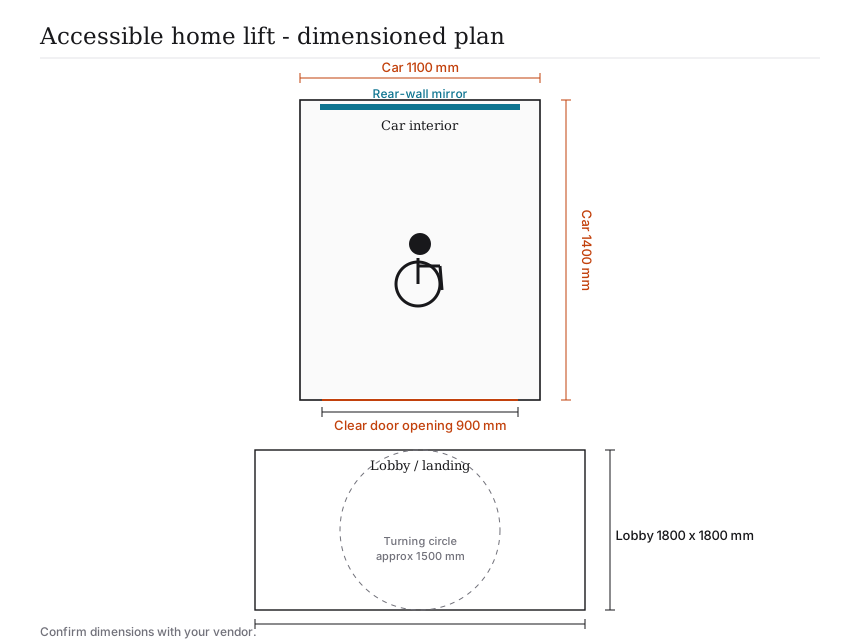
| Clear door width | ≥ 900 mm | A manual wheelchair is roughly 650–700 mm wide; 900 mm of clear opening lets it pass without scraping knuckles or footrests. Manual swing doors rarely give this — you need automatic sliding/telescopic doors. |
| Car internal size | ≈ 1100 × 1400 mm minimum | Big enough for a wheelchair plus a standing attendant or carer. The 1400 mm depth lets a chair sit squarely and gives room to position. |
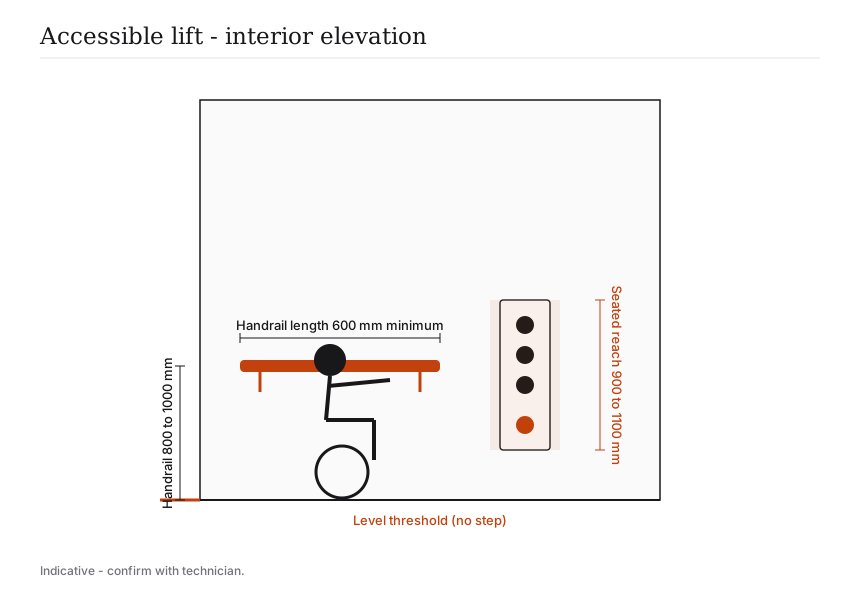
| Handrail | ≥ 600 mm long, at 800–1000 mm above floor, near the controls | A 600 mm grab length gives a senior or unsteady user something secure to hold while the car moves and while transferring. The 800–1000 mm height suits both standing and seated reach. |
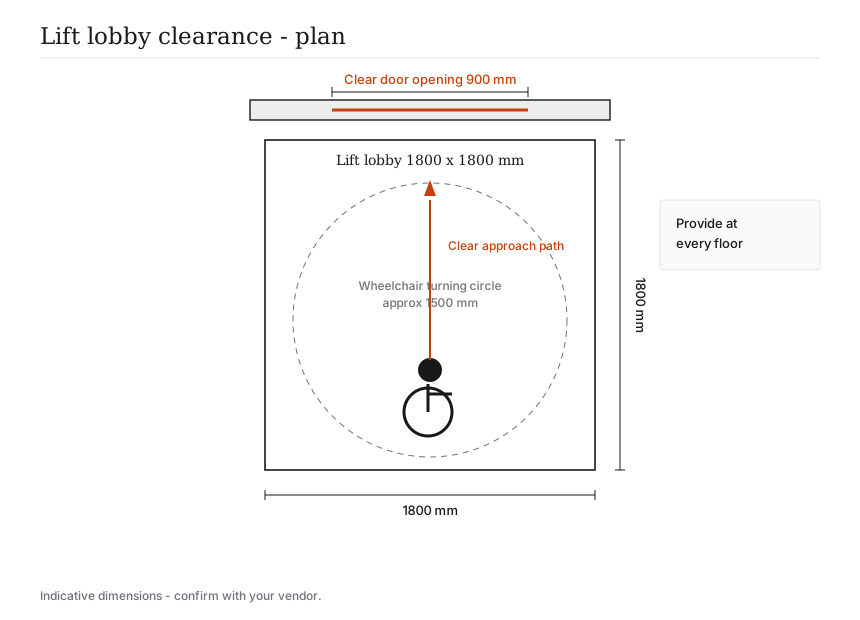
| Lift lobby (landing) | ≈ 1800 × 1800 mm | A wheelchair needs a full turning circle (about 1500 mm) plus door swing/approach space to line up and enter the car without a three-point shuffle. |
| Automatic door dwell | ≥ 5 seconds open | A slow mover or wheelchair user needs unhurried time to enter or exit before the doors begin to close. Five seconds is the minimum that does not rush them. |
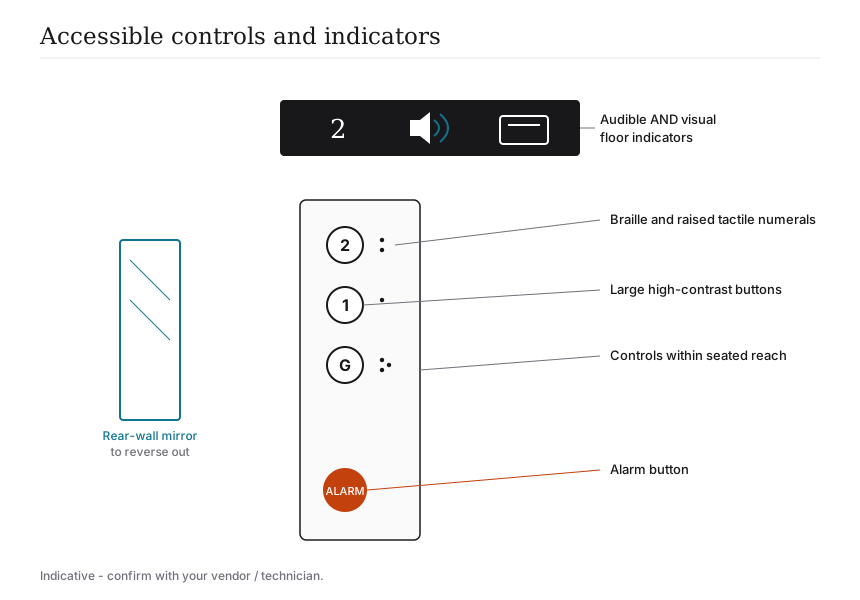
| Braille / tactile buttons | Required | A user with low or no vision must identify floors by touch. Raised numerals and Braille on the call and car buttons make the lift usable without sight. |
| Audible AND visual floor indicators | Both required | The audible chime/announcement serves users with low vision; the visual display serves users who are deaf or hard of hearing. You need both, not either. |
| Rear mirror | Required on rear wall | A wheelchair user often cannot turn inside the car, so they reverse out. A rear mirror lets them see the landing behind them as they back out safely. |
Why these particular dimensions hang together
The numbers are not arbitrary; they form a chain. A wheelchair is wide, so the door must be at least 900 mm. The chair plus an attendant must fit, so the car is at least 1100 × 1400 mm. The user must be able to line up with that door and that car, so the lobby gives a 1800 × 1800 mm turning space. And because they cannot always turn inside, they reverse out — which is why the rear mirror matters. Miss one link and the chain breaks: a perfect car is useless behind a 750 mm door.
CPWD's own worked example for a 13-person public lift is larger still — depth 1100, width 2000, door 900 mm. A home car does not need to be that big, but the door width and the principles are identical.
Doors, dwell time and entering safely
The door is where most home lifts fail accessibility. Manual swing doors are the cheapest option and they are not wheelchair-friendly — a seated user cannot easily pull a heavy door open and roll through at the same time, and the door eats into the car opening.
For an accessible lift you want automatic telescopic or sliding doors giving the full ≥ 900 mm clear opening. The door must stay open for at least 5 seconds so nobody is hurried. Crucially, this dwell works with the lift's safety devices, not against them:
- The infrared light curtain / door sensor detects a person or wheelchair in the doorway and instantly stops and re-opens the doors — so a slow user is never caught by a closing door.
- The door interlock keeps the car from moving unless the doors are properly closed and locked at a landing.
You never trade accessibility against safety. The 5-second dwell is a comfort minimum; the sensor is the hard safeguard behind it. (See Home Lift Safety in India for how these devices work together.)
Inside the car: handrail, controls, indicators and mirror
Once a user is in the car, four details decide whether the lift is genuinely usable.
Handrail
A handrail at least 600 mm long, mounted 800–1000 mm above the floor, near the control panel, gives a steady hold for a senior, someone with balance issues, or a person transferring from a wheelchair. The 800–1000 mm band is reachable whether the user is standing or seated. This same handrail is one of the core senior-safety features covered in Senior Citizen Safety in Home Elevators.
Controls — reachable and readable
Call and car buttons must be within seated reach (roughly 900–1100 mm above floor), and must carry Braille and raised tactile markings so a user with low vision can find and read the right floor by touch. Large, high-contrast buttons help everyone, especially seniors.
Indicators — audible AND visual
The lift must announce arrivals both audibly and visually. The audible chime or voice announcement serves a blind or low-vision user; the visual floor display serves a deaf or hard-of-hearing user. Specifying only one excludes half the people the standard is meant to protect.
Rear mirror
A mirror on the rear wall lets a wheelchair user — who frequently cannot turn around inside a 1100 × 1400 mm car — see the landing behind them and reverse out safely. It is a small, cheap fitting that solves a real daily problem.
The landing: lobby and clear approach
Accessibility does not stop at the car door. A wheelchair user must be able to arrive, turn, line up and enter without a struggle. That is what the ≈ 1800 × 1800 mm lift lobby provides: room for the roughly 1500 mm wheelchair turning circle plus the space the doors and approach take up.
If the lobby is cramped, even a perfect car becomes hard to use, because the user cannot get square to the door. So when you plan the lift position, protect the landing space at every floor — not just the ground floor. This landing geometry is exactly the kind of whole-house thinking covered in Universal Design, which designs spaces to work for every age and ability from the start.
A specifier's checklist
Use this when you brief your vendor and when you inspect the finished lift. Confirm every figure against the actual model and your local bye-laws.
| Do | Don't |
|---|---|
| Specify automatic sliding/telescopic doors with ≥ 900 mm clear opening | Accept manual swing doors for an accessible lift |
| Confirm car is at least ≈ 1100 × 1400 mm | Squeeze the car down to fit a tight shaft and lose wheelchair clearance |
| Demand a ≥ 600 mm handrail at 800–1000 mm near the controls | Leave the handrail out "to save cost" |
| Set automatic door dwell to ≥ 5 seconds | Let the doors snap shut on default factory timing |
| Insist on Braille / tactile buttons and both audible and visual indicators | Settle for a visual display only |
| Fit a rear-wall mirror | Assume the user can turn inside the car |
| Protect a ≈ 1800 × 1800 mm lobby at every floor | Plan generous space only at the ground floor |
| Treat ARD battery backup as standard so a power cut never strands a wheelchair user | Buy an accessible lift without rescue backup |
The accessibility provisions and the safety provisions overlap. ARD (automatic rescue to the nearest floor on a power cut), door sensors, and a working alarm/intercom are both safety features and accessibility features — they matter most to exactly the people the accessibility standards protect. Specify them together.
Why this matters more than the law requires
Building to these standards costs little extra at design stage and almost nothing to retrofit a homeowner's good intentions onto an under-sized lift later (which is usually impossible). The accessible lift is what lets a parent age in their own home, lets a family member who uses a wheelchair live with dignity and independence, and lets the house serve three generations. The RPwD Act may not compel a private home — but a lift built to the CPWD benchmark is simply a better lift for everyone who will ever use it.
References
Standards and authorities referenced in this guide. Figures are indicative — confirm against your local municipal bye-laws and a licensed lift contractor.
- Rights of Persons with Disabilities (RPwD) Act, 2016 (Sec 40, 44, 45) — full text: https://ssepd.odisha.gov.in/sites/default/files/2024-01/RPWD%20ACT.pdf
- Department of Empowerment of Persons with Disabilities (DEPwD) — accessibility FAQs: https://depwd.gov.in/en/faqs-4/
- CPWD / MoHUA Harmonised Guidelines and Space Standards for a Barrier-Free Built Environment (2016; Harmonised Guidelines 2021): https://www.cpwd.gov.in/Publication/Harmonisedguidelinesdreleasedon23rdMarch2016.pdf
- IS 14665 — Electric Traction Lifts (BIS) Part 1, Outline dimensions: https://law.resource.org/pub/in/bis/S05/is.14665.1.2000.pdf
- IS 14665 Part 2 — Installation, operation and maintenance: https://law.resource.org/pub/in/bis/S05/is.14665.2.1-2.2000.pdf
- National Building Code of India 2016 (BIS), Part 8 Section 5 — Installation of Lifts, Escalators and Moving Walks: https://www.bis.gov.in/standards/technical-department/national-building-code/
- BIS — Guide for Using NBC 2016: https://www.bis.gov.in/wp-content/uploads/2022/08/Booklet-Guide-for-Using-NBC-2016.pdf
Related guides
- Accessible Home Design in India — the homeowner execution lens across the whole house
- Universal Design in India — designing every space to work for all ages and abilities
- Senior Citizen Safety in Home Elevators — the lift safety-features lens for older users
- Home Lift Safety in India — how the safety devices work in everyday use
- Residential Elevator Buyer's Guide (India) — the pillar guide to choosing a home lift
- Lift Specification Checklist (India) — what to put in your vendor brief
Export this guide
Related Guides — Deep-dive reading
Universal Design Doors for Indian Homes: Inclusive Doors That Work for Everyone (2026)
How to design and specify doors that serve children, the elderly, pregnant women, the injured and wheelchair users by default - generous width, lever handles, near-flush thresholds, low-force closing, contrast and good lighting - without your home ever looking medical.
Home Doors & EntrancesDesigning Adaptable & Universal-Design Homes
Accessibility, Aging-in-Place, and the Multi-Stage Family — Code, Anthropometrics, and Plan-Stage Discipline for Indian Residential Architects
Room PlanningSenior Citizen Safety Features in Home Elevators (India)
The cabin and control features that make a home lift genuinely safe and easy for an older person — automatic doors, level entry, handrail, fold-down seat, reachable contrasting controls, ARD and an alarm pendant.
Home Lifts & AccessibilityRelated Tools — Try Free
Accessibility Compliance Calculator
Check a planned lift against the CPWD and RPwD accessible-lift benchmarks for a score.
Lift CheckerLift Safety Audit Checklist
Interactive checklist that scores your home lift on safety devices, compliance and upkeep.
ChecklistHome Accessibility Planner
Integrate lift, ramp, stairlift and wheelchair circulation into one accessibility plan.
Planner