

Power Failure Safety in Elevators (India): What Happens and What to Do
A power cut does not drop the car. Here is exactly what happens, why an ARD is non-negotiable in India, and how to protect the controller so your lift restarts safely.
Power cuts are part of life across much of India. So one of the most common worries homeowners have about a home lift is also one of the most reassuring to answer: what happens to the car when the power goes off, and is anyone inside in danger? The short version is that a power cut does not drop the car. The brakes are designed to hold it in place the instant power is lost, and with the right battery device fitted the car simply drifts to the nearest floor and opens its doors. This guide is the calm, practical playbook for the Indian power-cut scenario — what actually happens, what to do, and how to protect the lift's electronics so it restarts safely every time.
This is the safe-use and household-procedure lens. The battery hardware itself is covered in battery backup systems for elevators, and keeping that battery healthy is covered in lift battery backup maintenance. We link both rather than repeat them. For the full if-trapped playbook see lift emergency procedures and the device detail in emergency rescue systems for home lifts.
The single most important fact: a power cut does not drop the car
A home lift does not stay up because the motor is holding it. It stays up because of a brake that is held open by power and clamps shut the moment power is lost. This is a deliberate fail-safe: no electricity means the brake grips, and the car is held exactly where it is. On top of that, the car hangs from multiple steel ropes (or sits on a hydraulic ram, or threads onto a screw column, depending on type), each with a large safety factor, and an overspeed governor and safety gear stand ready to grip the guide rails if the car ever moved too fast. A free fall is not what a power cut causes.
A power cut removes the lift's ability to move. It does not remove its ability to hold. The car stays safe and still; nobody inside is falling.
So the real question is not "will the car drop" — it will not — but "how does anyone inside get out once the lift has stopped." That depends entirely on one component: the ARD.
With an ARD vs without an ARD
The Automatic Rescue Device (ARD) is a battery unit on the lift controller. When it senses that mains power has failed, it supplies just enough stored energy to move the car — at slow, controlled speed — to the nearest landing, then opens the doors automatically. The whole sequence usually takes only a few seconds. Passengers step out at a floor as if nothing happened.
Without an ARD, the car does not move on its own. It stops safely and waits. Anyone inside is in no danger, but they are stuck until power returns or a technician performs a manual rescue. In a country with frequent outages, that turns a routine power cut into a trapped-in-the-lift event several times a year. This is why an ARD is essentially non-negotiable in India — it is the difference between a power cut being a non-event and being a rescue call.
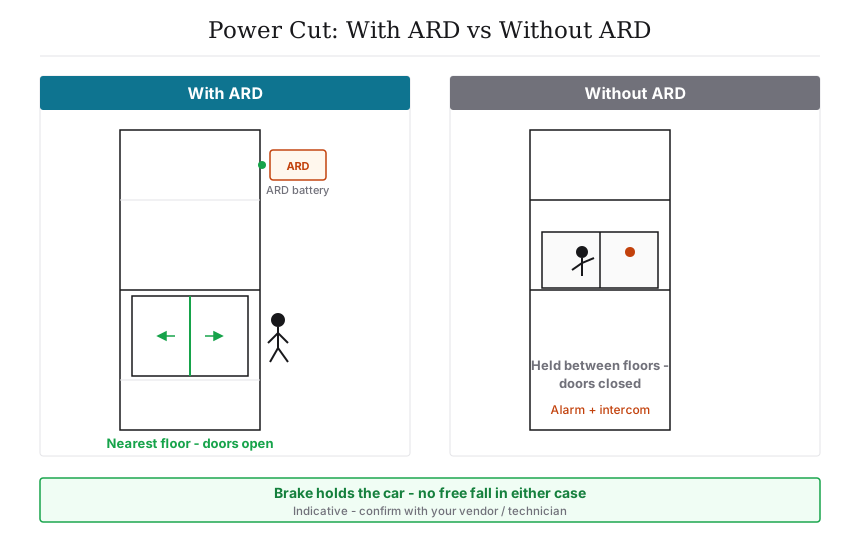
What the car actually does — power-cut behaviour table
| Moment | What happens (with ARD) | What happens (without ARD) |
|---|---|---|
| Power fails | Brake grips, car held still | Brake grips, car held still |
| Within seconds | ARD battery moves car to nearest floor | Car stays where it is, lights/alarm on battery |
| Doors | Open automatically at the landing | Stay closed and locked until power or rescue |
| Passengers | Step out normally | Stay calm inside, use alarm and intercom, wait |
| Free-fall risk | None | None |
| Your action | Note the cut; lift will restart when power steady | Press alarm, call on intercom, wait for technician |
| Restart | Lift resumes on stable mains | Lift resumes on stable mains, or technician rescues |
The two columns share the most important rows: in both cases the car is held safely and there is no risk of falling. The ARD column simply removes the waiting. Figures and timings are indicative — confirm your specific model's behaviour with your vendor or technician.
What to do during a power cut
Most of the time you will do nothing at all — with an ARD the lift quietly self-rescues and you carry on. The instructions below matter most when there is no ARD, or when someone is inside as the power goes.
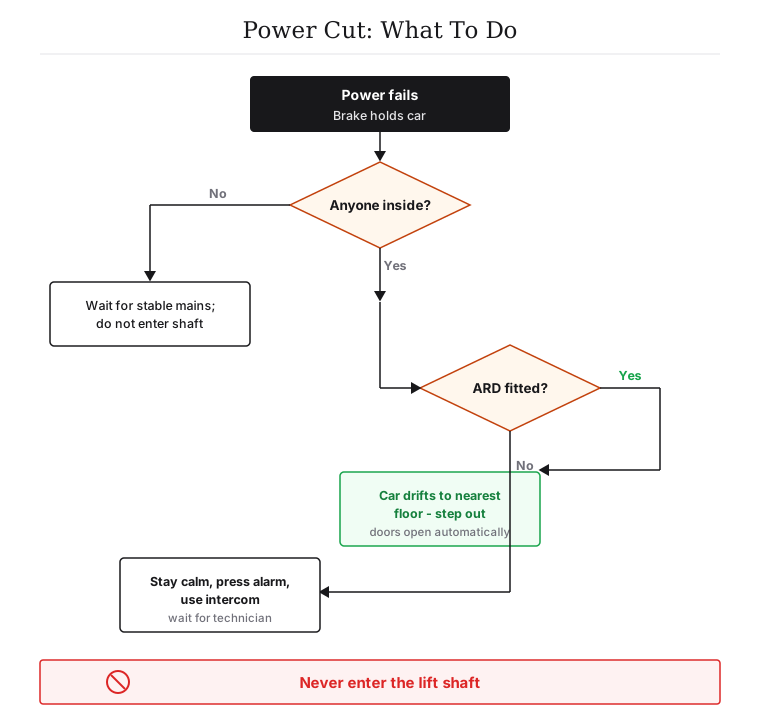
Do and don't during an outage
| Do | Don't |
|---|---|
| Stay calm — the car is held safely and is ventilated | Do not try to force or pry the doors open |
| If inside, press the alarm and use the intercom to call for help | Do not try to climb out of the car or through the roof |
| Wait for the car to self-rescue (ARD) or for a technician | Do not panic-press or yank at the car |
| Keep the AMC/technician emergency number saved and by the lift | Do not enter the lift shaft or pit to "look" or help |
| Let the lift restart only once mains power is steady | Do not run the lift on flickering or unstable power |
| Teach everyone in the house how the alarm and intercom work | Do not let children treat a stopped lift as a place to play |
The rule that sits above all others: never enter the shaft during an outage. A lift shaft is a deep, dark, dangerous space and the car can move the instant power or the ARD kicks in. Rescuing a trapped person from outside the car is a licensed technician's job using the proper manual-lowering procedure — never a do-it-yourself task with the doors levered open.
Protecting the controller from voltage surges
The bigger threat to a home lift from the Indian grid is not the power cut itself — it is the voltage surge and instability that often comes with it. Brownouts, sudden restorations, lightning and load-shedding swings can all spike the supply, and the lift controller is a sensitive piece of electronics that does not enjoy that. A surge can corrupt the controller, trip the lift into a fault, or in the worst case damage expensive boards.
Two protections handle this, and both belong on the supply before it reaches the lift:
- A voltage stabiliser sized for the lift keeps the incoming voltage within the band the controller expects, smoothing out the sags and swells that are routine on Indian mains.
- A surge protection device (SPD) clamps short, sharp spikes — from lightning or switching — so they never reach the controller.
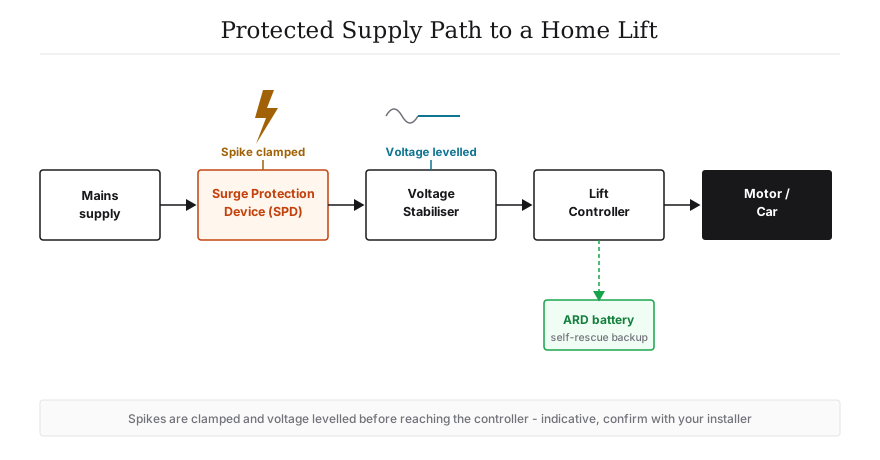
Specifying and wiring the stabiliser and SPD is part of the electrical scope at installation. Ask your vendor to confirm both are fitted and correctly sized — this is one of the cheapest pieces of protection on the whole job and it guards the most expensive part of the lift.
Coordinating an inverter or generator so the lift restarts safely
Many Indian homes run a whole-home inverter or a generator (DG set) that cuts in when mains fails. A lift and a backup source need to be coordinated deliberately, or the lift can be hit with exactly the kind of unstable supply that harms it.
- Sizing: a lift's motor draws a large surge of current when it starts. An inverter or generator that runs lights and fans comfortably can be badly undersized for a lift's starting load. Have your electrician and lift vendor agree whether the lift should be on the backup at all, and if so, on a source rated for the start-up surge.
- The changeover moment: the switch from mains to backup (and back again) is the riskiest instant for the controller. A clean automatic transfer switch (ATS) with a brief pause, plus the stabiliser, ensures the lift sees steady power on each side of the switch — not a glitchy transition.
- A common, sensible choice: rely on the ARD to bring the car to a floor and let people out during the cut, and keep the lift off the inverter/generator. The car self-rescues on its own battery, and the lift only resumes on stable mains. This avoids loading a home inverter with a lift it was never sized for. Confirm the right approach for your home with your vendor.
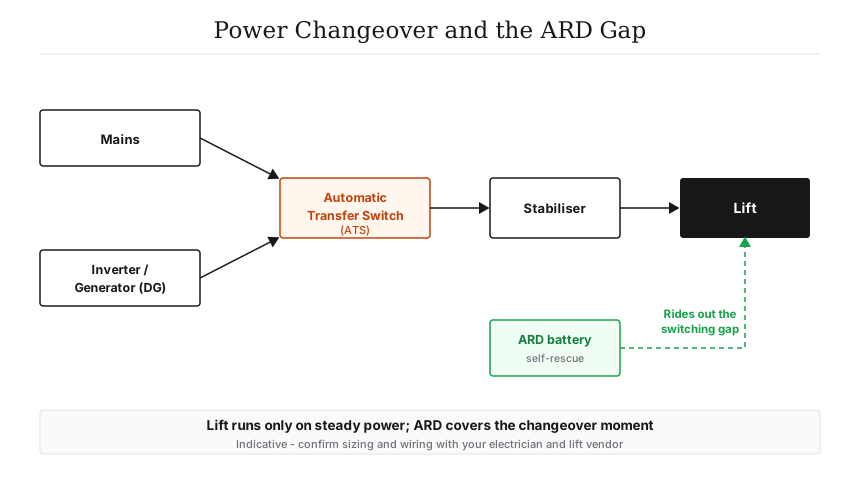
Whatever the setup, the principle is the same: the lift should only ever run on clean, stable power. Let it ride out the cut on the brake and the ARD, and bring it back only when the supply it sees is steady.
Routine ownership vs technician work
As the homeowner, your job is safe use and a few sensible checks: confirm an ARD is fitted and that its battery is maintained, know that the stabiliser and SPD are in place, keep the emergency number handy, and make sure everyone in the house knows the alarm and intercom. Anything inside the shaft, controller, brake or battery wiring is a licensed technician's job — never open the controller, never enter the shaft, and never defeat a safety device to "keep the lift running" during dodgy power.
For the rest of the safe-use picture, see the home lift safety guide for everyday use, and the residential elevator buyers guide and lift specification checklist to make sure the ARD, stabiliser and SPD are written into your order in the first place.
References
- IS 14665 (Electric Traction Lifts) Part 1 — Outline dimensions, BIS: https://law.resource.org/pub/in/bis/S05/is.14665.1.2000.pdf
- IS 14665 Part 2 — Code of practice for installation, operation and maintenance, BIS: https://law.resource.org/pub/in/bis/S05/is.14665.2.1-2.2000.pdf
- National Building Code of India 2016, Part 8 Section 5 (Lifts, Escalators and Moving Walks), BIS: https://www.bis.gov.in/standards/technical-department/national-building-code/
- BIS Guide for Using NBC 2016: https://www.bis.gov.in/wp-content/uploads/2022/08/Booklet-Guide-for-Using-NBC-2016.pdf
- National Government Services Portal — Maharashtra licence to operate a lift: https://services.india.gov.in/service/detail/maharashtra-license-to-operate-lift
- 99acres — lift regulations in India: https://www.99acres.com/articles/know-all-about-the-lift-regulations-in-india.html
- Nibav — home elevator safety features: https://www.nibavlifts.us/blog/home-elevator-safety-features/
- Inclinator — how safe are home elevators: https://inclinator.com/blog/how-safe-home-elevators/
Export this guide
Related Guides — Deep-dive reading
Emergency Rescue Systems in Home Lifts (India): ARD, Manual Rescue, Alarm and What to Do
How the Automatic Rescue Device, manual rescue, alarm, intercom and emergency light work together — and the calm, simple thing to do if you are ever trapped.
Home Lifts & AccessibilityHome Lift Safety Guide (India): How Safe Home Lifts Are and How to Use One Safely
Why modern home lifts cannot free-fall or open onto an empty shaft, the safety features explained, and how to use one safely every day — for children, seniors and emergencies.
Home Lifts & AccessibilityHow Home Lifts Work (India): Hydraulic, Traction, Screw and Vacuum Explained
A plain-language look inside the four drive types that lift a home elevator, plus the core components and safety systems every homeowner should be able to name.
Home Lifts & AccessibilityRelated Tools — Try Free
Home Lift Comparison Tool
Compare hydraulic, traction, pneumatic vacuum and screw lifts side by side for your home.
Lift ComparisonLift Safety Audit Checklist
Interactive checklist that scores your home lift on safety devices, compliance and upkeep.
ChecklistAccess-Control Battery-Backup Calculator
Size the standby battery so an access system keeps running through a power cut, with an egress life-safety note.
Battery Backup