

Earthquake Safety for Residential Lifts (India)
Why you never ride a lift in a quake, what to do if you are inside, how the seismic switch protects you, and the inspection to do before anyone rides again.
A home lift is one of the safest machines in your house. It cannot free-fall, the brakes hold it on a power cut, and the doors stay locked unless the car is level at a floor. But an earthquake is the one moment when even a perfectly working lift is the wrong choice. The rule is simple and it never changes: in a quake, do not use the lift — use the stairs. This guide explains why, what to do if you are already inside when the shaking starts, how a seismic switch protects the lift, and the one inspection you must not skip before anyone rides again.
The good news is that this is a short list of calm, memorable actions. None of it requires you to touch anything inside the shaft, the controller or the brake — that is always a licensed technician's job. Your job is to know the rule, teach it to the household, and call the service company afterwards.
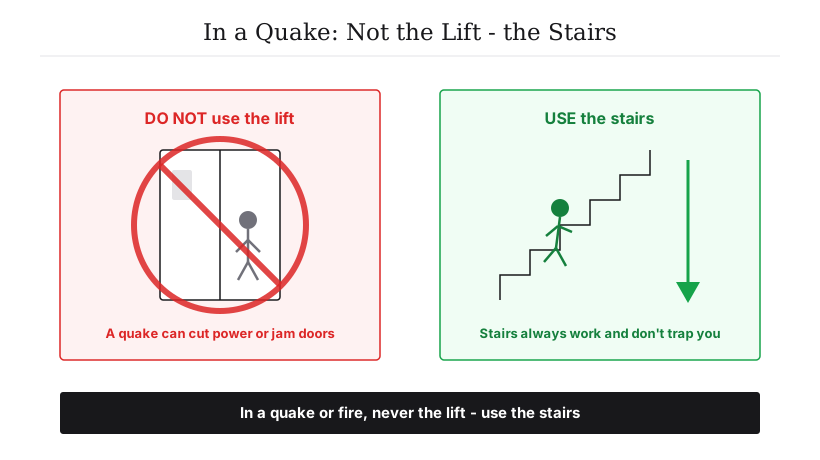
The cardinal rule: stairs, not the lift
Treat an earthquake exactly the way you would treat a fire. A passenger lift — including a home lift — is not an escape route during seismic shaking. There are three plain reasons:
- Shaking can momentarily misalign the car and the guide rails, or trip a safety device, leaving the car stranded between floors with people inside.
- A quake is often followed by a power cut. The lift then stops safely and waits, but you do not want to be sitting in it during aftershocks.
- The staircase is a structural escape route designed to stay usable; the lift is not part of your evacuation plan.
So the moment you feel the ground move, do not call the lift, and do not step into one that is waiting with open doors. If you are on an upper floor, follow the standard earthquake drill first — Drop, Cover and Hold On under a sturdy table away from windows — and only move to the stairs once the shaking stops. This mirrors the household fire rule in our fire safety for home lifts guide: the lift is assumed to be unavailable in any building emergency.
The whole household should know one sentence: "In a quake or a fire, never the lift — always the stairs." Children and visitors included.
If you are inside the car when shaking starts
This is the one situation people worry about, and the answer is reassuringly mechanical. If you are already riding when an earthquake begins:
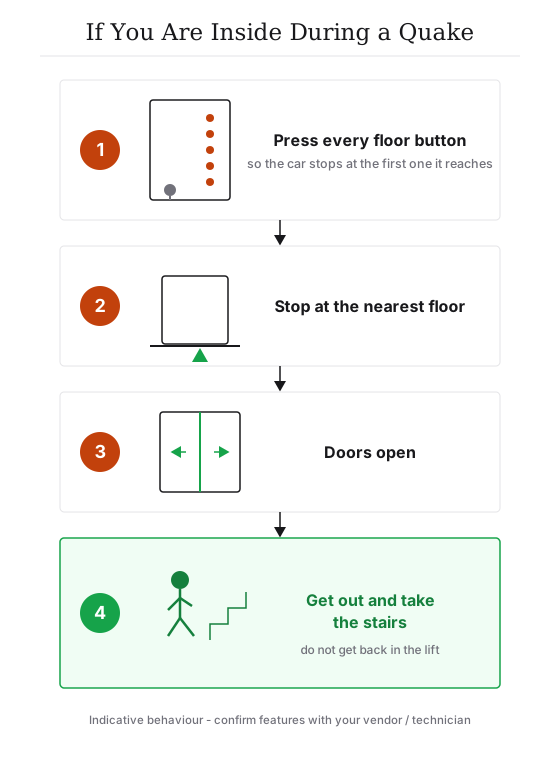
1. Press every floor button. You want the car to stop at the very next landing it can reach.
2. Get out at the first floor where the doors open. Do not wait for your original destination.
3. Move to the stairs and continue your evacuation drill from there.
4. Do not try to force the doors if the car halts between floors. Stay calm — the car is a safe, ventilated steel box that cannot fall. Press the alarm, use the intercom, and wait for help, exactly as in the lift emergency procedures guide.
Pressing all the buttons is the manual version of what a seismic switch does automatically: it gets you to the nearest floor and out, instead of riding past it. If the lift has the seismic feature described below, it will often do this for you before you can even react.
The seismic switch: how the lift protects itself
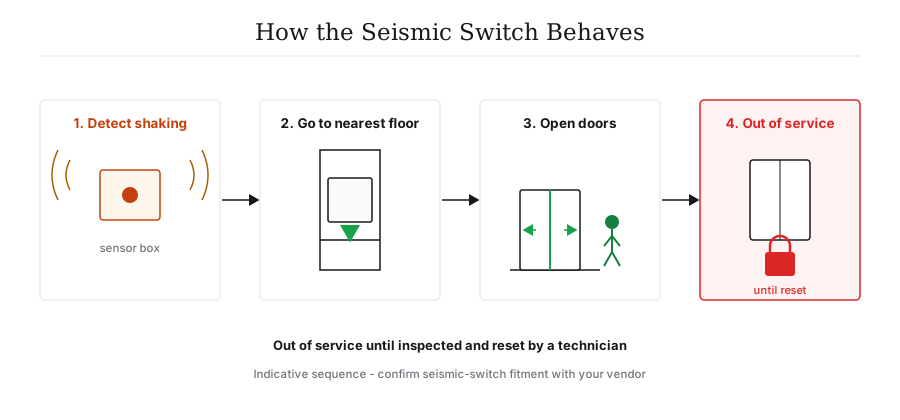
Lifts installed in earthquake-prone areas — and larger installations where it is required — can be fitted with a seismic switch (also called a seismic sensor or earthquake detector). It is a small device that senses ground motion and acts faster than any person can. When it detects shaking above its set threshold, the controller follows a fixed, safe sequence:
| Step | What the seismic switch does | Why |
|---|---|---|
| 1. Detect | A sensor picks up ground acceleration above a preset threshold | Distinguishes a real quake from normal building vibration |
| 2. Slow and redirect | The car is driven to the nearest floor, not its original call | Shortest safe distance, avoids long travel during shaking |
| 3. Open doors | Doors open at that floor so occupants can step out | Lets people reach the stairs immediately |
| 4. Take out of service | The lift parks and disables itself until reset | Prevents anyone riding a lift that may need inspection |
| 5. Stay out of service | It will not return to normal use until a technician checks and resets it | Guarantees a human verifies the lift before reuse |
In short, a seismic switch turns the manual "press every button and get out" routine into an automatic one, and then locks the lift out so nobody accidentally rides it after the event. Whether your lift has one — and what its threshold and reset procedure are — is a question for your vendor. Ask them directly: is a seismic switch fitted, and what does it do? This sensor lives in the wider family of protective devices catalogued in the elevator safety components guide.
A seismic switch is a safety device. Never ask a technician to bypass, disable or "turn down" one so the lift keeps running through tremors — that defeats the very protection you paid for.
India is a seismic country: zones II to V
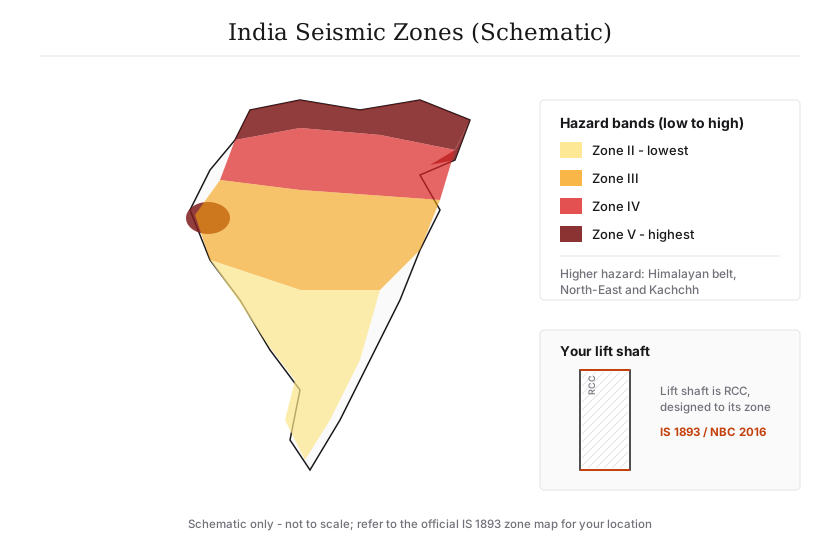
Earthquake design is not an add-on in India; it is built into the structure. The Bureau of Indian Standards maps the whole country into four seismic zones, Zone II (lowest hazard) to Zone V (highest hazard), under IS 1893 and the National Building Code (NBC 2016). Large parts of the Himalayan belt, the North-East, Kachchh in Gujarat and the Andaman and Nicobar Islands fall in the highest zones; much of the peninsula sits in the lower zones — but no part of India is exempt from seismic consideration.
This matters for your lift because the lift shaft (hoistway) is a reinforced-concrete (RCC) structural element designed together with the building to resist the lateral forces of its zone. The guide rails, brackets and fixings inside the shaft are anchored to that structure. You do not design or check this yourself — your structural engineer does, in line with the zone and the soil — but it is worth knowing that the shaft is engineered to move with the building, not against it. The structural side is covered in the home lift structural design guide.
| Concept | What it means for a homeowner |
|---|---|
| Seismic zones II to V | India is mapped by hazard; your city's zone is set by IS 1893 / NBC 2016 |
| Lift shaft = RCC structural element | The hoistway is designed with the building for its zone — not a bolt-on box |
| Guide rails anchored to the shaft | Fixings are part of the seismic design; never modified by the owner |
| Seismic switch (where fitted) | The active, event-time protection that parks the lift safely |
After the quake: inspect before you ride
This is the step people forget, and it is the most important one after the shaking stops. After any significant earthquake, do not put the lift back into normal use until the service company has inspected it — even if it looks and sounds fine, and even if the seismic switch already took it out of service.
A quake can cause things you cannot see from the lobby: a rope or chain shifted on its sheave, a guide-rail bracket loosened, a counterweight nudged out of true, a door interlock knocked out of fine alignment, or debris in the pit. A trained technician checks all of this and resets the seismic switch. Until then, keep using the stairs.
Practical aftermath checklist:
- Keep the lift out of use until inspected — tape a note on the landing doors if needed so family and helpers do not call it.
- Call your AMC / service company and tell them there was an earthquake; ask for a seismic inspection, not just a normal visit.
- Switch the lift off at the main isolator if it is behaving erratically (humming, doors cycling) — this is to power it down safely, never to attempt a rescue yourself.
- Note any aftershocks to the technician; a strong aftershock after an "all clear" means another inspection.
- Reset only by the technician. A seismic switch is designed so the lift stays locked out until a qualified person resets it. Do not look for a way to override that.
A comprehensive annual maintenance contract makes this call easy — you already have a relationship with a local service team who can respond. Keep their emergency number saved in phones and stuck near the lift, exactly as you would for any other emergency.
A 30-second household drill
Teach everyone — including grandparents, children and domestic staff — this short routine. Pair it with the broader emergency playbook in the lift emergency procedures guide and the household fire plan in the fire safety for home lifts guide.
| Situation | Do this |
|---|---|
| You feel shaking and you are NOT in the lift | Drop, Cover, Hold On; when it stops, take the stairs. Never call the lift. |
| You feel shaking and you ARE in the lift | Press every floor button; get out at the first floor the doors open; take the stairs. |
| The car stops between floors | Stay calm, do not force the doors; press the alarm, use the intercom, wait for help. |
| After the quake | Keep the lift off / out of use; call the service company for a seismic inspection before anyone rides. |
| Anyone hurt or unwell inside | Use the intercom to call for help and medical aid; keep the person calm. |
Modern home lifts are very safe machines. The earthquake rule is not about a fragile lift — it is about keeping your evacuation simple and your lift verified before reuse.
Related safety guides
- Home lift safety guide (India) — the overall safe-use overview.
- Lift emergency procedures (India) — the if-trapped household playbook.
- Power-failure safety for home elevators (India) — outages, ARD and brakes.
- Fire safety for home lifts (India) — the matching stairs-not-the-lift fire rule.
- Emergency rescue systems for home lifts (India) — the rescue devices behind self-rescue.
- Home lift structural design (India) — how the RCC shaft is engineered.
- Elevator safety components (India) — the full catalogue of protective devices.
References
- IS 1893 (Criteria for Earthquake Resistant Design of Structures) and NBC 2016 — BIS National Building Code: https://www.bis.gov.in/standards/technical-department/national-building-code/
- BIS Guide for Using NBC 2016: https://www.bis.gov.in/wp-content/uploads/2022/08/Booklet-Guide-for-Using-NBC-2016.pdf
- IS 14665 (Electric Traction Lifts) Part 2 — installation, operation and maintenance: https://law.resource.org/pub/in/bis/S05/is.14665.2.1-2.2000.pdf
- IS 14665 Part 1 — outline dimensions (shaft, pit, headroom): https://law.resource.org/pub/in/bis/S05/is.14665.1.2000.pdf
- Maharashtra licence to operate a lift (periodic inspection context), National Govt Services Portal: https://services.india.gov.in/service/detail/maharashtra-license-to-operate-lift
- Lift regulations in India (overview, 99acres): https://www.99acres.com/articles/know-all-about-the-lift-regulations-in-india.html
- Home elevator earthquake safety (California Mobility): https://californiamobility.com/home-elevator-earthquake-safety-california/
Figures and any reset thresholds are indicative — confirm whether your lift has a seismic switch, and its exact behaviour, with your vendor or licensed technician.
Export this guide
Related Guides — Deep-dive reading
Lift Emergency Procedures (India): What to Do in Any Lift Emergency
A calm household playbook for every home lift emergency, with clear step-by-step actions and the few things to prepare in advance.
Home Lifts & AccessibilityLift and Fire Safety Planning (India): What Home Lifts Must Do When There's a Fire
Why your home lift is never the escape route, how fire recall works, when a fireman's lift is required, and the local fire NOC and bye-law checks every Indian homeowner should make.
Home Lifts & AccessibilityHome Lift Safety Guide (India): How Safe Home Lifts Are and How to Use One Safely
Why modern home lifts cannot free-fall or open onto an empty shaft, the safety features explained, and how to use one safely every day — for children, seniors and emergencies.
Home Lifts & AccessibilityRelated Tools — Try Free
Lift Shaft Size Calculator
Required hoistway, pit and headroom dimensions for a home lift by capacity and drive type.
Lift CalculatorLift Annual Maintenance Cost Calculator
AMC cost for a home lift — comprehensive vs non-comprehensive, with a 5-year projection.
Lift CalculatorLift Safety Audit Checklist
Interactive checklist that scores your home lift on safety devices, compliance and upkeep.
Checklist