
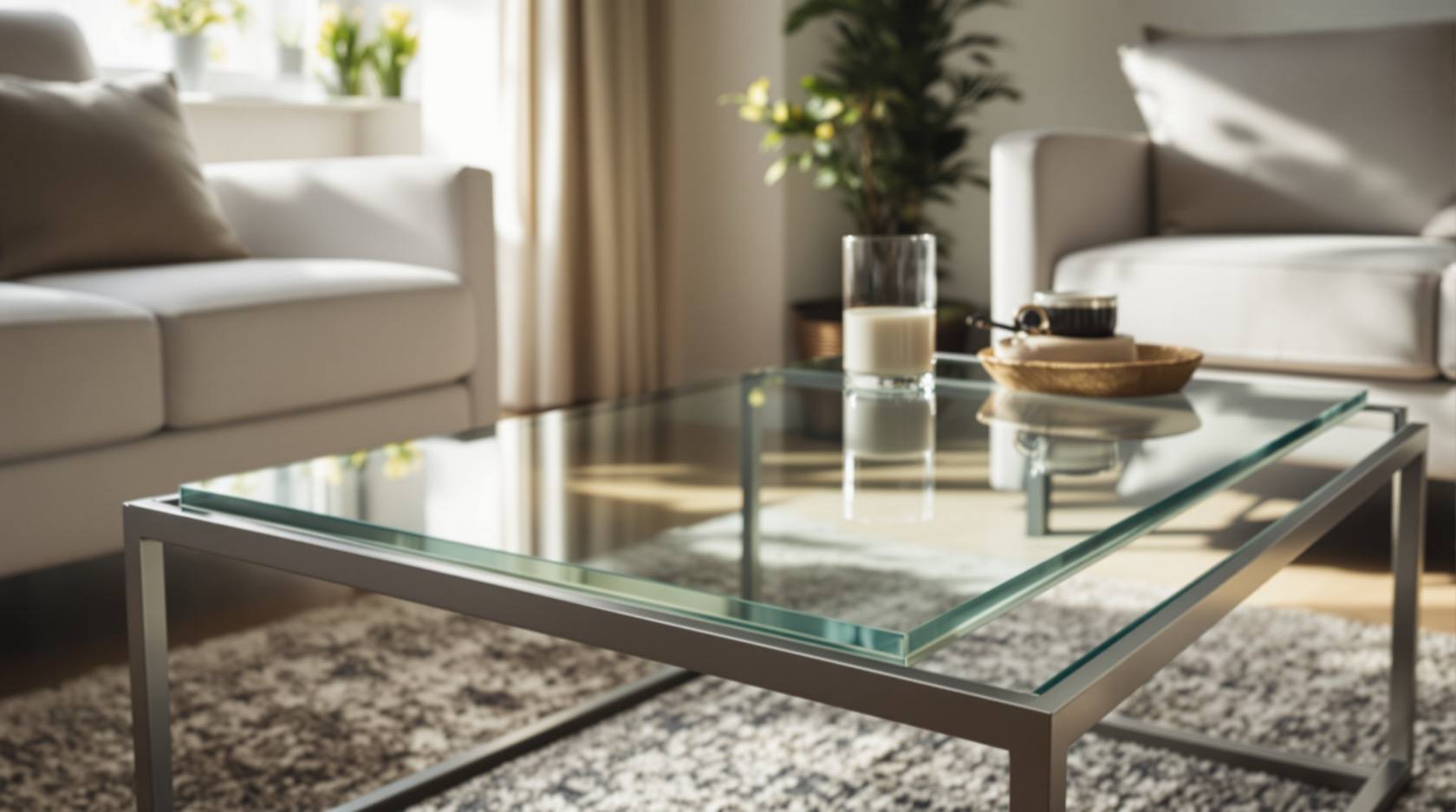
Glass Furniture in India: Types, Safety, Thickness & Care (2026)
A homeowner's guide to using glass in furniture — table tops, shelves, cabinet fronts, TV units and partitions. Which glass is safe where, how thick it needs to be, how edges and fixings are done, and where glass simply does not belong.
Glass earns its place in furniture for one reason: it disappears. A glass table top shows off the base beneath it, a glass shelf floats without visual weight, and a frosted cabinet front hides clutter while catching light. In a compact Indian apartment that visual lightness is worth a lot — it keeps a room from feeling crowded. But glass is the one furniture material that can hurt you when it fails, so the whole game is choosing the right type, the right thickness and the right fixing for each job, and knowing the handful of places glass should never go.
This guide is part of the Studio Matrx furniture material series. It sits beside the guides on metal furniture, solid wood furniture and upholstered furniture — because a real piece is usually glass plus a frame: a glass top on a metal or timber base, a glass front on a plywood carcass. Read this for the glass; read those for what carries it.
Scope & how to read this. Every thickness, span and cost band here is typical and indicative to help you specify, budget and brief a supplier — confirm exact figures against your glass processor and the relevant IS glass and furniture-safety standards. Glass in furniture is a safety matter: the wrong glass, undersized or badly fixed, can shatter into injuries. This guide helps you choose and buy well; the cutting, toughening and on-site fixing of glass are done by a professional glass processor and installer, and any heavy top, partition or head-height panel should be sized and fitted by one. Costs are relative bands only — get local quotes.
The one thing that matters most: glass type
Almost every glass-furniture safety decision comes down to which of three glass types you use. Get this right and most other choices become easy.
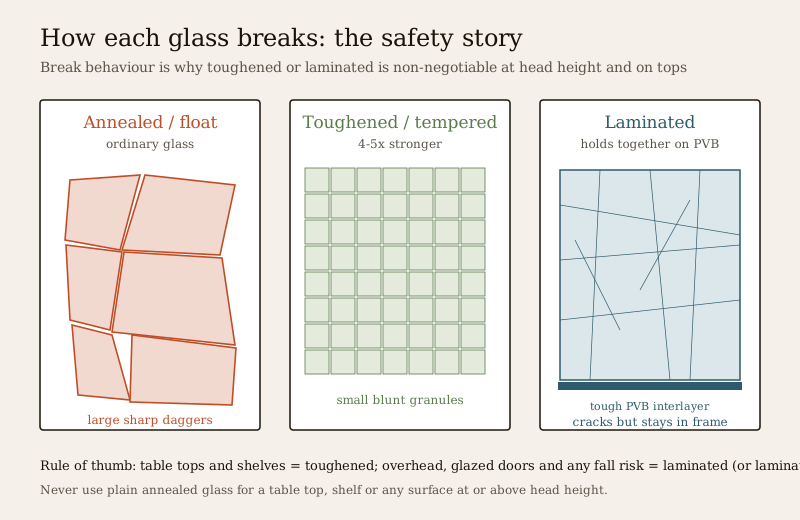
- Annealed / float glass (ordinary glass). This is standard sheet glass straight off the float line. It is cheap and perfectly clear, but when it breaks it forms large, sharp, dagger-like shards that cause deep cuts. It also has the lowest strength. Annealed glass is fine for a picture frame or a mirror backing, but it has no place in a table top, a shelf, or any panel at or above head height.
- Toughened / tempered glass. The same glass, heated and rapidly cooled so its surface is under compression. This makes it roughly four to five times stronger than annealed glass, more resistant to thermal and impact stress, and — crucially — when it does break it crumbles into small, blunt granules instead of daggers. This is the safety glass you want for table tops and shelves. One catch: it cannot be cut, drilled or edged after toughening, so every hole, cutout and edge finish must be specified before it goes into the furnace.
- Laminated glass. Two (or more) layers of glass bonded to a tough plastic PVB interlayer. When it cracks, the interlayer holds the fragments in place — the panel stays in its frame rather than falling out. This is the safest option for anything overhead, any glazed door, and any panel where a person could fall against it. You can also get laminated-toughened glass, which combines both benefits.
The safety rule, stated plainly
| Furniture element | Minimum safe glass | Why |
|---|---|---|
| Coffee / dining / console table top | Toughened | Load-bearing, hip-to-head height, people lean on it |
| Wall / cabinet / display shelf | Toughened | Load-bearing; a shelf that shatters drops everything on it |
| Glazed cabinet or wardrobe door | Toughened (laminated if full-height / fall risk) | Impact and slam risk at body height |
| TV unit glass top / floating panel | Toughened | Heavy electronics, daily handling |
| Room partition / glass wall | Toughened or laminated | Walk-into and fall-through risk |
| Overhead / suspended glass | Laminated | Must never fall as loose pieces |
| Picture frame, mirror backing | Annealed acceptable | No load, no fall risk |
The short version: for anything you load or anything at head height, use toughened; for anything overhead or a fall risk, use laminated. If a supplier offers you plain annealed glass for a table top to save money, walk away — that saving is not worth an emergency-room visit.
How thick? Match thickness to span and load
Thicker glass resists bending and breakage, but it is also heavier and costlier. The right thickness depends mainly on the unsupported span (how far the glass reaches between supports) and the load it carries. Longer span or heavier load means thicker glass.
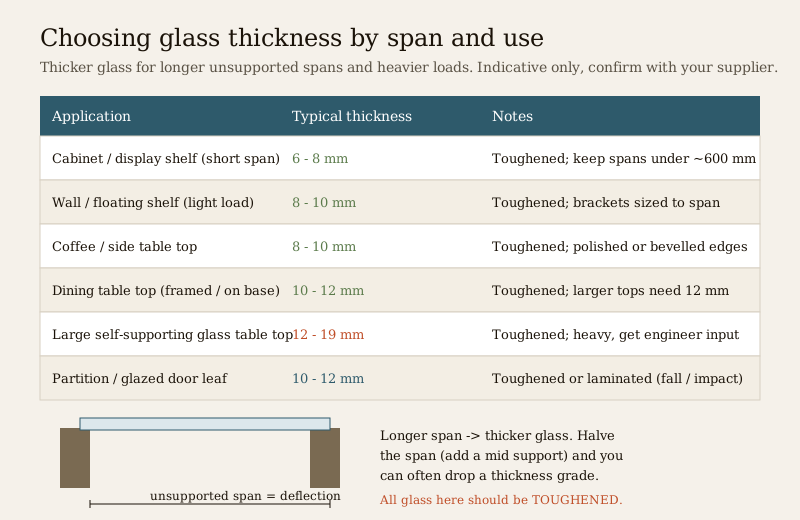
| Application | Typical thickness | Notes |
|---|---|---|
| Cabinet / display shelf (short span, light load) | 6 - 8 mm | Toughened; keep spans short, around 600 mm |
| Wall or floating shelf (light load) | 8 - 10 mm | Toughened; size brackets to the span, not just the wall |
| Coffee / side table top | 8 - 10 mm | Toughened; polished or bevelled edges |
| Dining table top (framed or on a base) | 10 - 12 mm | Toughened; larger tops move to 12 mm |
| Large self-supporting glass table top | 12 - 19 mm | Toughened; heavy — get processor / engineer input |
| Glass partition or glazed door leaf | 10 - 12 mm | Toughened or laminated for impact and fall safety |
Two practical levers. First, shorten the span and you can often drop a thickness grade — a shelf with a centre bracket, or a table top with a mid rail under it, carries far more for the same glass. Second, a bigger top nearly always needs to step up, because span and self-weight both grow. When a top gets genuinely large or has no frame at all, treat the thickness as an engineering question, not a catalogue pick, and let the glass processor advise. For sizing the piece itself, the furniture size chart gives standard table and shelf dimensions to design around.
Edges, holes and cutouts — the finishing that keeps it safe
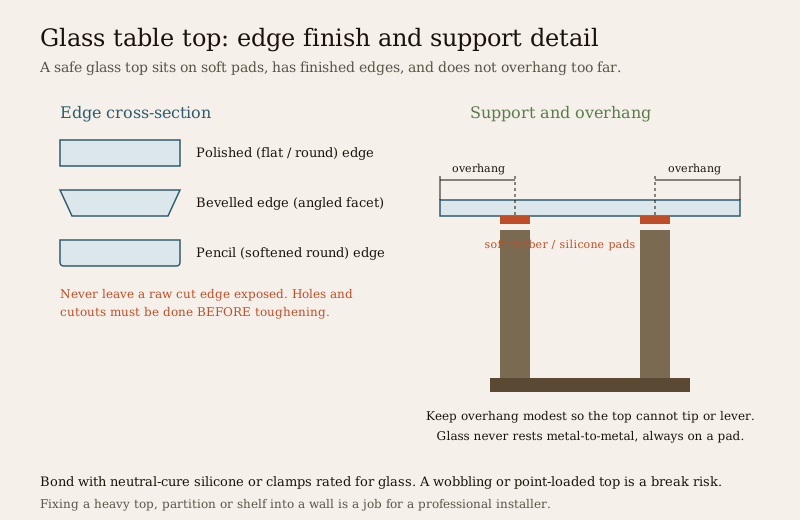
A raw-cut glass edge is sharp and is where cracks start. Finished edges are both safer to touch and stronger, because grinding removes the tiny flaws a break would run from.
- Polished (flat or round) edge — the clean everyday finish for shelves and simple tops; smooth and safe to touch.
- Bevelled edge — an angled facet ground around the perimeter; a decorative, slightly premium look for table tops and mirrors.
- Pencil edge — a softly rounded profile, gentle on hands and a good pick where children are around.
The rule that trips people up: because toughened glass cannot be worked after toughening, every edge finish, hole, notch and cutout must be done first, then the glass is toughened. Want a hole for a cable, a parasol, or a fixing bolt? Specify its exact position before the furnace. Try to drill toughened glass afterwards and it will explode. This is precisely why glass furniture is measured and detailed carefully up front.
Frosted, tinted, lacquered — glass for looks
Beyond clear glass, processing gives you a range of finishes that change how a piece reads:
- Frosted / acid-etched / sandblasted glass — a translucent matte surface that passes light but blurs what is behind it. Ideal for cabinet fronts, wardrobe shutters and partitions where you want light but not a view of the clutter inside.
- Tinted glass — body-tinted grey, bronze or smoke; softens reflections and hides fingerprints and dust better than clear glass, which is a real advantage on a coffee table.
- Lacquered / back-painted glass — glass painted on the reverse in a solid colour, giving a glossy, seamless, wipe-clean surface. Popular as a kitchen splashback alternative and on cabinet fronts. It is a surface finish, not a structural upgrade — it does not make the glass safer.
- Fluted / reeded glass — vertical ridges that distort the view for privacy with a textured, currently fashionable look on cabinet and TV-unit fronts.
These are aesthetic choices layered on top of the type-and-thickness decision. A frosted shelf still needs to be toughened; a back-painted cabinet front near body height still benefits from toughening. Looks never override the safety rule.
Where glass belongs — and where to avoid it
Glass is a wonderful material in the right spot and a liability in the wrong one. Be honest about your household before you commit.
Glass works well for:
- Coffee, side and console table tops (toughened) where you want to show the base or keep the room light.
- Display and cabinet shelves (toughened) that need to feel airy and let light through.
- Cabinet, wardrobe and TV-unit fronts (frosted, fluted or clear toughened) for a light, modern face.
- Partitions (toughened or laminated) that divide space without blocking light — see space-saving furniture ideas for how partitions earn their keep in small homes.
Think hard, or avoid, when:
- You have young children — glass tables at toddler head height, and shelves they can pull on, are a real hazard. Prefer rounded (pencil) edges, laminated glass, or skip glass tops entirely in play areas.
- You have elderly members at risk of falls — a fall onto or through a glass panel is far more serious than onto timber or upholstery. Favour laminated glass and solid alternatives.
- The piece takes hard daily knocks — a busy family dining table or a kids' study desk may be better in solid wood or a laminate top.
- You want truly low maintenance — glass shows every fingerprint, water ring and speck of dust, especially clear glass in bright light.
For rooms where glass shines, browse living-room design ideas and TV-unit ideas; for the pieces to avoid glass, the metal and wood guides give sturdier options.
Support and fixing — get this professionally done
Even the right glass fails if it is badly supported. Glass hates point loads and metal-to-metal contact — a top resting directly on a hard frame will crack at the contact points.
- Pads and cushioning. A glass top must sit on soft rubber, PVC or silicone pads, never directly on metal or timber. Pads spread the load and stop rattling and stress cracks.
- Overhang limits. Keep the top's overhang beyond its supports modest — too much overhang lets the top tip or lever, and concentrates stress at the support edge. A large top needs a base that carries it near its corners.
- Silicone and clamps. Glass is bonded or clamped with neutral-cure silicone or purpose-made glass clamps and connectors — spider fittings, standoffs, shelf brackets rated for glass. Ordinary hardware is not a substitute.
- Wall fixing. A heavy glass shelf or a glass partition anchored into a wall must be fixed by someone who will get the anchors, brackets and levelling right. A partition that is out of plumb or under-anchored is dangerous.
This is the part to hand to a professional. Measuring, detailing the cutouts, toughening and fixing on site are a glass processor's and installer's job — the same way you would not fabricate your own metal frame. Your role is to specify what you want and where; theirs is to make it safe.
Cleaning, scratches and chips
Glass is easy to keep looking new if you treat it kindly:
- Daily wipe — a microfibre cloth with a little glass cleaner or diluted vinegar. Avoid abrasive pads and gritty cloths, which leave fine scratches.
- Water rings and hard-water spots — common in much of India's hard water; wipe spills promptly and use coasters. A dilute vinegar solution lifts limescale marks.
- Scratches — minor surface scratches on glass are hard to remove; prevention (coasters, felt pads under objects, not dragging items across the top) beats cure.
- Chips and cracks — a chip on toughened glass is a warning sign. Toughened glass under stress can fail suddenly from a damaged edge, so a chipped toughened top or shelf should be replaced, not patched. Never keep using cracked structural glass.
What glass furniture costs
Treat these as relative bands, not prices — the actual figure depends on glass type, thickness, size, edgework, finish and your city. Get local quotes and use the furniture cost calculator for a first-cut budget.
| Cost driver | Lower cost | Higher cost |
|---|---|---|
| Glass type | Annealed (avoid for furniture) | Laminated / laminated-toughened |
| Thickness | 6 - 8 mm | 12 - 19 mm |
| Edge finish | Polished flat | Bevelled, shaped, multiple cutouts |
| Surface finish | Clear | Lacquered, fluted, custom tint |
| Size / span | Small, framed | Large, self-supporting |
The honest guidance: do not economise on glass type or thickness — that is the safety budget. If cost is tight, save on finish and size (clear instead of lacquered, a smaller framed top instead of a large self-supporting one), and keep the toughened or laminated spec intact.
How it connects
- Start with the complete guide to furniture in India for how to plan a whole scheme, then compare materials across metal, solid wood, engineered wood and upholstered furniture.
- Glass almost always pairs with a carcass or frame — see plywood furniture for cabinet bodies behind glass fronts, and MDF vs particle board for budget carcasses.
- For finishes on the frame and adjacent joinery, browse the materials hub and best laminate finishes.
- Size and lay out the piece with the furniture size chart and the furniture layout designer; budget it with the furniture cost calculator.
- For where glass tops and partitions shine, see living-room and TV-unit design ideas, and read modern TV unit ideas.
- Designers wanting the underlying craft can go deeper in the furniture construction & detailing course.
Key takeaways
- Glass type is the safety decision. Use toughened for every table top and shelf (4-5x stronger, breaks into blunt granules); use laminated for anything overhead or a fall risk. Never use plain annealed glass in a load-bearing or head-height piece.
- Match thickness to span and load — roughly 6-8 mm short shelves, 8-10 mm small tops and shelves, 10-12 mm dining tops and partitions, 12-19 mm large self-supporting tops. Shorten the span to drop a grade.
- Edges, holes and cutouts are done before toughening — toughened glass cannot be cut or drilled afterwards. Always finish edges (polished, bevelled or pencil); never leave a raw edge.
- Frosted, tinted, lacquered and fluted finishes are for looks and do not change the safety requirement — a decorative shelf still must be toughened.
- Reconsider glass around young children and elderly members, and on hard-use family surfaces; prefer laminated glass, rounded edges, or a sturdier material.
- Fixing is a professional job — soft pads not metal-to-metal, modest overhangs, neutral-cure silicone or rated clamps, and proper wall anchoring. Replace any chipped or cracked structural glass.
- All thicknesses and costs here are indicative — confirm with your glass processor and get local quotes.
References
- IS glass standards for architectural and safety glazing — float, toughened (tempered) and laminated safety glass (named generally, no clause numbers).
- IS furniture strength, stability and durability standards — general provisions for furniture safety and load performance (named generally).
- Glass processor and installer specifications — toughening, edgework, cutouts and on-site fixing details for your specific piece.
- BIFMA-type furniture test methods (commercial context) and manufacturer load ratings for glass shelving and fittings (named generally).
All glass types, thicknesses, spans, finishes and cost bands here are indicative planning aids only; confirm the governing values against the relevant IS glass and furniture-safety standards and your glass processor, get local quotes for cost, and have a professional size and fix any table top, shelf, partition or head-height glass panel.
Export this guide
Related Guides — Deep-dive reading
Glass Wall Finishes: The Complete Guide for Indian Homes
The seamless, wipe-clean, light-reflecting wall — back-painted and mirror to frosted and glass block. The whole family, where glass shines, how it's fixed and the safety spec, the back-painted splashback in detail, and glass versus tile.
Wall FinishesThe Complete Guide to Furniture for Indian Homes (2026)
The start-here master guide for furnishing an Indian home — what furniture actually does, the five families of pieces, the decisions in the order you face them (space and needs, loose vs modular vs built-in, materials, size and layout, budget, buy, maintain), an honest read on plywood, humidity and termites, and where every choice hands off to the carpenter, the brand or the fixer.
FurnitureGlass Bathroom Walls India: Toughened Shower Partitions, Enclosures & Back-Painted Glass
A practical, India-first guide to glass in bathroom walls and partitions — toughened glass thickness (8/10/12 mm), IS 2553 safety glass, frameless vs framed enclosures, back-painted lacquered glass wall finishes, frosting for privacy, hard-water spotting and coatings, rupee costs and the safety rules that matter.
BathroomsRelated Tools — Try Free
Material Comparison Sheet
India's interior material cheatsheet — plywood, finishes, hardware, countertops, paints, waterproofing.
Reference GuideAcoustic Privacy (STC) Visualizer
Indian healthcare acoustic visualizer — compare wall assemblies and noise sources, see received SPL after STC attenuation, and check FGI 2018 / IS 1950 / NABH speech-privacy compliance with live dual-canvas waveform.
Acoustic ToolApartment Furniture Size Chart
Standard furniture dimensions for Indian apartments — sofas, beds, tables, dining, storage.
Reference Chart