
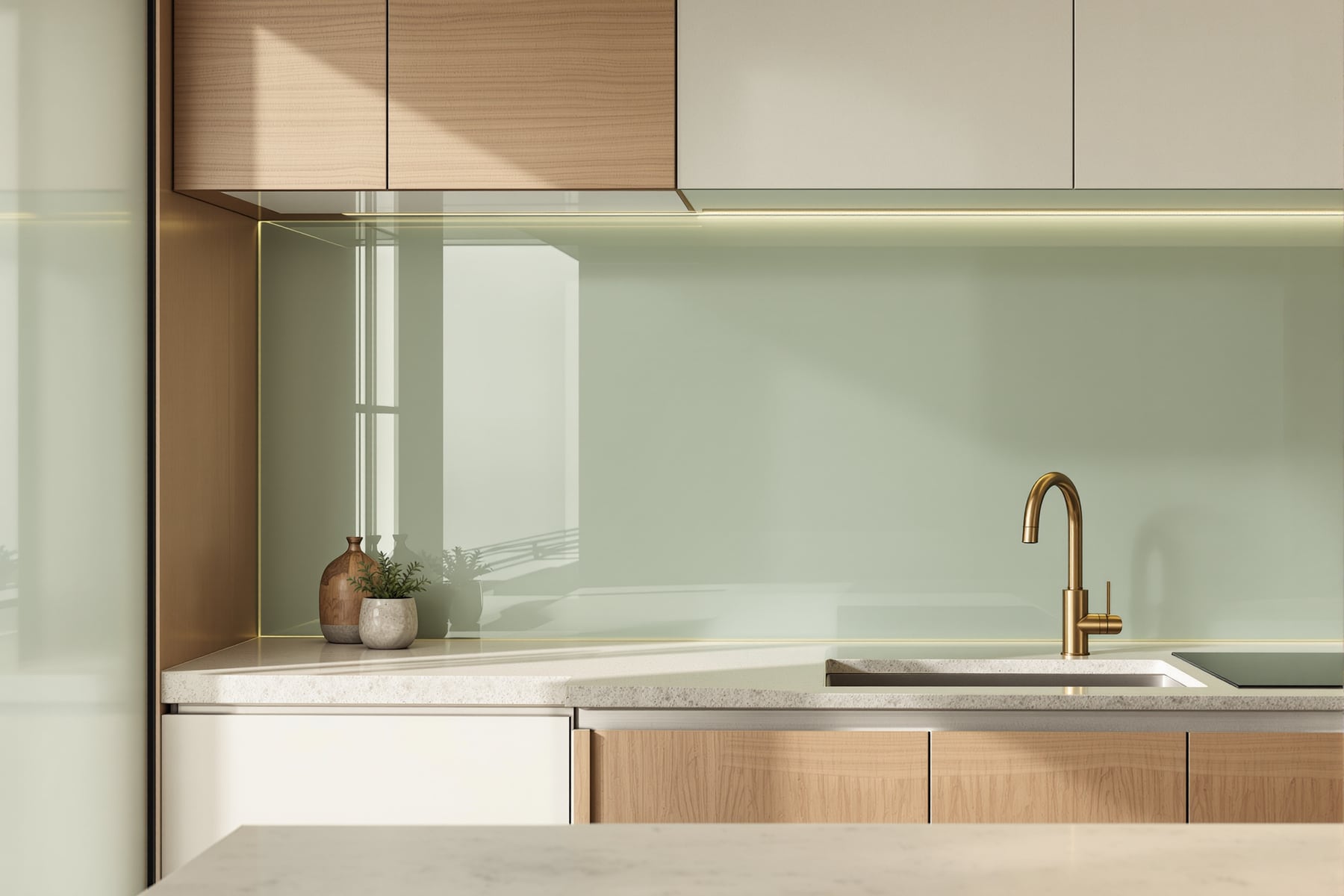
Glass Wall Finishes: The Complete Guide for Indian Homes
The seamless, wipe-clean, light-reflecting wall — back-painted and mirror to frosted and glass block. The whole family, where glass shines, how it's fixed and the safety spec, the back-painted splashback in detail, and glass versus tile.
Glass is the one wall finish that does something none of the others can: it is utterly seamless, wipes clean in a single stroke, reflects light to make a room feel larger and brighter, and can take any colour or even a printed image — all in a surface with no joints, no grout and nothing for grime or mould to hide in. A back-painted glass splashback turns a kitchen wall into a sheet of glossy colour; a mirror doubles a cramped bathroom; a frosted panel divides a room without stealing its light. Used well, glass is the most modern and hygienic wall in the house.
This is the complete guide to glass wall finishes for Indian homes — the deep dive under the master wall-finishes guide into a finish most people meet only as a splashback but which does far more. We will map the glass family, show where it truly shines, explain how it is fixed and the non-negotiable safety spec, open up the back-painted splashback that makes glass famous, and settle the kitchen-wall question of glass versus tile.
The glass wall-finish family
Glass on a wall is not one product but a family of treatments, from mirror-bright to milk-frosted to any printed image. Knowing them is how you match the effect to the room.
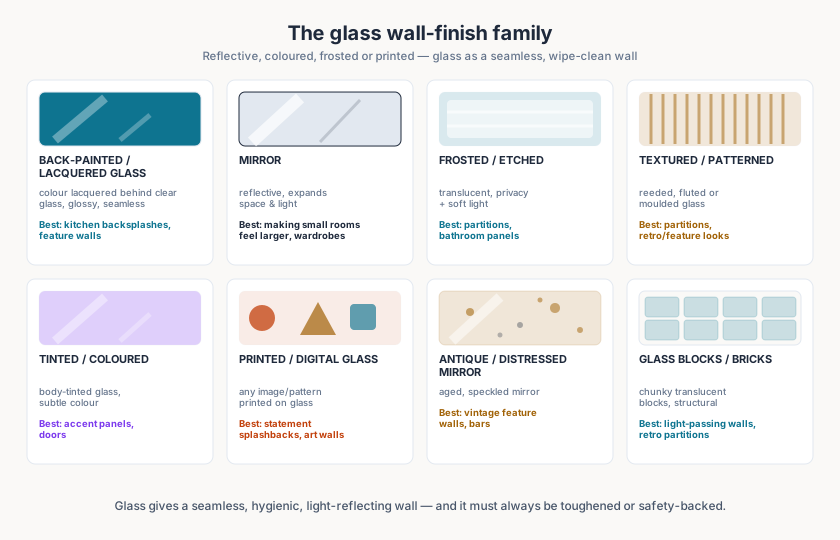
- Back-painted / lacquered glass — colour lacquered behind clear glass for a glossy, seamless panel; the classic splashback and feature wall.
- Mirror — reflective glass that expands space and light, ideal in small rooms and on wardrobes.
- Frosted / etched — translucent glass that gives privacy while passing soft light; a partition favourite.
- Textured / patterned — reeded, fluted or moulded glass for partitions and a retro-modern feature look.
- Tinted / coloured — body-tinted glass for subtle colour in panels and doors.
- Printed / digital glass — any image or pattern printed onto glass, for statement splashbacks and art walls.
- Antique / distressed mirror — aged, speckled mirror for vintage feature walls and bars.
- Glass blocks / bricks — chunky translucent blocks that build a light-passing wall.
The common thread: glass gives a seamless, hygienic, light-reflecting wall — and, as we'll see, it must always be toughened or safety-backed.
Where glass walls shine
Glass is a specialist, not an all-rounder. It earns its place on specific walls where seamlessness, hygiene and reflected light matter most.
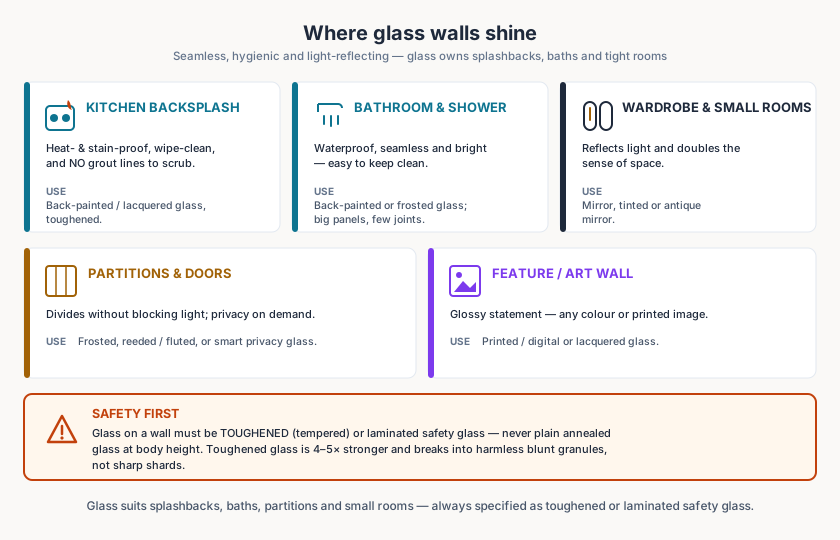
A kitchen backsplash is glass's signature act — heat- and stain-proof, wipe-clean, and with no grout lines to scrub — in toughened back-painted glass. Bathroom walls and showers take waterproof, seamless, bright back-painted or frosted panels. Wardrobes and small rooms use mirror to reflect light and double the sense of space. Partitions and doors want frosted, reeded or smart privacy glass to divide without blocking light. And a feature or art wall can be glossy lacquered or a printed/digital image.
One rule governs all of it: glass on a wall must be toughened (tempered) or laminated safety glass — never plain annealed glass at body height. Toughened glass is four to five times stronger and, if it ever fails, breaks into harmless blunt granules rather than dangerous shards (see safety glass for homes and toughened glass).
How it's fixed — and the safety spec
Glass is a made-to-measure finish, and two things decide whether a glass wall is safe and lasting: how it is mounted, and the specification you insist on before it is made.
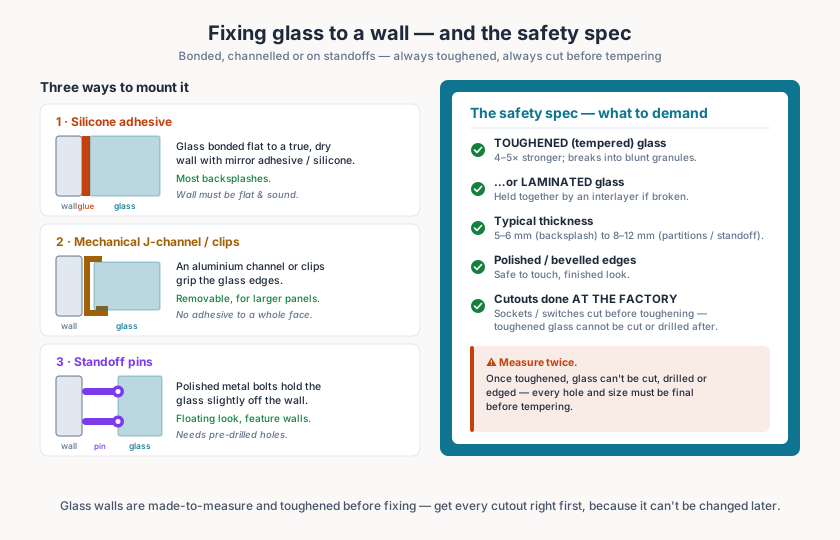
There are three ways to mount it: silicone adhesive bonds the glass flat to a true, dry wall (most backsplashes); a mechanical J-channel or clips holds the edges for larger, removable panels; and standoff pins hold the glass slightly off the wall for a floating, feature look. Whichever you choose, demand the right safety spec: toughened (or laminated) glass; the right thickness (roughly 5–6 mm for a backsplash, 8–12 mm for partitions and standoffs); polished or bevelled edges; and — critically — all cutouts for sockets and switches done at the factory before toughening.
That last point is the one that catches people out: once glass is toughened, it cannot be cut, drilled or re-edged — every size and hole must be final before tempering. Measure twice; a mistake means a whole new panel.
Back-painted glass: the seamless splashback
Back-painted glass deserves a closer look, because it is the finish that made glass a mainstream wall material — and understanding how it is made explains both its magic and its one real limitation.
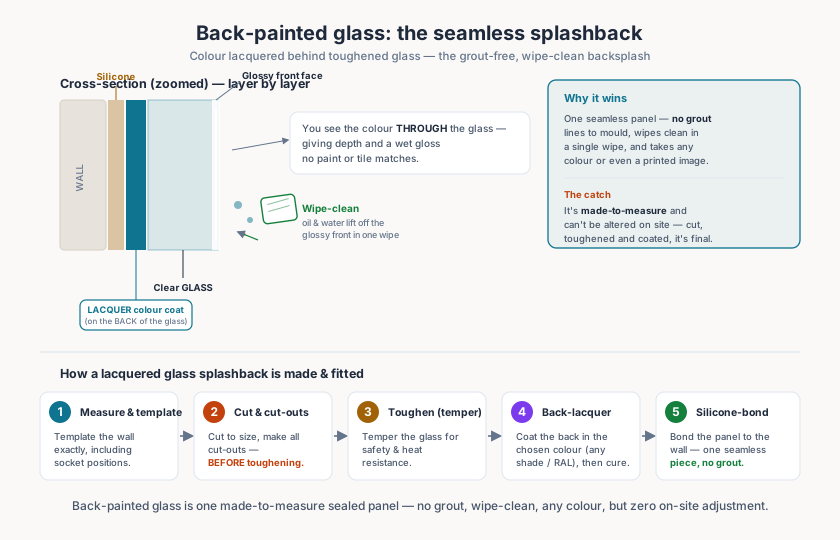
The trick is simple and beautiful: colour is lacquered onto the back of a clear glass panel, so you see the shade through the glass, giving a depth and wet gloss no paint or tile can match. The process is made-to-measure: the wall is measured and templated (sockets included), the glass is cut to size with all cutouts made before toughening, then toughened for strength and heat resistance, back-lacquered in any colour or even a printed image and cured, and finally silicone-bonded to the wall as one seamless piece.
The payoff is a single panel with no grout lines to mould, wiping clean in a stroke, in any colour you like — behind a hob, a basin or as a whole feature wall. The catch, as with all toughened glass, is that it is entirely made-to-measure and cannot be altered on site, so the template and the order have to be right the first time.
Glass versus tile
On a kitchen or bathroom wall, glass and tile are the two great rivals, and the honest answer is that each wins a different kitchen.
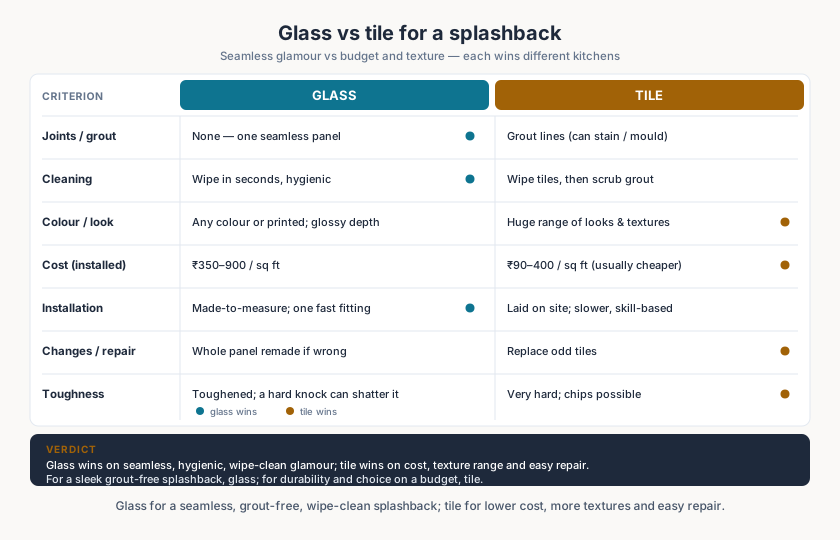
Glass wins decisively on seamlessness and hygiene — no joints, no grout, a wipe-clean glossy surface — and on glamour, with any colour or printed image and real reflective depth. Tile wins on cost (₹90–400/sq ft installed against glass's ₹350–900), on the sheer range of textures and looks, and on repairability — you can replace an odd cracked tile, whereas a glass panel must be remade whole if it is wrong or breaks. Installation favours glass for speed (one made-to-measure fitting versus laying tile on site), while toughness slightly favours tile (very hard, though it can chip), since even toughened glass can shatter under a hard point impact.
So: for a sleek, grout-free, wipe-clean splashback with glamour, choose glass; for durability, texture and choice on a budget, choose tile. Glass is the most modern and hygienic wall finish in the Indian home — seamless, bright and effortless to keep — and, specified as toughened safety glass and measured right the first time, one of the most rewarding. When the wall calls for warmth or texture instead, step back to the master wall-finishes guide and compare glass against paint, wallpaper, cladding, decorative plaster and tile.
Export this guide
Related Guides — Deep-dive reading
Ultimate Guide to Wall Finishes for Indian Homes
Paint, wallpaper, panels, stone, plaster, microcement and more — the whole family of wall finishes, a five-question way to choose, and the real cost, climate and maintenance trade-offs.
Wall FinishesKitchen Wall Finishes: The Complete Guide for Indian Homes
Grease, heat and steam every day — the kitchen's wall zones, the best backsplash options, what to use on the other walls, the five hygiene-and-heat rules, and three budget combinations.
Wall FinishesMirror Walls: The Complete Guide for Indian Homes
The oldest trick for a small room — what a mirror wall does, the types from clear to antique, how it's fixed safely, where it works (and where not, including Vastu), plus design tips and cost.
Wall FinishesRelated Tools — Try Free
Window Cleaning Cost Calculator
Estimate professional window cleaning cost per visit and per year by access and frequency.
Window CalculatorAcoustic Privacy (STC) Visualizer
Indian healthcare acoustic visualizer — compare wall assemblies and noise sources, see received SPL after STC attenuation, and check FGI 2018 / IS 1950 / NABH speech-privacy compliance with live dual-canvas waveform.
Acoustic ToolCross-Ventilation Analyzer
Estimate airflow and air changes per hour (ACH) from room size, window areas, layout, and local wind — with NBC 2016 Part 8 compliance check.
Ventilation Calculator