
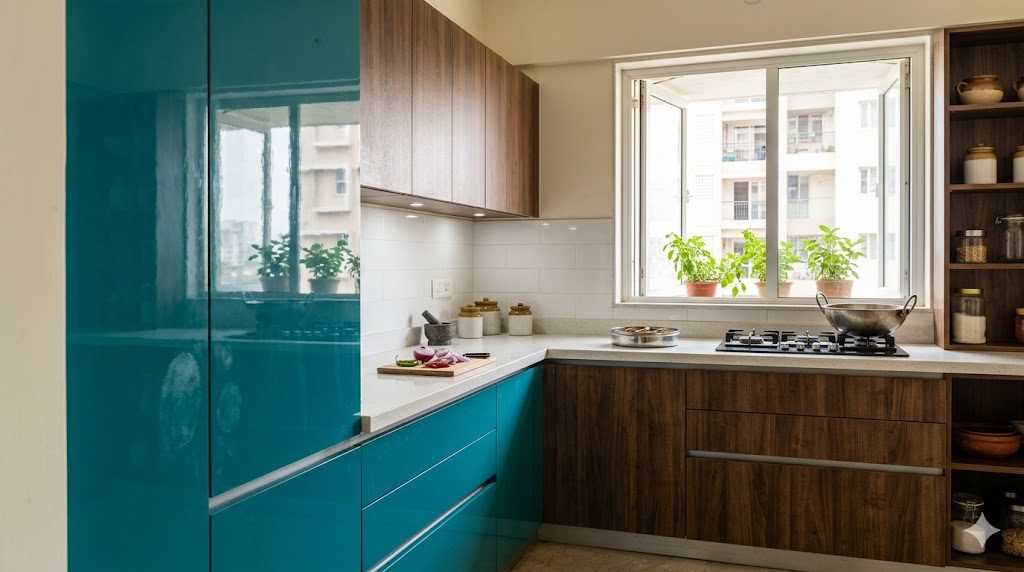
Acrylic vs Laminate Kitchen: Complete Comparison
Which shutter finish actually ages better in an Indian kitchen — gloss, matte, and the hidden third option
Every modular kitchen quote in India lands on the same fork in the road: do you go acrylic, or do you go laminate? The brochure makes it look like an aesthetics call — gloss or matte, mirror or wood. In practice it is a question about how the kitchen will look in year five, how much it will cost to keep that way, and how well it survives the part of cooking the showroom never shows you: the splattered tadka, the wet sink-side shutter, the wiped-down fingerprint at 11 PM after dinner.
This guide breaks down acrylic, laminate, and the often-undiscussed third option (membrane) for an Indian kitchen — what each material actually is under the marketing, what they cost installed in a typical 10 ft × 8 ft kitchen, and how each one ages under turmeric, ghee, steam, and Mumbai/Chennai humidity. We will close with a clear decision framework for where each finish belongs in the same kitchen.
It is a deep-dive companion to our best modular kitchen layout for Indian cooking pillar — read that for the layout and the work triangle; this article picks up where the finish call begins.
What each material actually is
The first source of confusion is that "acrylic", "laminate", and "membrane" are bundled in quotations as if they were interchangeable categories. They are not.
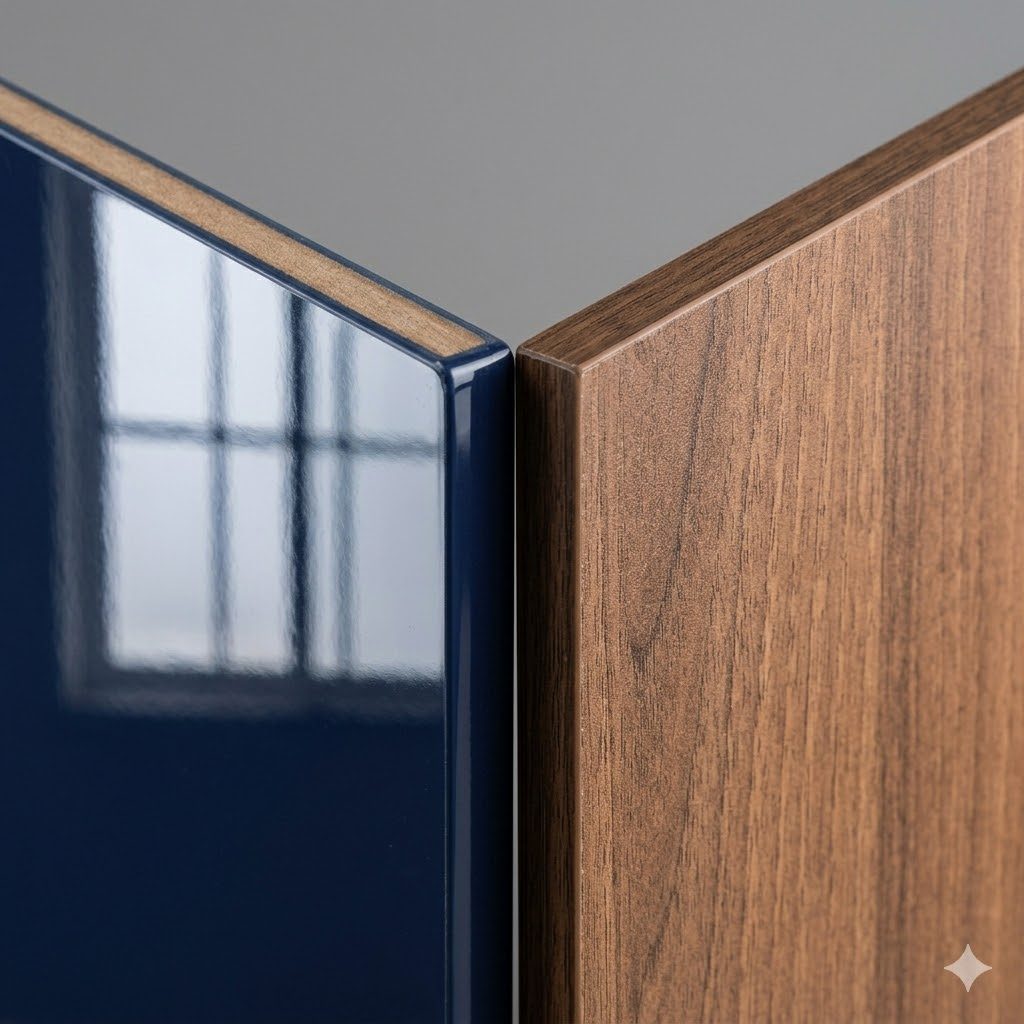
Acrylic is a 1 mm sheet of PMMA (polymethyl methacrylate) glass-clear plastic, mirror-polished on the show face, bonded to an 18 mm MDF substrate with PUR hot-melt adhesive. The look is the closest the industry has come to glass-on-cabinet: a deep, wet, mirror-like reflection that a soft matte cannot match. The cost is the surface — that PMMA layer is the most expensive component of the entire shutter.
Laminate, properly called high-pressure laminate or HPL, is a 0.8 to 1.0 mm decorative sheet pressed under heat and high pressure from a stack of kraft paper, decorative paper and a melamine top coat. It is bonded to a substrate of MR-grade plywood or MDF. India calls 1 mm HPL "1 mm" and the thinner liner sheets "0.8 mm" or "0.92 mm". The top sheet is what carries colour, wood texture, stone print, and the matte or gloss finish — and what gives laminate its abrasion class.
Membrane is the third option that quotes hide. A vacuum-pressed 0.3 to 0.4 mm PVC foil wrapped over a CNC-routed MDF blank, hot-glued in a vacuum membrane press. The seamless, profiled edge — no separate edge band — is its defining feature, and the reason it shows up in "shaker style" and classical kitchens. It is also why it is the least durable in heat.
The chart above prices what most buyers actually pay in Indian metros in 2026 — installed shutter cost on a standard 18 mm substrate, including hardware, but before the carcase upgrade for branded plywood. We will come back to the cost-of-ownership picture in a moment.
The real cost difference, for a 10 ft × 8 ft kitchen
A typical Indian L-shaped 10 ft × 8 ft kitchen has roughly 80 sqft of shutter face, split across 14–18 shutter pieces and 12–16 drawer fronts. At today's metro rates that translates to:
| Finish | Shutter rate | 80 sqft total | Plus hardware (₹) | Installed all-in |
|---|---|---|---|---|
| Membrane | ₹650–1,000 / sqft | ₹52,000–80,000 | ₹15,000–30,000 | ₹67,000–1,10,000 |
| Laminate (1 mm HPL on ply) | ₹800–1,400 / sqft | ₹64,000–1,12,000 | ₹20,000–40,000 | ₹84,000–1,52,000 |
| Acrylic (1 mm PMMA on MDF) | ₹1,400–2,200 / sqft | ₹1,12,000–1,76,000 | ₹30,000–60,000 | ₹1,42,000–2,36,000 |
The acrylic kitchen is, roughly, 1.5× to 2× the cost of the laminate equivalent at install. That is the number every showroom will quote — and where most homeowners stop comparing. The number that actually matters, however, is what each kitchen costs to keep over ten years.
What's actually inside the shutter
Cost is downstream of construction. The two shutters look identical from the outside; under the show face they are very different objects.
Three details are worth flagging because they decide whether the shutter survives year three:
1. The substrate. Acrylic is almost always on MDF (because MDF is dimensionally perfect, which matters when the surface is mirror-flat). Laminate can be on either MDF or MR-grade plywood — and on ply, it lasts longer in humid coastal kitchens because the substrate does not swell when water creeps past a damaged edge.
2. The edge band. Acrylic shutters carry a 2 mm ABS edge band, bonded with PUR hot-melt. In a humid coastal city the PUR-vs-EVA distinction is the most important spec line in the quote. EVA bonds (cheaper, common in budget shutters) lift in 2–4 years. PUR bonds typically last 8+. Membrane has no edge band because the foil wraps the edge — but the foil itself peels off the routed edge first in heat.
3. The balancing back. A proper acrylic or laminate shutter has a back-balancing layer (the back foil or back laminate) of similar thickness to the front. This is not decorative; it stops the shutter from cupping. Some budget shutters skip it. They will warp inside two years.
How each finish ages in an Indian kitchen
The five things an Indian kitchen does to a shutter that no European showroom test simulates:
- Tadka splatter — hot oil + asafoetida onto the shutter face next to the hob, daily.
- Masala stain — turmeric on a wiping cloth, dragged across the shutter.
- Steam dado — the splashback area gets near-100% humidity 4–6 times a day.
- Pressure-cooker exhaust — a focused jet of steam, often aimed at an overhead shutter.
- Coastal salt air — a Mumbai, Chennai or Kochi monsoon delivers 90% RH for 90 days.
Against these, the three finishes age very differently.
| Stress | Acrylic | Laminate (matte) | Membrane |
|---|---|---|---|
| Tadka splatter (oil + heat) | Excellent if kept ≥ 300 mm from hob | Excellent | Avoid — foil softens at 60°C+ |
| Turmeric stain | Wipes clean | Wipes clean | Wipes clean (foil intact) |
| Fingerprints | Show immediately | Hide well in matte | Medium |
| Scratch from a steel utensil | Visible in 1–2 strokes | Visible only in heavy gloss; matte hides | Very visible |
| Coastal humidity / edge band lift | 3–5 yr with PUR edges | 6–8 yr with PUR edges | 2–3 yr (foil edge) |
| Pressure-cooker steam zone | Risky overhead | Safe | Fails fast |
| Repair of single damaged shutter | Possible — buff or replace one panel | Replace one shutter cleanly | Re-skin the panel |
The single biggest mismatch in Indian kitchens is putting membrane near the hob. The PVC foil softens above about 60°C and starts to lift along the routed profile. In a year of weekly pressure-cooker steam, the overhead shutter next to the hob will show foil-lift along the edge.
The ten-year cost-of-ownership picture
This is where the cheap finish stops looking cheap.
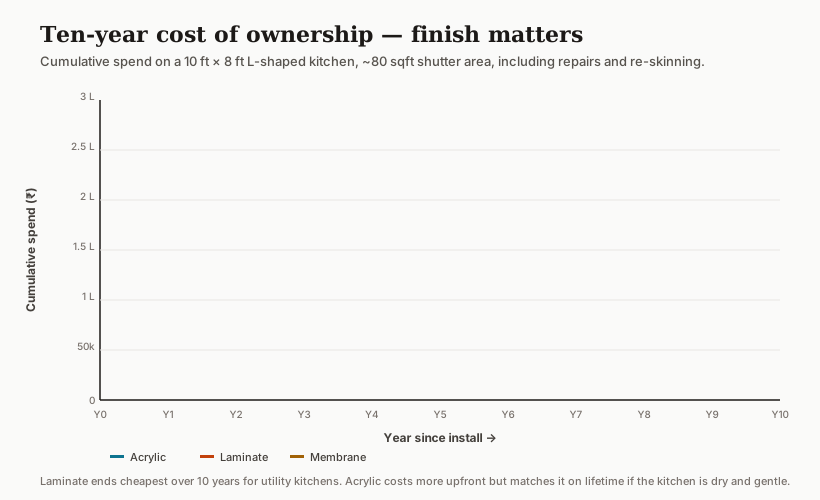
Membrane is the cheapest day-one install but typically needs a re-skin of damaged panels around year 5–6. Laminate is the cheapest over ten years for an everyday utility kitchen because almost nothing fails before year 8. Acrylic is the most expensive but stays close-to-pristine if the kitchen is dry and the edges are PUR-bonded.
Pick acrylic for the kitchen you want guests to see. Pick laminate for the kitchen you cook in. In a small flat the same kitchen has to do both — and there is a way to split the difference.
When each finish is the right call
The most useful Indian kitchen we keep specifying is a hybrid. Not because clients ask for it, but because each finish is honestly best at one job.
- Acrylic belongs on the living-side modules — the wall the dining room looks at, a kitchen island in an open plan, a tall pull-out next to a pass-through. Anywhere the kitchen is on display and not directly next to flame.
- Laminate (matte, 1 mm) belongs on the utility-heavy runs — the hob run, the sink run, the under-counter pull-outs and tall pantry. It hides fingerprints, hides scratches, and the back-of-hob heat does not bother it.
- Membrane belongs in cool, dry, low-use parts of the kitchen — a tall pantry door on the cool wall, profile-edge shaker style for a classical look in a dry-climate home. Skip it within 600 mm of the hob.
Brand quality tiers in India shake out roughly:
| Tier | Acrylic / laminate brands | What you get |
|---|---|---|
| Premium | Merino, Greenlam (Decowood), Senosan, LX Hausys | PUR edges, branded substrate, 10-year warranty, colour-match in 5 yr |
| Mid | Century, Stylam, Royale Touche | Solid HPL, EVA or PUR depending on dealer — ask in writing |
| Budget / no-name | "Imported", "Korean", local OEM | Mystery substrate, EVA edges, no balancing back |
The Indian quote game is to specify the brand and the bond. A line in the quote that says "1 mm laminate" tells you nothing. A line that says "1 mm Merino HPL on 18 mm Century Sainik MR-grade ply, PUR edge banding 2 mm ABS, matching back balancing laminate" tells you everything.
The fix, in order
1. Decide the finish by zone, not the whole kitchen. Living-side modules can take acrylic; utility runs and the hob wall should be matte laminate. Membrane stays in cool, dry, low-use areas.
2. Specify the brand of the HPL or PMMA in writing, not just the thickness. Merino, Greenlam, Century, Stylam are real brands with traceable warranties.
3. Specify the substrate in writing too — MR-grade plywood for utility runs (sink, hob, base modules); MDF only for acrylic or where the surface must be perfectly flat.
4. Specify PUR-bonded edges, especially in coastal cities. Refuse EVA hot-melt.
5. Insist on a back-balancing layer. Cup-prevention is built, not warranted.
6. Keep heat-sensitive finishes off the hob wall. Acrylic at least 300 mm from the burner, membrane nowhere near it.
Prevent it / Plan it: Compare materials honestly with the Studio Matrx material decision framework and material quality checklist, and read why cheap interiors get expensive later, expensive interior choices that age poorly, engineered wood lifecycle costing for India, and the modular kitchen guide. Then take the choices back into the pillar layout for Indian cooking.
References
- Bureau of Indian Standards (2008) IS 2046: Decorative Thermosetting Synthetic Resin Bonded Laminated Sheets — Specification. New Delhi: BIS.
- Bureau of Indian Standards (1989, reaff. 2018) IS 303: Plywood for General Purposes — Specification. New Delhi: BIS.
- Bureau of Indian Standards (2014) IS 12406: Medium Density Fibreboard for General Purpose — Specification. New Delhi: BIS.
- European Decorative Surfaces Association (EDPA) (2021) Guidelines for Selection and Specification of HPL and CPL in Kitchen Applications. Frankfurt: EDPA.
- Forest Stewardship Council India (2023) Wood-Based Panel Substrates: Selection Guide for Indian Climates. New Delhi: FSC India.
Part of the Studio Matrx Kitchen Design series.
Export this guide
Related Guides — Deep-dive reading
The Design Decisions With the Biggest Cost Consequences
A cost-leverage map of Indian home interiors — the handful of decisions that swing your total budget the most, so you spend your attention where a single choice has an outsized rupee impact.
Cost & MoneyWhat ₹10 Lakhs Can Actually Build in Interiors
A realistic, itemised look at what a ₹10 lakh interior budget gets you in an Indian home (2026)
Cost & MoneyBest Laminate Finishes for Indian Homes
Mirror, super-matte, suede, woodgrain, metallic — which laminate finish actually survives turmeric, oil and weekly mop water
Materials & FinishesRelated Tools — Try Free
Material Comparison Sheet
India's interior material cheatsheet — plywood, finishes, hardware, countertops, paints, waterproofing.
Reference GuideModular Kitchen Budget Calculator
Live breakdown by running feet, countertop area, material tier and city — with wastage, design fee, GST.
Kitchen CalculatorWindow Material Comparison Tool
Compare uPVC, aluminium, wood, steel and composite windows on cost, life, upkeep and insulation.
Compare