
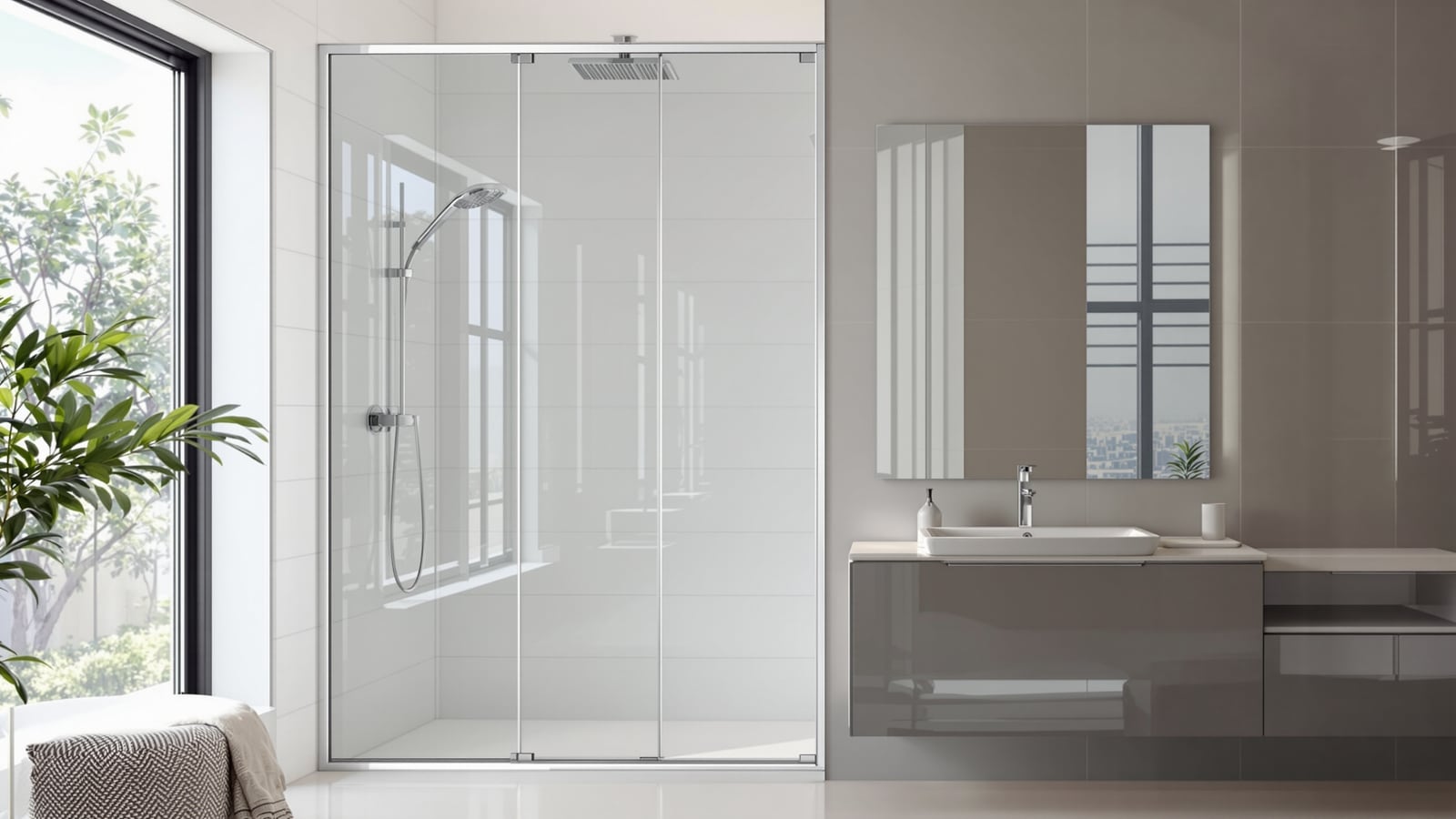
Glass Bathroom Walls India: Toughened Shower Partitions, Enclosures & Back-Painted Glass
A practical, India-first guide to glass in bathroom walls and partitions — toughened glass thickness (8/10/12 mm), IS 2553 safety glass, frameless vs framed enclosures, back-painted lacquered glass wall finishes, frosting for privacy, hard-water spotting and coatings, rupee costs and the safety rules that matter.
Glass earns its place in a bathroom in two very different ways, and Indian homeowners often mix them up. The first is structural-ish: a toughened glass partition or enclosure that walls off the shower, splitting a wet zone from a dry one without the visual weight of a masonry wall. The second is cosmetic and protective: back-painted (lacquered) glass used as a jointless, waterproof wall finish behind a basin or across a feature wall — no grout lines to grow mould. Both are "glass bathroom walls," and both live or die on the same details: the right glass, the right thickness, the right coating for our hard water, and safe fixing.
This is the glass-walls guide in the Studio Matrx bathroom hub. It pairs naturally with the bathroom wall tiles guide — glass and tile are the two dominant wall finishes, and most bathrooms use both. If you are using glass to separate zones, read it alongside the wet room design guide and the dry bathroom design guide, where the partition is the whole point of the layout.
Never put ordinary annealed glass in a bathroom. Any pane a person could fall against — a partition, an enclosure, a door — must be toughened (tempered) safety glass to IS 2553. This is non-negotiable, not an upgrade.
The two jobs glass does — and the glass each needs
| Use | What it is | Glass type | Typical thickness |
|---|---|---|---|
| Shower partition / screen | Fixed panel splitting wet and dry | Toughened, clear or frosted | 8–12 mm |
| Shower enclosure / cubicle | Multi-panel box with a door | Toughened | 8–10 mm |
| Shower / partition door | Hinged or sliding leaf | Toughened | 8–10 mm |
| Back-painted wall finish | Colour-lacquered glass on the wall | Lacquered float glass | 5–6 mm |
| Privacy panel / window infill | Obscured vision panel | Toughened + frosted/laminated | 6–8 mm |
The key split: partitions and doors carry impact risk, so they are always toughened. A back-painted wall finish is bonded flat to a solid wall behind it, carries no standalone impact load, and so can be thinner ordinary float glass with a lacquer coat — though toughened lacquered glass is available where you want extra margin near a shower.
Toughened glass partitions: thickness, frames and safety
Toughened (tempered) glass is heat-treated so it is four to five times stronger than annealed glass and, crucially, shatters into small blunt granules rather than long shards if it ever fails. In India it is specified to IS 2553 (safety glass); the base float glass is to IS 2835. Insist on the supplier's toughening / heat-soak certificate and a visible edge stamp — untested "toughened" glass is a real hazard.
Thickness drives everything — cost, feel and how much framing you need:
- 8 mm — the workhorse for framed and semi-frameless partitions and for panels bracketed to a dwarf wall. Economical and perfectly safe when properly supported.
- 10 mm — the default for frameless partitions and enclosure panels of normal height (up to about 2000 mm). Feels solid, doors do not flex.
- 12 mm — for tall frameless panels, wide unsupported spans, and large frameless swing doors. Premium look, premium price.
Edges must be polished and, where they meet a door, arrised (bevelled) so they do not chip. Every hole for a hinge or knob is drilled before toughening — you can never drill or cut toughened glass afterward; it will explode. So measure once, measure carefully.
Framed, semi-frameless or frameless?
- Framed wraps the glass in an aluminium channel on all sides. Cheapest and most forgiving of out-of-plumb Indian walls, but the frame traps water and grime and reads as dated. Uses thinner 8 mm glass.
- Semi-frameless keeps a slim channel on the fixed edges but leaves the door edge bare. A sensible middle ground.
- Frameless is glass held by discreet clamps or a bottom shoe, often with a slim stabiliser bar for tall panels. The premium, spa-like look — but it demands 10–12 mm glass, true walls, and precise fixing into masonry (not just tile).
Back-painted (lacquered) glass as a wall finish
Here glass replaces tile. A sheet of float glass is lacquered on the back in a colour, then bonded to the wall with a neutral-cure silicone. The result is a seamless, grout-free, fully waterproof panel — no joints for mould, wiped clean in one stroke. It suits a basin backsplash, a feature strip, or a whole dry-zone wall.
| Feature | Back-painted glass | Ceramic / vitrified tile |
|---|---|---|
| Joints | None (jointless sheet) | Grout lines that stain |
| Cleaning | Single wipe, no grout scrub | Grout needs periodic sealing |
| Look | Deep, glossy, uniform colour | Modular, wide design range |
| Wet-zone use | Fine on walls; not floors | Floors and walls |
| Cost per sq ft | Higher | Lower to mid |
| Repair | Whole panel if cracked | Swap a few tiles |
Two cautions for India. First, back-painted glass is a wall finish, never a floor — it has no slip rating. Second, in a direct shower-spray zone, prefer a toughened lacquered panel and a sound, dry substrate; trapped moisture behind a cheaply bonded sheet can lift the lacquer over time. For the full wall-finish comparison, see the bathroom wall tiles guide.
Privacy: frosting, obscuring and film
Clear glass is not always wanted — a partition facing a WC, or a bathroom window onto a neighbour, needs privacy. Options, cheapest to dearest:
- Applied frosting film — a vinyl film stuck to clear glass. Cheapest, retrofittable, but can peel at edges in humidity over years.
- Acid-etched / sandblasted glass — the surface is permanently frosted. Durable and elegant; slightly harder to clean where etched.
- Ceramic-fritted or laminated obscure glass — a pattern fired or laminated in. Most durable, most expensive.
A useful trick: frost only the lower or middle band of a partition or window, leaving clear glass above for light. You get privacy at body height and daylight overhead.
The Indian problem: hard water and glass spotting
Nothing ruins a glass shower faster than hard water. Across much of India the supply is hard; every drop that dries on the glass leaves a scale spot, and within months a clear panel looks permanently milky. Plan for this from day one.
Three defences, best used together:
- A factory nano / hydrophobic coating at the toughening stage. Water beads and runs off instead of sheeting and drying, so far less scale sticks. Worth the small premium in any hard-water city.
- A squeegee habit. Ten seconds after each shower removes most of the water before it can dry. The single highest-return habit for glass longevity.
- Do not scrub with abrasives. They micro-scratch the surface and make spotting worse. Clean with a mild acidic descaler (diluted vinegar or a proprietary glass descaler), never a wire scrubber.
Costs in an Indian bathroom
Indicative supply-and-fix ranges (materials plus labour; hardware finish and brand move these):
| Item | Indicative cost (₹) |
|---|---|
| Framed shower partition, 8 mm | 350–600 / sq ft |
| Semi-frameless partition, 8–10 mm | 550–850 / sq ft |
| Frameless partition/enclosure, 10–12 mm | 750–1,400 / sq ft |
| Frameless swing/sliding door + hardware | 12,000–35,000 / door |
| Nano anti-spot coating | 60–150 / sq ft |
| Back-painted (lacquered) glass wall | 250–500 / sq ft |
| Frosting film (applied) | 45–110 / sq ft |
A typical single-panel frameless shower screen for a compact flat lands around ₹18,000–40,000 installed. A framed enclosure can come in under ₹15,000. Weigh this against a masonry-plus-tile partition in the dry bathroom design guide — glass costs more but keeps the room feeling open and lets light through.
Safety and fixing: the rules that keep glass safe
- Toughened only for any partition, enclosure or door — IS 2553. Ask for the certificate.
- Heat-soaked toughened glass for large frameless panels reduces the rare risk of spontaneous breakage from nickel-sulphide inclusions.
- Fix into masonry, not tile. Hinge and clamp anchors must reach solid wall or an embedded backing plate; screwing only into a tile face will fail.
- Respect the door swing and gap. Leave a small drip gap and swing the door so water drains back into the wet zone, per the wet room design guide.
- Comply with NBC 2016 glazing guidance on safety glass in wet and impact-prone locations, and use a licensed fabricator.
Done right, glass gives an Indian bathroom the two things it most wants: a genuinely dry side, and a sense of space that no solid wall can. Treat the glass as safety-critical, coat it for our water, and keep a squeegee on the hook.
References
- IS 2553 (Parts) — Safety Glass — specification for toughened and laminated safety glass; the governing standard for shower partitions, enclosures and doors.
- IS 2835 — Flat Transparent Sheet Glass — base float/sheet glass specification.
- NBC 2016 (National Building Code of India), Part 6 (Structural Design, glazing) and Part 9 (Plumbing Services) — safety glazing in wet and impact-prone locations, and shower drainage.
- IS 15622 — Pressed Ceramic and Vitrified Tiles — for comparing glass against tiled wall and floor finishes.
- BIS product certification — verify the fabricator's toughening and heat-soak test certificates before fixing.
Export this guide
Related Guides — Deep-dive reading
Shower Glass Doors in India: Types, Glass, Sealing & Cost (2026)
Hinged, sliding and walk-in shower enclosures in 8-10 mm toughened glass — how to pick the type for your bathroom, get the water-tightness right, and live with India's hard-water spotting.
Home Doors & EntrancesBathroom Flooring Guide India: Anti-Skid Tiles, Stone, Vinyl & Epoxy Compared
Every bathroom floor material for Indian homes in one place — anti-skid ceramic and vitrified tiles, natural stone, mosaic, vinyl (SPC/LVT) and epoxy — with a full comparison table, slip ratings, ₹/sq ft costs and the safety and slope rules that keep a wet floor from becoming a hazard.
BathroomsHow to Clean Bathroom Tiles (India): Shine, Hard-Water Film & Soap Scum
A practical, India-first routine for cleaning bathroom tiles and keeping them glossy — the daily squeegee habit, weekly wash, monthly deep clean, and the safe cleaner for each tile type, including the golden rule that natural stone must never meet acid.
BathroomsRelated Tools — Try Free
Cross-Ventilation Analyzer
Estimate airflow and air changes per hour (ACH) from room size, window areas, layout, and local wind — with NBC 2016 Part 8 compliance check.
Ventilation CalculatorMaterial Comparison Sheet
India's interior material cheatsheet — plywood, finishes, hardware, countertops, paints, waterproofing.
Reference GuideWindow Size Calculator
Get the right window size, glazing area and openable area for any room using NBC daylight rules.
Window Tool