
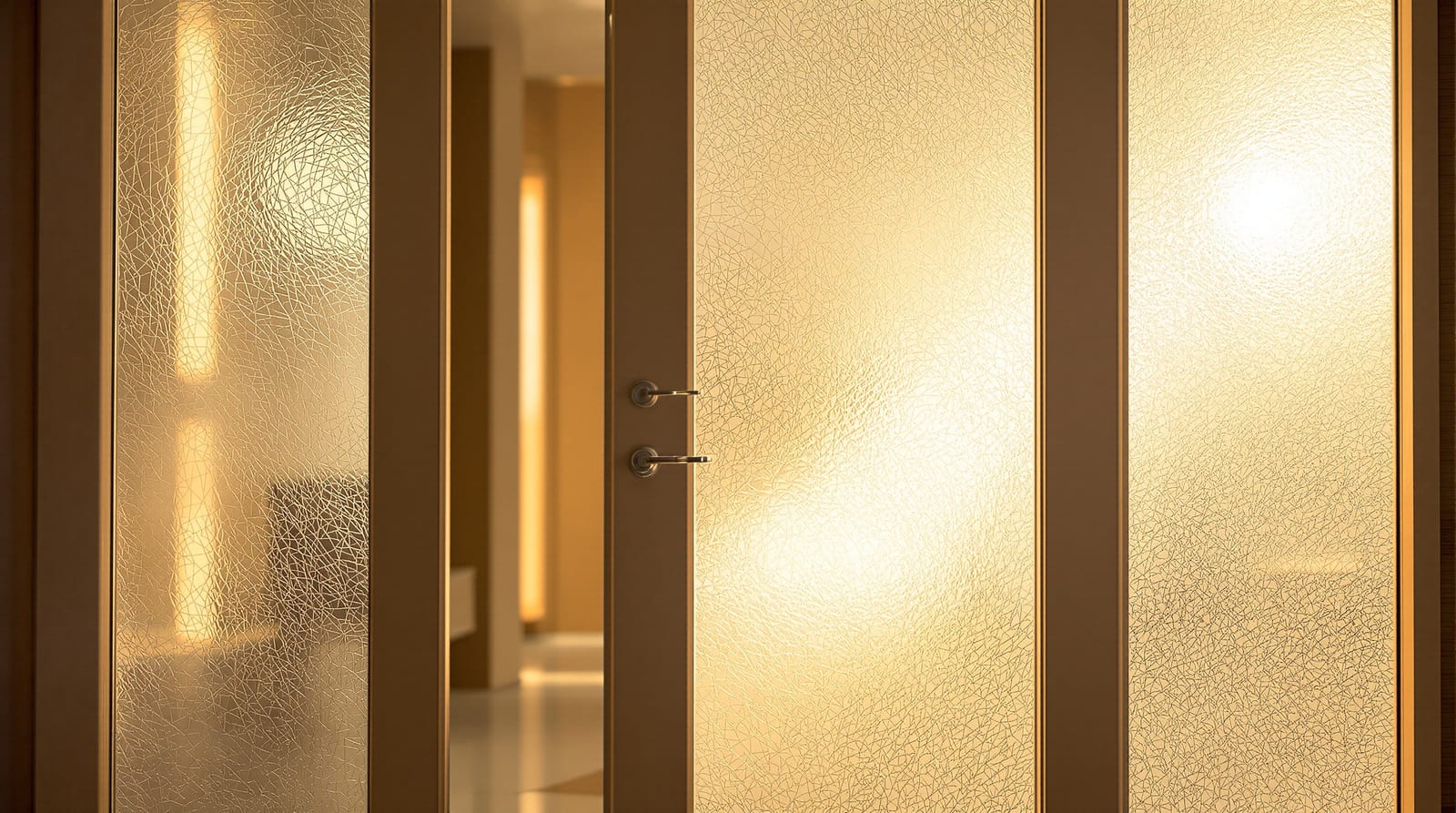
Frosted Glass Doors in India: Privacy, Designs & Cost (2026)
How glass is frosted — acid-etched, sandblasted, frosting film and lacquered — privacy levels from full frost to banded designs, where each suits (bathroom, pooja, office cabin, partition), pairing with toughened glass per IS 2553, and ₹ per sq ft.
A frosted glass door solves a very specific Indian problem: you want daylight to move between two spaces — a bathroom, a pooja niche, an office cabin, a cramped passage — but you do not want to be seen through the glass. Frosting turns a transparent sheet into a translucent one. Light passes; the image does not. It is the reason a frosted bathroom door feels bright but private, and why a glass cabin partition can stay open and airy without becoming a fishbowl. This guide explains the four ways glass is actually frosted in the Indian market, the privacy LEVELS you can dial in (full frost, partial banding, etched designs), where each suits, why your frosted door must also be toughened to IS 2553, and indicative ₹ per square foot.
How glass gets frosted — four methods
"Frosted" describes the look, not the process. The same hazy finish is reached four different ways, and they differ sharply in durability, cost, and how they fail.
| Method | How it works | Permanence | Look & feel | ₹ per sq ft (indicative) | Best for |
|---|---|---|---|---|---|
| Acid-etched | Glass surface chemically eaten to a fine, even matte | Permanent — part of the glass | Smooth, silky, uniform; low fingerprint | ₹120-300 (on top of base glass) | Premium doors, designs, where touch quality matters |
| Sandblasted | High-pressure sand abrades the surface to a rougher matte | Permanent | Grainier, more "fogged"; can hold marks | ₹80-220 (on top of base glass) | Custom patterns, logos, stencilled designs |
| Frosting film (vinyl) | Self-adhesive translucent film stuck to clear glass | Temporary (3-8 yrs) | Plasticky up close; edges can lift | ₹40-120 (film + application) | Retrofits, rentals, reversible privacy |
| Lacquered (back-painted) | Opaque coloured lacquer baked on the rear face | Permanent (opaque, not translucent) | Solid colour, no light through | ₹150-350 | Wardrobe shutters, opaque partitions — note: this is NOT translucent |
A few things worth knowing before you choose. Acid-etched glass is the connoisseur's frost — the etch is microscopically even, so it reads as a soft uniform haze and resists the smudgy fingerprints that plague cheaper finishes (Saint-Gobain "SatinGlass," AIS "Krystal" and similar branded etched glass sit here). Sandblasting is the workhorse for designs: a stencil is laid on clear glass and the exposed areas are blasted, so the frosted and clear regions form a pattern — this is how most etched florals, Om symbols, geometric bands and company logos are made. Frosting film is the only reversible option; it is what you buy when you rent, or when you want privacy this week without re-glazing — but treat it as a 3-5 year consumable, not a finish. Lacquered glass is often lumped in with "frosted," but it is opaque back-paint: no light passes through it at all, so it belongs on wardrobe shutters and solid partitions, not where you want a glowing translucent door.
A note on terminology: "etched" is used loosely. True acid-etching and decorative sandblasting are both called "etched glass" by fabricators. Ask specifically how the design is made if durability matters — a deep sandblasted carving lasts forever; a printed or filmed "etch effect" does not.
Privacy LEVELS — full frost, banded, and designs
Frosting is not all-or-nothing. You can tune exactly how much is hidden, and this is the single most useful decision in the whole exercise.
- Full frost (100%) — the entire panel is frosted. Maximum privacy; you see a blurred silhouette and light, nothing more. The default for bathroom and toilet doors, where you want zero visibility but maximum daylight. From a corridor, a fully frosted door reads as a glowing panel.
- Partial / banded frost — a horizontal band is frosted (typically at standing eye and torso level, roughly 900-1700 mm from the floor) while strips above and below stay clear. Hugely popular for office cabins and glass partitions: you cannot be seen seated or standing, but the clear strips keep the space feeling open and let you sense movement. The "manager's cabin" look.
- Gradient frost — frosting fades from dense at one height to clear at another. A softer, more designed version of banding; common on staircase and lobby partitions.
- Patterned / etched designs — frosting is applied as a motif: vertical reeds, geometric grids, florals, a paisley or a temple-arch outline, an Om or Ganesha for a pooja room door. The clear gaps in the pattern leak a little visibility, so a busy all-over pattern hides more than a sparse one. This is where frosted glass earns its decorative keep.
The privacy lesson: more frost = more privacy but less of the airy openness that made you choose glass. For a bathroom, go full frost. For a cabin or partition you want to feel spacious, band it. For a pooja or feature door, use a design and accept a touch of see-through where the pattern is clear.
Frosted vs clear — what actually changes
The diagram below shows the core difference. Both panels are the same glass; only the surface treatment changes.
Clear glass passes both the image and the light, so you see straight through. Frosting scatters the light at the surface so the image dissolves into a blur while the brightness still comes through. That scatter is also why a frosted door looks evenly luminous rather than transparent — useful in a windowless internal bathroom that borrows daylight from an adjoining room.
Where frosted glass doors suit
- Bathroom and toilet doors — the classic use. A full-frost toughened panel in an aluminium or WPC frame brings daylight into an internal bathroom while staying completely private. Pair with a good seal and ventilation since glass shows water spots. See our bathroom door guide.
- Pooja room doors — a frosted or etched panel with a temple-arch, Om or floral motif gives a serene, glowing threshold while keeping the space gently screened. Frame the choice within tradition — many families prefer a solid or jali pooja door; discuss orientation and threshold in our pooja room door and entrance Vastu notes.
- Office cabins and home offices — banded frost is ideal: privacy when seated, openness for the team. Works beautifully in a home office door.
- Glass partitions — a frosted partition door separates living and dining, or a study from a passage, without walling off the light. Compare full glass-wall approaches in our glass doors guide.
- Main-door sidelights and fanlights — a frosted sidelight beside a solid main door brings daylight into the foyer without exposing the hallway to the street. This is the safest place to use glass on a main door — the structural leaf stays solid for security, the frost panel only carries light.
- Kitchen and utility doors — frosting hides clutter while keeping the kitchen connected to the dining space.
For the full vocabulary of glass-panel layouts — half-glass, full-glass, Georgian-bar, reeded — see glass panel door designs.
Safety: frosted glass must be toughened (IS 2553)
This is non-negotiable. Any glass in a door leaf, or in a sidelight that could be walked into, is safety-critical glazing and must be toughened (tempered) to IS 2553. Frosting itself adds no strength — it is only a surface finish. So the correct specification is frosted toughened glass, not frosted ordinary float glass.
Why it matters: ordinary annealed glass breaks into long dagger shards; toughened glass is heat-treated to be 4-5 times stronger and, when it does break, crumbles into small blunt granules that rarely cause serious injury. In a door — which gets slammed, leaned on, and walked into — this is the difference between a scare and a hospital visit.
Two fabrication rules that follow from this:
- Frost first, toughen last is impossible — toughened glass cannot be cut, drilled or etched after tempering. So acid-etching and sandblasting are done on the glass and then it is toughened, or the frosting film is applied to an already-toughened sheet. Confirm with your fabricator that the final door glass is toughened.
- Thickness: 8 mm toughened for framed interior doors and partitions; 10-12 mm for frameless or large panels. Toughened 12 mm glass runs roughly ₹450-1,200 per sq ft before frosting and patch fittings (indicative, varies by city and vendor).
For the full safety-glass story — handling, patch fittings, frameless systems — see our toughened glass doors guide, and for wet-area glass specifically, shower glass doors.
Designs and patterns
The decorative range is wide because both sandblasting and film printing let you put almost any motif on the glass:
- Reeded / fluted bands — vertical frosted stripes; contemporary and very forgiving of fingerprints.
- Geometric grids and lines — clean lines for modern and minimalist interiors.
- Floral, paisley, jali-inspired motifs — soften a partition or pooja door with a traditional Indian pattern.
- Temple arches, Om, Ganesha, lotus — for pooja and prayer thresholds.
- Logos and house names — sandblasted into office and entrance glass.
A practical tip: a frosted background with clear motifs (the design shows as clear glass against frost) hides more than the reverse, because the frost is doing the privacy work everywhere except the small clear figures.
Cleaning and care
Frosted glass shows water spots and oily fingerprints more than clear glass, because the matte surface holds residue in its microscopic texture. Care differs by method:
- Acid-etched — easiest to clean; the smooth etch resists marks. Wipe with a glass cleaner and a microfibre cloth.
- Sandblasted — the rougher surface traps grime; for stubborn marks use a soft brush with mild soapy water, then dry. Avoid abrasive scourers, which can polish out the frost unevenly.
- Frosting film — clean gently with soapy water and a soft cloth; never use solvents or scrapers, which dissolve or peel the film. Expect to replace it every few years.
- All types — avoid acidic or ammonia-heavy cleaners on the edges and fittings; dry the bottom edge in wet areas to prevent water staining.
In coastal cities, rinse exterior frosted glass and stainless patch fittings periodically to keep salt from etching the fittings.
Indicative costs
These are 2026 ballpark figures, indicative and varying by city, vendor, glass brand and fitting. Add 18% GST and patch-fitting/frame and labour separately.
| Item | Indicative ₹ |
|---|---|
| Base toughened glass 8 mm | ₹350-700 per sq ft |
| Base toughened glass 12 mm | ₹450-1,200 per sq ft |
| Acid-etched frosting (added) | ₹120-300 per sq ft |
| Sandblasted frosting / design (added) | ₹80-220 per sq ft |
| Frosting film (supplied & applied) | ₹40-120 per sq ft |
| Patch fittings / hinges set | ₹3,000-12,000 per door |
| Aluminium / WPC framed bathroom door (frosted, fitted) | ₹6,000-18,000 |
A typical framed frosted-glass bathroom door, fitted, lands around ₹6,000-15,000; a frameless frosted toughened partition door with patch fittings climbs higher with glass area and hardware. Use our door cost calculator and door size calculator to size your panel and budget.
Frequently asked questions
Is frosted glass completely private?
Full-frost glass blocks any clear image — you see only a blurred silhouette and light, which is private enough for a bathroom. But in a dark room beside a brightly lit one, a strong silhouette can still show. Pattern or denser frost helps, and for total privacy at night, frost both faces or add a film.
Can I frost an existing clear glass door myself?
Yes — frosting film is the DIY route. Clean the glass, squeegee the self-adhesive translucent film on, and trim. It is reversible and cheap (₹40-120 per sq ft). It will not match the permanence of acid-etching, and edges may lift in 3-5 years, but it is perfect for rentals or a quick privacy fix.
Does frosting weaken the glass?
No — frosting is a surface finish and does not reduce strength on its own. But the glass must still be toughened to IS 2553 for safety in a door. Sandblasting removes a little surface material, which is why the glass is toughened after frosting, not before. Never use untoughened glass in a door leaf.
Frosted vs lacquered glass — what's the difference?
Frosted glass is translucent: light passes, image blurs. Lacquered glass is opaque back-painted glass: no light passes through it at all. Use frosted where you want a glowing, private door; use lacquered for solid wardrobe shutters and opaque partitions.
Is frosted glass good for a pooja room door?
It can be lovely — an etched temple-arch or Om motif on toughened glass gives a serene, glowing threshold. That said, many families prefer a solid or jali pooja door for tradition and warmth. Consider orientation and threshold custom alongside aesthetics; our entrance Vastu and pooja room door guides cover both views.
Export this guide
Related Guides — Deep-dive reading
Glass-Panel Door Designs for Indian Homes (2026): Glass Types, Panel Layouts & Privacy Ideas
A design-led guide to doors with glass inserts and panels — clear, frosted, fluted, lacquered and stained glass, half-glass and grid layouts, and where to use each for light without losing privacy.
Home Doors & EntrancesGlass Bathroom Walls India: Toughened Shower Partitions, Enclosures & Back-Painted Glass
A practical, India-first guide to glass in bathroom walls and partitions — toughened glass thickness (8/10/12 mm), IS 2553 safety glass, frameless vs framed enclosures, back-painted lacquered glass wall finishes, frosting for privacy, hard-water spotting and coatings, rupee costs and the safety rules that matter.
BathroomsMinimalist Door Designs in India (2026): Flush, Frameless & Concealed-Frame Doors
The clean-line, no-architrave, hidden-hardware door language behind modern Indian apartments and designer interiors — flush-to-wall doors, concealed hinges, recessed pulls, tall leaves and what the look really costs.
Home Doors & EntrancesRelated Tools — Try Free
Window Hardware Cost Calculator
Estimate window hardware cost — hinges, handles, locks, rollers and multipoint gears.
Window CalculatorCross-Ventilation Analyzer
Estimate airflow and air changes per hour (ACH) from room size, window areas, layout, and local wind — with NBC 2016 Part 8 compliance check.
Ventilation CalculatorDoor Cost Calculator
Estimate the all-in cost of a door — leaf, frame, hardware, fitting and GST — by type, material and size.
Door Calculator