
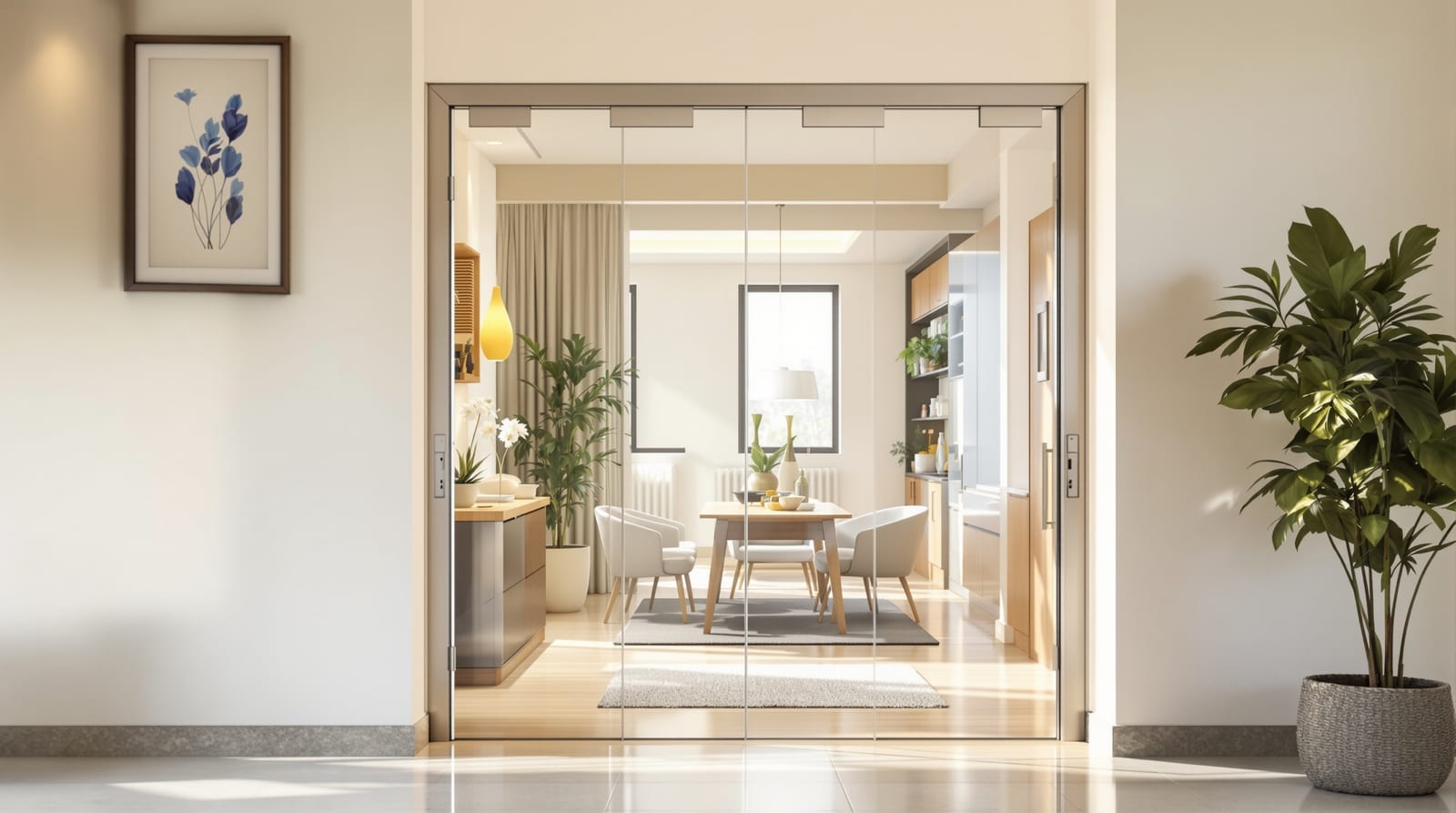
Toughened Glass Doors in India: Thickness, IS 2553, Safety & Cost
Why tempered glass is mandatory for large and low door panels, what thickness to specify, and the one rule you cannot break: it can never be cut after toughening.
If you are putting a large sheet of glass where people walk, lean or push, the glass you choose is not a finish decision — it is a safety decision. Ordinary annealed glass breaks into long dagger-shaped shards that have caused serious injuries in Indian homes, which is exactly why toughened (tempered) glass exists. Toughened glass is heat-treated to be four to five times stronger, and when it does fail it crumbles into thousands of small, blunt granules rather than slicing. For any glass door that is large, reaches near the floor, or sits where someone could walk into it, toughened glass is not optional — it is the standard you should insist on.
This guide goes deep on toughening itself: what the heat process actually does, the Indian standard (IS 2553) that governs it, how to choose thickness by door size, the difference between toughened and laminated safety glass, and the one rule that trips up most first-time buyers — toughened glass can never be cut or drilled after it is made. For the bigger picture on glass door types, finishes and where they suit a home, see our glass doors in India pillar; for cost benchmarking across glass door systems see glass door cost in India.
What "toughening" actually does to glass
Toughening — properly called tempering — is a controlled heat process. A cut, edged and drilled sheet of ordinary float glass is heated in a furnace to around 620-650 degrees Celsius, just short of softening, then rapidly cooled (quenched) with jets of cold air on both faces. The surfaces cool and harden first while the core is still hot; as the core then cools and contracts, it pulls the surfaces into permanent compression. The result is a glass with the outer skin locked in compression and the centre in tension.
That locked-in stress is the whole point. Because cracks in glass start at the surface, a surface that is held in compression resists cracking far better. This is why toughened glass is roughly 4-5 times stronger than annealed glass of the same thickness against impact and bending, and far more resistant to thermal shock (sudden temperature change — relevant for a glass door catching harsh afternoon sun on one side and air-conditioning on the other).
The safety behaviour on failure is the other reason it dominates door applications. When toughened glass finally breaks, all that stored energy releases at once and the entire panel disintegrates into thousands of small cuboidal granules with blunt edges — the familiar "crumbled windscreen" pattern. You can be cut, but you are very unlikely to be lacerated. This break behaviour is what classifies it as a safety glass and is why building practice, and common sense, calls for it in doors.
There is also heat-strengthened glass, made by a gentler, slower cooling. It is about twice as strong as annealed (not 4-5x) and does NOT crumble safely — it breaks into larger pieces. Heat-strengthened glass is used in some facade and overhead glazing applications for its lower spontaneous-breakage risk, but it is not a safety glass and should not be specified for doors. For doors, the choice is toughened or laminated, not heat-strengthened.
IS 2553 — the Indian standard you should quote
In India, toughened safety glass is governed by IS 2553 (Part 1): Safety Glass (the general/architectural part) and IS 2553 (Part 3) for road transport. For your home, IS 2553 Part 1 is the reference. It specifies the fragmentation requirement — when you break a test piece, the number of fragments inside a 50 mm square must exceed a minimum count, which is how a lab proves the glass crumbles safely rather than into shards.
When you buy, ask the fabricator for glass that conforms to IS 2553, and look for the supplier's certification or the manufacturer's stamp/logo etched in a corner (major Indian float-glass makers such as Saint-Gobain, AIS and Modi mark their toughened panels). A small bug mark or kitemark-style etch in the corner is a quick visual confirmation you are not getting un-toughened glass passed off as tempered. The National Building Code (NBC 2016) and good practice both expect safety glazing in doors, side panels next to doors, and any glazing within roughly 800-900 mm of floor level.
Why toughened is effectively mandatory for large and low glass doors
Two situations make toughened glass non-negotiable in a door:
- Large panels. A big sheet of annealed glass is heavy and fragile; a knock, a slam, or wind load on a balcony or patio door can break it, and an annealed break in a tall door drops dagger shards from head height. Toughened glass handles the bending and impact loads of a large leaf and fails safely.
- Low / near-floor glazing. Children running, a slipping adult, furniture being moved — glass within about 800 mm of the floor is in the "impact zone". Annealed glass here is a documented injury cause. Safety glass (toughened or laminated) is the correct specification.
Practically, almost every modern glass door — frameless office-style doors, glass shower glass doors, glass patio doors and balcony doors, and the glass leaf in glass panel door designs — uses toughened glass for exactly these reasons. If a vendor offers a cheaper "glass door" without confirming it is toughened, treat that as a red flag.
Thickness: match it to door size and use
Thickness is chosen by panel size, frame type and use. Thicker glass spans larger, deflects less and feels more solid. For a fully frameless door (where the glass is structural, with no frame to support it) you step up a thickness compared with the same size in a frame.
| Glass thickness | Typical door application | Frame type | Notes |
|---|---|---|---|
| 8 mm | Small framed interior glass doors, light bathroom doors, glazed leaf within a wooden/aluminium frame | Framed | Lightest; only where panel is modest and supported by frame |
| 10 mm | Standard interior frameless doors up to ~900 x 2100 mm, shower enclosures, partition doors | Frameless or framed | The common "default" for residential frameless interior doors |
| 12 mm | Large frameless entry/patio doors, tall balcony doors, glass leaves above ~900 mm wide or ~2100 mm tall | Frameless | Most common for structural frameless and main glass doors in India |
| 15-19 mm | Oversize/feature doors, very tall storefront-style frameless doors | Frameless | Heavy; needs floor spring and robust patch fittings |
As a rule of thumb in Indian homes: 10 mm for a normal frameless interior door, 12 mm for anything large, structural or external. When in doubt, go one step thicker — the cost difference is small against the safety and feel. Always confirm the final size against door size standards in India and use our door size calculator to fix the opening before ordering.
The rule you cannot break: plan every hole and cut FIRST
This is the single most important practical fact about toughened glass: it can never be cut, drilled, edged or notched after toughening. All cutting, hole-drilling (for handles, patch fittings, locks, hinges), edge-polishing and any notches must be done on the annealed sheet BEFORE it goes into the furnace. Once toughened, the glass is in locked stress — any attempt to cut or drill it releases that stress and the entire panel explodes into granules.
What this means for you in practice:
- Finalise everything before fabrication. The exact size, the position of every hole for patch fittings, handles, the lock, the floor spring and the hinges, and the edge finish must be specified before toughening. A toughened door is made to order; there is no adjusting it on site.
- Measure twice (or three times). If the opening is wrong by even a few millimetres, the panel is scrap — it cannot be trimmed. Have the fabricator template-measure the actual opening after the floor and frame are final. See how to measure a door in India.
- No site modifications. If a fitting position changes, you order a new panel. This is why a reputable vendor will insist on a signed hardware/cut-out drawing before fabrication.
Framed vs frameless toughened glass doors
A framed toughened door sits inside a frame — wood, aluminium or uPVC — which carries the load and protects the edges. It can use slightly thinner glass (8-10 mm), is more forgiving, and the frame hides any minor edge chips. A frameless toughened door uses the glass itself as the structure, held only by patch fittings (top and bottom corner clamps), a floor spring or pivots, and a handle. Frameless doors look minimal and premium but demand thicker glass (typically 12 mm), precise hardware cut-outs, and a floor spring for smooth, self-closing operation. For a full treatment of the minimal look, see frameless glass doors in India.
For privacy, a toughened panel can also be frosted (acid-etched or sandblasted) or have a film applied — covered in frosted glass doors in India. Frosting is done before or after toughening depending on method (sandblasting after is possible but acid-etch and ceramic-fired patterns are usually before).
Toughened vs laminated: two different kinds of "safety glass"
Both toughened and laminated glass are safety glasses, but they fail differently and suit different jobs.
| Property | Toughened (tempered) | Laminated |
|---|---|---|
| Make-up | Single sheet, heat-treated | Two+ glass plies bonded with a PVB/SGP interlayer |
| Strength | 4-5x annealed | Similar to annealed unless plies also toughened |
| On breakage | Crumbles into blunt granules; opening is left empty | Cracks but pieces stick to the interlayer; stays in the opening |
| Security / fall protection | Lower — once broken, the opening is clear | Higher — holds together; harder to break through |
| Sound & UV | Standard | Better acoustic and UV-blocking (the interlayer helps) |
| Can be cut after make? | No (toughened) | Yes (laminated can be cut; toughened-laminated cannot) |
| Typical door use | Most frameless and interior glass doors | External security doors, overhead glazing, where fall-through must be prevented |
For most residential glass doors, toughened is the right and most economical choice. Laminated (or toughened-laminated, the premium combination) is worth the extra cost where security, sound, or fall-through protection matters — a ground-floor street-facing glass door, or a high balcony where you do not want a clear opening if the glass fails.
Cost in India
Costs below are indicative and vary by city, vendor and brand (Saint-Gobain, AIS, Modi for the glass; the fabricator for cutting, toughening and fitting). Add 18% GST. Glass is priced per square foot; fittings are extra and often the bigger line for a frameless door.
| Item | Indicative cost (India, 2026) |
|---|---|
| 8 mm toughened glass | ₹100-180 / sq ft |
| 10 mm toughened glass | ₹150-280 / sq ft |
| 12 mm toughened glass | ₹250-450 / sq ft (premium/branded up to ~₹600+) |
| Frosting / acid-etch (add-on) | ₹40-150 / sq ft |
| Patch fittings set (top + bottom + handle) | ₹3,000-12,000 / door |
| Floor spring (for frameless self-closing) | ₹2,000-7,000 |
| Handle / pull (glass door) | ₹500-6,000 |
A typical frameless 12 mm interior glass door (about 0.9 x 2.1 m, ~20 sq ft) lands around ₹8,000-18,000 for the glass plus ₹6,000-15,000 in patch fittings, floor spring and handle — so roughly ₹15,000-35,000 fitted, before GST, depending on hardware grade. For full cost context across glass systems use glass door cost in India, the glass doors pillar, and our door cost calculator.
Living with toughened glass doors in India
A few India-specific points. Coastal homes (Mumbai, Chennai, Goa, Kochi) should specify stainless-steel patch fittings and floor springs — ordinary mild-steel hardware rusts in salt air. In hot climates, toughened glass tolerates thermal shock well, but heavy direct sun plus a stray edge chip can still trigger spontaneous breakage, so protect the polished edges during handling and keep them undamaged. Clean with a soft cloth and mild solution; avoid abrasive scourers that scratch the surface. Because a broken toughened panel cannot be repaired — only replaced — keep the fabricator's cut-out drawing so a replacement can be ordered to the exact same spec.
Frequently asked questions
Can toughened glass be cut or drilled after it is made?
No. All cutting, drilling and edging must be done before the glass is toughened. Once toughened, any cut or drill releases the locked-in stress and shatters the whole panel into granules. This is why every hole for handles, locks and patch fittings must be planned and templated before fabrication.
Is toughened glass unbreakable?
No — it is about 4-5 times stronger than ordinary glass and far more impact-resistant, but it can still break under a hard, sharp or point impact (or rarely, spontaneously from edge damage or nickel-sulphide inclusions). The key benefit is that when it does break, it crumbles into blunt granules instead of dangerous shards.
What thickness should a frameless glass door be?
For a normal interior frameless door, 10 mm is the common default; for large, tall or external frameless doors, 12 mm is standard in India. Framed doors can use 8-10 mm because the frame carries the load. When unsure, choose one step thicker.
Toughened or laminated for my front glass door?
Toughened is fine and economical for most doors. For a ground-floor, street-facing or security-sensitive front door, consider laminated or toughened-laminated glass — it holds together when broken, resists forced entry better, and improves sound and UV control. See frameless glass doors in India for hardware options either way.
How do I know the glass I am getting is genuinely toughened?
Ask for IS 2553 conformity and look for the manufacturer's etched logo or a "TOUGHENED" bug mark in a corner of the pane. A genuine toughened panel is made to order and cannot be trimmed on site; if a vendor cuts the glass at your home, it is not toughened.
Export this guide
Related Guides — Deep-dive reading
The Complete Home Door Guide for Indian Homes (2026): Types, Materials, Cost, Security & Vastu
Everything an Indian homeowner needs to specify the right door for every opening — from main entrance to bathroom — with real 2026 prices, IS/NBC standards and Vastu sense.
Home Doors & EntrancesAluminium Door Cost in India 2026: ₹/Sq Ft by Profile Grade, Finish, Glazing & Hardware
A focused 2026 cost guide for aluminium doors in India — ₹ per sq ft of opening by profile grade (economy domal vs branded system sections vs thermal-break), powder-coat vs anodised vs wood-finish surcharge, glazing, rollers/locks/handles, sliding vs openable, fitting and GST, with a worked balcony/utility example.
Home Doors & EntrancesFrameless Glass Doors in India: 12 mm Toughened Glass, Patch Fittings & Floor Springs
How frameless glass doors work for Indian homes and offices — patch fittings, floor springs, patch locks, safety manifestation, planning holes before toughening, and what glass plus hardware really costs.
Home Doors & EntrancesRelated Tools — Try Free
Window Hardware Cost Calculator
Estimate window hardware cost — hinges, handles, locks, rollers and multipoint gears.
Window CalculatorAcoustic Privacy (STC) Visualizer
Indian healthcare acoustic visualizer — compare wall assemblies and noise sources, see received SPL after STC attenuation, and check FGI 2018 / IS 1950 / NABH speech-privacy compliance with live dual-canvas waveform.
Acoustic ToolHealing View Impact Calculator
Evidence-Based Design dashboard quantifying the recovery impact of nature view + daylight factor on analgesic use, length of stay, and HCAHPS patient-experience uplift. Calibrated against Ulrich 1984 (Science), Park & Mattson 2008, and the CHD EBD evidence base.
EBD Calculator