
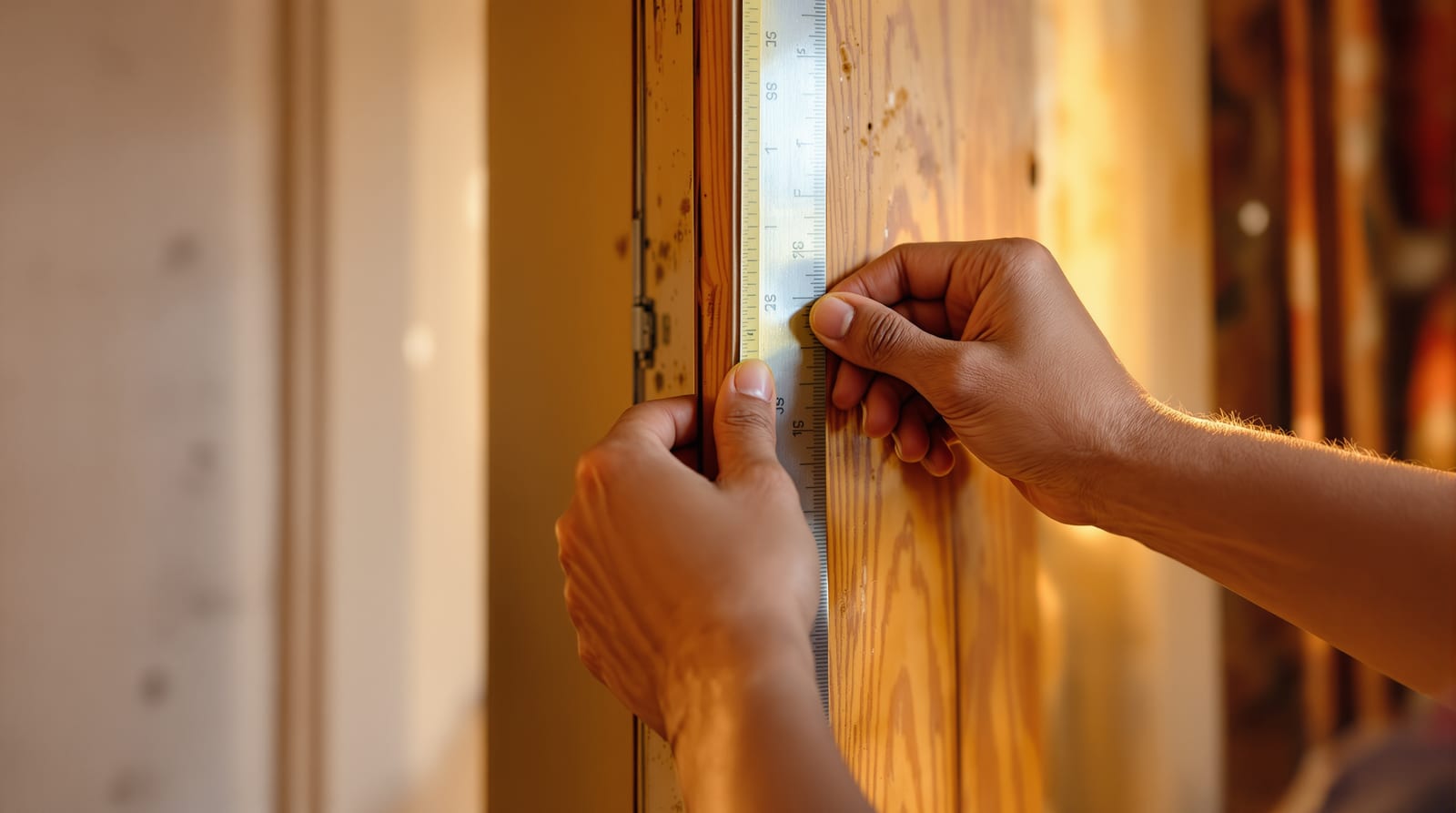
How to Measure a Door India: Opening, Leaf, Frame and Hand the Right Way
A homeowner's measuring guide for India — measure the structural opening, work out leaf versus frame size, find the door hand and swing, allow for floor finish, and order without the classic too-tight or wrong-hand mistakes.
Most door problems start before a single screw is turned — at the measuring tape. Order a leaf 10 mm too wide and the carpenter "adjusts" it by shaving the stile until the lock pocket is paper-thin; order it the wrong hand and your beautiful main door now opens into the wall switch instead of the wall. Measuring a door sounds trivial, but the trap is that a "door" is really three different sizes — the structural opening, the frame, and the leaf — and the number your supplier needs depends on which one you are buying. This guide walks through exactly what to measure, how, and why, so you can order a new or replacement door in India that fits the first time and swings the way you want.
The three sizes: opening vs frame vs leaf
Before you touch the tape, fix this vocabulary, because half of all ordering errors come from quoting the wrong one:
- Structural opening (also called the rough opening or the masonry opening) — the raw gap left in the brick or block wall by the mason. The frame sits inside this. It is the biggest of the three.
- Frame size (the chowkat) — the timber, WPC, steel or aluminium surround fixed inside the opening. Its outer size is slightly smaller than the opening (you need a gap all round to plumb and pack it); its inner size is what the leaf closes into.
- Leaf size (the shutter) — the moving door panel itself. It is smaller than the frame's inner clear size by the gaps you leave for hinges, swing clearance and the floor.
A rough rule of thumb for a standard timber frame in India: the leaf is about 60-75 mm narrower and 40-55 mm shorter than the structural opening, once you subtract the frame sections (typically 60-75 mm wide rebated profiles) and the working gaps. So a 1000 mm wide opening commonly gives a frame with roughly 880-900 mm clear, and a leaf around 870-890 mm wide. Never assume — measure, then tell your supplier which size you are quoting. The single most useful sentence you can say to a vendor is: "This is the structural opening: 1020 wide by 2150 high." Let them size the frame and leaf from it.
What to measure, how, and why
Use a steel tape (not a cloth one), measure in millimetres, and always take more than one reading. Indian masonry openings are rarely truly square, so a single measurement will lie to you.
| What to measure | How to measure it | Why it matters |
|---|---|---|
| Opening width | Across the bare opening at top, middle and bottom; record the smallest of the three | Walls bow; the frame must pass the tightest point. Quote the smallest width. |
| Opening height | Floor (finished level) to the underside of the lintel, on left, centre and right | Tells the frame and leaf height; reveals if the lintel is out of level. |
| Wall thickness / depth | The depth of the opening from one face of the wall to the other, at 2-3 points | Sets the frame depth. A 230 mm brick wall plus plaster needs a deeper frame than a 115 mm partition. |
| Diagonal squareness | Corner-to-corner both ways; the two diagonals should match | Unequal diagonals mean the opening is out of square — the carpenter must pack and shim. |
| Floor finish status | Is the final tile/marble/wood floor laid yet? Measure to finished or note the pending thickness | A door measured before flooring will jam after it — see the floor-finish allowance below. |
| Existing leaf (for replacement) | Width and height of the old leaf, plus its thickness (30/35/40 mm) | For a like-for-like leaf swap into a sound frame, the leaf size is what you order. |
| Hinge side and swing | Stand on the side the door opens towards you; note hinges left or right (see hand section) | Gets the door hand right so hinges, lock and handing match. |
Always measure at three points
The discipline of measuring width at top, middle and bottom — and height on both jambs and the centre — is not fussiness. In a typical Indian site, the difference between the three readings is often 5-15 mm, and occasionally more in older or roughly-built walls. For the opening width you quote the smallest reading (the frame has to fit through the tightest pinch). For height you quote the shortest drop to the lintel. Note the spread too: if width varies by more than about 10 mm, warn your carpenter so they plan for packing.
Floor-finish allowance and the threshold
This is the mistake that ruins more doors in India than any other: measuring before the floor is laid. If you measure the opening height to a bare RCC slab or sand bed and then a contractor lays 10-20 mm of tile, marble or wooden flooring, your door height shrinks by exactly that much — and either the leaf scrapes or the carpenter saws the bottom off and ruins the proportion.
- If the finished floor is already laid, measure to it directly.
- If it is not yet laid, find out the finish thickness (vitrified tile + adhesive ≈ 12-18 mm; marble/granite ≈ 18-25 mm; engineered wood + underlay ≈ 15-22 mm) and deduct it from your opening height so the leaf sits above the future floor.
- Leave a deliberate bottom gap under interior doors of about 8-12 mm (more if a rug or a return-air path is wanted, less for an AC-sealed room). This gap also lets you fit a bottom seal later — see the door seals and weatherstripping guide.
- At the main door, plan the dehleez / threshold. Keep any threshold step low — 12 mm or less keeps it accessible for elderly relatives, trolleys and wheelchairs per the RPwD Harmonised Guidelines 2021 and NBC intent; see accessible doors. A high threshold trips people and blocks the door bottom.
Get the bottom gap and threshold right at measuring time and you avoid both the scraping door and the wind-tunnel under it.
Finding the door hand (left or right) and the swing
"Wrong hand" is the other classic ordering error. The hand of a door tells the maker which edge the hinges go on and which way it swings, so the lock, handle set and hinges all match. There are competing conventions, so use one method and state it plainly to your vendor.
A simple, unambiguous method that Indian carpenters readily understand:
1. Stand on the side the door opens towards you — the side you pull it open from (for a main door, that is usually inside the house, since Vastu and security both favour doors opening inward).
2. Look at which jamb the hinges are on. Hinges on the left = a left-hand door. Hinges on the right = a right-hand door.
3. Note in/out. Add whether it swings in (towards you, the standard) or out (away). So a full description is, for example, "left-hand, opens inward."
Because conventions vary between suppliers and imported hardware, the safest practice is to sketch it: draw the opening from above as a plan, mark the hinge edge with a small arc showing the swing direction, and photograph it for the vendor. A picture removes all doubt. For double doors, also note which leaf is the active (regularly used) one and which carries the shoot bolts.
Clearance for the swing
A door needs empty floor to swing into. Before you fix the hand, walk the arc: the leaf needs roughly its own width of clear radius to open fully. Check the swing does not hit a light switch, an adjacent door (the dreaded two-doors-clashing in a tight lobby), a wardrobe, the WC, or furniture. If clearance is tight, that is the cue to consider an outward swing, a sliding door or a pocket door instead — decide this at measuring stage, not after the leaf arrives. You can sanity-check swing and clashes with the door swing planner tool.
Measuring an existing door for a like-for-like replacement
If the frame is sound and you only want a new leaf (a very common Indian scenario — the chowkat is solid teak but the flush shutter has delaminated), you measure the existing leaf, not the opening:
1. Width of the old leaf, edge to edge, at top, middle and bottom — take the largest if you will trim, but normally they match.
2. Height of the leaf, edge to edge, on both sides.
3. Thickness — usually 30, 35 or 40 mm; new leaf must match the frame rebate and the existing hinges/lock mortise depth.
4. Hinge positions — measure from the top down to each hinge centre, so a pre-morticed replacement lines up; standard is three hinges (top ~150-250 mm from top, bottom ~250 mm from bottom, third near the middle or upper-third for heavy leaves).
5. Lock height — height of the lock/handle centre from the floor (commonly ~900-1050 mm) so the new leaf's mortise matches.
6. Hand — confirm the existing hand so the new leaf's hinge and lock cutouts are on the right edges.
If you are replacing the whole assembly (frame and leaf), go back to measuring the structural opening as above. For the full fitting sequence afterwards, see the door installation guide.
Standard sizes to compare against
Your measurements should land near these NBC 2016 norms; if they are wildly off, re-check before ordering. Sizes are leaf nominal width × height in mm.
| Door | Typical size (mm) | Notes |
|---|---|---|
| Main / entrance | 1000-1200 × 2100 | Largest in the home; Vastu prefers it the biggest leaf. Single 1000-1050, or double for grand entries. |
| Bedroom | 900 × 2100 | The everyday interior standard. |
| Bathroom / WC | 700-750 × 2000-2100 | Narrowest; still allow a comfortable clear width. |
| Kitchen | 800-900 × 2100 | Wider where appliances pass through. |
| Wheelchair-accessible | 900 leaf → ~810-850 clear | RPwD Harmonised Guidelines 2021 want ≥800-900 mm clear width; a 900 leaf gives roughly 810-850 clear. |
| Standard height | 2100 | Frames commonly to 2100; taller designer doors to 2400+. |
Compare your figures against the door size standards guide and the door width standards guide, and run your numbers through the door size calculator to convert an opening into a leaf and frame size. These standard sizes also matter because off-the-shelf flush and WPC leaves come in them — order a non-standard size and you pay a custom premium.
Ordering tips to avoid the classic errors
- Quote the right size by name. Say "structural opening" or "leaf size" explicitly; never just "the door is 3 feet."
- Use millimetres, not a mix of feet and inches that gets fat-fingered in translation.
- Quote the smallest width and shortest height from your three readings.
- State the hand and swing, and attach a plan sketch with the swing arc.
- Confirm floor finish is accounted for, and the threshold height.
- Add the wall thickness so the frame depth is right.
- Don't measure too tight. A leaf made exactly to the clear opening will bind; doors need a small uniform gap, and timber and flush leaves swell in the monsoon. A leaf cut snug in dry April can jam shut in July. Leave the maker's standard fitting tolerance.
- Order frame and leaf together where possible so rebate, hinge and lock positions are matched at the factory.
Get these seven things right on paper and your door will arrive the correct size, the correct hand, and with room to swing and breathe through the monsoon.
Frequently asked questions
Do I measure the door opening or the door itself?
It depends on what you are buying. For a brand-new door (frame and leaf), measure the structural opening — the raw gap in the wall — and let the supplier size the frame and leaf from it. For a like-for-like leaf replacement into an existing sound frame, measure the old leaf (width, height, thickness, hinge and lock positions). Always tell the vendor which size you are quoting.
Why measure the width at three heights?
Because Indian masonry openings are rarely perfectly straight — the wall can bow by 5-15 mm between top, middle and bottom. The frame has to fit through the tightest point, so you measure at all three and quote the smallest width. Do the same for height on both jambs and the centre.
How do I tell if a door is left-hand or right-hand?
Stand on the side the door opens towards you (the side you pull). If the hinges are on the left, it is a left-hand door; on the right, a right-hand door. Also note whether it swings in or out. To remove all doubt with your supplier, sketch the opening in plan and draw an arc showing the swing direction.
How much gap should I leave under and around the door?
Around the sides and top, the maker leaves a small uniform gap (a couple of millimetres) so the leaf does not bind — and you should not order it cut exactly to the clear opening, because timber and flush leaves swell in the monsoon. Under interior doors leave about 8-12 mm to the finished floor for clearance, ventilation and a future bottom seal; keep any main-door threshold to 12 mm or less for accessibility.
What happens if I measure before the floor tiles are laid?
Your door will end up too tall for the finished floor and will scrape, or a contractor will saw the bottom off and spoil it. If the final flooring is not yet laid, find out its thickness (tile ≈ 12-18 mm, marble ≈ 18-25 mm) and deduct it from the opening height so the leaf clears the future floor with the right gap.
Export this guide
Related Guides — Deep-dive reading
Measuring for a Door: Opening Sizes & Checks (India 2026)
How to measure a door opening in India — three width and height points, diagonals, plumb and level — so the carpenter cuts it right the first time.
Home Doors & EntrancesDoor Width Standards for Indian Homes: Room-by-Room Widths & Clear Opening (2026)
Standard door widths by room per NBC 2016, the difference between frame size, leaf size and clear opening, and the minimum widths furniture and wheelchairs actually need.
Home Doors & EntrancesDouble Doors in India (2026): Two-Leaf Entrances, Proportions, Hardware & Cost
When a double-leaf door makes sense for Indian main entrances, pooja rooms and master suites, plus active/inactive leaf hardware, the Vastu note on even panels, security at the meeting stile and the rupee premium over a single door.
Home Doors & EntrancesRelated Tools — Try Free
Door Size Calculator
Get the standard door and frame size by room, with swing clearance and the accessible clear-width check.
Door ToolDoor Material Comparison Tool
Compare 2–4 door materials on cost, durability, maintenance, security and moisture resistance.
Comparison ToolDouble Door Planner
Decide single vs double from your opening width and get leaf sizes, hardware and a Vastu even-leaf note.
Door Planner