
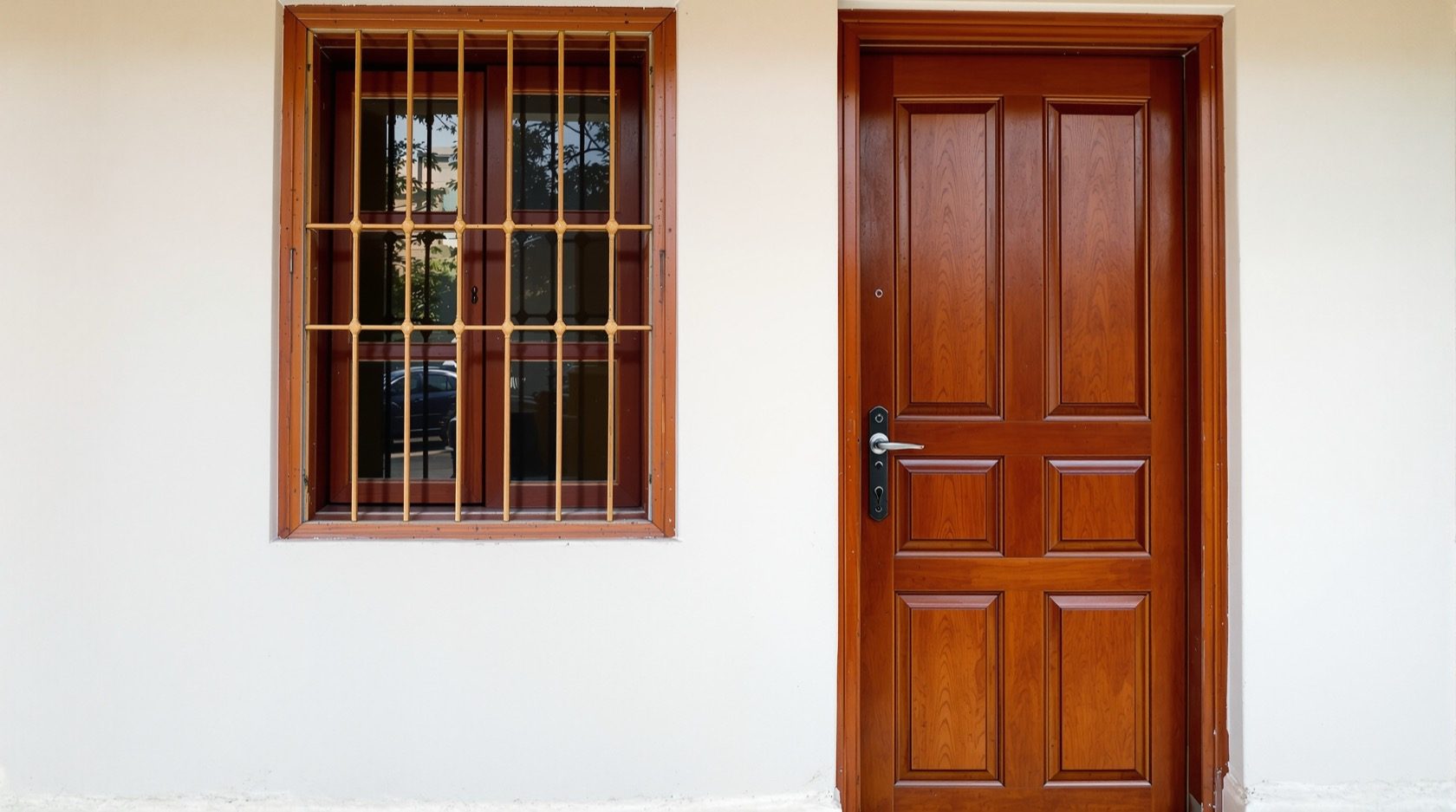
Door and Window Security Assessment for Indian Homes
Go opening by opening and rate the hardware itself — leaf and frame, hinges and locks, strike plates, grilles, glazing and latches — so you can grade each door and window's real resistance while never trapping anyone behind it.
A break-in almost never defeats a whole house. It defeats one opening — one door leaf that flexed, one latch that slipped, one grille whose screws pulled out of soft plaster. The entry and exit assessment tells you which openings you have and how someone moves between them. This guide goes one level deeper: it rates the hardware and construction of each opening itself — is this particular door or window actually hard to force, and if not, exactly which part is the weak link?
This is a focused companion within the Home Security Risk Assessment Guide. Where that guide models your whole risk, here we crouch down at each door and window, examine the leaf, frame, hinge, lock, strike, grille, glazing and latch, and give each opening an honest resistance rating. Throughout, one rule overrides everything: an opening you strengthen against intruders must still let your family out fast in a fire. Security hardware that traps people is a failure, not an upgrade.
Scope & safety. This is a strictly defensive assessment guide. It teaches you to find and grade weaknesses in your own openings — never how to defeat, pick or bypass any lock, grille or door. Lock fitting, grille and gate fabrication, structural frame anchoring and any electric or electronic lock is qualified work: specify it, then have a licensed carpenter, fabricator or locksmith install and certify it.
How to run an opening-by-opening assessment
The method is simple and slow. Make a list of every door and window in the home — main door, internal doors, service and back door, each ground-floor window, reachable upper windows and balconies, sliding doors, ventilators and any small opening a body could pass. Then visit each one and rate five elements in turn:
1. The leaf — the door shutter or window sash itself: material, thickness, solid or hollow.
2. The frame and its fixing — the chowkat and how firmly it is anchored into the wall.
3. The hinges — type, number, and whether the hinge side is exposed to the outside.
4. The lock and strike — lock type and grade, deadbolt or latch, and the strike plate it throws into.
5. The barrier and glazing — grille, glass type, latch, stay or restrictor.
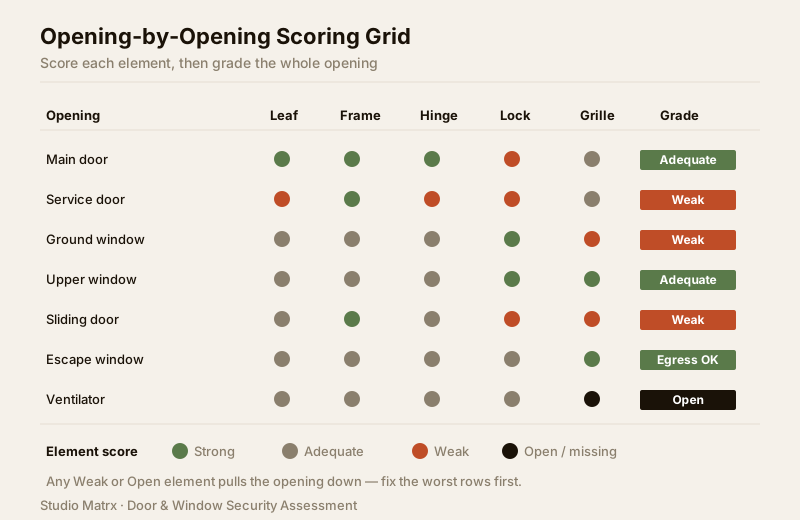
Give each opening a single resistance grade afterwards: Strong, Adequate, Weak, or Open. Anything you grade Weak or Open goes on your fix list. Photograph each one — you will forget which window had the loose grille by the time you are pricing repairs.
Assessing doors, element by element
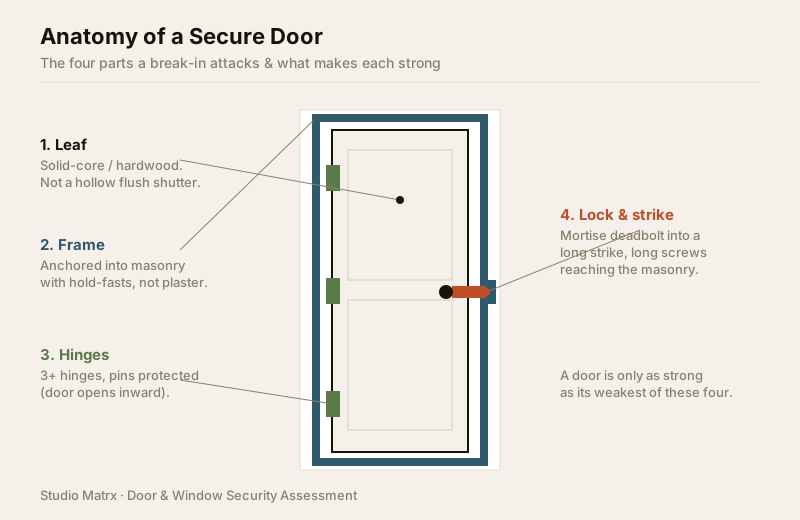
A door is only as strong as its weakest of four parts. A ₹12,000 lock on a hollow flush shutter, or a solid teak leaf whose frame is barely nailed to a plastered brick jamb, both fail the same way — around the strong part.
Leaf: material and thickness
Push the middle of the closed door hard. A solid-core or seasoned hardwood leaf barely moves; a hollow flush door (a cardboard-honeycomb core between two thin plywood skins, common on internal and cheaper external doors) flexes and drums. Hollow leaves are fine inside the home but weak as an external barrier — the lock can be forced through the leaf rather than the frame. Note leaf thickness too: external doors want a substantial, rigid section, not a light internal-grade shutter pressed into outdoor duty.
Frame strength and fixing
The strongest leaf is useless in a weak frame. Check the chowkat: is it seasoned hardwood or pressed section, and — critically — is it anchored into the masonry with hold-fasts or long anchors, or just wedged and plastered over? A frame that is only skin-deep in soft plaster will lever out as a unit, lock and all. Look for gaps, movement when the door is pulled, and rot at the base where floor-washing water sits. Frame anchoring is structural work; flag it for a professional.
Hinges and hinge-side exposure
Count the hinges (an external door wants three or more) and check the screws are long and tight. The big question: does the door open outward with the hinge knuckles facing outside? Externally-mounted hinge pins on an outward-opening door are an exposed weak point. Inward-opening doors keep hinges protected. If an important door opens outward, note it — the fix (fixed-pin or security hinges, or hinge-side bolts) is a locksmith job, not a DIY one.
Lock type, grade, deadbolt and multipoint
Identify what actually secures the door. A spring-latch night latch that holds by a bevelled tongue is convenience, not security — it can be slipped. A mortise deadbolt with a solid rectangular bolt thrown deep into the frame is the baseline for an external door. On tall or important doors, a multipoint lock that bolts at several heights spreads the load and resists levering far better than a single central bolt. Rate each external door: is there a real deadbolt, does it throw fully, and is the cylinder a decent grade? Route any electronic or motorised lock to a professional and never let it be the only thing between your family and a fire exit.
Strike plates and the frame side
The bolt is only as good as what it lands in. Look at the strike plate — the metal plate on the frame the bolt enters. A short strike held by two stubby screws into plaster is a classic failure point; the bolt holds but the plate tears out. A long strike (or a box strike) fixed with long screws reaching into the masonry behind the frame is far stronger. This is a cheap, high-value upgrade a carpenter can do in an hour.
Glazed panels beside the lock
If a door — or the side-light or fanlight next to it — has glass within arm's reach of the lock or thumb-turn, the glazing becomes the weak point regardless of how good the lock is. Note any glazed panel beside a locking point as a vulnerability; the assessment answer is laminated or grilled glazing, or a lock design that does not depend on an easily-reached thumb-turn.
Main vs internal vs service doors
Grade by role. The main door carries the highest expectation — solid leaf, anchored frame, deadbolt, long strike, video door phone and peephole. Internal doors are about privacy and compartmentation, not intrusion resistance — a hollow leaf is acceptable, though a lockable internal door to a safe zone has value. The service or back door is statistically the most attacked and the most neglected — cheaper leaf, weaker latch, dark unwatched yard. Treat it with main-door seriousness, not as an afterthought.
Sliding doors: anti-lift and anti-slide
Aluminium or uPVC sliding doors and their patio cousins fail two special ways. Lifting — a poorly-adjusted sliding leaf can be heaved up and off its bottom track. Sliding — a simple crescent latch can be worked loose. Assess whether the leaf has anti-lift blocks or top guides preventing it being lifted out, whether the latch is a proper hook-bolt rather than a light crescent catch, and whether a foot-bolt or a bar in the track backs it up. Big glazed sliders also expose a large pane; note the glass type.
Assessing windows, element by element
Windows are the most common forced entry in Indian homes because so many are protected by a grille that was fitted for the look of security rather than the fact of it.
Grilles and — above all — their fixing
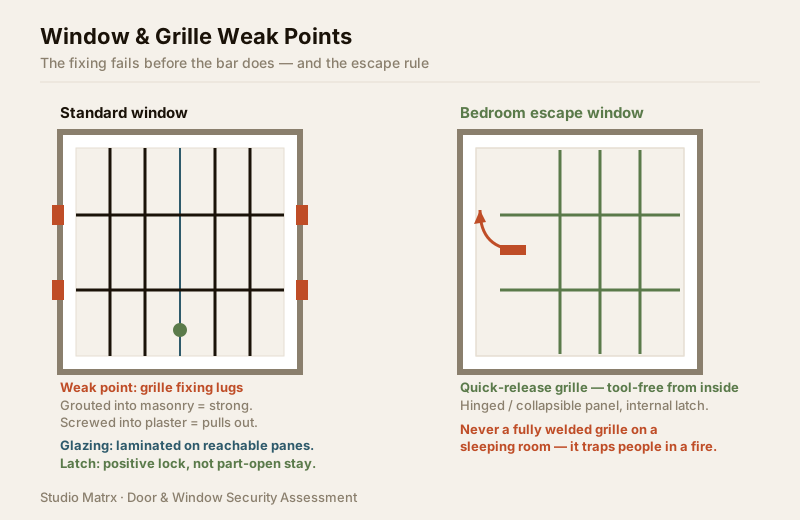
Everyone checks the bars; almost no one checks the fixing. Grip the grille and pull and shake it firmly. A strong grille barely moves; a weak one rattles because its lugs are screwed into plaster or a crumbling frame rather than embedded in the masonry. The bars are rarely the failure point — the fixing is. Assess: are the lugs grouted into the wall or the concrete frame; is the steel section solid and closely spaced; is there rust at the base weakening it; and are the joints welded rather than merely bolted where they can be undone from outside. Grille fabrication and re-anchoring is a fabricator's job — specify it, do not improvise.
Glazing type
Note the glass. Ordinary annealed float glass offers no delay. Laminated glass (a plastic interlayer that holds shards together) resists being cleared quickly and is worth specifying on reachable and large panes. You cannot always tell by looking — note pane size and reachability so you can prioritise which windows deserve better glass.
Latches, stays and restrictors
Check how the window actually secures when "closed". A single central latch on a wide casement, or a friction stay that holds it only part-open, may not resist a determined push. Restrictors that limit how far a window opens are useful on upper floors and children's rooms — but on any window that is an escape route they must be releasable from inside without a key. Rate each: does it lock positively, and does the locking mechanism ever conflict with escape?
Ground and reachable-upper windows
Prioritise by reach. Ground-floor windows are the front line — every one wants a well-anchored grille and a positive latch. Do not assume upper floors are safe: a boundary wall, sunshade (chhajja), drainpipe, parapet, AC unit or adjoining terrace or roof can turn a first-floor window into a ground-floor one. Walk outside and honestly judge which upper openings are reachable, and grade those as if they were at ground level.
Ventilators and small openings
The opening people forget: bathroom ventilators, kitchen exhaust gaps, gaps above doors, pet flaps. Any clear opening a body can pass — roughly larger than a dinner plate — is an entry point and should be barred or grilled. Note each small opening and whether it is secured.
The egress rule: never trade a fire for a burglar
The single most dangerous mistake in Indian homes is the fully welded, un-openable window grille on a bedroom. It stops a burglar and traps a family in a fire. Every assessment must flag escape windows and ensure they can be opened from inside without a key or a hunt for a tool.
- Identify at least one escape window per sleeping area. On these, a fixed grille is a life-safety hazard.
- Escape-window grilles should be quick-release from inside — a hinged or collapsible grille panel with an internal, tool-free release, kept unobstructed and known to everyone in the home.
- Never fit a double-cylinder (key-both-sides) lock on a final exit door where the key could be missing in an emergency.
- Coordinate this with your emergency preparedness plan so the release is part of a drill, not a surprise.
Security that cannot be escaped is not security. Grade any opening that traps people as a failure regardless of how burglar-resistant it is.
Per-opening security rating checklist
Walk each opening and fill a row. Grade the overall opening at the far right: Strong / Adequate / Weak / Open. Every Weak or Open row is an action item.
| Opening | Element to check | Common weakness in Indian homes | Rating (Strong/Adequate/Weak/Open) | Likely fix |
|---|---|---|---|---|
| Main door | Leaf, frame anchor, deadbolt, strike, hinges | Good lock on flexing leaf; short strike in plaster | Long strike + long screws; solid leaf | |
| Service / back door | Leaf, latch, hinge exposure, yard light | Cheap leaf, spring latch, dark unwatched yard | Add deadbolt; security hinges; light | |
| Ground-floor window | Grille fixing, latch, glazing | Grille lugs in plaster; ordinary glass | Re-anchor grille into masonry | |
| Reachable upper window | Climb route, grille, latch | "Too high to matter" but reachable via chhajja | Grille + positive latch; block climb | |
| Sliding door | Anti-lift, hook latch, track bolt, glass | Liftable leaf; light crescent latch | Anti-lift blocks; foot-bolt in track | |
| Glazed panel beside lock | Glass within reach of thumb-turn | Clear glass next to the deadbolt | Laminated / grilled panel | |
| Bedroom escape window | Quick-release grille from inside | Fully welded grille — traps occupants | Hinged quick-release grille (egress) | |
| Ventilator / small opening | Bar or grille | Open, unbarred, body-sized | Bar the opening |
Door and window weak-points reference
A quick map of where each opening actually fails, so your assessment looks in the right place.
| Component | The real weak point | What "good" looks like |
|---|---|---|
| Door leaf | Hollow flush core flexes; lock forced through the leaf | Solid-core or seasoned hardwood external leaf |
| Door frame | Wedged in plaster, levers out as a unit | Anchored into masonry with hold-fasts |
| Hinges | Exposed pins on an outward-opening door | Inward opening, or fixed-pin / security hinges |
| Lock | Bevelled spring latch only; single point on a tall door | Mortise deadbolt; multipoint on tall doors |
| Strike plate | Short plate, two stubby screws into plaster | Long / box strike, long screws into masonry |
| Sliding leaf | Lifts off track; light crescent latch | Anti-lift guides; hook-bolt; track bolt |
| Window grille | Lugs screwed to plaster, not embedded | Lugs grouted into masonry; welded joints |
| Glazing | Ordinary glass near a lock or at reach | Laminated glass on reachable / large panes |
| Escape window | Fixed welded grille traps occupants | Quick-release grille, tool-free from inside |
Turning ratings into a plan
Sort your graded openings and act from the worst up. Typically the cheapest, highest-value fixes come first: latching every window nightly (free), upgrading a service-door latch to a deadbolt, and swapping short strike plates for long ones often cut real risk more than a costly camera. Re-anchoring loose grilles and fitting anti-lift blocks are mid-cost fabricator jobs. A full leaf-and-frame replacement is a project — sequence it. As rough Indian ranges: a long strike-plate upgrade runs a few hundred rupees a door; a good mortise deadbolt roughly ₹1,500 to ₹6,000; re-anchoring or refabricating a grille from around ₹2,000 per window depending on size and steel. When you plan the spend, the guide to upgrading security in existing homes sequences it against the rest of your layers.
When to bring in a professional
Do the assessment yourself — you know every door and window in your home. But route the work to qualified trades: frame anchoring and any structural fixing, grille and gate fabrication and re-anchoring, lock fitting and cylinder upgrades, and every electric or electronic lock. These touch structure and life-safety egress, and a badly-fixed grille or a trapping lock is worse than none. Frame and grille anchoring intersects with the building fabric, so read it alongside structural safety; specify what you want and why, then have a licensed carpenter, fabricator or locksmith install and certify it. Verify any applicable National Building Code or municipal bye-law egress requirement before fixing bars on a bedroom window.
Key takeaways
- Rate the opening, not the house. Go door by door and window by window, scoring leaf, frame, hinges, lock/strike and grille/glazing, then grade each Strong, Adequate, Weak or Open.
- The failure is usually the fixing, not the bar or the lock — a short strike in plaster or grille lugs in plaster undo strong hardware. Check anchoring first.
- Do not neglect the service door and reachable upper windows — they are the statistically favoured and most overlooked routes.
- Never trap people. Every escape window needs a tool-free, quick-release grille; a fixed welded grille on a bedroom is a life-safety failure, not a security win.
- Route structural, grille and lock work to licensed professionals, then re-assess your openings after any renovation, incident, or new climb route appearing next door.
Start with the Home Security Risk Assessment Guide, pair this with the entry and exit assessment and lighting and visibility assessment, then browse the full security guides collection.
This is an educational planning guide. It is strictly defensive and does not describe how to defeat any lock, grille or door. Frame anchoring, grille fabrication, lock fitting and electronic-lock work is qualified professional work — engage licensed trades and verify any applicable National Building Code or municipal bye-law egress requirement for your project.
Export this guide
Related Guides — Deep-dive reading
Door Frame Security in India (2026): Anchoring the Chowkhat Break-Ins Actually Exploit
A homeowner's guide to the real weak point behind most forced entries: the frame, not the leaf or the lock, and how to anchor, pack and reinforce a chowkhat so a strong door genuinely stays in the wall.
SecurityReinforced Wooden Doors in India (2026): Making the Timber Main Door Actually Secure
A homeowner's decision guide to choosing or upgrading the wooden main or flat door most Indian homes actually have, so it genuinely resists a break-in, without pretending a hollow flush door is secure.
SecurityBalcony Door Security in India (2026): The Upstairs Opening Thieves Actually Use
A homeowner's guide to the balcony and French door most families treat as safe because it is upstairs, showing why drainpipes, scaffolding and ledges make upper-floor balconies a real entry route, and how to secure the door without ever caging your fire escape.
SecurityRelated Tools — Try Free
Door Security Rating Calculator
Score your main door out of 100 across leaf, frame, lock and hardware — and see the top upgrades.
Security ToolWindow Grill Design Selector
Pick a window grille style and material by priority — security, looks, budget, view — and estimate cost.
Window ToolWindow Hardware Cost Calculator
Estimate window hardware cost — hinges, handles, locks, rollers and multipoint gears.
Window Calculator